Showing posts with label creator: dick giordano. Show all posts

01 April 2026

DC Finest: Crisis on Infinite Earths, Part One by Marv Wolfman, Roy Thomas, Doug Moench, George Pérez, et al.

DC Finest: Events: Crisis on Infinite Earths, Part One

Collection published: 2025
Contents originally published: 1985-86
Acquired: December 2025
Read: January 2026
Writers: Marv Wolfman, Roy Thomas (with Dann Thomas), Gerry Conway, Jason Todd, Steve Englehart, Doug Moench, Alan Moore, Robert Kanigher, Mindy Newell
Pencillers: Curt Swan, George Pérez, Mike Clark, Arvell Jones, Rafael Kayanan, Todd McFarlane, Gene Colan, Joe Staton, Tom Mandrake, Stephen R. Bissette, Judith Hunt, Sam Glanzman, Michael Esposito, Don Heck
Inkers: Dave Hunt, Dick Giordano, Vince Colletta (with DeZuniga), Alfredo Alcala, Akin & Garvey, Pablo Marcos, Bob Smith, Bruce Patterson, Steve Montana, Mike Machlan, Tom Mandrake, Tatjana Wood, Mike DeCarlo, Judith Hunt, Sam Glanzman, Michael Esposito, Don Heck
Colorists: Gene D'Angelo, Anthony Tollin, Carl Gafford, Nansi Hoolahan, Adrienne Roy, Jerry Serpe
Letterers: Ben Oda, John Costanza, David Cody Weiss, Duncan Andrews, John Workman, L. Lois Buhalis, Albert De Guzman, Gaspar, Helen Vesik
Plot: Wolfman/Wein/Greenberger

DC has begun a new reprint series called "DC Finest." Despite the name—which would seem to indicate some kind of selectivity—its aim to comprehensively reprint everything DC has ever published in various lines. One of those is the "Events" line, which reprints not just the headline event stories, but integrates them with their myriad tie-ins. Crisis on Infinite Earths has of course been reprinted many times, but never with all of the "Special Crisis Cross-overs." The core series is twelve issues long, but estimates are that its DC Finest reprinting will run four 500-page volumes! I've read Crisis a couple times before, so here I won't focus on the core story, but the various included stories.

A lot of the included issues are of Roy Thomas's Earth-Two titles: here we get issues #50-52 of the WWII-set All-Star Squadron and issues #18-19 of the present-day Infinity, Inc. (There's also Justice League of America #244, which is the second half of the story begun in Infinc #19, the last-ever JLA/JSA team-up.) Both of these titles were significantly affected by the Crisis and did a lot tying into it, so their inclusion here makes sense... though I know from past experience I will definitely be bored of A-SS's Shanghaied into Hyperspace! story by the end of it. Overall, though, no complaints; these are exactly the kind of stories that ought to be included in a book like this.

No one:
Absolutely no one:
Roy Thomas: My Crisis on Infinite Earths tie-in is going to be about Mister Mind crossing between universe because he loves listening to Charlie McCarthy on the radio so much!
from All-Star Squadron #51 (plot by Roy Thomas & Dann Thomas, script by Roy Thomas, art by Mike Clark & Vince Colletta)

We also get a bunch of one-off stories from various titles: Fury of Firestorm #41, Green Lantern #194, and Wonder Woman #327. The Firestorm one is fine, it basically just shows how Firestorm is recruited by Harbinger in more detail, which isn't particularly interesting but I guess the kind of thing you'd expect a Crisis Cross-over to do. The Green Lantern story is kind of complicated, as it's clearly very enmeshed in the ongoing stories of Hal Jordan, John Stewart, and Guy Gardner, but I'm always happy to see some Joe Staton artwork, and I'm curious to see how it continues in later volumes. (There's a funny bit of continuity massaging; as John thinks to himself that he usually doesn't wear a mask anymore but he's going to put one on before journeying to the Monitor's satellite, presumably because George Pérez drew him with a mask.) The Wonder Woman story is clearly the wrapup of an ongoing story, and therefore pretty confusing on its own.

I'm always game for some Harbinger action, great visual design.
from The Fury of Firestorm: The Nuclear Man #41 (script by Gerry Conway, art by Rafael Kayanan and Akin & Garvey)

There are a couple inclusions I didn't get. There weren't any Crisis ties in Detective Comics #555 that I detected, nor in The Losers Special, even though that does have the Crisis Cross-over branding on the cover.

Wait, did the pre-Crisis Blue Beetle have a wife!? (It's just a joke, right?)
from Green Lantern vol. 2 #194 (script by Steve Englehart, art by Joe Staton & Bruce Patterson) 

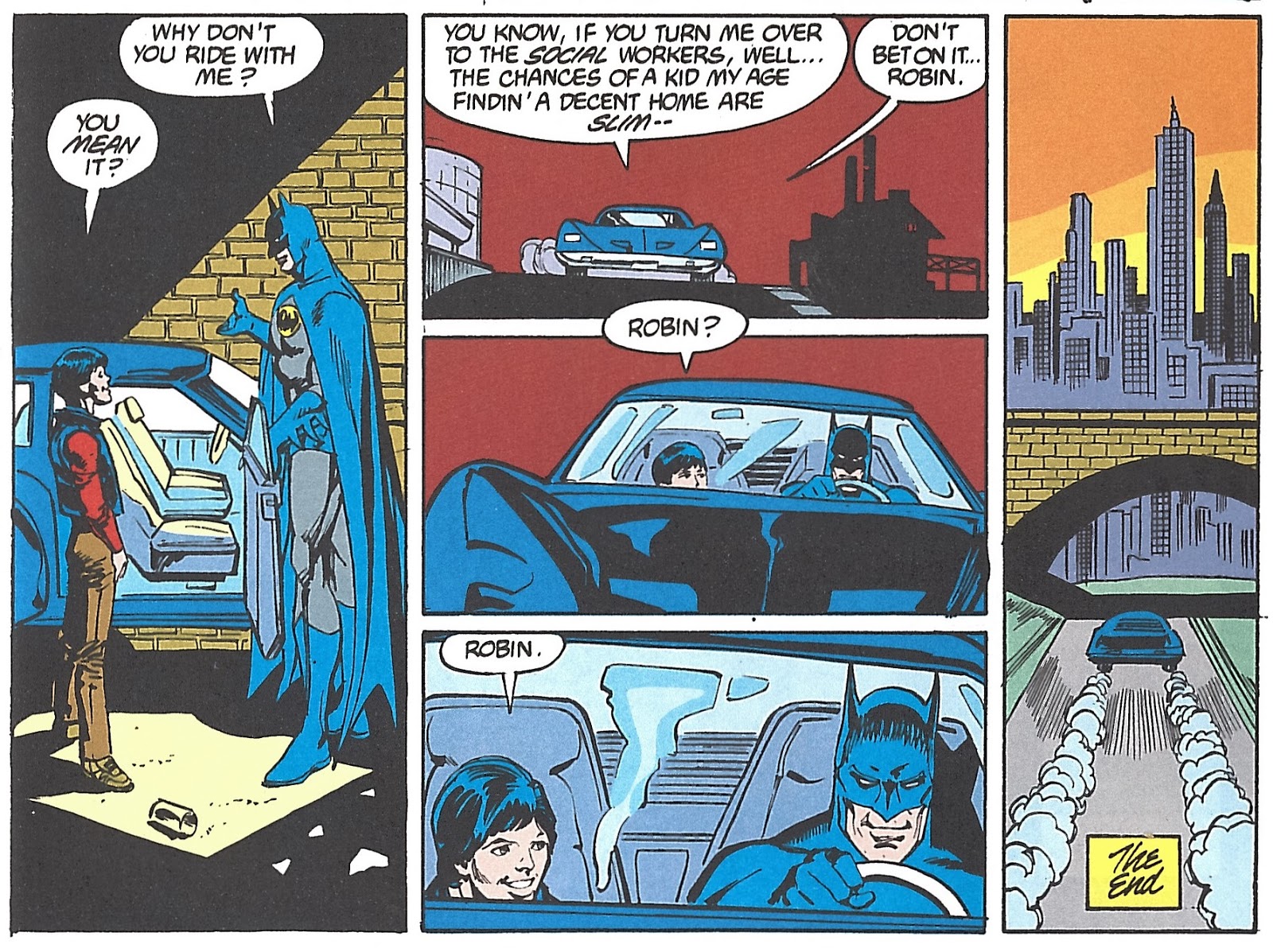
The real highlight of the book, though, are the Batman issues: we get a continuous six-part Batman story from Batman #389-91 and Detective #556-58. The Crisis connection is technically slight, in that there's just the red skies from the Crisis... but man these stories (from the team of Doug Moench and Tom Mandrake, somehow pumping out an issue every two weeks) are great! Jason Todd is Robin, but this is before Jim Starlin turned him into an obnoxious asshole; here he's a kid trying to find his way in rough world, bereft of strong parental figures to give him guidance. Like some of the other stories I've read from this era, we're clearly at a transitional point between the Silver Age aesthetic and the Frank Miller one; unlike those other stories, I thought this really worked. It's high melodrama, but it doesn't take itself too seriously; it's dark without being grim; it's not afraid to be goofy but we get solid psychological depth for all of the principal characters. Sure, the only Crisis element is that the skies are red... but it's so beautifully used, creating a funereal atmosphere. These stories are also included in a Batman "DC Finest," Red Skies, and after reading this, I'm sorely tempted to pick up that, because I'd love to see more Moench and Mandrake on Batman.

I very much appreciated the delving into Batman's very bad taste in bad women.
from Detective Comics vol. 1 #556 (script by Doug Moench, art by Gene Colan & Bob Smith)

My only quibble with this volume is the sequencing doesn't always make sense; Detective #558 ends with Batman hearing Joker has escaped, leading into Crisis #2... but for some reason the story is placed after Crisis #2. Similarly, I think the Wonder Woman issue is also in the wrong spot. On the whole, this isn't high art, or often, even medium art, but if the point of superhero comics is their sheer interconnectedness, the creation of a massive tapestry of events that becomes a pleasure in itself, then this book captures that exceedingly well. I hope that Part Two is solicited sooner rather than later! 

12 August 2020

Review: Jonni Thunder, a.k.a. Thunderbolt by Roy & Dann Thomas, Dick Giordano, et al.

Jonni Thunder, a.k.a. Thunderbolt reinvents the character of Johnny Thunder for the 1980s, though really it takes the name of the character and basically nothing else. Jonni is a private investigator, formerly in partnership with her father until he recently died; a man dies in her office, thrusting her into the middle of a complex situation with multiple participants jockeying for possession of a small statuette she's had since she was a child... only she's somehow gained possession of superpowers?

I read Jonni Thunder because I believed it took place on Earth-Two (and I understand that Jonni ends up appearing in Infinity, Inc. during Crisis on Infinite Earths), but within this four-issue miniseries, it's not really connected at all. When Jonni gains superpowers, her referents are tv shows, not real superheroes buzzing around, and the one reference to Wonder Woman could easily be construed to WW as a fictional character. Though it has some of the trappings of it, it's not really a superhero story, but something else entirely.

This is very much the hard-boiled detective genre, one I don't have a ton of experience with, but I have enough to identify how it slots in. It's kind of like Chinatown, if Jack Nicholson suddenly manifested the ability to mentally fuse with a thunderbolt and leave his body behind. Jonni has to figure out who she can trust (no one) and has to compromise her morality in order to accomplish her goal of solving the murder. Things richochet back and forth between Los Angeles and San Francisco as she fights gangsters, movie stars, technical geniuses, good cops, lazy cops, sleazy P.I.s, and the starter on her 1957 Thunderbird.

from Jonni Thunder #3
(plot & script by Roy & Dann Thomas, art by Dick Giordano)
I enjoyed it. Like I said, I don't know hard-boiled well, but I'm always up for a good pastiche, and this is a great one. Roy and Dann Thomas have a good knack for the genre, and the supernatural elements don't feel too grafted on. Jonni is a great protagonist, in slightly over her head, but quick-witted and always planning her next move. Dick Giordano is one of comics's most reliable artists, and he does good work here, though I found myself wishing it had been printed on nicer, Baxter paper-- the inks would have held up better, but also more interesting things could have been done with the coloring. Ernie Colón (originally slated to be the artist but it didn't work out) gives Jonni great style, men's suits in black and white, but they don't really pop with the primitive coloring technology of the mid-1980s. Imagine a moodier, atmospheric version of this comic!

I've read a lot of Roy Thomas comics by now (all of All-Star Squadron, America vs. the Justice Society, and the first seventeen issues of Infinity, Inc.), and this is the first one where his wife Dann gets a full co-writer credit, not just co-plot. Surely not coincidentally, it has the best dialogue and other prose of any Roy Thomas comic I've read. The banter is fun, and first-person narration is characterful and insightful. Apparently the plotted the issues together, than Dann wrote the scripts, then Roy did a little polish-- but, he says in the lettercol, not much was needed. On the strength of this, I look forward to reading the Infinity, Inc. issues where she graduates to full co-writer.

Jonni Thunder is in some ways a simple comic, but simple pleasures are still pleasures. This is a delightful mash-up of superhero and P.I., and I wish there had been more of it. In the lettercols, Roy suggests that thought he and Giordano didn't have time to write an ongoing, they could do a succession of miniseries and/or graphic novels. Alas, they never came to pass. But I am curious to see how Jonni will integrate into the very different style of full-color superheroics in Infinity, Inc.!

Jonni Thunder, a.k.a. Thunderbolt originally appeared in issues #1-4 of Jonni Thunder (Feb.-Aug. 1985). The series was created by Roy & Dann Thomas, Dick Giordano, and Gerry Conway, with special thanks to Ernie Colón; scripted by Roy & Dann Thomas; illustrated by Dick Giordano (#1-4), with an assist by Mike Esposito (#2); co-plotted by Gerry Conway (#1); colored by A. Tollin (#1) and Adrienne Roy (#2-4); and lettered by L. Lois Buhalis & Orzechowski.

This post is the eighth in a series about the Justice Society and Earth-Two. The next installment covers Crisis on Multiple Earths, Volume 7. Previous installments are listed below:
  1. All Star Comics: Only Legends Live Forever (1976-79)
  2. The Huntress: Origins (1977-82)
  3. All-Star Squadron (1981-87)
  4. Infinity, Inc.: The Generations Saga, Volume One (1983-84)
  5. Infinity, Inc.: The Generations Saga, Volume Two (1984-85)
  6. Showcase Presents... Power Girl (1978)
  7. America vs. the Justice Society (1985)

06 July 2020

Review: Showcase Presents... Power Girl by Paul Levitz, Joe Staton, Dick Giordano, et al.

After her debut in All Star Comics, Power Girl got a three-month feature in Showcase, DC's title with rotating stars (for example, the Doom Patrol starred before her, and Hawkman after). I had originally skipped this in my Earth-Two reading project because the back issues are pretty expensive, and the trade they're in is half Geoff Johns shit with an awful Adam Hughes cover, but after early issues of Infinity, Inc. made a couple references to them, I looked into picking them up, and saw they were just $0.99 on Comixology. I don't normally like buying DC stuff on Comixology (unlike IDW publications, you can't download a PDF, so you have to read it in the terrible Comixology viewer), but $3 seemed hard to turn down.

It's a bit off. Since Power Girl was just one of an ensemble in All Star Comics, she didn't have much of a backstory there-- she's just like, "oh I'm Superman's cousin, hi"-- and these stories fill it in to an extent, and also give her a status quo outside of her JSA activities. But it's kind of awkward and weird. Power Girl was rocketed to Earth as an infant to escape the destruction of Krypton, of course, but unlike Kal-L, who landed on Earth still a small child, Kara Zor-L was raised to a young adult level in an artificial simulation of Kryptonian childhood before she reached Earth. I think there's real potential in such a situation, but the story doesn't make a whole lot of it: Kara's "symbioship" is trying to reabsorb her, she reveals her backstory, she defeats it with the help of Andrew Vinson (a Gotham reporter), the end, all in the space of two issues.

from Showcase #98 (art by Joe Staton & Dick Giordano)

It's over improbably quickly, and I'm not sure why the symbioshop had to attack Power Girl and try to absorb Vinson, but it is a set-up with some good dramatic potential. I like the idea that she fits so poorly into human society because she was raised in Kryptonian society... but that was an illusion, so the only thing she knows is fake. It's a much more tragic take on the Krypton backstory than Superman's. (Though All Star indicated she was raised by the Kents, who are never mentioned here.)

from Showcase #98 (art by Joe Staton & Dick Giordano)

But it's all over just like that. Between the second and third issues, she concocts a human identity as Karen Starr, Wonder Woman uses an Amazonian teaching machine to give her knowledge of human culture as well as software development, and Vinson gets her a job at a software company. Like, that's it? It seems pretty meh that she didn't even know what software was until the machine taught it to her, so her job doesn't even build on any preexisting interests or skills. I mean, she was raised in a computer world, the connection is right there, but the story never makes it! Why give her a dilemma she actually never confronts in a story? (I'll be curious to see if future Power Girl stories, in Infinity, Inc. or elsewhere, make more of this. Probably not, because the Crisis on Infinite Earths will wipe this whole backstory away.)

from Showcase #99 (art by Joe Staton & Dick Giordano)

There's a subplot in the first two issues about someone stealing technical equipment; it turns out to be the Brain Wave at the end of the second, and the third focuses on Kara's battle with him. For some reason he hates Power Girl more than the rest of the Justice Society because she's defeated him more (really?) than them. I thought his power was brain stuff, but here he's building tripod war machines and sending cities into dimensional limbo, which doesn't really flow from that as far as I can tell. I do really like how Joe Staton draws his enlarged cranium, though.

from Showcase #97 (art by Joe Staton & Joe Orlando)

As always, I like Staton's art. Lightly stylized but full of energy, too, and his Kara looks like a powerhouse. Power Girl wears a choker; so did Black Canary at this time if I recall correctly, so I guess it was a thing then.

Showcase Presents... Power Girl originally appeared in issues #97-99 of Showcase (Feb.-Apr. 1978). The story was written by Paul Levitz; illustrated by Joe Staton (#97-99), Joe Orlando (#97), and Dick Giordano (#98-99); lettered by Ben Oda (#97-98) and Shelly Leferman (#99); colored by Jerry Serpe (#97) and Adrienne Roy (#98-99); and edited by Joe Orlando.

This post is the sixth in a series about the Justice Society and Earth-Two. The next installment covers America vs. the Justice Society. Previous installments are listed below:
  1. All Star Comics: Only Legends Live Forever (1976-79)
  2. The Huntress: Origins (1977-82)
  3. All-Star Squadron (1981-87)
  4. Infinity, Inc.: The Generations Saga, Volume One (1983-84)
  5. Infinity, Inc.: The Generations Saga, Volume Two (1984-85)

05 April 2019

The Earth Is Our Mother, We Must Take Care of Her: Black Orchid

Neil Gaiman's three-issue Black Orchid miniseries has been collected more than once, I believe. The 23-issue ongoing series it spawned, however, has never been collected at all. But I was curious, and so as I do, I tracked it down to read it.

Black Orchid is one of those many Vertigo titles that reads as though the writer wants to be Neil Gaiman. Sprawling, full of mythical and mystical side creatures and side stories. But trying to be Gaiman means you can never be Gaiman, because the one thing Gaiman is, is distinctive.

Dick Foreman's best issue is his first, where a reporter tries to track down Black Orchid years after the events of the miniseries. He has a cluster of information, but he's not sure if it really all goes together. Could this prostitute and this superhero and this campaign volunteer all be the same person? The story is told from his perspective, and glimpsing Black Orchid from the outside is intriguing and often horrifying, especially in the story's climax. It's jumpy but never confusing, probably thanks in part to Jill Thompson's expressive artwork. You always know what these people are thinking.

After that, though, it feels like Foreman never quite knows what he wants to do. First Black Orchid travels south with her new human friend, to a refuge in Tennessee. On the way, she fights an alien fungal infection. Not exactly what I thought the remit of this series was but okay. Then she learns of a Greek immigrant's love affair with a dryad. More mythological than I imagined (the myth of the original mini was more vague "Earth mother" stuff) but it's all plants, so that's okay.

But then she goes back to South America and it all goes a bit wonky, what with dream quests and whatnot, the series drifting further and further away from the ecological roots of its premise. I found this stuff so incredibly uninteresting. It's also around this time that Rebecca Guay takes over as penciller. Guay gets better, but her stuff always looks stiff compared to Thompson's.

There's a brief uptick when Black Orchid marries a capitalist overlord, forcing an examination of her morality, but then it's a trip to England in what really feels like a Sandman rip-off, and the worst part of Sandman, Faerie. And then all of a sudden the series is hurtling toward a conclusion it feels like it didn't properly set up. Instead of a vision quest, couldn't we have spent time moving the pieces into position for Black Orchid's "turn"?

I like the idea of the climax, but it feels too sudden, and too obvious. In the early issues, Black Orchid was broadly sympathetic but occasionally dark, but then she all of a sudden becomes manically evil... even though it really seems like she has a point about humanity on the Earth, even moreso in 2019 than 1995.

On the whole, the trajectory of the comic feels like a weird choice. It ought to be about environmentalism and gaiaism. Instead it moves into more Sandman-style magic; there are whole issues, for example, about the little Black Orchid, Suzy, journeying through strange fantasy realms. These realms might fit into The Sandman or Lucifer or The Books of Magic, but they pull the book away from its own unique selling point. The book ought to be about the magic of flowers, of the environment, of our relationship with the Earth, but instead it's about all this other stuff, and I don't know why.

26 October 2016

Faster than a DC Bullet: Birds of Prey, Part XVIII: Birds of Prey, Volume 2

Back in early 2013, I read all the Birds of Prey comics that then existed; since there, more have been published, and catching up on them is my last round of catching up before I turn my eyes back to other ongoing projects.

Comic trade paperback, n.pag.
Published 2016 (contents: 1999)
Borrowed from the library
Read May 2016
Birds of Prey, Volume 2

Writer: Chuck Dixon
Pencillers: Greg Land, Dick Giordano, Pete Krause, Nelson DeCastro
Inkers: Drew Geraci, Mark Propst
Colorists: Gloria Vasquez, James Sinclair
Letterers: Albert T. DeGuzman, Tim Harkins

DC Comics has been re-collecting the original Birds of Prey comics from the beginning. They're chunkier than the old collections, which means that Volume 1 of these new collections contained all the comics previously collected in Black Canary/Oracle/Huntress: Birds of Prey and some of those in Old Friends, New Enemies, while Volume 2 contains the balance of issues from Old Friends, plus a number of issues that have never been collected before at all, so that's were I'm starting in these new collections.

Even when a slave laborer in a third-world country, Dinah looks good.
from Birds of Prey vol. 1 #3 (art by Greg Land & Drew Geraci)

Birds of Prey as originally conceived is undeniably a fun concept: Black Canary and Oracle, both characters with somewhat rocky pasts, moving on with their lives and kicking butt. During this period of the book, they've never met in person (well, not since Barbara Gordon became Oracle); Oracle's identity is a secret from Dinah, and there's also an online relationship brewing between Barbara and the mysterious "Beeb." What we end up with here are a variety of exciting, action-based stories by Chuck Dixon (undeniably an expert at exciting, action-based stories, but Birds of Prey is probably him at his best) and Greg Land and Drew Geraci (who draw attractive women without being sleazy). I already reviewed the first couple stories in this book in my review of Old Friends, New Enemies, so here I'll focus on what was new to me, though suffice it to say that I found the story where Black Canary and the Ravens both end up on vacation in Minnesota and a dinosaur comes through a time portal to be immense fun.

07 September 2016

Faster than a DC Bullet: Gotham Central, Part Ø: Batman: Gordon of Gotham

Before plunging into my next comics project, I want to cycle back to some old ones and read some books related to them that have come out since then. The first of these is Gotham Central, which I read over five years ago now.

Comic trade paperback, n.pag.
Published 2014 (contents: 1996-98)

Borrowed from the library
Read March 2016
Batman: Gordon of Gotham

Writers: Chuck Dixon, Dennis O'Neil
Artists: Klaus Janson, Jim Aparo, Bill Sienkiewicz, Dick Giordano
Colorists: Kevin Somers, Ian Laughlin, Pam Rambo, Jamison
Letterers: John Costanza, Clem Robins

This book collects three four-issue miniseries that feature Commissioner Gordon and/or the Gotham City Police Department; it's a precursor of sorts to Gotham Central, though I am pretty sure that the only main character here who is also a main character there is the ubiquitous Renee Montoya. Each of the stories here has a slightly different focus.

"Gordon's Law" is pretty squarely focused on Commissioner Gordon himself, as he discovers that there's possibly some corruption in the GCPD, which means he can't trust anyone on the force-- and to make things worse, he only wants cops to go after cops, which means he rejects Batman's offer of assistance as well. The story is kinda complicated; there are a lot of characters, and most of them were new to me (if not new to everyone), and though I really like the gritty tone established by Klaus Janson's artwork, he didn't always make it easy to remember who was who. Its biggest weakness is probably that it's one of those stories where tons of "old friends" we've never seen before turn up, and the narrative expects us to be surprised when an "old friend" we've never seen before turns out to not be altogether trustworthy. And that's not the only obvious twist, but there were some good ones as well. Overall, it's an okay tale: some good crime fiction influences, but it doesn't really have anything to say about Gordon, about the GCPD, or about Batman.

I love how sleazy/creepy the face of this guy (he's an informant) looks.
from Batman: Gordon's Law #1 (script by Chuck Dixon, art by Klaus Janson)

"GCPD" is the most like Gotham Central of all the stories here; the commissioner is just a minor part of a sprawling, ensemble tale of various members of the GCPD pursuing various cases. Harvey Bullock struggled with anger management, a new partner, and a serial killer; Renee Montoya goes undercover as a diplomat's wife to help catch an assassin; two cops named Kitch (a trained lawyer) and Cav (a grizzled old vet) track down art thieves and an insurance same; an administrator named Hendricks tries to figure out who's stealing stationery. As you might imagine, some of these stories are better than others: I always enjoy a Montoya tale, but Chuck Dixon doesn't really her very unique, and the circumstance she ends up in seems incredibly contrived to say the least. (Do local cops really handle assassination plots against foreign officials? Would there really be no plan for cancelling the operation when it all goes wrong and the diplomat deliberately endangers Montoya's life?) On the other hand, I did enjoy the Harvey Bullock plot. This was my first real exposure to the character (he was retired during Gotham Central), and he gets to do some good old-fashioned investigating that shows off his intelligence as well as his human side, and I liked his contentious relationship with his new partner.

Jim Aparo just can't resist giving Gordon that dandyesque mustache curl, though.
from Batman: GCPD #3 (script by Chuck Dixon, art by Jim Aparo & Bill Sienkiewicz)

The Kitch/Cav plot had its moments, but some of its beats were very familiar. Is the lawyer-turned-cop who is mocked for his education by the cops and for his slumming it by the lawyers, and flirts with going back to law only to be reminded that lawyers are corrupt, a thing? I am pretty sure I read this exact story last year in Fort Freak. I liked Cav, though. The best character of all, however, was Hendricks: of course a desk officer grimly determined to catch an office supplies thief in the fact of mockery from his colleagues was my fave. The law begins and ends with him! I've previously struggled with Jim Aparo art on stories of the "gritty" type, but to my surprise, he paired really well with Bill Sienkiewicz on inks: Aparo does great figures and great storytelling, but Sienkiewicz's rough inks add the right tone for an urban cop story. Best art in the book.

CHILL OUT JIM!
from Batman: Gordon of Gotham #1 (script by Dennis O'Neil, art by Dick Giordano & Klaus Janson)

"Gordon of Gotham" is even less about the GCPD than "Gordon's Law," as it's mostly a present-day Gordon telling Batman about his last year as a Chicago cop, leading into the events of Batman: Year One. As anyone who read my review of that story would know, I love Jim Gordon, and Dennis O'Neil really captures what it is that I like about him. Gordon is just a man trying to do the right thing in a world that will never reward him for it, because it is a world that needs Batman. Gordon argues with his wife (there's a callback to his struggle with domestic violence from Night Cries, another quality Jim Gordon tale), but ends up stopping a diner holdup almost by accident, then decides to go after corruption, but the world itself is corrupt, and he quickly gets in deeply over his head and ends up making choices that violate his moral core... or so he had thought. O'Neil piles on the twists and the action in a compelling way, and I really liked how this set us up for the  Gordon on Year One, down to his decision to grow a mustache. The only real weakness is the frame; I wonder why they didn't just do this story in pure flashback.

I didn't quite buy that everyone would recognize a "hero cop" so readily, but I guess more people watched local tv news back in the 1980s.
from Batman: Gordon of Gotham #1 (script by Dennis O'Neil, art by Dick Giordano & Klaus Janson)

Next Week: And now I'll be catching up on the expanded universe of The Sandman, beginning with the long-delayed collected edition of The Children's Crusade, Free Country!

15 June 2016

Faster than a DC Bullet: Project Gotham, Part XXVI: Batman: Second Chances

Comic trade paperback, 276 pages
Published 2014 (contents: 1986-87)

Borrowed from the library
Read November 2015
Batman: Second Chances

Writers: Max Allan Collins, Jo Duffy, Jim Starlin
Pencillers: Jim Starlin, Denys B. Cowan, Chris Warner, Ross Andru, Dave Cockrum, Kieron Dwyer, Jim Aparo, Norm Breyfogle
Inkers: Jim Starlin, Greg Brooks, Mike DeCarlo, Dick Giordano, Don Heck, Norm Breyfogle
Colorists: Daina Graziunas, Adrienne Roy
Letterers: John Costanza, Todd Klein, Agustin Más, Albert DeGuzman

Year Ten, October
Out of universe it's been ten years, but in universe it's just been two since Batman moved to a downtown penthouse and Dick Grayson went off to college. Now Bruce is back in Stately Ward Manor and there's a new Robin in town. Second Chances collects twelve stories, whose unifying feature is that the majority of them are by Max Allan Collins, and all of them feature Jason Todd as the new Robin. (Unfortunately, there's almost no consistency in the artistic team.)

The book opens with a two-part tale: "There's Nothing So Savage-- As a Man Destroying Himself!"/"One Batman Too Many." Criminals are turning up violently murdered... seemingly by the Batman! Jim Starlin provides some great, dynamic layouts in the first half, which I really enjoyed; the second part, where the faux Batman escapes Arkham and Batman hunts him down, was less interesting, partly because the art of Denys Cowan and Greg Brooks was not as sharp as Starlin's. In this story, Jason is already the new Robin, and evidencing a slight bloodthirsty streak, as he wonders if Batman maybe should be employing some of the techniques of his impersonator.

The book then jumps backward to explain how Jason got to be the new Robin; "Did Robin Die Tonight?" opens with Dick Grayson still operating as Robin, receiving an injury at the hands of the Joker. Bruce fires Robin: "In what I do, there is no place for a child. [...] Son, I'm sorry. And you are a man-- man enough to accept my decision." We don't even see what happens to Dick, though; he informs Bruce that though Robin will stay "dead," he has a destiny to pursue, but as far as we see, he doesn't even leave. What's he off doing? Who knows! After operating solo for a little bit, Batman goes to visit Crime Alley on the anniversary of his parents' death, where while he's out walking (Batman strolling down the street, saying "Gentlemen" to a pair of men on the sidewalk, is a surreal sight), a juvenile delinquent steals the tires off the Batmobile.

Batman enrolls Jason in a reform school, but in "Just Another Kid on Crime Alley," it's revealed the school is actually a front for a crime ring, which Jason helps Batman break up. And then, even though Batman just claimed he didn't want any kids around, he's calling Jason "Robin" just like that. If I was Dick, I'd be ticked off! I know from reading interviews with Collins was that the idea was Jason would live a life so dangerous on the streets that being Robin was actually a safer alternative, but no one in the story actually says this, and it's not convincing: surely Bruce making Jason his ward without revealing he was Batman would be safer than either crime or crime-fighting!

"Dick Grayson? Who cares about Dick Grayson? Screw that guy."
from Batman vol. 1 #409 (script by Max Allan Collins, art by Ross Andru & Dick Giordano)

The next few stories chronicle the early days of Jason Todd as Robin, as they face Two-Face, who turns out to be responsible for Jason's father's death. It's a lot of weird, Silver Age-style hijinks, with Two-Face employing the "Dopple Gang" and robbing one of Gotham's two major league baseball stadiums during the second half of the second inning when there's two strikes, two balls, and two men on base! It's not Starlin's best work on the title. I assume the intro story about the false Batman slots in here, before the next couple tales, each more weird than the last: an evil mime and a samurai ghost.

That last tale is by Jo Duffy, and then Jim Starlin takes over as writer. His first story is a sort of grim, but consequence-free story of Batman hunting a serial killer. With only 22 pages to make us care about some woman and kill her off, the story isn't big enough to succeed. Then Batman discovers Commissioner Gordon is a Manhunter in a crossover with Millennium that totally does not stand on its own, and then Dick Grayson comes back in "White Gold and Truth"-- which is dated "ONE YEAR AGO." I have no idea where that's mean to place it relative to the other stories in the volume.

This story finally fills in what Dick Grayson has been up to. In a retcon I don't think later writers abided by, allegedly all of Dick's adventures with the Teen Titans occurred after he left Batman's company. Dick's retelling of their split is also a little more acrimonious than the one we saw in "Did Robin Die Tonight?" Bruce and Dick argue, but Dick and Jason team up to beat up some criminals while Bruce smiles from the rooftop, unseen. It feels more like a patch over Collins's sparse story than a story of its own.

Collins isn't all done; the last story in the book is "Love Bird," a cute tale illustrated by Norm Breyfogle about a paroled Penguin seeking love and trying to go straight.

A common denominator between many of these stories is the presence of Vicki Vale as Bruce's girlfriend who hates the Batman and also hates Bruce's idling about all the time. Her presence is inconsistent; Collins seems to keep forgetting about her. As a result, I never really had a good feel for what she and Bruce saw in each other, so she comes across as largely superfluous.

"Batman, if you just drive a couple more miles to the other Kroger's, their bananas are two cents cheaper!"
from Batman vol. 1 #402 (script by Max Allan Collins, art by Jim Starlin)

So: historically important tales, yes, but inconsistent in quality. But I got very intrigued from this era of Batman history, and I actually added a few more 1980s/Jason Todd stories to my list after reading it, wanting to flesh him and his era out before hitting A Death in the Family. These came out after Batman: Year One, but that story didn't change the other Batman tales overnight; these later stories feel like a weird jumble of the Silver Age aesthetic and the Frank Miller one (Commissioner Gordon looks more like a jolly grandpa than a hard-hitting cop/special forces vet), and I look forward to seeing how that changes over time.

Next Week: It's Year One again as Huntress makes her debut on the Gotham stage!

08 June 2016

Faster than a DC Bullet: Project Gotham, Part XXV: Batman: Strange Apparitions

Quick note: read my review of Doctor Who: You Are the Doctor and other stories at Unreality SF. Today!

Comic trade paperback, 175 pages
Published 1999 (contents: 1977-78)

Borrowed from the library
Read November 2015
Batman: Strange Apparitions

Writers: Steve Englehart, Len Wein
Pencillers: Marshall Rogers, Walt Simonson
Inkers: Terry Austin, Al Milgrom, Dick Giordano
Original Colorists: Marshall Rogers, Jerry Serpe
Letterers: Ben Oda, Milton Snapinn, John Workman

Year Eight, November
All of the Batman stories I've read so far (in this project) have been "flashback" tales: they haven't been set in what was the current continuity at their time of publication, but rather have been set in some earlier period. Strange Apparitions marks a first for me, then, in that this is the first Batman story I've read that took place in the "present" when it was published. This is no flashback to the early days of Batman, but simply the next adventure of Batman.

Much has changed of late. The Caped Crusader is fundamentally solo again, as Dick Grayson is off attending Hudson University. He's grown up so fast! In addition, Bruce Wayne has moved from Stately Wayne Manor to the actual city of Gotham; he now resides in a penthouse on the top floor of the new Wayne Foundation tower, beneath which there is, of course, a cave, where he's relocated all his stuff. An secret elevator directly connects his penthouse to the cave. I like this change: if you imagine Gotham as a New York, it strains credulity to anyone who's ever driven anywhere near New York that Batman could effectively police the city from the location where his manor ought to be. I was surprised, though, to learn that the Wayne Foundation was not in the heart of the city, but rather past "the impressive rows of ancient brownstones" in "Gotham's humbler districts, where the Wayne Foundation towers above the lower, leaner skyline."

Strange Apparitions collects the full run of the creative team of Steve Englehart, Marshall Rogers, and Terry Austin on Detective Comics, which despite its significance, was a mere six issues long. It also collects, however, two issues Steve Englehart wrote but someone else drew, and two issues that Marshall Rogers drew, but someone else wrote. I was surprised to read in Englehart's introduction to the collection that while he and Walt Simonson worked from the "Marvel style" (the writer plots, then the artists draw, then the writer does dialogue) and he and Marshall Rogers worked "DC style" (the writer does a full script, the artists draw), and that Englehart actually wrote all six issues without even knowing who would draw them, because Steve Englehart and Marshall Rogers mesh perfectly. Englehart's writing and Rogers's illustrations support each other perfectly to create a moody, atmospheric, but ultimately fun story, whereas the first two issues drawn by the great Walt Simonson are just kinda there (though necessary for Englehart's eight-issue plot).

Strange Apparitions begins with a so-so story about a new Batman villain, one Doctor Phosphorous, a medical doctor who invests his money in a nuclear plant where disaster strikes: "Five million slivers of red-hot sand were driven through my body! But not--hee hee-- ordinary sand! No! Radioactive sand--blasted upward one level on the chemical scale!" I'm sure this is all very scientific. Doctor Phosphorous doesn't appear again, but the two issues do introduce a couple of important characters: Rupert Thorne, chairman of the City Council, and Silver St. Cloud, a socialite with whom Bruce Wayne quickly becomes sexually involved.

Scott McCloud would be proud of this use of the gutter.
Also, get your mind out of it.
from Detective Comics vol. 1 #472 (script by Steve Englehart, art by Marshall Rogers & Terry Austin)

Englehart's story is a tour through a sequence of Batman rogues in a way that I really enjoyed, bringing in one for an issue or two at a time, and then moving on to another one, without feeling contrived or pandering. With the wounds he sustained at the hand of Phosphorous not healing, Bruce Wayne checks himself into a clinic for Gotham elites renowned for its discretion-- only to discover that the clinic manager is actually Hugo Strange in disguise: Batman's very first supervillain opponent, from Batman and the Monster Men. Batman shouts, "Professor Hugo Strange! I thought you were dead!" and indeed, when we last saw Strange in Batman: Prey, he was quite clearly dead, his body having been impaled on a metal pole for several days before it was found. But Strange apparently wasn't really dead, just in Europe. Even though The Monster Men and Prey were written much later, these stories are all of a piece, Strange's obsession with Batman here leading him to actually take over Bruce Wayne's life. (Amazingly, at one point he wears a Batman mask over a Bruce Wayne mask.) The work of Englehart and Rogers is perfectly simpatico here: it's a moody, splashy, nightmarish tale with some great twists and turns. Dick Grayson guest stars to help Bruce reclaim his life, but then leaves for an issue of Teen Titans when Wonder Girl calls.

Everything continues from there. Having deduced Batman's identity, Strange wants to sell it to the highest bidder, but he decides Boss Thorne isn't worthy of it, prompting Thorne to have him killed. (No doubt he'll get better again.) While Strange's ghost heckles Thorne, the Penguin (having lost his bid) decides to carry out a scheme anyway. Batman puts him in jail, where his escape gadget is stolen by Deadshot, who escapes himself to get revenge on Batman for putting him away. Meanwhile, Bruce's romance with Silver has been turning into one of real emotion, and Silver works out that Bruce is Batman-- and when his fight with Deadshot ends up in her place of work (Silver runs a convention center), Batman realizes she knows! Then the Joker turns up with a wacky but deadly plan, and so on. Meanwhile meanwhile, Boss Thorne is trying to eliminate the Batman while being haunted.
Sound effects never looked so good.
from Detective Comics vol. 1 #473 (script by Steve Englehart, art by Marshall Rogers & Terry Austin)

Englehart and Rogers have a handle on each and every one of these villains, not to mention Batman himself, who is clearly a man as much as he is an unstoppable force of the night. The story is moody without being grim in a way that hits the exact tone I want out of a Batman tale: darkly fun.

The book wraps up with a two-issue Clayface story written by Len Wein (in a surprising display of fan pedantry, it is actually titled "The Coming of... Clayface III!", making a fan's numerical bookkeeping part of the actual narrative), that follows on from the events of Englehart's run. I've read and liked other stuff by Wein, but it pales in comparisons to Englehart's work; suddenly Batman is melodramatically shouting his feelings at everyone: "Blast it--it's all going sour!! [...] Alfred, things couldn't be more wrong! I let two punks I tangled with tonight get to me--and that's a luxury I cannot afford!" Still, it comes to a suitably tragic conclusion, and I also noted that the trick Prey pulled with Strange's manikin lover was actually first used here with Clayface III.

On the whole, this is one of the best stories I've read so far on this project, and probably one of the best Batman books I've read full stop. Englehart and Rogers perfectly balance ongoing plots with standalone stories, and character insight with fun adventures in darkness.

Next Week: Out with the old Robin, in with the new Robin, in Second Chances!

23 September 2015

Faster than a DC Bullet: Project Gotham, Part VIII: Batman: The Ring, the Arrow and the Bat

Comic trade paperback, 182 pages
Published 2003 (contents: 1998-2000)

Borrowed from the library
Read November 2014
Batman: The Ring, the Arrow and the Bat

Writer: Dennis O'Neil
Pencillers: Greg Land, Sergio Cariello
Inkers: Dick Giordano, Matt Ryan
Colorists: Greg Wright, Rick Taylor
Letterers: Clem Robins, Willie Schubert

Year One, August - Year Two, February
I wish I'd known about this book when I did my big readthrough of Green Arrow tales, because it's much more Green Arrow and Green Lantern's tale than it is Batman's. This collects two stories: the first, "Peacemakers," is about the first meeting between Green Arrow and Green Lantern, while the second, "The Arrow and the Bat," unites the two with Batman.

That said, it's not very good. I feel like the later you are in Denny O'Neil's career, the worse his writing is, and this book is no exception. It's jumpy, characters don't (re)act realistically, the conspiracies are too complicated to make sense, it's bloodier than a mainstream DC superhero story ought to be, and it doesn't even get basic points of continuity right. Oliver seems to have lost his fortune already, but he hasn't even joined the Justice League yet because there is no Justice League yet. And it was O'Neil who wrote the story where Oliver lost his fortune, set well into his tenure on the League! What's the point of writing a tale to tick off a continuity box if you get the continuity wrong? None, as far as I can tell, because this is a disappointing and uninteresting book.

Next Week: Batman enrolls in D.A.R.E. in Venom!

30 December 2013

Review: The Starman Omnibus, Volume Four by James Robinson with Jerry Ordway

Comic hardcover, n.pag.
Published 2010 (contents: 1998-99)
Acquired February 2010
Read October 2013
The Starman Omnibus, Volume Four

Writers: James Robinson, Jerry Ordway
Pencillers: Tony Harris, Mike Mignola, Pete Krause, John Lucas, Mike Mayhew, Gary Erskine, Matt Smith, Gene Ha, Steve Sadowski, Wade von Grawbadger, Dusty Abell, Tim Burgand
Inkers: Wade von Grawbadger, Mike Mignola, Dick Giordano, Gary Erskine, Richard Case, Gene Ha, John Lucas, Mike Mayhew, Tom Nguyen, Drew Geraci, Tim Burgand, Ray Snyder
Colorists: Gregory Wright, Carla Feeny, Matt Hollingsworth, Glenn Whitmore, Pat Garrahy, Gene Ha
Letterers: Bill Oakley, Kurt Hathaway, Willie Schubert, John Costanza

Volume Four is maybe the weakest part of Starman. A lot of it feels like biding time. At the end of Volume Three, Sadie asks Jack if he will go into space to look for her brother, because (susprise!), she is secretly the brother of a previous Starman. But that doesn't happen in this book, and indeed, there's no emotional fallout from the fact that Sadie has basically been lying to/manipulating Jack their entire relationship. I get that she grew to love him, but there should be something to deal with it.

Also: the crossover with Captain Marvel doesn't quite work, though I don't have a good feeling as to why. I don't think the worlds are incommensurable, but the fight is forced, and the contrasts aren't hit quite the way one would hope.

While the book bides its time, it does have its highlights: a "Time Past" story of Ted Knight and the ever-lovable Etrigan, the cleverly constructed 80-page giant anthology (especially the appearance of "Those Li'l O'Dares (and Patrolman Clarence)"), and the story of the Mist's "team-up" with Mary Marvel, the exploration of the relationship between Ted and his cousin Sandra (the Phantom Lady) all stand out to me as some of the more memorable standalone Starman stories. Mike Mayhew's art on the latter is especially superb.

Also featuring superb artwork: issue #45, where Jack finally leaves for space. Tony Harris pulls out all the stops for his last issue on the title. The two-page spread of Jack and Mikaal boarding the rocket, saying goodbye to friends and family, is superb, and a worthy final effort from Harris, whose talents visibly grew over the course of the series. The rocket's launch is also magnificent.

Finally, I don't know why someone out there thought that Batman/Hellboy/Starman was a must-have crossover, but I could look at that beautiful Mike Mignola artwork all day. Combined with Matt Hollingsworth's colors, it's a stunning use of light and dark.

07 August 2013

Faster than a DC Bullet: Project Crisis!, Part VIII: Crisis on Infinite Earths: The Absolute Edition

Comic hardcover, n.pag.
Published 2005 (contents: 1985)
Borrowed from the library
Read July 2013
Crisis on Infinite Earths: The Absolute Edition

Writer: Marv Wolfman
Penciller: George Pérez
Inkers: Dick Giordano, Mike DeCarlo, Jerry Ordway
Colorists: Anthony Tollin, Tom Ziuko, Carl Gafford
Color Reconstruction and Enhancement: Tom McCraw
Letterer: John Costanza

I've read Crisis on Infinite Earths twice before, I think (see a lengthy review here), but this is my first time reading the absolute edition, and also my first time reading in in context-- I've just come off reading seven volumes of Crisis on Multiple Earths (unfortunately, not eight; I had to skip the latest one because it came out too recently to get hold of via interlibrary loan). That context, to my surprise, really did add something beyond the fact that I recognized many more of the characters this time out: when Earth-3 bit the dust in the first chapter, I knew what  their deaths meant, and the demise of Ultraman was surprisingly touching.

Looking over my old review, though, I must say I have little to add, other than that the earlier chapters dragged for me more than they did last time-- man, is it clear that Wolfman did not know how to stretch this story out to twelve issues. And the later chapters are stuffed with continuity gubbins. On the other hand, the larger size shows that delicious Pérez artwork off even better than before-- man, can he do layouts like no other. There is some absolutely killer page design here. And to think he was working from dialogue-less plots!

Now that I've read more, it's a little odd how the timeline changes happen here. Once Earth-1, Earth-2, Earth-4, Earth-S, and Earth-X are all integrated, no one's history seems to have really changed: Captain Marvel is still around, Supergirl still existed, &c. It's only later, apparently, that they were wiped from continuity. Poor guys-- one imagines a desparate Captain Marvel watching his family slowly wiped from existence, one by one, as the way is paved for Roy Thomas's Shazam! The New Beginning. Or that one day, Superman wakes up and discovers no one remembers Supergirl... and then the next day wakes up and he doesn't remember her, either.

I do have a new favorite moment. When Brainiac and the Earth-1 Lex Luthor create their time-filling alliance of evil, the Earth-2 Luthor is offended that he wasn't picked. Brainiac just disintegrates Luthor-2, which made me laugh, but what nails the whole thing is the way Luthor-1 doesn't even really react. He gives a small smile, says, "Good," and is on with the business of plotting multiversal domination. I love you, Lex.

"...THE DARKNESS IS ALIVE!" is still one of the most chilling things I have read, though.

10 July 2013

Faster than a DC Bullet: Project Crisis!, Part V: Crisis on Multiple Earths, Volume 3

Comic trade paperback, 191 pages
Published 2004 (contents: 1971-74)
Borrowed from the library
Read June 2013
Crisis on Multiple Earths, Volume 3

Writers: Mike Friedrich, Len Wein
Penciller: Dick Dillin
Inkers: Joe Giella, Dick Giordano
Letterers: John Costanza, Ben Oda

Dennis O'Neil's run on Justice League is sadly brief, as Volume 3 of Crisis on Multiple Earths sees him replaced by Mike Friedrich for one story and Len Wein for three. Friedrich's "Earth-- The Monster Maker!" / "Solomon Grundy-- The One and Only" tries to use the parallel Earths to advantage by telling the story of an alien and his symbiotic pet stranded between the two Earths, but it turns out to be boring fight scene after boring fight scene until the heroes figure out the kid is lost, not evil. Of vague interest is some interaction between the Robins of both Earths, but vague is as far as the characterization goes. The Robin of Earth-One borrows a costume unused by the Earth-Two Robin-- I can see why, because it's godawful, even if Neal Adams (acknowledged in dialogue!) did design it.

I found both of Len Wein's big event stories ("The Unknown Soldier of Victory!"/"The Hand That Shook the World"/"And One of Us Must Die!" and "Crisis on Earth-X!"/"Thirteen against the Earth!") very uninspired. They're old-school team-ups, where the Justice League/Justice Society/whatever team split up into groups and each fight mini-battle before uniting for the finale. Depressingly formulaic. Wein pulls in more and more obscure heroes, but does nothing to make you care about them. "The Creature in the Velvet Cage" is decent, but it explains something that didn't really need an explanation: why did the Sandman change his costume back to his gas mask one (um, because it's awesome and the purple one sucked?) and what happened to Sandy Hawkins?

Dick Dillin is still pretty awesome, though. Keep rocking it out on art, man.

27 February 2013

Faster than a DC Bullet: Birds of Prey, Part VIII: Perfect Pitch

Comic trade paperback, 223 pages
Published 2007 (contents: 2005-06)
Borrowed from the library
Read February 2013
Birds of Prey: Perfect Pitch

Writer: Gail Simone
Pencillers: Paulo Siqueira, Joe Bennett, Joe Prado, Eddy Barrows, Adriana Melo, Bruce Timm, David Lopez, Adam Dekraker
Inkers: Robin Riggs, Jack Jadson, Dick Giordano, Will Conrad, Fernando Blanco
Letterers: Jared K. Fletcher, Pat Brosseau

Perfect Pitch opens with a three-part celebratory story, which is possible one of the funnest Birds of Prey tales yet. The first part gives us a part for the recovered Dinah, with lots of fun moments for each of the characters, especially Zinda's attempts to flirt with Creote, Helena trying a new Italian restaurant's food, and Barbara making up with Dick. (Speaking of which, I feel like I only ever have half the story on that relationship-- was the other half happening in Nightwing comics I haven't read?) Then, there's a crazy story of a cultist attempt to sacrifice reporters in downtown Metropolis while Superman's away, which Dinah defeats with her usual aggressive approach. Bruce Timm's artwork for this tale is, of course, amazing. Finally, Helena gets to do some avenging. I'd say she was rapidly becoming my favorite Bird of Prey, except Barbara and Dinah are just as awesome.

The next story, the titular "Perfect Pitch," puts the Birds of Prey up against the Calculator (last seen by me being an anti-Oracle in Identity Crisis) as they continue their efforts to destroy Gotham's gangs by letting Huntress take over one of them. I didn't like this as much as some of the other recent stories: Batman is a jerk for unexplained reasons (if he previously told Oracle to stay out of Gotham, we never saw it happen in Birds of Prey itself), and Deathstroke the Terminator, possible my least favorite DC villain who is not Mongul, shows up. While him posing a threat to the Birds of Prey is more probable than him posing a threat to the Justice League, he's still completely overdone, and I was beyond pleased to see Dinah get him in the eye! Actually, there are a number of good moments in the story, such as Barbara revealing her new secret identity to her father, Huntress continuing to be badass, Dinah reconnecting with Oliver Queen for the first time since he cheated on her in Straight Shooter, Savant and Creote finally achieving real redemption, Dinah... "thanking" Batman, and Zinda learning the truth about Creote.

There's a year-long gap between "Pefect Pitch" and the next story, "Progeny." By the time of "Progeny," Dinah has left the team to switch positions with Shiva, who she wants to both learn from and redeem. I found that takeaway from Dinah being in the village where Shiva was raised kinda weak: she learns who she really is for the umpteenth time, I think. But I did like the subplot with Sin, even knowing how this will end up in Green Arrow and Black Canary.

On the other hand, Shiva serving with the Birds of Prey as "the Jade Canary" is every bit as delightful as you might imagine. But ugh, Prometheus shows up, and as long-time readers of my reviews might know, I hate him as much as Deathstroke and Mongul combined, probably. How did this many bad villains end up in the same collection? Also, Gypsy joins the Birds in this story... only you wouldn't even know that was her name were in not for the dramatis personae at the volume's beginning! Whoops.

Paulo Siequeira and Robin Riggs draw most of this volume, and they turn out to be Simone's most solid artistic partners yet. Good faces, solid linework. I was amused to notice that in this volume, Helena starts wearing purple lipstick that matches her Huntress costume's colors!

23 January 2013

Faster than a DC Bullet: Birds of Prey, Part II: Old Friends, New Enemies

Comic trade paperback, 223 pages
Published 2003 (contents: 1997-99)
Borrowed from the library
Read January 2013
Birds of Prey: Old Friends, New Enemies

Writer: Chuck Dixon
Pencillers: Greg Land, Dick Giordano
Inkers: Drew Geraci, Wayne Faucher
Colorist: Gloria Vasquez
Letterer: Albert T. DeGuzman

The second volume of Birds of Prey collects the series' last two one-shots ("Wolves" and "Batgirl"), and then the first six issues of the ongoing series-- so popular had been the one-shots, that DC decided they could sustain an ongoing. Old Friends, New Enemies is perhaps more consistent and settled than Black Canary/Oracle/Huntress, but also less striking and less fun: fewer highs and fewer lows.

The good news is that the stories here don't feel curtailed. In part, that's because Dixon can write every story across multiple issues if it's that complex, but even the one-shots are more curtailed, as though he's finally gotten to grips with the format. The first of those, "Wolves," runs two largely parallel stories: Dinah meets up with her ex-husband(!), while Barbara almost gets mugged, almost gets hit by a car, almost goes on a date, and almost gets mugged. The common theme between the two plots is men, who are "wolves" who devour women. I don't know that we needed to give Dinah a one-year marriage in college except to give this story some extra emotional investment, but her plot is not too great: it basically hits all the beats any TV show does when a cast member's former lover shows up "in trouble." (I think Babylon 5 did this plot every other week its first two seasons.)

The Barbara story is more interesting, though. I am pretty sure that this is the first time we've seen here outside of her headquarters (what is that place with the clock on it, anyway? no one in this book ever says? and does she live there?) in the Birds of Prey series, and she's a little angry-- but then she's having a bad day. She gets to go on a date, which is quite sweet, and gives us a facet of her we've been deprived of in the series thus far. Of course, it all goes south, and then we get to see Dinah fight off a group of robbers while in a wheelchair while in her home. It maybe pushes the bounds of credulity a little, but probably no more so than that Dinah could do all the things she does; anyone who used to be Batgirl has to be the best of the best, after all. I'm curious to see how often Birds of Prey will end up going to the wheelchair-bound-Barbara-in-danger well by the end of the series, but I liked it here; it's a big change from the stories in the first volume. Dick Giordano's art is usually good, but I've seen better from him: there's the occasional bad angle, and both male characters look creepy and plastic-faced.

"Batgirl" features Black Canary teamed up with... Batgirl!? Why does Barbara have longer hair when she's an physically-active crimefighter? How is that safe? Anyway, it's not real, as you might imagine, and the villain looks so ridiculous that you can't even blame her on the '90s; she's just terrible.

We then launch into the ongoing with a three-part story: "Long Time Gone"/"One of Those Days"/"Hounded." Like a lot of the stories in the first volume, this one feature hijinks in a Third-World country. Is that the Birds of Prey's thing? The plot (which confused me) ultimately isn't the point here, though: the extra space and assurance of future stories mean that Dixon starts working in a lot of nice little touches: Dinah's technophobia, Barbara's ex-fiancé, Robin hanging out with Oracle and helping, Barabara's Internet romance. It's things like this that keep me interested and invested; actually, I was surprised how much I liked the ex-fiancé.

(On the other hand, there's constant cutting to a subplot about the Air Force finding someone using their computer-- implied to be Oracle-- and a guy with a big head who I may have been supposed to recognize but no one ever explains who he was. Also someone has been spying on Dinah, and then you find out it was just Batman. Not cool, dude.)

"Return of the Ravens" sees Dinah randomly bump into a group of terrorists called the Ravens, who include Cheshire, who was at some point (not sure if that's before or after this) the mother of Green Arrow's ward Arsenal's child. It's faintly ridiculous-- there's a dinosaur involved-- but in the way that superhero comics can be ridiculous, and I liked the banter between the three villains. It does have the worst map of the United States that I've ever seen, though.

"Batgirl," the "Long Time Gone" trilogy, and "Return of the Ravens" are all drawn by Greg Land and Drew Geraci. This is my first experience reading a Greg Land comic, I think, though I'm well familiar with his work from his Internet infamy. This comparatively early stuff isn't as bad as what he does now, it seems. There are definitely times where the characters looked posed and cheesecakey, but there's worse out there, and it often results in very nice art.

The real shame about Old Friends, New Enemies is not the book itself, but the fact it collects issue #1-6 of the ongoing... and the next collection of Birds of Prey doesn't pick up until issue #56. That's fifty uncollected issues, and I bet something important happens in there. Boo on you, DC. Where's my Birds of Prey Omnibus?