Showing posts with label blog: audio. Show all posts

14 February 2025

What Is a Dalek?: Nicholas Briggs's Dalek Empire, Series Three and Four (2004–08)

A couple weeks ago, I wrote up my thoughts on the first two series of Dalek Empire; here are my thoughts on the third and fourth ones. Again, I'm kind of reviewing them, but I'm more interested in thinking through what Daleks "represent" in each of the stories. While in first two series I argued they stood for the "violent sublime," humanity's propensity toward violent conflict, I think Briggs quite smartly does not keep the representations the same, but cannily explores something different every time out.

Dalek Empire III

Series three of Dalek Empire is very different to the first two, in that it jumps millennia into the future. Series two was framed by a couple historians trying to uncover what the "Great Catastrophe" was that ruined the galaxy; series three moves us into the era of those historians, as one of them tries to warn the galaxy about the Daleks... though it is, of course, too late. While series one and two had a main cast of about three characters across four discs, series three is more sprawling, both in terms of the number of cast members, and in the fact that it occupies six discs. Like he often does, Briggs uses a lot of nonlinear storytelling. I don't think the characters here will be as close to my heart as Suz, Alby, and Kalendorf, but I admired the audacity and scope of this a lot. The cliffhanger ending to episode four is genuinely beautiful. Well done, Nick Briggs, on writing, directing, music, and sound design. (And, some actor named David Tennant. Wonder why he never made it big, he was quite good.)

It was the day after the U.S. presidential election, when I listened to episode three, though, I realized what the Daleks represent in Dalek Empire III.

If I was going to be pretentious, what I love most about fiction is a sense of what you might call "epistemic crisis": the world does not work the way you think it does. Your systems for understanding the world are at fault. Obviously this drives mystery stories, honestly a genre I don't partake of very much, but always enjoy when I do. My favorite genre is science fiction, and of course this permeates science fiction; as Jo Walton says, sf stories are mystery stories where the world itself is the mystery. What are the rules then? It's a game I love to play. (I don't like fantasy as much because the game is more arbitrary there.) I don't do a lot of thrillers, but again, when I do, that's why I enjoy them; I love that disconcerting feeling you get in the best of them. Everything you know is wrong. (I've discussed this idea at length in this review of We Have Always Lived in the Castle; am I the first person to ever argue that Shirley Jackson and Nick Briggs are doing something similar?)

The critic George Levine argues that even the realist novel is about epistemology, it's about finding a system you can operate under in the world. He says that practice of realism “suggest(s) how central [...] was the enterprise of knowledge seeking and truth telling, how often plots turn on the power of protagonists to develop the proper temper and state of mind to allow realistic confrontations with the ‘object’—what one might see as the acquisition of the proper ‘method.’” One must figure out how the world works. (This is what I love about Sinclair Lewis's Arrowsmith, of course.)

Throughout Dalek Empire III, there's this ongoing undercurrent of epistemic crisis. The Graxus Rangers find out that they are ultimately disposable, that the society they thought valued their environmentalist efforts in fact didn't value them at all, and is happy to throw them away in the name of expediency. There's a thriller-type quality as they keep being surprised by the way things have shifted politically and they hadn't noticed. Listening to this right after the election, it was impossible not to notice this. The world didn't work they way they thought it did. The Daleks are simply the literalization of this discovery. There's a creeping unease to these sections that really resonated with me.

At the end of Dalek Empire III episode three, we get epistemological crisis upon epistemological crisis. Giorgi Selestru realizes he doesn't have the level of authority he thought he did, as the Galactic Union Council moves against him politically. Galanar turns out to not be a human being. Siy Tarkov's daughter turns out to have been dead all along. Galanar himself finds out that he's been created by the Daleks. The world doesn't work the way you thought it did. Again and again, characters have their assumptions shattered. It would be easy to criticize Nicholas Briggs's out-of-sequence storytelling and layered narration as gimmicky, and certainly there are authors for whom this kind of thing is a gimmick, but just like in the first two series, it is anything but. The whole story is about the shifting, contingent nature of knowledge. How could it be told any other way?

The Daleks are an epistemic rupture made metallic flesh: you are exterminated by your own lack of understanding of the nature of the universe. If only you had understood, might you have survived? But of course you can't. The universe never conforms to our expectations; that's why we need fiction to try to make sense of it all.

I had all these thoughts formulated following the end of episode three. If that had been all there was to Dalek Empire III, I would have been satisfied. Indeed, I might have worried I was projecting a bit. But as I listened to episode six, I only found more evidence for my assertion. Again and again, characters confront the fact that not only don't know what's really going on, there is no way to ever know what's going on. Did Elaria betray the Graxus Wardens to the Daleks? How did the Daleks track down their ship? Did Elaria switch sides and aid the Galactic Union? We don't know and we never will know. The only certainty that Galanar can find is that Siy Tarkov, a man who threw away two decades of his life working to stop the Daleks, will become one himself. Siy Tarkov realizes that humanity will make itself more Dalek-like willingly, it will choose to become fascist. No wonder Galanar becomes homicidal.

At the end, though, Galanar is brought before the Dalek Supreme, and in this conversation—a brilliant, clever exchange, perhaps the best thing Nicholas Briggs has ever written—we realize that the Daleks aren't just a force of epistemic crisis, they are also an embodiment of the futility of attempts to prevent it. Why do Daleks do what they do? Because the universe doesn't work the way they think it does, either. In the Dalek Supreme's last conversation with Galanar, she reveals her own lack of knowledge of how the universe works. Fascism is an attempt to stave off epistemic crisis: by forcing the universe to work the way you think it works.

The only power you can have then, in the face of the Daleks, in the face of epistemic crisis, is acceptance. Not acceptance of what the Daleks, the fascists do, but acceptance of the fact that the universe will surprise you in terrible ways. You can't force it not to, otherwise you will become them.

Dalek Empire: The Fearless

Though Dalek Empire III ends with a lot of unknowns that certainly could be followed up, the fourth series of Dalek Empire totally ignores them—perhaps wisely, given what I wrote above. Would the ending of Dalek Empire III be so effective on a relisten if, when you heard it again, you knew the answers to all of those questions?

In the extras to series two, Briggs had stated his original intention was for series two to be a series of one-offs set during the war. I think this was even his original intention for series three as well. Each time, though, he was persuaded to continue the story and move it forward instead. He finally did move backward with the final series of Dalek Empire, The Fearless, which returns to the time of the first set (it's set during episode three of series one, I think), though it's one big story as opposed to a number of one-offs. We even get an appearance by Suz.

But even if the story moves backward chronologically, it moves forward thematically. If you are first-time listener, do not slot this in chronologically, because episode one of The Fearless picks right up from episode six of Dalek Empire III. In the latter, Siy Tarkov speculates that the only way to  defeat a Dalek is to willingly make yourself more Dalek-like... and that's exactly what humanity is doing in The Fearless, which focuses on a group of Earth Alliance soldiers in dehumanizing power armor, mainly one played by Noel Clarke (Mickey on the tv show) named Salus Kade.

I thought this idea was potentially quite strong, but I found The Fearless the least effective and least interesting of the four Dalek Empire sets. Thematically, at least, I feel like it's a bit too bound in Salus Kade specifically and thus not interested enough in the broader social forces that give rise to something like fascism. Kade's life is horrific, but it's also very specific and unique. Noel Clarke gives it his all, but I think the character as written is a bit one-note, and Clarke doesn't do enough to open him up. (Even though, on the extras, he reveals himself to be a very thoughtful performer.) I did really like Maureen O'Brien (Vicki in the tv show) as the ruthless general.

I like the idea of exploring humanity's tendency to fascism, it's a very obvious use of the Daleks but surprisingly not one we see in a lot of stories, but the story doesn't do enough with the concept. Unfortunately!

31 January 2025

What Is a Dalek?: Nicholas Briggs's Dalek Empire, Series One and Two (2001–03)

Back before Big Finish became a Doctor Who content machine, spin-offs were a rare thing indeed. The very first of them came in 2001, a four-part miniseries called Dalek Empire about a Dalek invasion of the galaxy... with no Doctor around to stop it. Written, directed, sound-designed, and composed by Nicholas Briggs (plus with Daleks and one other character played by him), the series strikes a very different tone to other Big Finish releases; it doesn't just feel like Doctor Who without the Doctor in it as many of Big Finish's later spin-offs have. 

It was successful enough to spawn three further series: Dalek Empire II: Dalek War (2003), an immediate sequel; Dalek Empire III (2004), set thousands of years later; and Dalek Empire: The Fearless (2007-08), an interquel set during the original Dalek Empire. There was also a Doctor Who story where the Doctor met a couple of the main characters, Return of the Daleks (2006), and a Short Trips volume (2006).

I picked the set up in a Humble Bundle sale in 2014... but with my Big Finish backlog, didn't get around to listening to them until late 2024! I'm sorry I waited so long, and here I kind of want to review them, but mostly want to think a little bit about what the Daleks "represent" in each story.

Dalek Empire Series One

As much as I have gone off a lot of Nick Briggs's writing tics at this point, it's interesting how much I enjoy his approach to something like this. I wouldn't say he's a great master of characterization, but I think he does a good job with some archetypes that a set of skilled performers successfully bring to life. The ground-level view here also plays to his strengths a lot. The stuff with Suz and the Daleks is genuinely clever.

As he often did early in his career, I think Briggs make some interesting structural choices; I really like the bait-and-switch about who the narrator is, which totally wrongfooted me. Some comedy aliens with sound effects, so points off for that, but overall this plays to his strengths in that the end is totally about the futility of resistance, which isn't something I want from all or even most of my Doctor Who stories, but does seem to me the exact kind of story the Daleks deserve on their first solo outing. And at the end, we even learn that the Daleks themselves are kind of pointless. A lot of stuff here, Briggs would do again later but worse (e.g., the Cutbert stories), so it's good to hear it done well.

The cast is largely great. I particularly like Gareth Thomas as Kalendorf, though I hope he gets more to do in series two. Sarah Mowat is excellent, she teeters between likeable and unsympathetic perfectly. And the guy who plays Alby Brook manages to make a somewhat stock character come to life.

What I really miss is the early 2000s Big Finish sound design. It's funny that when Briggs became the head honcho, the company largely moved away from this style. I don't know if I have the vocab to support my claims, but it's not doing the "episode of the new show without pictures" style that dominates now, but it has a real tactile feel to it. I miss those clunky Nick Briggs space doors opening and closing! When you listen to a piece of sound design and music by early 2000s Nick, you live it. I much prefer the "moody noise" style of music to the "orchestral warblings" that dominate Big Finish now. All those clunking doors and electronic dings... beautiful!

Even the covers are unique and beautiful; again, a lot of 2020s Big Finish product looks samey, all photoshopped floating heads, but from the moment you pick up the CD (or open up your download, I guess), you know you're in for something different here.

I also miss that early 2000s "Big Finish universe" feel; it's not distracting, but in addition to the ties to the main range Dalek Empire stories, we also get ties to The Sirens of Time (the Knights of Velyshaa) and Sword of Orion (the Garazone sector... complete with the notorious cell phone ring!).

Dalek Empire II: Dalek War

Dalek War is less focused than the original Dalek Empire but I still enjoyed it a lot. Like in a good movie, we actually don't know these characters—Kalendorf, Suz, Alby—very well in the sense that we've only spent a few hours with them, but in actuality you become quite attached to them, which really makes the ending quite effective. Maybe it's because I was an emotional wreck for other reasons at the time, but I teared up a bit at Kal and Suz's final scene in Dalek Empire II. Would not have expected that of a Nick Briggs script, to be honest.

What Is a Dalek?

Surely the best Doctor Who monsters "mean" something beyond the literal. A Sontaran, for example, is over-the-top patriotism and militarism; hardly subtle, but a good Sontaran story does something thematically with this. (Part of the reason they work so well in the Crimean War in Flux, for example.) A Cyberman can represent ideas about transhumanism or conformity—the monster doesn't have to be the same thing in every story.

Daleks are often stand-ins for fascism and/or xenophobia; in the original series, this is probably most clear in their first and last stories, The Daleks and Remembrance of the Daleks. The latter, in particular, makes it very obvious by having the Daleks team up with humans who think England should have allied with the Nazis during World War II!

I spent a lot of the first two series thinking about what the Daleks "mean" for Nick Briggs. Though there are flashes of Daleks-as-fascists here, that's not really his mode. So what is it? The ending drove home that they are humanity's need for conflict, for war (what, if we want to get pretentious, literary theorist Elana Gomel calls "the violent sublime"). The frame story of DE II makes it clear that the Daleks will always be with us, they will always comes back-- just as war always comes back. The flip-flopping of who is on whose side in DE II shows that someone will always be fighting someone else, and Kalendorf's story in particular shows that if he wasn't fighting the Daleks, he would be fighting someone. The Daleks always return, because humanity always returns to violence. It's bleak, but hey, it's Nick Briggs writing a universe (essentially) without the Doctor, of course it's bleak.

13 June 2019

Audio Catch-up!

At some point, I slipped on cross-posting my reviews of audio dramas over at Unreality SF to this blog, so here is a giant catch-up post, for anyone out there who cares(???).
Uh, that was more than I thought!

    08 November 2017

    Audio Catch-Up: Fourth Doctor Adventures, H. G. Wells, and Torchwood

    It's been a while, and I don't have a post to run this Wednesday, so here's my recent witterings on Big Finish audio dramas.
    • Vivisection run amok in Big Finish Classics: The Island of Doctor Moreau. "Fundamentally, I suspect, this is a story whose horror is ill-suited to audio."
    • Evolution run amok with the fourth Doctor in Doctor Who: Dethras. "There’s also a lot of rattling off of cod-scientific terms, in the fashion of the era that gave us 'chronic hysteresis' and 'block transfer computation'."
    • Seances with the fourth Doctor in Doctor Who: The Haunting of Malkin Place. "Sound designer Jamie Robertson does a great job with the sound, especially the séance, which was unsettling even though I listened to the story in broad daylight while commuting to work!" 
    • The deepest of time in Big Finish Classics: The Time Machine. "I mostly know [Ben] Miles from his role as Patrick on Coupling, which is about as far from the erudite Time Traveller as you can get, but he comes across as the quintessential Victorian amateur scientist here."
    • The fourth Doctor meets mole-men(!) in Doctor Who: Subterranea. "Way back in the day, Big Finish did The Sandman, which really used its distinctive setting of a migratory space fleet called 'the Clutch' to good effect; I think that if this had done the same, it could have been a minor classic."
    • There's sex plagues, domestic killings, gig economy apps, and police violence in Torchwood: Aliens Among Us 2. "Andy has always been as steady as a rock in his own way [...] so listening to him as his world disintegrates is just so desperately sad."
    Phew!

    I've moved slowly and fallen behind in my audio listening the past couple years, but now spending 70+ minutes in the car every day commuting, plus however much other listening time I get in, means I've been moving much faster through my backlog. Maybe someday I'll catch up! The problem now isn't listening to them, it's writing them up.

    26 September 2012

    Audio Catchup: Doctor Who: The New Fourth Doctor Adventures, Season One

    I can't be bothered to do elaborate posts for what are essentially links, so here are all of the releases in the fourth Doctor's first-ever season of adventures for Big Finish Productions, which I've worked my way through over the last three months:
    I'll excerpt my summative comment from the final one:
    I’d like to take a step back for a moment and talk about this first season of the “New Fourth Doctor Adventures” as a whole, now that it’s come to an end. I was initially turned off by Big Finish’s marketing for it, since it was primarily nostalgia-based; I have no particular affection for Tom Baker over any other Doctor, and “Saturday night tea time in 1977” is an event I’ve literally never experienced. Destination: Nerva felt like it confirmed all my worst suspicions, but I found The Renaissance Man and The Wrath of the Iceni both very enjoyable — though Energy of the Dalekswas a big, big low point.

    The consistent strength of this season, though, has been Tom Baker and Louise Jameson. I mean, I knew they were good on television, but it’s easy to get complacent with that sort of thing; even in Energy of the Daleks, they’ve never done less than give the Doctor and Leela their all. Every word that comes out of either character’s mouth is a joy to listen to, and that’s no small feat. The writing helps, too, of course: though Leela is a great character, one often felt that Louise Jameson made her so by overcoming scripts that didn’t serve her well. Justin Richards, John Dorney, Alan Barnes, and even Nicholas Briggs have really played to her strengths in a way one more usually associates with a “modern” companion like Charley or Evelyn, and she’s been all the better for it.

    So, to my surprise, I find myself actively looking forward to the second season of the New Fourth Doctor Adventures. Tom Baker in action again, Mary Tamm back as Romana, Jonathan Morris penning a Wodehouse pastiche, John Leeson back as K-9, David Warner appearing in multiple episodes, and Nicholas Briggs writing 50 percent of the stories. What’s not to look forward to? (Don’t answer that.)

    27 June 2012

    Audio Catchup: Doctor Who: The Jupiter Conjunction

    written by Eddie Robson
    directed by Ken Bentley
    released May 2012

    starring
    Peter Davison as the Doctor
    Janet Fielding as Tegan Jovanka
    Mark Strickson as Vislor Turlough
    Sarah Sutton as Nyssa
    Doctor Who #160: The Jupiter Conjunction

    Though I enjoyed Big Finish’s first trilogy that reunited the Fifth Doctor with Nyssa, Tegan, and Turlough (Cobwebs, The Whispering Forest, The Cradle of the Snake), it didn’t push its TARDIS team into must-buy status for me, and thus I gave a miss to the second trilogy — and I’d intended to do so to the third.

    But there I was, reading reviews for The Jupiter Conjunction, a release which had been overshadowed in my mind by the fact that Big Finish was bringing back Magnus Greel in a prequel to The Talons of Weng-Chiang in the final instalment of this trilogy. As usual, I had grumbled sight unseen about the return of yet another villain from the Hinchcliffe/Holmes era; I’m still waiting for Kandyman II: Sweeties’ Revenge. Anyway, many of the reviews of The Jupiter Conjunction were saying that it was a nice, solid story, the sort that wouldn’t knock the world over but perhaps was the kind of thing Doctor Who should generally aspire to.

    10 June 2012

    Audio Catchup: Doctor Who: The Companion Chronicles: The Revenants

    written by Ian Potter
    directed by Lisa Bowerman
    released May 2012

    starring
    William Russell as Ian Chesterton
    Sharon Small as Jeannie / Janet
    Doctor Who: The Companion Chronicles: The Revenants

    For the third time in a row, the bonus Big Finish release with Doctor Who Magazine (included as a free download) is a Companion Chronicle-style audio. The Revenants, written by Ian Potter, features William Russell playing Ian Chesterton in a story set between The Dalek Invasion of Earth and The Rescue, a tantalising but seemingly little-used period where the Doctor travelled with only Ian and Barbara. (The only full-length story set in this gap is a Missing Adventure, Venusian Lullaby.)

    With Susan gone, the Doctor’s decided to get Ian and Barbara home as well, doing some calculations that get the TARDIS closer to 1963 London than it’s ever gotten before. But the TARDIS takes off before the Doctor can step out, meaning that Ian and Barbara are left alone in a strange marsh. This sequence, about a third of the way through the story, is without a doubt its best part. The combination of Potter’s writing, Russell’s narration, and Toby Hrycek-Robinson’s sound design makes this part completely absorbing, utterly chilling, and even a little frightening. Never thought I’d say that for a swamp!

    21 May 2012

    Audio Catchup: Professor Bernice Summerfield Season 5

    written by Jacqueline Rayner
    directed by Gary Russell
    released July 2004

    starring
    Lisa Bowerman as Bernice Summerfield
    Stephen Fewell as Jason Kane
    Steven Wickham as Joseph the Porter
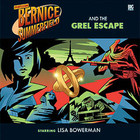
    Professor Bernice Summerfield and the Grel Escape (#5.1)

    After the harrowing events of Life During Wartime and Death and the Daleks, it’s apparently time for some lighthearted events in the life of Bernice Summerfield. And so Jacqueline Rayner makes a welcome return to the range, having previously penned most of the (almost) uniformly excellent adaptations in the first season, not to mention the novels The Squire’s Crystal and The Mirror Effect. And even better, it brings back the Grel!

    The Grel originally appeared in Paul Cornell’s New Adventures novel Oh No It Isn’t!, but truly obtained life in Rayner’s audio adaptation of that novel. They’ve been chronically underused since, though they are the only (I am pretty sure) monster to originate in a spin-off and make it into the parent series, having fought the Doctor and Charley in The Doomwood Curse. They’re simply a delight to listen to (so good choices for audio, then) as they travel the universe looking for facts. “Find facts! Find facts! Find facts!” It’s a nice change of pace to the run of four “monster stories” that preceded this one; we have a monster from Bernice’s own history, rather than an attempt to boost sales by pulling in something from the parent show.

    ( Read more... )


    written by Simon A. Forward
    directed by Edward Salt
    released August 2004

    starring
    Lisa Bowerman as Bernice Summerfield
    Professor Bernice Summerfield and the Bone of Contention (#5.2)

    Professor Bernice Summerfield and the Bone of Contention is the sixth Bernice Summerfield audio drama in a row to feature a “monster,” but like The Grel Escape before it, Bone of Contention switches things up by not featuring a monster that appeared in the classic Doctor Who television series. Rather, The Bone of Contention features one of the alien races Big Finish created itself: the Galyari, who previously appeared in The Sandman with the Sixth Doctor and Evelyn. Bone of Contention is even written by Simon A. Forward, who created the Galyari for The Sandman.

    Bone of Conention sees Bernice hired by the Perlorans to visit the Clutch, a convoy of ships traversing interstellar space, on their behalf to recover a precious artefact from the Galyari. Of course, the Galyari claim to not have the artefact, and Bernice soon ends up sidetracked by Griko, the deformed son of Commander Korschal of the Security Directorate. In a move that surprises no one that has ever experienced another Bernice Summerfield story, the plight of Griko turns out to be related to the artefact, and Bernice is quickly brought into conflict with the Galyari.

    ( Read more... )


    written by Stephen Cole
    directed by Edward Salt
    released November 2004

    starring
    Lisa Bowerman as Bernice Summerfield
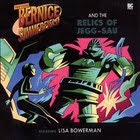
    Professor Bernice Summerfield and the Relics of Jegg-Sau (#5.3)

    Okay, so this season, Benny has faced two monsters from the spin-off media: the Grel and the Galyari. For the third release of the fifth season, it’s a monster from the parent show, but perhaps not one you’d expect: K-1, a.k.a. the Giant Robot. Appearing in just Tom Baker’s debut Robot, the titular character was not one of a race of evil conquerors, but a lone and lonely creation, destroyed at the story’s end. Nevertheless, Stephen Cole brought back the Robot for Professor Bernice Summerfield and the Relics of Jegg-Sau, where she runs afoul of one after crash-landing on an alien planet.

    Despite its seemingly-goofy premise — the Robot’s limp wrists and skinny legs didn’t exactly put it at the top of the monster pantheon — The Relics of Jegg-Sau is actually a fairly grim story. It opens with Bernice imprisoned by the Robot, as she tells the story through flashbacks. And those flashbacks begin with her crashing on an alien planet, rescued by two very strange people: the explorer Kalwell and his daughter Elise. Despite have been trapped on the planet for years, neither is in a hurry to be rescued.


    written by Stewart Sheargold
    directed by John Ainsworth
    released March 2005

    starring
    Lisa Bowerman as Bernice Summerfield
    Harry Myers as Adrian Wall
    Professor Bernice Summerfield in the Masquerade of Death (#5.4)

    “You can’t have a good climax without some effective shouting!”

    Bernice and Adrian are in Spring, where there’s been a murder. Only the Queen of Spring can’t quite tell who’s been murdered. Also Bernice and Adrian are sleeping together. And a mysterious Player has decided to dissect Bernice to prove to everyone that’s she’s fictional. And the dialogue is strange.

    The last instalment of Professor Bernice Summerfield’s fifth season, Professor Bernice Summerfield in the Masquerade of Death by Stewart Sheargold, includes not a single returning monster and makes up for it by being one of the most original releases in the series ever. Unfortunately, “original” seems to largely translate into “completely baffling”. I mean, you eventually find out what’s going on on a macro level, but there are lines of dialogue and whole scenes even that still don’t seem to mean anything by the time you get to the end. I don’t mind working to enjoy something, but I do want to know why I’m working, and I don’t think The Masquerade of Death ever gives me a reason.

    02 May 2012

    Audio Catchup: Doctor Who: The Lost Stories: The Fourth Doctor Box Set

    written by Robert Banks Stewart & John Dorney
    and Philip Hinchcliffe & Jonathan Morris
    directed by Ken Bentley
    released January 2012

    starring
    Tom Baker as the Doctor
    Louise Jameson as Leela
    Doctor Who: The Lost Stories: The Fourth Doctor Box Set

    The third season of Doctor Who: The Lost Stories takes a breather for The Fourth Doctor Box Set, which contains two unmade Tom Baker adventures: Robert Banks Stewart’s The Foe from the Future, completed by John Dorney, and Philip Hinchcliffe’s The Valley of Death, completed by Jonathan Morris. With a six-parter and a four-parter, that’s a whopping ten episodes across six discs! (There is, of course, the traditional egregious disc of extras.)

    I’m not the biggest fan of Robert Banks Stewart’s televised Doctor Who stories. Terror of the Zygons left me cold, and though I thought the first two episodes of The Seeds of Doom were terrific, some of the best base-under-siege the show has ever done, then they go to England and it all gets a bit silly. The Foe from the Future is a storyline that Stewart submitted, but it ended up not being made and the seminal The Talons of Weng-Chiang was made instead. The only real similarity The Foe from the Future has to Talons is the one in its title: the bad guy is from the future. It’s set in 1977, and the Doctor and Leela discover that people are disappearing near a mysterious mansion…

    08 April 2012

    Audio Catchup: Three Fifth Doctor Lost Stories

    written by Barbara Clegg & John Dorney
    directed by Ken Bentley
    released October 2011

    starring
    Peter Davison as the Doctor
    Janet Fielding as Tegan
    Sarah Sutton as Nyssa
    Doctor Who: The Lost Stories #3.1: The Elite

    The third season of Big Finish’s Doctor Who: The Lost Stories is here. The scars still haven’t healed since Andrew Cartmel inflicted Season 27 on us, but regardless, we soldier on into the future. Or rather, into the past — the third season takes us back to Season 20 of classic Doctor Who, reuniting the Fifth Doctor with Tegan and Nyssa in the gap between Arc of Infinity and Snakedance. The Elite is written by John Dorney, based upon a scrap of an idea by Barbara Clegg. It’s not quite “authentic” (are these Lost Stories ever?) as Clegg pitched The Elite after Enlightenment, which means it could never have featured Tegan and Nyssa, but on the other hand, it’s one of the most authentic-sounding Lost Stories yet.

    As Dorney points out in the liner notes, The Elite opens the way many Nathan-Turner/Saward stories did: the Doctor and his companions in a long TARDIS scene, discussing the previous adventure and bickering a bit. For someone like me who considers Seasons 18 through 21 to be one of his favourite periods of Doctor Who, it’s a joy to listen to. Dorney writes the Fifth Doctor, Tegan, and Nyssa perfectly. But he’s not above a bit of modern joking at the expense of the era, as we find out why Tegan wore that tube top all season long. There’s also a reference to the Big Finish adventure Omega. I feel like I shouldn’t like these ahistorical components, but they work here, making the story not just a pastiche of the era it’s recreating, but a knowing one. The music all adds to the experience — moreso than any Lost Story so far, it sounds perfectly like the music of the era. You can imagine Roger Limb or Paddy Kingsland slaving away in the BBC Radiophonic Workshop producing this score. It’s the work of Fool Circle Productions (I see what you did there), who were previously responsible for excellent work on Cyberman 2. The sound effects get it, too.

    ( Read more... )


    written by Hazel Adair, Peter Ling & Paul Finch
    directed by Ken Bentley
    released November 2011

    starring
    Peter Davison as the Doctor
    Janet Fielding as Tegan
    Sarah Sutton as Nyssa
    Doctor Who: The Lost Stories #3.2: Hexagora

    Hexagora is the second of the Lost Stories to feature the Fifth Doctor, Nyssa, and Tegan, following straight on from The Elite in a way that feels nicely authentic to the 1980s. The original outline for Hexagora was written by Peter Ling and Hazel Adair (Ling was the writer of The Mind Robber back in the 1960s), and it was adapted to audio by Brian Finch (who’s penned a few Big Finish stories the past couple years, including a Sixth Doctor Lost Story, Leviathan). Vacationing in Australia, Tegan alerts the Doctor to the fact that a guy she knew at school has gone missing… and of course the Doctor determines that he’s been abducted to another planet. But when the TARDIS arrives on Proxima Centauri, they find not an advanced civilisation, but a recreation of Elizabethan London.

    Hexagora starts off roughly, with a hoary scene where Mike Bretherton talks to his editor on the phone in a distracting accent when he sees a meteor, then a couple scenes where the Doctor, Tegan, and Nyssa work to track Mike down that are high on technogubbins and low on energy. But once the plot makes it to Luparis, it picks up in energy. At first, I was worried because Hexagora seemed to do that thing that bad Doctor Who stories do — jam together a number of disparate elements in the hope that it creates something interesting — with Elizabethan London, Proxima Centauri, alien insects, and court politics, but in fact as the story unfolds, we see that all of these elements go together quite nicely.


    written by Christopher Bailey & Marc Platt
    directed by Ken Bentley
    released December 2011

    starring
    Peter Davison as the Doctor
    Janet Fielding as Tegan
    Sarah Sutton as Nyssa
    Doctor Who: The Lost Stories #3.3: The Children of Seth

    The Fifth Doctor strand of Doctor Who: The Lost Stories comes to a close with The Children of Seth, written by Marc Platt from a story by Christopher Bailey. Bailey of course wrote Kinda and Snakedance, the former of which is one of my favourite Doctor Who stories. So the promise of a Bailey Lost Story, written by one of Big Finish’s best writers, was one I couldn’t resist.

    The Children of Seth delivers. While this isn’t as good as Kinda, it’s better than Snakedance. More importantly, it has the same kind of feel as both — that the Doctor and company have stepped into a large and complex adventure close to the end. There’s a whole world in place here already, built up through tiny mentions and a series of excellent performances, not to mention some brilliantly atmospheric sound design/music by the always-reliable Richard Fox and Lauren Yason. (Once again I’m bummed that The Lost Stories use interviews as extras on both CDs, and no music.) I loved almost every guest character. David Warner puts in an unusually subdued performance as Siris, Autarch of the Sirius Archipelago. Honor Blackman is brilliant as Anahita, his wily wife. My favorite of all, however, was Vernon Dobtcheff’s Shamur, an old soldier forgotten by the empire who goes back into battle to save it despite itself.

    24 March 2012

    Audio Catchup: Two First Doctor Companion Chronicles by Simon Guerrier

    written by Simon Guerrier
    directed by Lisa Bowerman
    released November 2011

    starring
    Peter Purves as Steven Taylor
    Tom Allen as Oliver Harper
    Doctor Who: The Companion Chronicles #6.05: The First Wave

    Having enjoyed The Perpetual Bond and glorified The Cold Equations, you might imagine that I was a wee bit excited to get ahold of the final part of the Oliver Harper trilogy, The First Wave. As with the other two, this release was written by Simon Guerrier, directed by Lisa Bowerman, produced by David Richardson, and sound designed by Richard Fox and Lauren Yason. It stars, once again, Peter Purves as Steven Taylor and Tom Allen as Oliver Harper.

    The First Wave isn’t quite as immersive in the 1960s as its predecessors were, but it still has a feeling of staunch emotional realism for all the characters involved, but especially Steven. Steven has rarely been treated so well as a character as in The Cold Equations, and that trend continues here. Once again, the characters are in a space environment that lets Steven shine but also feels utterly real — and completely resonant with the emotional tone of the story. The First Wave takes place on an mostly airless planetoid at the fringes of the solar system, and the starkness mirrors Steven’s mood. He’s seen Katarina and Sara die… and the Doctor too. How can he and Oliver possibly survive this one?

    ( Read more... )


    written by Simon Guerrier
    directed by Ken Bentley
    released January 2012

    starring
    Peter Purves as Steven Taylor
    Jean Marsh as Sara Kingdom
    Doctor Who: The Companion Chronicles #6.07: The Anachronauts

    What was good? The three Companion Chronicles by Simon Guerrier about Sara Kingdom. What was great? The three Companion Chronicles by Simon Guerrier about Steven Taylor. So what could possibly be even greater except a Companion Chronicle by Simon Guerrier featuring both Jean Marsh and Peter Purves as Sara and Steven? Doctor Who: The Anachronauts, this year’s double-disc/double-voiced Companion Chronicle is exactly that, uniting the Doctor, Steven, and Sara in the gap in the middle of The Daleks’ Master Plan.

    The story picks up right from the end of The Feast of Steven with the TARDIS crew celebrating Christmas when the Ship collides with another timeship in the Vortex. The crews of both ships are flung on an alien beach, beginning a journey that will take Steven and Sara into an alien jungle, the depths of the TARDIS itself, and East Berlin during the Cold War…

    26 February 2012

    Audio Catchup: The Scarifyers: The Magic Circle

    written by Simon Barnard and Paul Morris
    directed by Simon Barnard
    released November 2011

    starring
    David Warner as Harry Crow
    Terry Molloy as Professor Dunning
    The Scarifyers: The Magic Circle

    Since 2007, Nicholas “Brigadier” Courtney and Terry “Davros” Molloy have played Inspector Lionheart and Professor Dunning in the ongoing Scarifyers series of audio dramas. After the unfortunate death of Nicholas Courtney, it was thankfully decided to not end The Scarifyers, but to continue the series with a new lead: David Warner as Harry “Thumper” Crow, Lionheart’s old sergeant. The Magic Circle is the story tasked with making that transition.

    Lionheart has suddenly gone missing, leaving poor Professor Dunning in all kinds of (literally) sticky situations without backup. Concerned, his investigations leads him to Harry Crow, and then on the trail of any number of magical acts. Meanwhile, an old woman named Iris Binns has begun chasing down these magical acts for her own reasons…

    Audio Catchup: Doctor Who: The Curse of Davros

    written by Jonathan Morris
    directed by Nicholas Briggs
    released January 2012

    starring
    Colin Baker as the Doctor
    Lisa Greenwood as Flip Jackson
    Terry Molloy as Davros
    Doctor Who #156: The Curse of Davros

    Jonathan Morris’s Doctor Who audio The Curse of Davros introduces a new companion, but an old character, bringing back Lisa Greenwood as Flip Jackson, who previously appeared in the overcrowded The Crimes of Thomas Brewster. I actually heard the announcement that Flip would be returning before I heard Crimes, and on finally listening to the story, I was baffled; I don’t think I’d’ve noticed her at all if it hadn’t been for that announcement. But here she is back (alongside her boyfriend Jared) when an escape pod carrying the Doctor crashes in London, and she’s the only one who notices.

    What follows is a story that’s hard to discuss, because it has a central premise that would be partially ruined by giving it away. I managed to intuit it even by reading a non-spoiler discussion, so I’ll try to be super-vague. In general terms, however, the Doctor is on the run from the Daleks in 2012, trying to get back to 1815, where Davros is allying with Napoleon to change the course of the Battle of Waterloo. The Doctor, Flip, and Jared must dodge the Daleks, the police, the French, and the Duke of Wellington if they want to keep history on course. It feels a little bit too small scale for Davros and the Daleks, coming off a lot like the Master’s plan in The King’s Demons.

    09 February 2012

    Audio Catchup: The Minister of Chance

    written and directed by Dan Freeman
    released February 2011

    starring
    Jenny Agutter as Professor Cantha
    Lauren Crace as Kitty
    Paul McGann as Durian
    The Minister of Chance, Prologue: The Pointed Hand

    I’m a big fan of Death Comes to Time, the 2001-02 webcast that recast Doctor Who as a sprawling, interplanetary, operatic epic along the lines of Babylon 5, Star Wars, or The Lord of the Rings. But even so, I was mighty sceptical when it was announced that Radio Static was bringing back the Minister of Chance, the Time Lord played by Stephen Fry in that series, in a new audio (or “radiophonic,” as they like to say) spin-off written by Dan Freeman.

    The Pointed Hand is the free prologue to The Minister of Chance, a quick nine-minute story that’s largely one long scene featuring a few characters, though a few others put in brief appearances. A rocket from the nation of Seswan lands on Tanto, bringing Ambassador Durian, played by Paul McGann. Most of the prologue is the negotiation between Durian and the King of Tanto, where Durian attempts to gain permission to place military base on Tanto. McGann is as good as he always is, and plays nicely against what I expected of him after 11 years of listening to him in Doctor Who.

    ( Read more... )


    written and directed by Dan Freeman
    released March 2011

    starring
    Julian Wadham as the Minister
    Jenny Agutter as Professor Cantha
    Lauren Crace as Kitty
    Sylvester McCoy as the Witch Prime
    Paul McGann as Durian
    Paul Darrow as Lord Rathen
    The Minister of Chance, Episode 1: The Broken World

    The Broken World is the first full episode of The Minister of Chance, and our first opportunity to hear Julian Wadham play this new incarnation of the Time Lord, taking over from Stephen Fry, who played the previous incarnation in Doctor Who: Death Comes to Time. It’s written and directed by Dan Freeman, who also wrote and directed Death Comes to Time, and that production’s lush sound design and music is also back here. I always loved how Death Comes to Time used classical music (that scene were the Doctor confronts the Minister is simply gorgeous), and that flair is back here.

    What particularly struck me was how like Death Comes to Time the setup for The Minister of Chance is. We’ve gone one nation occupying another, with head of state of the occupying nation itself feeling threatened by the actions of the member of their government doing the occupying. A Time Lord has come to the occupied nation, but not to help per se, but because something is “wrong” with the universe, and so he can’t spend much time helping out. But this is early days — The Broken World is only 35 minutes long — and there enough intriguing parts to the setup that I don’t think it’ll be a problem. The occupying nation of Seswan is democratic, and trumpets this fact loudly, but they are also anti-science, and ruled by a “Witch Prime”. The occupied nation of Tanto, on the other hand, is ruled by a king who ascended to the throne by killing his predecessor, but has an accomplished university. Also interesting are the hints about how the Minister travels between worlds.

    ( Read more... )


    written and directed by Dan Freeman
    released May 2011

    starring
    Julian Wadham as the Minister
    Jenny Agutter as Professor Cantha
    Gethin Anthony as Sutu
    Lauren Crace as Kitty
    Sylvester McCoy as the Witch Prime
    Paul McGann as Durian
    Paul Darrow as Lord Rathen
    Peter Guinness as the Horseman
    The Minister of Chance, Episode 2: The Forest Shakes

    My sense that The Minister of Chance was hitting several familiar story beats from Death Comes to Time was only heightened by its second full episode, The Forest Shakes. In this episode, the pacifist Professor Cantha ends up in a Sesian prison, and much of the discussion she has mirrors what Saint Valentine says to Nessican. In addition, Cantha’s comments to the Minister about his loneliness sound similar to what Senator Sala said to him, and Governor Durian’s return to Seswan is a lot like General Tannis’s return to Alpha Canis, and there’s a prison break here, though its connection to the Death Comes to Time prison break is admittedly small.

    But though it’s distracting, it’s not overwhelming. The exploration of how pacifism can be a form of strength actually goes further here than in Death Comes to Time, and I quite liked the scenes where Cantha talks to her well-meaning guard. And given Julian Wadham’s much gruffer incarnation of the Minister of Chance, the loneliness angle will probably play out differently as well.

    ( Read more... )

    04 February 2012

    Audio Catchup: Professor Bernice Summerfield and the Poison Seas

    I suppose that when I posted my reviews of the first two releases of Season 4 of Bernice Summerfield, I should have waited, since this one was yet to come, and I won't be reviewing the finale for Unreality, as I've previously listened to it out of sequence. (I have a policy of reviewing audios for USF only if it's the first time I've heard them.)

    Professor Bernice Summerfield and the Poison Seas (#4.3)

    written by David Bailey
    directed by Edward Salt
    released September 2003 

    starring
    Lisa Bowerman as Bernice Summerfield 
    Miles Richardson as Irving Braxiatel

    My ongoing journey through Bernice Summerfield‘s “monster season” brings me to Professor Bernice Summerfield and the Poison Seas, which brings back the Sea Devils, who appeared in Doctor Who in 1972’s The Sea Devils (well, duh) and 1984’s Warriors of the Deep. In an interesting twist on the usual storyline, instead of confronting latecomer humans on Earth, the Sea Devils (here described by the political correct “Earth Reptile” name) are themselves latecomers on the human colony world Chosan, previously seen in author David Bailey’s The Secret of Cassandra. (Hardly the most auspicious beginning, as that story was among the Benny series’ worst.)

    Though it’s a noble idea, The Poison Seas is pretty much an utter failure. Foremost among these is that the Sea Devils are nearly unintelligible, the usually reliable David Darlington committing a rare lapse in sound design. You can figure out what they’re saying enough to follow the plot, but I couldn’t tell any of the Sea Devil characters apart beyond that some were male and others female, and because they all speak in a whisper, all the scenes they feature in lack any kind of dramatic energy. Things only get worse when the Sea Devil computer speaks up, as it seems to have an additional electronic effect designed to make it even less intelligible. Come back Ice Warriors, all is forgiven; the Sea Devils are surely the Doctor Who monster least suitable to audio.