Showing posts with label topic: reading order. Show all posts

20 March 2026

Justice League International Reading Order

If you want to read the Justice League International comics in the order they are collected in the three Justice League International Omnibus volumes, you should knock yourself out. It's basically fine, though I'm not a big fan of volume two's strict publication order approach.

But here I've worked up an order that attempts to balance chronology with publication to make a smooth reading experience. When there are multiple ongoings, I've tried to bounce back and forth between them not in terms of strict chronology, but in a way that preserves references between stories, trying to put multiple issues in a row as much as possible. I have avoided splitting issues containing multiple stories up into different entries, except when the omnibus itself has done so. If you've read my posts reviewing JLI, the order here has been slightly tweaked from that one, based on things I noticed after writing up my posts.

I've also extended this order beyond what's in the omnibus volumes, up to the events of Zero Hour. The JLA and JLTF material of this era is collected in a series of trades, but the JLEJLI, and JLQ issues are largely uncollected. I have only included installments of non-JL series when they are part of crossovers that include JL issues (e.g., Suicide Squad #13, Guy Gardner #15), except I did include Elongated Man because it's by the same writer as JLE and there is a JLE storyline that is a direct sequel to it.

I've labelled issues by what collected editions they appear in (when they do). I've folded in stories published after the original order chronologically; certainly you can skip most of these and/or read them when they were released. Thanks a lot to Cosmic Teams, whose own chronology was a useful starting point. If you want to see the much more detailed notes I made, they are accessible in a Google Sheet here.

Key: JLIO# = Justice League International Omnibus volumes, S&JLA# = Superman and Justice League America trades, WW&JLA# = Wonder Woman and Justice League America trades, JLTF = Justice League Task Force, Volume 1: The Purification Plague

Part I: The Original Giffen/DeMatteis Run 

  • from Justice League vol. 1 #2
    Justice League vol. 1 #1-4 [JLIO1]
  • Justice League Annual vol. 1 #1 [JLIO1]
  • Justice League vol. 1 #5-6 [JLIO1]
  • Justice League International vol. 1 #7 [JLIO1]
  • JLA 80-Page Giant #1*† [JLIO3]
  • Justice League International vol. 1 #8-12 [JLIO1]
  • Justice League America Annual #9*†
  • Suicide Squad vs. Justice League [JLIO1]
    • Justice League International vol. 1 #13
    • Suicide Squad vol. 1 #13
  • Justice League International vol. 1 #14-15 [JLIO1]
  • JLA: Incarnations #6*‡
  • Justice League International Annual #2‡ [JLIO1] 
  • Justice League International vol. 1 #16-21 [JLIO1]
  • Secret Origins vol. 2 #33-35§ [JLIO3] 
  • Justice League International vol. 1 #22-25 [JLIO1]
  • Justice League Europe #1-3 [JLIO1]
  • from Justice League America #30
    Justice League America #26-30† [JLIO1]
  • Justice League Europe #4-6 [JLIO1]
  • Justice League International Annual #3 [JLIO1]
  • The Teasdale Imperative [JLIO2]
    • Justice League America #31
    • Justice League Europe #7
    • Justice League America #32
    • Justice League Europe #8
  • Justice League America #33-36 [JLIO2]
  • Justice League Europe #9-10 [JLIO2]
  • Justice League International Special #1 [JLIO2]
  • Justice League Europe #11-12 [JLIO2]
  • Furballs [JLIO2]
    • Justice League America #37
    • Justice League Europe #13
  • Justice League Europe Annual #1 [JLIO2]
  • from Justice League Europe #21
    Justice League Europe #14-19 [JLIO2]
  • Justice League America #38-42† [JLIO2]
  • DC Retroactive: Justice League America 1990s #1*‡ [JLIO3] 
  • Justice League America Annual #4 [JLIO2]
  • JLA Showcase 80-Page Giant #1*
  • Justice League Europe #20-21 [JLIO2]
  • Justice League America #43-44 [JLIO2] 
  • Justice League Quarterly #1 [JLIO2]
  • Justice League Europe #22 [JLIO2]
  • Justice League Quarterly #2 [JLIO3] 
  • Justice League America #45-50 [JLIO2]
  • Justice League International Special #2 [JLIO3] 
  • Justice League Quarterly #3-4 [JLIO3]
  • Justice League America #51 [JLIO3]
  • Justice League Europe #23-25 [JLIO2] 
  • Justice League Europe #26-28 [JLIO3]
  • Justice League America #52† [JLIO3] 
  • from Justice League America Annual #5
    Justice League America Annual #5 [JLIO3]
  • Breakdowns [JLIO3]
    • Justice League America #53
    • Justice League Europe #29
    • Justice League America #54
    • Justice League Europe #30
    • Justice League America #55
    • Justice League Europe Annual #2
    • Justice League Europe #31
    • Justice League America #56
    • Green Lantern vol. 3 #18†
    • Justice League Europe #32
    • Justice League America #57
    • Justice League Europe #33
    • Justice League America #58
    • Justice League Europe #34
    • Justice League America #59
    • Justice League Europe #35
    • Justice League America #60
    • Justice League Europe #36
  • from Justice League Quarterly #5
    Justice League Quarterly #5¶ [JLIO3]

Part II: The Pre–Zero Hour Run

  • Justice League Quarterly #6¶
  • Elongated Man #1-4
  • Justice League Spectacular #1 [S&JLA1] 
  • Justice League America #61-62 [S&JLA1] 
  • Justice League Quarterly #7
  • Justice League America #63-65 [S&JLA1]
  • Justice League Europe #37-44
  • Eclipso: The Darkness Within
    • Justice League America Annual #6 [S&JLA2]
    • Justice League Europe Annual #3 
  • Justice League Quarterly #8¶
  • Justice League America #66 [S&JLA1]
  • Justice League Quarterly #9
  • Justice League America #67-68 [S&JLA1]
  • from Justice League Quarterly #10
    Justice League Quarterly #10
  • Justice League America #69-71 [S&JLA2]
  • Justice League Europe #45-50
  • Justice League America #72-77 [S&JLA2]
  • Justice League Quarterly #11‡
  • Justice League Task Force #1-8 [JLTF]
  • Justice League International vol. 2 #51-52
  • Justice League America #78-82 [WW&JLA1]
  • The Trouble with Guys [WW&JLA1]
    • Justice League America #83
    • Guy Gardner #15
  • Justice League America #84-85 [WW&JLA1]
  • Justice League Quarterly #12-15¶
  • Bloodlines
    • Justice League International Annual vol. 2 #4
    • Justice League America Annual #7 [WW&JLA1]
  • from Justice League
    International
     vol. 2 #54
    Justice League International vol. 2 #53-57
  • Justice League Task Force #9 [JLTF]
  • Elseworlds**
    • Justice League America Annual #8
    • Justice League International Annual #5 
  • Justice League International vol. 2 #58-62
  • Justice League Task Force #10-12† [JLTF]
  • Justice League America #86-88† [WW&JLA2]
  • Justice League International vol. 2 #63-64†
  • Judgment Day [WW&JLA2]
    • Justice League America #89
    • Justice League Task Force #13
    • Justice League International vol. 2 #65
    • Justice League America #90
    • Justice League Task Force #14
    • Justice League International vol. 2 #66 
  • Justice League America #91 [WW&JLA2]
  • from Justice League Quarterly #16
    Justice League Quarterly #16-17¶
  • Justice League Task Force #15
  • Justice League International vol. 2 #67
  • Return of the Hero!
    • Justice League America #92
    • Justice League Task Force #16
    • Justice League International vol. 2 #68 

* Published later.
† Takes place during / simultaneously with the events of the previous item on the list. 
‡ There is no possible place for this story to fit, but it probably reads best here.
§ As origin stories, these mostly take place much earlier, but reading them here gives useful background on the current line-up.
¶ The stories in this JLQ issue take place at various points, but as a whole, it reads best here. 
** Out of continuity, so can be read pretty much whenever, but I tried to put them close to when they were published without disrupting narrative flow.

This is the last in a series of posts about Justice League International. Previous installments are listed below:

  1. Justice League #1-6 / Justice League International #7-12 (May 1987–Apr. 1988)
  2. Justice League International #13-21 (May 1988–Dec. 1988)
  3. Justice League International #22-25 / Justice League America #26-30 / Justice League Europe #1-6 (Jan. 1989–Sept. 1989) 
  4. Justice League America #31-36 / Justice League Europe #7-12 (Oct. 1989–Mar. 1990)
  5. Justice League America #37 / Justice League Europe #13-21 (Apr. 1990–Dec. 1990)
  6. Justice League America #38-50 / Justice League Europe #22 (May 1990–May 1991)
  7. Justice League America #51-52 / Justice League Europe #23-28 (Feb. 1991–July 1991) 
  8. Justice League America #53-60 / Justice League Europe #29-36 (Aug. 1991–Mar. 1992) 
  9. Justice League America #61-65 / Justice League Europe #37-42 (Apr. 1992–Sept. 1992)
  10. Justice League America #66-69 / Justice League Europe #43-50 (Sept. 1992–May 1993) 
  11. Justice League America #70-77 / Justice League Task Force #1-3 (Jan. 1993–Aug. 1993) 
  12. Justice League America #78-83 / Justice League International #51-52 / Justice League Task Force #4-8 (June 1993–Jan. 1994)
  13. Justice League America #84-85 / Justice League International #53-57 / Justice League Task Force #9 (Aug. 1993–Feb. 1994) 
  14. Justice League America #86-88 / Justice League International #58-64 / Justice League Task Force #10-12 (Nov. 1993–May 1994) 
  15. Justice League America #89-92 / Justice League International #65-68 / Justice League Task Force #13-16 (June 1994–Sept. 1994)
  16. Formerly Known as the Justice League / I Can't Believe It's Not the Justice League (Feb. 2000–Aug. 2005)
  17. Blue and Gold / Fire & Ice (Sept. 2021– Nov. 2025)

15 August 2025

DC Animated Universe Hybrid Chronological Viewing Order

My seven-year-old is a fiend for DC Comics, and it's been making me nostalgic for the way I was introduced to a lot of DC characters, the DC Animated Universe. So I started thinking about trying to get them to watch it with me... which of course meant I wanted to work out a proper order!

Lots of people have made timelines, of course, but the problem with timelines is that there were two series set in the future compared to the others, but watching those at the end doesn't make sense; the assumption of the series is that when Terry from Batman Beyond pops up in Justice League or Static Shock, you know who the character is because you've already seen Batman Beyond. I suppose one could watch in a strict broadcast order, then, but that seemed to have its own downsides; I wanted something that captured more of a chronological flow, where you were moving back and forth between shows that happened simultaneously instead of watching in big chunks as seasons aired.

So here's my attempt:

The first tab shows the broad-strokes organization; the second gives you an episode-by-episode breakdown. Similarly, I'll give a broad-stroke explanation here, and then drill down into the details.

Broad-Strokes Organization 

The episodes of Batman: The Animated Series are notoriously confusingly ordered, either as produced or as broadcast. I used this Reddit thread as a guide to a totally new order, with some small tweaks based on the comments. I timed Superman: The Animated Series relative to it and The New Batman Adventures, such that the two crossovers between the two characters ("World's Finest" and "The Demon Reborn") lined up correctly. 

Once both shows come to an end, they are replaced by Batman BeyondJustice League (later Justice League Unlimited), and Static Shock, so at the same time you are following the Justice League and Static in the present, you are following the new Batman in the future; thus when he pops up in both shows, you know who he is. Finally, there's the other DCAU future-set show, the Batman Beyond spin-off The Zeta Project; I timed this to start when Zeta first appears on Batman Beyond and wrap up around the same time JLU ends.

There are obviously some times when there are big gaps between when things aired: for example, B:TAS finished airing Nov. 1994, while New Batman Adventures didn't start until Sept. 1997. Similarly, there was a big gap between when NBA and S:TAS ended (Jan. 1999 and Feb. 2000, respectively) and when Justice League started (Nov. 2001), where just Batman Beyond and Static Shock aired. But in all of these cases, I just had things carry through as continuously as I could.

Detailed Organization

Batman: The Animated Series and The New Batman Adventures 

I used Batman: The Animated Series and The New Batman Adventures as the organizing spine of the first half of the timeline. I added in the Batman-adjacent DCAU movies based on the Reddit thread above:

  • Mask of the Phantasm between "Prophecy of Doom" and "Night of the Ninja"
  • SubZero between B:TAS and NBA
  • Mystery of the Batwoman after "Sins of the Father"

This gave me 105 installments of Batman, which I numbered sequentially. (I did accidentally leave out "Two-Face, Part II," so it got added in as 15.50. I hope I didn't miss out anything else!)

Justice League and Justice League Unlimited

The two Justice League–focused shows ran the longest of everything that came after B:TAS and NBA, so I used them as the organizing spine of what was left. The regular stories were thus numbered 106 to 167 on my list. Then, at the end we got:

  • 168. Justice League vs. the Fatal Five: released years later, supposedly in continuity with the DCAU, after the end of JLU
  • 169. "Epilogue": the season two finale of JLU, but entirely set in the future timeline of Batman Beyond and designed to function as a coda to the whole DCAU

There's also a Batman & Harley Quinn movie that takes place between seasons of JLU, so I numbered it 154.50

Superman: The Animated Series

This began during the gap between B:TAS and NBA, and continued in parallel with NBAS:TAS and NBA crossed over in the S:TAS story "World's Finest," which is set before "Sins of the Father" (80.00), the first episode of NBA. I thus numbered "World's Finest" as 80.50. I decided that prior to that, I'd like it if the shows just pretty much alternated, so I numbered all the preceding stories of S:TAS backwards from there: the one immediately before "World's Finest" ("Father's Day") would be 79.50, the one before that ("Ghost in the Machine") 78.50, and so on. Working backwards, this gets you to the series premiere, "The Last Son of Krypton," as 56.50, so basically, fifty-six B:TAS stories in, you begin alternating the two shows up until you get to the crossover.

The next key story was "The Demon Reborn," which is another crossover with NBA. This story sees Batman and Superman teaming up, and so many place it simultaneously with the NBA episode "Girls' Night Out" (97.00), where Superman and Batman are away on a mission. So I numbered "The Demon Reborn" as 97.50. In between "World's Finest" and "The Demon Reborn," I just distributed stories evenly, which came out to intervals of 0.89. So mostly alternating between NBA and S:TAS, but sometimes you'd get two S:TAS stories between stories of NBA.

That left just one S:TAS episode, the series finale "Legacy." I decided to make both NBA and S:TAS wrap up at about the same time, and thus numbered it 104.50, placing it before the last episode of NBA, "Mad Love" (105.00). This creates a decent gap between the last two S:TAS episodes, but that actually reflects how they were broadcast, months apart.

Static Shock

Static Shock started out totally standalone, but ended up crossing over with the wider DCAU a few times. The first of these is "The Big Leagues," a crossover with NBA, which probably goes after the end of that show according to the fine folks on Reddit.

There are then two Justice League crossovers, "A League of Their Own" and "Fallen Heroes." These both need to go before the Justice League episode "Starcrossed" (130.00), before the league was reorganized as the Justice League Unlimited. So I numbered "Fallen Heroes" as 129.50.

I then decided that I'd like Static Shock to pretty much just start when S:TAS came to an end, so that there wouldn't be a point after the end of S:TAS before the debuts of the other shows where you were only watching NBA. Thus I numbered its first episode, "Shock to the System" as 98.50, picking up right off from S:TAS's "The Demon Reborn" at 97.50.

I then distributed the Static Shock stories between those two episodes evenly, which meant they occurred at intervals of 0.76. So between NBA stories (and later, Justice League stories), you'd typically have one or two episodes of Static Shock. Doing this gave "The Big Leagues" a placement of 108.33, so after the NBA finale (105.00), which was right, and "A League of Their Own" a placement of 120.43, so again, in the right spot.

After Static Shock came to an end, the character appeared in the JLU story "The Once and Future Thing" (142.00). So I set the last episode of Static Shock ("Power Outage") as 141.50, and distributed all the episodes between "Fallen Heroes" and "Power Outage" evenly at intervals of 1.33.

Batman Beyond

In terms of broadcast sequence, Batman Beyond picked right up from the end of NBA, so I set its first episode, "Rebirth," shortly after NBA's final episode (105.00) at 106.50Batman Beyond had forty-nine stories, plus a movie, Return of the Joker. There is a Static Shock episode where he travels to the future and meets the future Batman, "Future Shock" (127.23). The DCAU wiki suggests that Return of the Joker must take place before "Future Shock," so I numbered Return of the Joker as 126.85.

That meant I simply distributed all Batman Beyond stories evenly between those two points, at intervals of 0.42. So you are watching quite a lot of Batman Beyond in between episodes of the Justice League and Static Shock.

The Zeta Project

The last thing to place was the other DCAU future-set show, The Zeta Project. Zeta first appeared in the Batman Beyond episode "Zeta" (117.30). There actually was a decent-sized broadcast gap between Zeta's first appearance in Batman Beyond and their own show debuting, but I decided it was more satisfying to pick up right away, and thus set the first episode of Zeta Project ("The Accomplice") at 117.51Zeta Project crossed over with Batman Beyond again in the episode "Shadows," which the DCAU wiki says occurs after the Batman Beyond episode "Countdown" (126.44), so I set "Shadows" as 126.65. I then distributed the intervening episodes at even intervals of 1.31. 

Lastly, I decided it would make sense to wrap up Zeta Project before the future-set episode of JLU, "Epilogue" (169.00), so I set its series finale ("The Wrong Morph") to 167.50. I then distributed the episodes in between "Shadows" and "The Wrong Morph" evenly at intervals of 2.40.

Epilogue 

I think that's everything! In practice, this gets you the following periods:

  1. fifty-six sequential stories from Batman: The Animated Series
  2. alternating stories from Batman: The Animated Series and Superman: The Animated Series
  3. (roughly) alternating stories from New Batman Adventures and Superman: The Animated Series
  4. (roughly) alternating stories from New Batman Adventures and Static Shock
  5. lots of Batman Beyond, with interspersed stories from Static Shock and Justice League
  6. lots of Batman Beyond, with interspersed stories from Static Shock and Justice League and the occasional episode of Zeta Project (four shows at once!)
  7. (roughly) alternating stories from Static Shock and Justice League Unlimited, with occasional episodes of Zeta Project
  8. Justice League Unlimited, with occasional episodes of Zeta Project

The caveat here is, of course, I haven't watched it this way! And it's been a long time since I've watched any of this; if you have any advice or corrections, I'd love to hear them.

25 July 2025

Avatar: The Last Airbender Comics Chronology


My wife and kids are working their way through Avatar: The Last Airbender, and they've just got to the end of Book Two. When the Earth King and his bear turned up, my six-year-old remembered them... from the Avatar comics they had read on one of their reading sprees several months ago! I pointed out that the collected The Lost Adventures actually has three comics in it that bridge the gap between Books Two and Three, and suggested they read it before moving on. They did this, and then upon watching the first episode of Book Three, asked what comic went between that episode and the next.

Well! Never was this dad happier to be asked a question. With some help from the Avatar wiki, I worked out the timeline of Book Three's episodes, incorporating the comics from The Lost Adventures. When I told my wife I hadn't been able to find a good timeline online, she said... why don't you make one? So here we go. 

Thanks to the continuity notes on the Avatar wiki, and several threads on Reddit. Note that I don't care about things I have not and will not read, like the novels. I've used the episode numbers given on the Avatar wiki, which are different than the ones given on Netflix. Some of the after the show books overlap with each other (like technically Smoke and Shadow and North and South do), but I've listed them as single unit for readability.

KEY:

  • #x##: episode
  • TLA: The Lost Adventures comic
  • TATTeam Avatar Tales comic 
  • Title: standalone graphic novel 

Book One: Water

  • 1x01: "The Boy in the Iceberg"
  • 1x02: "The Avatar Returns"
  • 1x03: "The Southern Air Temple"
  • 1x04: "The Warriors of Kyoshi"
  • 1x05: "The King of Omashu"
  • 1x06: "Imprisoned"
  • 1x07/08: "Winter Solstice"
  • 1x09: "The Waterbending Scroll"
  • TLA"Bee Calm" 
  • 1x10: "Jet"
  • 1x11: "The Great Divide"
  • 1x12: "The Storm"
  • 1x13: "The Blue Spirit"
  • 1x14: "The Fortuneteller"
  • 1x15: "Bato of the Water Tribe"
  • TLA"Water War" 
  • 1x16: "The Deserter"
  • 1x17: "The Northern Air Temple"
  • TLA"Don't Blow It!" 
  • TLA"Relics" 
  • TLA"Fruit-Stand Freestyle" 
  • 1x18: "The Waterbending Master"
  • 1x19/20: "The Siege of the North" 

Book Two: Earth

  • 2x01: "The Avatar State"
  • TAT: "Origami" 
  • 2x02: "The Cave of Two Lovers"
  • 2x03: "Return to Omashu"
  • 2x04: "The Swamp"
  • 2x05: "Avatar Day"
  • 2x06: "The Blind Bandit"
  • 2x07: "Zuko Alone"
  • "Lost and Found" [uncollected comic] 
  • 2x08: "The Chase" 
  • 2x09: "Bitter Work"
  • Katara and the Pirate's Silver
  • TLA"Sleepbending"
  • TLA"Lessons"
  • TLA"Sokka the Avatar"
  • TLA"Dirty Is Only Skin Deep"
  • 2x10: "The Library"
  • 2x11: "The Desert"
  • TLA"Divided We Fall"
  • TLA"Reach for the Toph" 
  • 2x12: "The Serpent's Pass"
  • 2x13: "The Drill"
  • 2x14: "City of Walls and Secrets"
  • 2x15: "Tales of Ba Sing Se"
  • 2x16: "Appa's Lost Days" 
  • 2x17: "Laka Laogai"
  • 2x18: "The Earth King"
  • 2x19: "The Guru"
  • 2x20: "The Crossroads of Destiny"
  • TLA"It's Only Natural"
  • TLA"Going Home Again"
  • TLA"The Bridge" 

Book Three: Fire

  • 3x01: "The Awakening"
  • 3x02: "The Headband"
  • TLA"Private Fire"
  • 3x03: "The Painted Lady"
  • TLA"Night Animals"
  • TLA"Boys' Day Out"
  • 3x04: "Sokka's Master"
  • TAT: "The Substitute" 
  • 3x05: "The Beach"
  • TLA"Ember Island Arcade"
  • 3x06: "The Avatar and the Fire Lord" 
  • 3x07: "The Runaway"
  • TLA"Monster Slayer"
  • 3x08: "The Puppetmaster"
  • TLA"Combustion Man on a Train"
  • 3x09: "Nightmares and Daydreams"
  • 3x10/11: "The Day of Black Sun"
  • 3x12: "The Western Air Temple"
  • 3x13: "The Firebending Masters"
  • TLA"Swordbending"
  • TLA"No Benders Allowed"
  • Suki, Alone 
  • 3x14: "The Boiling Rock," Part 1
  • TLA"Love Is a Battlefield"
  • 3x15: "The Boiling Rock," Part 2 
  • 3x16: "The Southern Raiders"
  • TLA"Dragon Days"
  • 3x17: "The Ember Island Players"
  • TLA"Game Time"
  • 3x18/19: "Sozin's Comet," Parts 1-2
  • TLA"Bumi vs. Toph, Round One"
  • 3x20/21: "Sozin's Comet," Parts 3-4

After the Show

  • "Matcha Makers" [uncollected comic] 
  • The Promise
  • TAT"Rebound" 
  • The Search
  • TAT"Shells" 
  • TAT"Sokka's Poem" 
  • The Rift
  • TAT"Toph and the Boulder" 
  • TAT"Sisters" 
  • TAT"The Scarecrow" 
  • Toph Beifong's Metalbending Academy 
  • Smoke and Shadow
  • Azula in the Spirit Temple 
  • North and South
  • The Bounty Hunter and the Tea Brewer 
  • Ashes of the Academy 
  • Imbalance 

Every post-show timeline I looked at seems to have different, sometimes wildly different, placements, so your mileage may vary. If you have a compelling argument, I'd like to hear it!

03 January 2025

Doctor Who Magazine Graphic Novel Reading Order (From Stockbridge to Beyond Segonus: A Doctor Who Magazine Comics Marathon, Part 57)

From the inside, the reading order for the Doctor Who Magazine graphic novels seems pretty clear... but there are quite a lot of the things, and the release order of the collected editions is nothing like the release order of the original strips, so I imagine it can seem pretty intimidating to an outside reader. So to cap off my ongoing series of posts about the DWM comic strip (for now, anyway), I've written up a reading order for the collections.

Basically, the short answer is to do the volumes in the release order of the original strips. For example, the back-up tales go best by original publication, because characters from them eventually cross over into the main strip, so it's nice if you already know them. The past Doctor volumes best go by publication order, because they usually reflect what's going on around that time in publication order; most notably, the stories in Ground Zero lead straight into End Game.

In most cases, I would just read the strips in the order they are reproduced in the books, but in a couple cases, I've suggested a different order in my notes.

I've given issue numbers, but in a simplified form; if a single issue is being skipped, or put in a different volume, I'm not being pedantic about its positioning.

  1. Fourth Doctor: The Iron Legiona (#1-38)
  2. Back-Up Tales: The Return of the Daleksb (#1-46) 
  3. Fourth Doctor: Dragon's Clawa (#39-60)
  4. Back-Up Tales: Black Sun Risingb (#31-64)
  5. Fifth Doctor: The Tides of Time (#61-87)
  6. Sixth Doctor: Voyager (#88-107)
  7. Sixth Doctor: The World Shapers (#108-29)
  8. Seventh Doctor: A Cold Day in Hell! (#130-50)
  9. Seventh Doctor: Nemesis of the Daleks (#152-62)
  10. Seventh Doctor: The Good Soldier (#164-79)
  11. Seventh Doctor: Evening's Empire (#180-92)
  12. Seventh Doctor: Emperor of the Daleks (#193-211)
  13. Multi-Doctor: The Age of Chaosc (#305)
    • "Under Pressure"
    • "Metamorphosis"
    • "The Last Word"
    • "The Age of Chaos"
  14. Multi-Doctor: Land of the Blind (#212-26)
  15. Multi-Doctor: Ground Zero (#228-43)
  16. Eighth Doctor: End Gamed (#244-71) 
  17. Eighth Doctor: The Glorious Deadd (#273-99)
  18. Eighth Doctor: Oblivion (#300-28)
  19. Eighth Doctor: The Flood (#329-53)
  20. Ninth Doctor: The Cruel Sea (#355-64)
  21. Tenth Doctor: The Betrothal of Sontar (#365-80)
  22. Tenth Doctor: The Widow's Curse (#381-99)
  23. Tenth Doctor: The Crimson Hand (#400-20)
  24. Eleventh Doctor: The Child of Time (#421-41)
  25. Eleventh Doctor: The Chains of Olympus (#442-50)
  26. Eleventh Doctor: Hunters of the Burning Stone (#451-61)
  27. Eleventh Doctor: The Blood of Azrael (#462-74)
  28. Twelfth Doctor: The Eye of Torment (#475-88)
  29. Twelfth Doctor: The Highgate Horror (#489-500)
  30. Twelfth Doctor: Doorway to Hell (#501-11)
  31. Twelfth Doctor: The Phantom Piper (#512-23)
  32. Multi-Doctor: The Clockwise Ware (#524-30) 
  33. Thirteenth Doctor: Mistress of Chaos (#531-48)
  34. Thirteenth Doctor: The White Dragon (#549-77)
  35. Multi-Doctor: Monstrous Beautyf (#579-83)
  36. Fourteenth Doctor: Liberation of the Daleks (#584-97)

Notes

  1. The contents of these two volumes were later collected in one as The Fourth Doctor Anthology.
  2. I suggest reading each collection of back-up tales immediately after the main strip volume its contents were (largely) published simultaneously to. In particular, this maintains chronology for the character of Ivan Asimoff, who appears in Dragon's Claw, Black Sun Rising, and Voyager.
  3. Reading the volume here and in my suggested order means you start with three Virgin New Adventure–era stories (tying up that phase of the strip) and end with a "past Doctor" one (setting up the next era of the strip).
  4. Note that the strips in this collection are arranged out of order, but best read in original publication order; just pay attention to the original publication details.
  5. This volume is the finale to the twelfth Doctor strips, but is branded as "multi-Doctor" because it contains some unreprinted past Doctor material to get the volume up to full length. You can read that material here if you want, but if you wanted to experience it closer to original publication sequence, that would be between Land of the Blind and Ground Zero.
  6. This volume is the finale to the thirteenth Doctor strips, but is branded as "multi-Doctor" because it contains some unreprinted past Doctor material to get the volume up to full length. You can read that material here if you want, but if you wanted to experience it closer to original publication sequence, that would be between Land of the Blind and Ground Zero, except for Monstrous Beauty, which would best go before The White Dragon.

Jumping-On Points

Obviously you can always start at the beginning with The Iron Legion! But there are other good places to kick off. I think mostly any Doctor's first volume is a safe enough bet. In particular, though, I would suggest:

  • End Game. For a modern reader, the eighth Doctor stuff may read better than the fourth and fifth Doctor material, despite its classic status. It has a more of a character focus, and is better, I think, at using continuity with light callbacks that enhance your reading pleasure, as we are used to from, say, Buffy or the 2005-22 series. If you find yourself intrigued, you can jump back and read books like The Tides of Time to discover the stories this era is drawing on.
  • The Betrothal of Sontar. If you are a new series person, you may find it easier to jump on board with a new series Doctor. In that case, I would suggest skipping The Cruel Sea (for now), as I don't think the strip really got to grips with the new series style until David Tennant came on as the Doctor. The Betrothal of Sontar, The Widow's Curse, and The Crimson Hand are three strong volumes showing off the diversity of the DWM strip at its best, and you can continue on from there. Eventually, the strip will slowly drop in older continuity that you can eventually loop back to and explore. Similarly, I think The Chains of Olympus, Doorway to Hell, and Mistress of Chaos are all good points to begin for their respective Doctors.

Should I Work in Other Stuff?

If you look at my own sequence below, you'll see I worked in a lot of other stuff from outside the Doctor Who universe. In general, I would say, "No," you don't need any of this stuff to enjoy the DWM strip, especially if it's your first time through it. Make things easy on yourself, and just do the Doctor Who parts. Some specific notes on stuff I added in:

  • The Transformers UK. I read this because the character of Death's Head begins in The Transformers and appears in DWM strips collected in A Cold Day in Hell! and The Good Soldier. Those strips will work on their own if you haven't read Transformers, because the Doctor doesn't know who Death's Head is either. It's quite a commitment to read The Transformers UK, partially because the UK TF strip incorporated the American comic, so you would "need" to work that in too!... and you would thus actually be reading more Transformers than Doctor Who, I think.
  • Death's Head. Marvel has collected (most) of the original Death's Head series in a volume called Freelance Peacekeeping Agent; there's also a modern series collected as Clone Drive. If Death's Head's appearance in the DWM strip leaves you curious, sure go ahead and read this stuff... but I doubt it will, since DWM is not Death's Head at his best. Technically speaking, the first seven issues of Death's Head volume 1 do take place in the Doctor Who universe. Everything else takes place in the Marvel universe. If you are very much a completist, the one I would recommend tracking down is "Time Bomb!" from Death's Head vol. 1 #8, reprinted in The Incomplete Death's Head #9 (but not in any trades, alas), as it features key roles for the seventh Doctor and Josiah W. Dogbolter, and is written by DWM's Steve Parkhouse.
  • The Daleks. The 1965-67 Doctor-less comic strips from TV Century 21 are fun enough and collected in a convenient Panini "bookazine"; you can read them pretty much whenever, but in particular, you may benefit from doing them prior to Liberation of the Daleks, which uses some of their iconography to good effect.
  • The Sleeze Brothers. Against all my expectations, I did find this kind of charming. These characters debuted in a story collected in A Cold Day in Hell! before getting their own series. Definitely nonessential but fun enough.
  • The Ultimate Comic Strip Collections. Panini have collected all their Dalek strips in two volumes and all their Cybermen strips in a single large volume. For the most part, these volumes contain nothing you can't get from the collections I've listed above if you include the back-ups... except that volume 2 of the Dalek collection includes a single eight-page story about the Peter Cushing Doctor from the DWM 1996 spring special, Daleks versus the Martians, collected nowhere else. It seems a shame Panini couldn't have included this alongside their other Cushing story in Monstrous Beauty; it's probably not worth chasing down, though.

This post is the fifty-seventh in a series about the Doctor Who Magazine comic strip and Marvel UK. The next installment is currently unknown. Previous installments are listed below:

20 October 2023

Justice Society of America (2007–11) Reading Order

Volume 3 of DC's Justice Society of America comic (the one that began after 52 and came to an end with Flashpoint and the "New 52") is one of those titles that keeps getting sucked into crossovers and events, and thus what order you should read it in is not totally obvious. Thus, here I am to straighten it out for you.

Crossover/event titles are noted in bold.

  • Justice Society of America vol. 3 #1-4
  • The Lightning Saga
    • Justice League of America vol. 2 #8
    • Justice Society of America vol. 3 #5
    • Justice League of America vol. 2 #9
    • Justice Society of America vol. 3 #6
    • Justice League of America vol. 2 #10
  • Justice Society of America vol. 3 #7-8
  • Thy Kingdom Come
    • Justice Society of America vol. 3 #9-17
    • Justice Society of America Annual #1
    • Justice Society of America vol. 3 #18-20
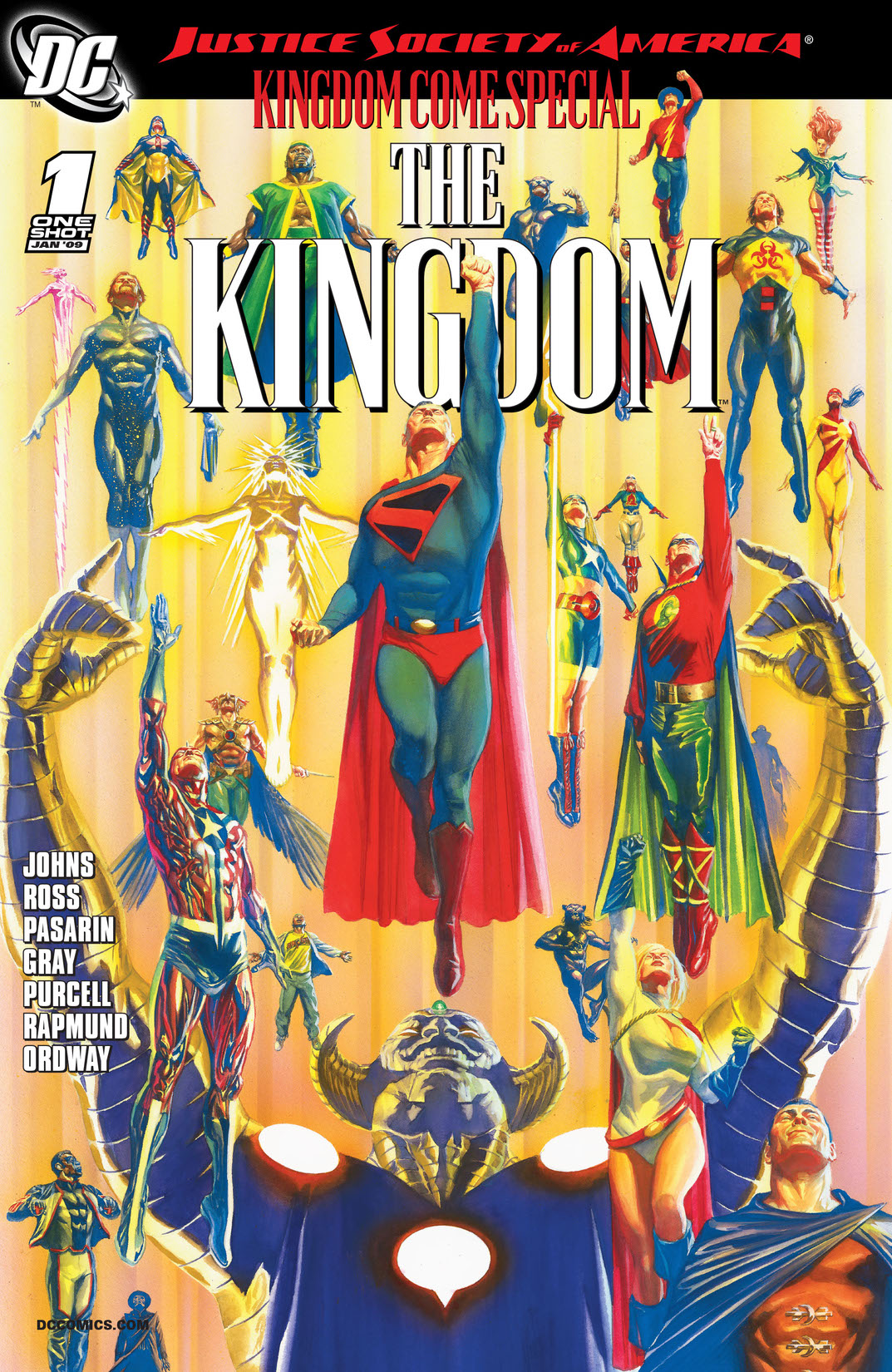
    • Justice Society of America: Kingdom Come Special: Superman #1
    • Justice Society of America: Kingdom Come Special: Magog #1
    • Justice Society of America: Kingdom Come Special: The Kingdom #1
    • Justice Society of America vol. 3 #21-22
  • Justice Society of America vol. 3 #23-28
  • Justice Society of America 80-Page Giant #1 
  • Justice Society of America vol. 3 #29-40
  • The Dark Things
    • Justice League of America vol. 2 #44-46
    • Justice Society of America vol. 3 #41
    • Justice League of America vol. 2 #47
    • Justice Society of America vol. 3 #42
    • Justice League of America vol. 2 #48
    • Justice Society of America vol. 3 #43
  • Justice Society of America 80-Page Giant 2010 #1
  • Justice Society of America vol. 3 #44-50
  • Justice Society of America 80-Page Giant 2011 #1
  • Justice Society of America vol. 3 #51-54

Note that there were two books that seem like they ought to be part of this reading order, but I omitted. Justice Society of America Annual #2 ties into JSA All-Stars vol. 2, and is best read after #3 of that title; Justice Society of America Special #1 concludes a three-part storyline that began in Magog #11 and 12; there is no best place to read it because no one will ever trick me into reading Magog.

This post is a supplement to an ever-expanding series about the Justice Society and Earth-Two. The next installment covers Power Girl: Power Trip Terra. Previous installments are listed below:

30 September 2022

The Expanse Reading Order

There are just nine novels in The Expanse, and they are numbered, so reading them in order is pretty easy.

However, there are also a number of novellas and short stories, available for individual purchase from ebook retailers like Amazon, and now collected in the book Memory's Legion. Some are prequels to the main series, showing what characters did before them; others are follow-ups to specific novels, showing more of characters and situations from the main series.

Possible Order #1: Release Date

The obvious, spoiler-free, way to read them is release order:

  1. Book One: Leviathan Wakes (June 2011)
  2. Short Story: The Butcher of Anderson Station (Oct. 2011)
  3. Book Two: Caliban's War (June 2012)
  4. Novella: Gods of Risk (Sept. 2012) 
  5. Short Story: "Drive" (Nov. 2012)
  6. Book Three: Abaddon's Gate (June 2013)
  7. Novella: The Churn (Apr. 2014)
  8. Book Four: Cibola Burn (June 2014)
  9. Book Five: Nemesis Games (June 2015)
  10. Novella: The Vital Abyss (Oct. 2015)
  11. Book Six: Babylon's Ashes (Dec. 2016)
  12. Novella: Strange Dogs (July 2017)
  13. Book Seven: Persepolis Rising (Dec. 2017)
  14. Book Eight: Tiamat's Wrath (Mar. 2019)
  15. Novella: Auberon (Nov. 2019)
  16. Book Nine: Leviathan Falls (Nov. 2021)
  17. Novella: The Sins of Our Fathers (Mar. 2022)

Possible Order #2: Chronological

I really don't think I would recommend this. It seems silly to me. The Expanse is definitely one of those series where the prequels are interesting because they tell you about characters you already like. Who would care about The Churn if you didn't already know Amos? And in some cases, it spoils: The Vital Abyss takes place over a span of time that ends around Cibola Burn, but builds on something revealed in Nemesis Games. But for completion's sake, here it is:
  1. Short Story: "Drive" [a long time before Book One]
  2. Novella: The Churn [some years before Book One]
  3. Short Story: The Butcher of Anderson Station [a few years before Book One]
  4. Book One: Leviathan Wakes
  5. Book Two: Caliban's War
  6. Novella: Gods of Risk [between Books Two and Three]
  7. Book Three: Abaddon's Gate
  8. Book Four: Cibola Burn
  9. Novella: The Vital Abyss [in parallel to Books One through Four]
  10. Book Five: Nemesis Games
  11. Book Six: Babylon's Ashes
  12. Novella: Strange Dogs [between Books Six and Seven]
  13. Book Seven: Persepolis Rising
  14. Novella: Auberon [between Books Seven and Eight]
  15. Book Eight: Tiamat's Wrath
  16. Book Nine: Leviathan Falls
  17. Novella: The Sins of Our Fathers [after Book Nine]

My Suggested Order

I actually came up with a different order to both. The thing off-putting about the release order is the somewhat erratic way the shorts were released—some books had two shorts between them, others none. I think having a small taster between each larger work is nice. So to maintain that, "Drive" gets pushed out of sequence a bit... but it can pretty much be read anywhere.

And I think in one case the prequel actually does benefit being read first: Auberon might have come out after Book Eight, but is more interesting read prior. So here is my "machete order" for The Expanse books, which tries to alternate between full-length novels and shorts, and also doesn't put anything where it will spoil something:

  1. Book One: Leviathan Wakes
  2. Short Story: The Butcher of Anderson Station [fills in background of a character introduced in Book One]
  3. Book Two: Caliban's War
  4. Novella: Gods of Risk [follows up on a Book Two character]
  5. Book Three: Abaddon's Gate
  6. Novella: The Churn [sets up some stuff that is used in Book Four]
  7. Book Four: Cibola Burn
  8. Short Story: "Drive" [could go anywhere]
  9. Book Five: Nemesis Games
  10. Novella: The Vital Abyss [fills in backstory for some stuff revealed in Book Five]
  11. Book Six: Babylon's Ashes
  12. Novella: Strange Dogs [takes place in this gap]
  13. Book Seven: Persepolis Rising
  14. Novella: Auberon [released after Book Eight but works well before it]
  15. Book Eight: Tiamat's Wrath
  16. Book Nine: Leviathan Falls
  17. Novella: The Sins of Our Fathers [follow-up to Book Nine]

It does kind of bother me that the alternating structure breaks down at the end! Maybe read The Expanse: Origins comic there, or maybe the answer is to work in "The Last Flight of the Cassandra" (a short story exclusive to the Expanse RPG sourcebook) somewhere.

My Expanse collection is a mish-mash. Mostly US trade paperbacks, but I have two UK trades and one US hardcover. Note that with the later US books, the author name and title switched prominence, but that didn't happen in the UK.

23 July 2021

My Time Lord Victorious Order

2020-21 saw the release of Time Lord Victorious, a giant Doctor Who event encompassing audio dramas, novels, toys, comic books, escape rooms, and more. It involves the eighth, ninth, and tenth Doctors in substantial ways, with cameos from other Doctors, as well as stories with no Doctor at all. The BBC released an official "story order," and Blogtor Who did a pretty neat set of interlocking paths, allowing you to see the event from the perspective of Eight, Nine, Ten, the Kotturuh, the Daleks, and Brian the Ood.

Both are pretty complicated, of course, and while the storyline has 25-plus installments, I imagine most people won't be experiencing most of those. I myself limited myself to two things:

  • stories featuring the eighth Doctor
  • stories released by Big Finish

In practice, this is basically just Big Finish stories, plus the novel All Flesh is Grass. (In the future, I will read the Doctor Who Magazine and Titan Comics contributions to the series, but I will read them in those contexts, not the TLV one.) So what's the best way to experience those particular stories?

First, here's my recommended order:

  1. Short Trips: Master Thief / Lesser Evils [narrated Big Finish audio]
  2. He Kills Me, He Kills Me Not [Eighth Doctor BFA]
  3. The Enemy of My Enemy [Eighth Doctor BFA]
  4. All Flesh is Grass [BBC Books novel]
  5. Mutually Assured Destruction [Eighth Doctor BFA]
  6. Genetics of the Daleks [Fourth Doctor BFA]
  7. Echoes of Extinction [Tenth/Eighth Doctor BFA]

Here's why:

  • The easy thing is #2-5-- that's the order those four stories take place for the eighth Doctor, and each basically follows directly on from the previous one.
  • #1, the two Short Trips featuring the Master, both don't have the Doctor in. But they make a good prelude; "Lesser Evils" sets up the Kotturuh, who play a big role in All Flesh is Grass, and if you skipped the other novel (as I did), they don't get much introduction otherwise. ("Master Thief" actually has a small link that means it follows on from The Enemy of My Enemy, so I guess you could listen to it later if you like.
  • #6 may feature the fourth Doctor and thus go first on this timeline in a sense, but for the Daleks, its events follow on pretty closely from Mutually Assured Destruction.
  • Echoes of Extension has a 30-minute episode each for the eighth Doctor, from before He Kills Me, He Kills Me Not, and tenth, from after All Flesh is Grass. You could split it up, but after listening to it, I felt like they went better together; I also felt that the Ten story was less interesting if heard second, even though it takes place second. There's a good justification, then, in the sense that for Ten, Echoes follows on from All Flesh, and then you loop back around to the beginning for Eight's perspective, knowing that He Kills Me comes next.

Here's my complicated pictorial way of depicting it:

  • DOUBLE LINE: my recommended path*
  • RED: Doctor's perspective
  • GRAY: Master's perspective
  • BLUE: Kotturuh perspective
  • YELLOW: Wrax perspective
  • GREEN: Daleks' perspective
  • PURPLE: Oriv perspective

* Put this way, you can better see that really, MAD/Genetics and Echoes are two parallel tracks emerging from All Flesh.
Of course, this is complicated by the fact that All Flesh is experienced by Eight, Nine, and Ten.
The Daleks are travelling with the eighth Doctor from Enemy of My Enemy to MAD, too.

Wow, that was something. Maybe I will come back to this post and make it even more complicated once I have read Defender of the Daleks (the Titan comics TLV tie-in) and Monstrous Beauty (the DWM comics TLV tie-in)!

30 October 2020

Infinity, Inc. Reading Order

Infinity, Inc. is one of those comics that has a lot of crossovers with other comics, and where other comics benefit you in the reading experience. Not so many that it gets overwhelming, or makes it feel like the important stuff is always happening elsewhere (as in The Darkstars)-- I think you could stick to the core title and be fine-- but it's nice to get the full picture.

This reading order covers Infinity, Inc. itself, obviously. It also works in:
  • Crossovers with All-Star Squadron, Justice League of America, The Outsiders, The New Teen Titans, and The Young All-Stars. [Updated to include the latter on 19 Jan. 2021. I should note that while without the JLA, Outsiders, and Teen Titans issues you'd be getting only half a story in each case, the Infinc issues of the two YA-S crossovers stand on their own just fine, since YA-S was set nearly fifty years earlier; the YA-S issues mostly provide historical context.]
  • Other stories set on Earth-Two during the time of Infinity, Inc., since their events were usually referenced in Infinity, Inc. I placed America vs. the Justice Society and Last Days of the Justice Society where they go chronologically; I put Jonni Thunder at the latest available story gap prior to her appearance in Infinity, Inc. #22.
  • Issues of Secret Origins about Infinity, Inc. characters (e.g., Skyman in #9) or ones that had present-day frame stories (e.g., the Golden Age Fury in #12) or ones that tied into the ongoing story of Infinity, Inc. (e.g., Hawkman in #11). If they had a frame, I placed them by when the frame took place; if not, I placed it at the point I felt it was most useful to read the origin. There are a bunch of other issues collected in the Last Days trade paperback (Sandman in #7, Flash in #9, Johnny Thunder in #13, the Spectre in #15, Green Lantern in #18, Dr. Mid-Nite in #20, Dr. Fate in #24, the Atom in #25, the JSA itself in #31); read these wherever you want, if you want.
  • The two issues of Convergence: Infinity, Inc. Convergence was a 2015 crossover event where DC characters from old continuities were plucked out of time and abducted to an alien planet. I placed these two issues at the point where the characters seem to originate. They are completely nonessential, but interesting; Infinity, Inc. co-creator Jerry Ordway wrote them, and uses the opportunity to retcon in revelations about the characters from the 2000s.
Here is the complete list. Crossover titles are noted in bold:
  • The Generations Saga
    • Infinity, Inc. vol. 1 #1-2
    • All-Star Squadron #25-26
    • All-Star Squadron Annual #1
    • Infinity, Inc. vol. 1 #3-10
  • Infinity, Inc. vol. 1 #11-12
  • America vs. the Justice Society #1-4
  • Infinity, Inc. vol. 1 #13-15
  • Jonni Thunder #1-4
  • Infinity, Inc. vol. 1 #16-17
  • Special Crisis Cross-overs
    • Infinity, Inc. vol. 1 #18
    • The Last JLA–Justice Society Team Up!
      • Infinity, Inc. vol. 1 #19
      • Justice League of America vol. 1 #244 
    • Infinity, Inc. vol. 1 #20
    • Infinity, Inc. Annual #1
    • Infinity, Inc. vol. 1 #21-24 
  • Convergence: Infinity, Inc. #1-2
  • Infinity, Inc. vol. 1 #25-29
  • Last Days of the Justice Society of America Special #1
  • Infinity, Inc. vol. 1 #30-31
  • Secret Origins vol. 2 #9 [Star-Spangled Kid story]
  • Infinity, Inc. vol. 1 #32-35
  • Secret Origins vol. 2 #12 [Fury story]
  • Infinity, Inc. vol. 1 #36
  • Secret Origins vol. 2 #11 [Hawkman story]
  • Infinity, Inc. vol. 1 #37-39
  • Secret Origins vol. 2 #16 [Hourman story]
  • Infinity, Inc. vol. 1 #40-41
  • Comicdom's Epic Crossover!*
    • The Outsiders Special #1
    • Infinity, Inc. Special #1
  • Infinity, Inc. vol. 1 #42-44
  • Clusters
    • The New Teen Titans vol. 2 #38
    • Infinity, Inc. vol. 1 #45
  • Millennium
    • Secret Origins vol. 2 #22
    • The Young All-Stars #8
    • Infinity, Inc. vol. 1 #46
    • The Young All-Stars #9
    • Infinity, Inc. vol. 1 #47
  • Infinity, Inc. vol. 1 #48-50
  • The Mekanique-Degaton Paradox
    • The Young All-Stars Annual #1
    • Infinity, Inc. Annual #2
  • Infinity, Inc. vol. 1 #51-53

* A note in Infinity, Inc. Special #1 says this story takes place between Infinity, Inc. #42 and 43, but in fact its events are referred to in #42 as being "a couple of weeks back."

This post is a supplement to a series about the Justice Society and Earth-Two. The next installment covers Last Days of the Justice Society of America. Previous installments are listed below:

  1. All Star Comics: Only Legends Live Forever (1976-79)
  2. The Huntress: Origins (1977-82)
  3. All-Star Squadron (1981-87)
  4. Infinity, Inc.: The Generations Saga, Volume One (1983-84)
  5. Infinity, Inc.: The Generations Saga, Volume Two (1984-85)
  6. Showcase Presents... Power Girl (1978)
  7. America vs. the Justice Society (1985)
  8. Jonni Thunder, a.k.a. Thunderbolt (1985)
  9. Crisis on Multiple Earths, Volume 7 (1983-85)
  10. Infinity, Inc. #11-53 (1985-88)