Showing posts with label blog: new books monday. Show all posts

27 January 2020

Review: Solve Your Child's Sleep Problems by Richard Ferber

Trade paperback, 440 pages
Published 2006 (original ed.: 1985)

Borrowed from the library
Read June 2019
Solve Your Child's Sleep Problems by Richard Ferber

Our baby would basically only go to sleep two ways: being nursed or moving (e.g., rocking, walking, swing, stroller, car). This meant he was co-sleeping at night and for many of his at-home naps. As he hit 25 pounds, he became impossible for me to put to sleep, as he was too big for the swing, and he was uncomfortable to carry around. But placing him in his crib for a moment resulted in tears.

After two times where he fell out of our bed after sleeping in it, we decided to do sleep training for his safety and health. (He was about ten months at this time.) A little bit of research, and I felt like Ferber's "graduated extinction" method seemed like a good fit for us, and the local library had his book. I'm glad I read it, because even though I had read brief explanations of the Ferber method on-line, the actual book explains why it works; the discussion of sleep associations was in particular very useful for making us understand exactly what we were doing. The first night felt rough; he took about 45 minutes of constant screaming before he fell asleep around 8:45pm, and then he woke up at midnight and didn't go back down until 4am! But subsequent nights got better, and though (I write this about two weeks in) he still cries when going into the crib, he's usually asleep before the first check, and when he wakes up crying, he puts himself back to sleep. As I guess so many parents say, we were surprised how easy it was! Hopefully he continues to improve.

The one downside is that Ferber has very little discussion of nap training, just saying to do basically the same thing as at night. On day one of nap training, we couldn't get him down for his morning nap in 30 minutes; Ferber says to give up at that point. We tried for longer that afternoon, and he took a very short one. But the next day we could not get him to nap at all and he was cranky and sleep deprived and utterly terrified of every aspect of his bedroom. Ferber provided no insight, seemingly believing your baby would catch on quickly enough that this wouldn't be an issue. Some Googling for "ferber naps" brought me a recommendation for The Sleepeasy Solution, which the library also had. It's basically an un-cited rip-off of Ferber (the authors' claim to expertise is that they're sleep consultants to famous Hollywood people, as though having been hired by Ben Stiller is somehow meaningful), but there is a more extended discussion of naps, which suggests waiting to do nap training until nighttime sleep training is well established.* I also skimmed Good Night, Sleep Tight by the self-proclaimed "Sleep Lady" who suggests that if you are delaying nap training, try to put your baby to sleep other ways than the association you are trying to break. (So we've been using the stroller during the day when we can, because the primary association we want to break is nursing in bed.)

But other than that deficiency, Ferber has been a real useful guide for us. He's matter-of-fact, thankfully not fluffy, and empirical, but he's sensitive to the emotions involved. Plus he gives you nice charts to fill out! If you think total cry-it-out is too much, and you want to understand the why of sleep training, not only the how, this is the book.

ELEVEN MONTHS LATER POSTSCRIPT: He eventually became a pro sleeper-- never crying at night, just lying down and going straight out. Naps took longer to establish, but we did get there in the end. Somewhere along the way, though, he just stopped napping in the crib, I think because it didn't happen enough to be reinforced (since he naps five out of seven days at daycare). As I write this addendum, I just checked the book back out of the library and we are implementing his strategies to reestablish nap training, and to get rid of some night waking issues that have recently emerged.  Hopefully Ferber works his magic again!

* I found the book hard to take seriously when it suggested thinking really hard at your baby when he's crying it out during graduated extinction, so he can receive your good vibes.

20 January 2020

Review: Discworld: The Fifth Elephant by Terry Pratchett

Mass market paperback, 455 pages
Published 2014 (originally 2000)

Borrowed from my wife
Read September 2019
The Fifth Elephant: A Novel of Discworld by Terry Pratchett

The Fifth Elephant continues the strong run of City Watch novels that came once Terry Pratchett perfected the concept. It's not as good as the novels on either side of it-- but given Jingo and Night Watch are my two favorites, that's nothing to sneer at. Like those two novels, Fifth Elephant takes Commander Vimes to his limits, as he's forced to play diplomat in the foreign land of Uberwald, but (of course) discovers a murderous conspiracy. He ends up on the run from a werewolf in the forest, forced to do anything he can to survive. The action scenes here are gripping and tense, as you know much this all means to Vimes as a person. Meanwhile, werewolf Sergeant Angua travels to Uberwald herself as part of a wolfpack, and her boyfriend Carrot follows here, and meanwhile meanwhile, "nature's sergeant" Colon goes mad with power when he becomes an officer.

Thematically, it's all quite tight: what is the difference between savagery and civilization? What separates the killing that Vimes and Angua must do from the killing that the werewolves of Uberwald carry out? Vimes marches right up to the line, but manages to not cross it by setting up circumstances that let him fairly kill someone. Like Jingo before it, it's at its best when it uses the genre of the police procedural to examine these issues of power and violence that suffuse the heroic fantasy-- and our own society. Vimes really is the best of us, and The Fifth Elephant shows why. Plus the stuff about Colon's going mad with power is hilarious.

13 January 2020

Review: Discworld: Jingo by Terry Pratchett

Mass market paperback, 437 pages
Published 2007 (originally 1997)

Borrowed from my wife
Read September 2019
Jingo: A Novel of Discworld by Terry Pratchett

People love genre mash-ups. Genre mash-ups are the entire way that Marvel has kept its film line vital. Captain America: The First Avenger is superhero movie plus WWII film; Thor is superhero movie plus epic fantasy; Guardians of the Galaxy is superhero movie plus science fiction; Ant-Man is superhero movie plus heist film; it seems to me that Black Widow will be superhero movie plus espionage thriller.

But why is this? Is it just in that combining the tropes of two different familiar genres, something sufficiently new emerges as to be entertaining? I think that's part of it, but not all of it. Or, at least, not in the best cases. In the best cases, the writer is thinking through not just the features of a genre, but its project, and uses that to make some kind of commentary on one or both of the genres. Brian Michael Bendis and Michael Gaydos's Alias (a.k.a. Jessica Jones) is probably the gold standard of this for me: in combining superhero comics with noir, they use the powerlessness inherent in the noir genre to highlight the power fantasy inherent in the superhero genre. The stories of hopelessness told in Alias were heightened by taking place in a world of gods. On the other hand, as much as I enjoyed Alan Moore and Gene Ha's Top 10, I didn't feel like it really had anything to say via its combination of superheroics and police procedurals. It has good jokes, but it's mostly just the familiar beats of police procedurals with a veneer of superheroics on top: it's got all the features of its two genres, but it doesn't really do anything with their projects.

So what is Terry Pratchett doing in the City Watch books by combining heroic fantasy and police procedurals? Is he pulling an Alias or a Top 10? The dedication of the first City Watch novel, Guards! Guards!, might suggest he's doing the latter:
They may be called the Palace Guard, the City Guard, or the Patrol. Whatever the name, their purpose in any work of heroic fantasy is identical: it is, round about Chapter Three (or ten minutes into the film) to rush into the room, attack the hero one at a time, and be slaughtered. No one ever asks them if they wanted to.

This book is dedicated to those fine men.
Ohoho, okay, it's funny to give the generic guards of fantasy stories actual lives.

But actually this dedication isn't very accurate: the City Watch of these novels never ends up in a situation remotely like the one the dedication describes! Despite the title of the first book, there's no point an evil tyrant ever does something like shout out "Guards! Guards!" as Boldnose, Son of Whomever saves the day. So why is this dedication actually here?

It points to the fact that heroic fantasy and police procedurals have very different attitudes toward the role of violence. In heroic fantasy, violence is authorized by the individual's own moral certainty, if not his Heroic Destiny, and operates outside the law. The hero does whatever he has to do to change the world because it is Right. In procedurals, on the other hand, the police deploy violence to restore the status quo, which is the rule of law; their violence is only authorized inasmuch as it prevents crimes (i.e., violence not authorized by the state).

All of the City Watch novels in fact deal with this tension between political violence and what we might call regulatory violence. In Guards! Guards!, Men at Arms, and Feet of Clay, there's criminal conspiracies and murders and such, but the real crime is someone's attempt to place a true king on the throne of Ankh-Morpork. Attempts to remake the political structure of the land are the bread and butter of heroic fantasy-- indeed, the placing of a "true king" on the throne is usually how you know everything in your heroic fantasy adventure has Gone Right-- but are fundamentally illegal and immoral actions in a story about the rule of law. And in these stories, the villains are the people trying to restore the true king. (There are two interesting wrinkles about this, which I don't have time to go into here: Lord Vetinari, the patriarch of Ankh-Morpork, has no democratic legitimacy, he's just better than any alternatives, and there is a real true king in the series who could rule Ankh-Morpork and would do so justly... and he's content to be a cop.)

So I bring all this up now (as opposed to in my reviews of the other City Watch books) because I think the conflict between regulatory violence and political violence reaches its peak in Jingo. When a new piece of land is discovered in the sea between Ankh-Morpork and Klatch, both sides claim it posthaste. Soon, war fervor is beginning to sweep through Ankh-Morpork: Klatchians who have lived in the community for years start to come under suspicion and become the target of racist attacks. As xenophobia sweeps through society and as aristocrats prepare to line their own nests at the expense of the lower classes who will do the actual fighting and dying, Commander Vimes of the City Watch can do nothing but watch in frustration. Because it turns out that you can kill one man, and it's a crime-- but propel your nation into a war that will kill thousands, and it's patriotism. It's weird to think that Pratchett wrote this in 1997, when there are so many obvious echoes of 9/11 in it; it's pretty discomforting to read it in 2019, a time once again of heightened xenophobia. Reading it, I shared in Vimes's sense of powerlessness and despair. People told me the Discworld books were funny. They didn't tell me they would be like this!

The book's climax is amazing, and bears quoting at length. Vimes turns up just before the battle is due to begin, and attempts to arrest the head of the Klatchian army:
"Vimes, you have gone insane," said Rust [head of the Ankh-Morpork army]. "You can't arrest the commander of an army!"
     "Actually, Mr. Vimes, I think we could," said Carrot. "And the army, too. I mean, I don't see why we can't. We could charge them with behavior likely to cause a breach of the peace, sir. I mean, that's what warfare is."
     Vimes's face split in a manic grin. "I like it."
     "But in fairness our—that is, the Ankh-Morpork army—are also—"
     "Then you'd better arrest them, too," said Vimes. "Arrest the lot of 'em. Conspiracy to cause an affray," he started to count on his fingers, "going equipped to cause a crime, obstruction, threatening behavior, loitering with intent, loitering within tent, hah, traveling for the purposes of committing a crime, malicious lingering and carrying concealed weapons."
     "I don't think that one—" Carrot began.
     "I can't see 'em," said Vimes. (386-87)
It doesn't work, of course. The two armies do surrender (and Carrot reads them their rights!), but when one of Vimes's Klatchian allies asks what they're going to do now, Vimes can only say, "I never thought we'd get this far!" (390) Soon Lord Vetinari shows up, ready with political machinations that he deploys to bring the war to an end.

But by God, it ought to work that way, and that's what Pratchett taps into for four glorious pages. The detective story is, Pam Bedore tells us, about contamination and containment: "The police procedural emphasizes the police detective's liminality rather than his conformity, as the police hero tends to function at the limits of the law, struggling to pursue justice within the bounds of his numerous rules and scarce resources" (29). As far as the rules are concerned, leading thousands to death in a war-- as the heroes of heroic fantasy do all the time-- is perfectly legal. Vimes can arrest someone plotting the death of one other, but has no way to impose justice on someone plotting the deaths of thousands.

By bringing the police procedural into the heroic fantasy in Jingo, Pratchett shows how war warps our very notions of justice, and twists good people into bad. You couldn't tell this story in an ordinary heroic fantasy story: you need the police procedural to expose the injustice of it all.

Plus it's very funny. Obviously the side-plot with Lord Vetinari, Sergeant Colon, and Nobby adventuring in Klatch is hilarious, but my favorite joke is probably this one:
"Veni, vidi, vici." I came, I saw, I conquered.
     As a comment it always struck Vimes as a bit too pat. It wasn't the sort of thing you came up with on the spur of the moment, was it? It sounded as if he had worked it out. He'd probably spent long evenings in his tent, looking up in the dictionary short words beginning with V and trying them out... Veni, vermini, vomui, I came, I got ratted, I threw up? Visi, veneri, vamoosi, I visited, I caught an embarrassing disease, I ran away? It must have been a big relief to come up with three short acceptable words. He probably made them up first, and then went off to see somewhere and conquer it. (213)
And it's moving. The sub-plot about Vimes's organizer (bingeley-bingeley beep!) starts off  funny, but thanks to some timeline shenanigans, become quite a clever way to generate tension over a world that never came to be, but could have been quite significant, as you learn what kind of things could have happened there.

All of the City Watch novels are strong, but for me, Jingo is the master class in plotting, themes, humor, and character. It all comes together perfectly.

06 January 2020

Review: Discworld: Feet of Clay by Terry Pratchett

Mass market paperback, 357 pages
Published 2007 (originally 1996)

Borrowed from my wife
Read September 2019
Feet of Clay: A Novel of Discworld by Terry Pratchett

Feet of Clay is probably the weakest City Watch novel in one sense: it's the one I remember the least about, and probably has the least to say. At times it's a bit too much like Men at Arms to be satisfying on its own. But it's also the strongest City Watch novel thus far, as Pratchett continues to refine and perfect the format of this subseries, nailing the existing characters and adding new ones. Vimes's single-mindedness in pursuing the poisoner of Lord Vetinari was pretty great, too. Despite the comedy trappings, there's obviously something fundamentally meaningful underneath all this, and at times ominous; I really liked what was done with the golems. On the other hand, I was surprised that there was a whole chunk riffing on Ian Fleming's On Her Majesty's Secret Service! (Or maybe Pratchett and Fleming just have the same thoughts about heraldry and its devotees.)

30 December 2019

Review: Discworld: Men at Arms by Terry Pratchett

Mass market paperback, 420 pages
Published 2013 (originally 1993)

Borrowed from my wife
Read August 2019
Men at Arms: A Novel of Discworld by Terry Pratchett

The U.S. Harper edition of the first City Watch novel gave away something important on its back cover; this one does in its cover image, I reckon, letting me put some clues together more quickly than I reckon Pratchett intended. But it's hard to not look at the front cover!

Despite that, this was another enjoyable book. The Night Watch is expanding, and for affirmative action reasons, that means nonhumans are being recruited: dwarves, trolls, werewolves. Meanwhile, Captain Vimes is getting married and will have to step down as head of the Watch (it's too plebeian a position for one about to join the patrician classes).

It's funny, but it's also touching. There's a lot of good jokes about trolls, but also an unexpected death. There's also some pointed stuff about the seductive power of violence. I think this was less focused plot-wise than Guards! Guards! but also more honed character- and theme-wise; Pratchett was converging toward what he really wanted to do with this series, step by step.

23 December 2019

Review: Once Upon a Parsec edited by David Gullen

Kindle eBook, n.pag.
Published 2019

Acquired October 2019
Read December 2019
Once Upon a Parsec: The Book of Alien Fairy Tales
edited by David Gullen

This science fiction anthology has a fairy tale theme: some of the stories are in the form of fairy tales, others are about the telling of tales. Some are both! The title uses the word "alien" but sometimes it means humans on alien planets-- though many others are alien creatures on alien worlds with no acknowledged connections to humanity at all. Like any anthology outside of a really good "best of," the stories are hit and miss; I found the ones that just were fairy tales (but for alien cultures) to be on the weaker side, often too weird and inscrutable-- or too straightforward. The ones more about the telling of tales were usually better, in my opinion, going beyond the frame to say something about why we tell fairy tales.

Along those lines, it's probably bad for the book that one of its best stories is its first, "The Little People" by Una McCormack. It's about human settlers on a distant world, alternating between a second-person narrative about the child of settlers telling themselves the story of colonization and the third-person narrative of the actual colonization. Like all sf, it reflects back on our own world... in this case, quite damningly... but it is (as always for Una) beautifully told. I also liked Liz Williams's "Starfish," which takes as its subject the difficulty of doing something like translating a story from an alien culture to a human one.

That said, Chris Beckett's "The Land of Grunts and Squeaks" was a very good example of what you can do with a "straight" alien fairy tale. It's a tale from the culture of insect species that's in telepathic communion, and it's about a curse: the curse of having that taken away! "Children were left alone with fears which no one else could see. Lovers could no longer feel each other's love. A woman would look at her life's companion and think, 'I'm sorry about those angry feelings I had earlier on. I truly love you with all my heart', but her friend would have no idea she'd had that thought. Tender caresses lost their meaning, becoming no more than one skin touching another." Imagine such a terrible world! It works because it communicates an alien value system and sensibility at the same time it tells a pretty simple story; the weaker examples just tell a system but don't communicate a worldview. Other good stories of this type included "The Tale of Suyenye the Wise, the Ay, and the People of the Shining Land" by Gaie Sebold and "Pale Sister" by Jaine Fenn. There were, perhaps, a few too many like these, though, and after a while, the book got a little monotonous. I want to say that the best stories were up front, but maybe it's just that I got used to most of the themes contained within.

16 December 2019

Review: Discworld: Guards! Guards! by Terry Pratchett

Mass market paperback, 355 pages
Published 2001 (originally 1989)

Borrowed from my wife
Read August 2019
Guards! Guards!: A Novel of Discworld by Terry Pratchett

I recently organized my wife's books for her, which made me cognizant of the number of books she owned that I would like to read, but haven't. So I have begun a sporadic project to do so, beginning with the Discworld novels in general, and the City Watch subseries in particular, since multiple people who know my tastes well have told me these would be my favorites.

Well, there are some forty Discworld novels to read after this, so it will be a long time before I know if they actually are my favorites, but I did really enjoy this. It's one of those books were you keep laughing aloud-- and keep pausing your reading to explain the jokes to whoever's around you, who in my case was my wife, which meant she suffered through hearing about jokes she'd already read! Carrot Ironfoundersson is a human biologically, but a dwarf culturally, and is sent to Ankh-Morpork to make something of himself after a lifetime in the dwarf mines. But he's also a bit dim, a bit literal, and bit earnest, meaning the fact that the Night Watch spends its time avoiding work is kind of lost on him. One of my favorite gags was when he's told all he has to do is walk around the streets saying, "It's Twelve O'clock and All's Well." Carrot asks what if it's not all well, and he's told, "You bloody well find another street"! (I was also a big fan of all the jokes about the incompetent secret conspiracy.)

So I laughed a lot as Carrot's new way of doing things gradually infects the other members of the Watch, especially its alcoholic captain, Samuel Vimes, and before they know it, they're actually investigating crimes. It occasionally gets serious, which I appreciate; there's a small subplot about xenophobia, which feels more relevant in 2019 than it did in 1989, I suspect, and is a theme Pratchett will return to in future City Watch novels, especially Jingo. This might be the funniest of the City Watch novels, actually, because as time goes on, Pratchett tones down the comedy and amps up the social commentary. The funniest, perhaps, but not the best.

(If you have the 2000s U.S. Harper edition, don't read the back cover, as it gives away what would have been a clever twist from around the three-quarters mark. Unforgivable!)

09 December 2019

Hugos 1956: Double Star by Robert A. Heinlein

Trade paperback, 208 pages
Published 2013 (originally 1956)
Acquired and read August 2019
Double Star by Robert A. Heinlein

I was surprised how much I liked this book. It's a relatively simple and predictable plot: Lorenzo Smythe is an actor hired to impersonate a politician at a key political moment. Only thing is, the politician is pro-Martian, and Smythe is racist against Martians. Plus, things kind of spiral out of control, and the impersonation keeps going on longer and longer...

I was rarely surprised by what happened, but often surprised by how much I felt it regardless. This is a story of a man coming to understand what it means to be a good person, to stand for something bigger than the self. It's actually quite moving in parts, and dreadfully earnest, but earnest in the sense that you want people like this to be out there. But it's also not naïve (there are no Pollyannas here), and even if the set-up is contrived, Heinlein imbues it with enough procedural and character detail to make it work. For example, I liked the idea of the Farleyfile, but also the way in which it ultimately let Lorenzo down made sense.

I've read Heinlein before, of course, but everything I've read previously came from his imperial phase (Stranger in a Strange Land, Starship Troopers) or from his twilight era (Friday). I've never read anything from his early career before, when he was making his name as a solid, successful writer, but Double Star makes me want to read more of his early stuff. This is solidly successful sf; I zipped through the whole book in about an evening, and I enjoyed every word of it.

25 November 2019

Review: Hunger Games: Catching Fire by Suzanne Collins

Acquired July 2012
Read August 2019
Catching Fire by Suzanne Collins

I was a little worried about this book going in. I didn't have good memories of the film, where I felt the first half was rushed and the second half repeated the first film over again. Plus, I've recently read a lot of contemporary YA that had the same style the Hunger Games books do (first-person present-tense narration) and really bounced off most of them.

Well, I needn't have worried. The movie's first half is actually the novel's first two-thirds, as Katniss tries to navigate her new post-game life, balancing her personal needs with the needs of everyone around her. In the films, it's hard to care about the character I could only ever remember as not-Peeta, but in the books you see her struggle over Gale much more clearly because you're always in her thoughts, so even though Gale isn't actually there very much, you see her thinking about him. There are a lot of nice bits that didn't make it into the films, like Katniss and Peeta watching footage of Haymitch's games. The other tributes in the Quarter Quell feel more like real people, too.

The actual Hunger Game doesn't feel repetitive, either, mostly because Katniss's mindset is completely different. In the first book, it was mostly about keeping herself alive. Here, it's about keeping Peeta alive, and working with a team. Back when I read The Hunger Games, I argued that the point of the novel was to reveal that cooperation is our natural way of being, but oppressors disrupt that: "'Survival of the fittest' isn't a natural ethos, it's imposed on human beings by a small subset. The natural inclination of human beings, we are shown multiple times throughout the novel, is actually to cooperate with one another. It's only when a powerful force compels them that they fight with one another." The thing is, I'm not sure that Katniss really learned that lesson. She wants to look out for Peeta, but is bad at doing it; she is really bad at imagining that other people could possibly be looking out for her, and why. Catching Fire is about how far she has to go to learn about cooperation, because the Capitol has done such a good job of forcing its subjects to prioritize survival of the self above all other considerations. During the Games, she is constantly learning that other people want to help her, and underestimating them anyway. I look forward to seeing how Collins develops this in the final book; I saw the third film but not the fourth, so I don't know how it all ends.

Also: I kind of feel like Peeta is a wet blanket in the movies. In the books, his steadfastness quickly made him into my favorite character. I'm Team Peeta all the way. Not in the sense that I want Katniss to be with him romantically (she should pick whoever she wants), but in the sense that he is clearly a stand-up guy that deserves happiness.

18 November 2019

Review: Always Coming Home by Ursula K. Le Guin

Hardcover, 826 pages
Published 2019 (contents: 1981-2019)

Acquired July 2019
Read August 2019
Always Coming Home: Author's Expanded Edition
by Ursula K. Le Guin

Always Coming Home is a critical utopia by Le Guin from 1985, here collected in a beautiful Library of America edition with many supplemental materials (I own all four LoA Le Guins, but this is the first I've read). The book is odd and tough to get into at first: Pandora, an anthropologist from our time, is doing a study of the Kesh, a civilization in the postapocalyptic Napa Valley. What we get are a mixture of texts: notes by Pandora on Kesh culture and language, Kesh poetry and song and myth, Kesh biography and memoir, short interviews with particular Kesh, and a partial Kesh novel. At first I admired it more than I liked it, but as I went on, I got into it more and more.

I particularly liked how it was structured: most of the biographies are short, but there's one long one, "Stone Telling," that's distributed in three chunks across the whole book. The first part is tough going, because you're thrown into this alien culture with pretty much no explanation. But as you read further into the book, moving back and forth between different kinds of texts, they start to reinforce one another. The specificity of "Stone Telling" brings some of the anthropological details to life, keeps them from being abstractions, but also by the time you get to the final chunk of "Stone Telling," you understand it a lot better because of all the other material about the Kesh you've read. It help that "Stone Telling" is about a Kesh who goes outside the valley; Le Guin correctly grasps that contrast is a strong way to reveal how something is constructed. We figure out the Kesh by seeing what they are not.

There are lots of neat little details. I like the train, and the Kesh lodges and houses, and the attention to how language structures thought, and the discussion of Kesh adolescence, and the Kesh term for "pets," and how some Kesh became warriors because of outside influence. I like how at first the society seems non-technological, but as you go you realize that this seemingly "primitive" people have solar panels on every roof and a computer access terminal in every village! I liked the City of Mind (a vast computer network) and the City of Man (the way the Kesh understand our civilization). As someone who reads a lot of nineteenth-century utopian literature, I liked when Pandora gets metatextual with one of her cicerones: "This is the kind of conversation they always have in utopia. I set you up and then you give interesting, eloquent, and almost entirely convincing replies. Surely we can do better than that!" (370) I laughed out loud at that (and then struggled to explain why it was funny to my wife). H. G. Wells made a similar joke in The Time Machine, but Le Guin takes it in a much more optimistic direction.

I don't think you have to read every word to enjoy this (I skimmed some of the poetry, sorry Ursula, and occasionally some of the narratives got a little too weird to be interesting), but by the end I was really enjoying it, and I feel like I learned something about my own society, which is what any good utopia should do. I don't think I would like being Kesh, to be honest, but thank you to Pandora and Le Guin for letting me visit them.

The book also contains three other sections: "Pandora Revisits the Kesh and Come Back with New Texts," "Other Writing Related to Always Coming Home," and "Essays." The first is some extra material Le Guin finalized just before her death, published here for the first time. The most noteworthy part is that Always Coming Home features a one-chapter excerpt from the Kesh novel Dangerous People, but here we get three chapters, and extra footnotes from Pandora; when I got to where Dangerous People was incorporated in the original ACH, I jumped ahead and read the version here, before going back. There's also some more poems.

The second section is Kesh-related material published elsewhere; the standout part of it is "May's Lion," a great little short story about a dying mountain lion, in both our world and the Kesh's.

The final section is a number of essays and lectures by Le Guin that illuminate Always Coming Home in some way. They did indeed deepen my appreciation for the book, and allow me to see more of the levels on which it was operating. But also Le Guin was an accomplished essayist, so these make for thoughtful, interesting reading on their own, especially "A Non-Euclidean View of California as a Cold Place to Be" (about how to imagine utopias better), "The Carrier Bag Theory of Fiction" (fiction that moves away from conflict), and "Indian Uncles" (Le Guin's relationships with three Native men who were friends of her father, himself an anthropologist).
"Many theorizers feel that the earliest cultural invention must have been a container to hold the gathered products and some kind of sling or net carrier." So says Elizabeth Fisher in Women's Creation. But no, this cannot be. Where is that wonderful, big, long, hard thing, a bone, I believe, that the Ape Man first bashed somebody with in the movie and then, grunting with ecstasy at having achieved the first proper murder, flung up into the sky, and whirling there it became a spaceship thrusting its way into the cosmos to fertilize it and produce at the end of the movie a lovely fetus, a boy of course, drifting around the Milky Way without (oddly enough) any womb, any matrix at all? I don't know. I don't even care. I'm not telling that story. (726-7)

11 November 2019

Review: Shazam!: The Monster Society of Evil by Jeff Smith

Comic trade paperback, 206 pages
Published 2009 (contents: 2007)
Acquired December 2017
Read March 2019
Shazam!: The Monster Society of Evil

Written and drawn by Jeff Smith
Colored by Steve Hamaker

I liked this, but I wanted to love it; I got interested in reading more modern takes on Captain Marvel after enjoying the character's appearances in The Multiversity and Convergence: Infinite Earths. I don't think The Monster Society of Evil quite hits the notes of joy or childlike wonder that those stories do; Smith's take on Captain Marvel is a little too... bogged down. It's nowhere near grim and gritty, but it feels bound in a way that those other stories don't. Still: Smith's artwork is delightful and the story does a great job playing with a lot of classic Captain Marvel concepts but updating them for the 2000s. I can always go for a talking tiger.

04 November 2019

Review: The Science Fiction Hall of Fame, Volume Three edited Arthur C. Clarke and George W. Proctor

Hardcover, 623 pages
Published 1982 (contents: 1965-69)

Acquired January 2009
Read August 2019
The Science Fiction Hall of Fame, Volume Three: Nebula Winners, 1965-1969
edited Arthur C. Clarke and George W. Proctor

My reading of the first two volumes of The Science Fiction Hall of Fame (which actually occupied three books) predates this blog, but I enjoyed volumes one and two B, and found volume two A lacking. In the stronger volumes, it felt like every story was a great, just one after another after another. Which, one supposes, is what you want out of a series called "The Science Fiction Hall of Fame." Volume three is somewhere in the middle; while I remember mostly bouncing off volume two A, volume three contains some great work, some important work I'm glad to have read, and some stuff that while not terrible, did little for me.

Highlights included the two stories by Harlan Ellison: "'Repent, Harlequin!' Said the Ticktockman" and "A Boy and His Dog." The latter, about a boy and his telepathic dog in a postapocalyptic wasteland, is kind of a predictable Twilight Zoneesque affair, but with more sex and violence, elevated by a strong sense of voice. The former was excellent sf-as-satire, and feels even more pressing in the 2010s than it did in the 1960s, I suspect. After reading Ellison's biography last year, I realized I'd read little of the man's actual work, so it was nice to have some fall into my lap.

There are a couple Roger Zelazny stories as well; while I found "The Doors of His Face, the Lamps of His Mouth" kind of meh, I really enjoyed "He Who Shapes." More intelligent dogs, this time used to aid blind people. Interestingly, Zelazny can imagine self-driving cars... but not text-to-speech or speech-to-text technology! But it's a cool concept, well-executed, and the self-driving cars are kind of an incidental detail of the story, but one whose implications he pursues in interesting ways nonetheless.

Of course I was fond of Brian Aldiss's H. G. Wells pastiche, "The Saliva Tree," which does a good job of doing the Wellsian thing of reimagining humanity's place in the universe through biological analogy. The bit where he stuffs in all the story titles was a bit much, but overall this gets both the flavor and the mission of the early scientific romances.

Samuel Delany is someone else I'm always meaning to read more of. "Time Considered as a Helix of Semi-Precious Stones" was strong on atmosphere, but a little impenetrable; however, I was very impressed by "Aye, and Gomorrah . . .", which imagines not only a group of sexless spacers (the radiation of space damages the sexual organs), but a group of people who would be attracted to them.

I was also pleased to read some more of Robert Silverberg's short sf, another person I feel like I haven't read enough of; "Passengers" is grim and well put together. And I've read Anne McCaffrey's "Dragonrider" before (it's a novella that became the middle third of her novel Dragonflight, which I read as part of The Dragonriders of Pern omnibus), but it mostly works on its own, too, and I enjoyed it all over again; it reminded me that I have a few more Pern novels I have never read.

Other good stories, though not as strong as the above, included Michael Moorcock's "Behold the Man" and Richard Wilson's "Mother to the World." And then there are several more besides. It's a big book, with sixteen stories ranging from about ten pages to ninety. There were only two stories I bounced off completely: Richard McKenna's "The Secret Place" and Kate Willhelm's "The Planners." I don't think either was bad; they just never grabbed me. It's a good hit rate for an anthology.

Unlike volumes ones and two, volume three of The Science Fiction Hall of Fame is no longer in print, but if you come across it in a used bookstore (as I did), it's worth your time and money. I look forward to reading volume four and beyond in time.

28 October 2019

Review: The Gap of Time by Jeanette Winterson

Trade paperback, 289 pages
Published 2016 (originally 2015)

Acquired December 2018
Read July 2019
The Gap of Time: The Winter's Tale retold by Jeanette Winterson

Given Jeanette Winterson is one of my top five literary novelists, I don't read her near enough-- there are still so many of her books I've yet to read! But this one reaffirmed my belief in how good she is. You don't have to know the Shakespeare play it's based on but it helps (I either read or saw it in an undergraduate class, so over ten years ago, and the included synopsis was enough to jog my memory). Like the play, it's a novel of two halves: the events that lead up to Perdita being abandoned by her parents, and then the reunion. The first part is horrifying and engrossing, as you see one man's self-destruction play out, ensnaring everyone around him too. The fact that you read the synopsis doesn't spoil things; it only makes you even more tense, because you know what's coming and fear for it. (Poor Milo...) It's a great portrait of a certain kind of self-destructive masculinity. As always, Winterson's way with character and with language is superb. So many great people populating this book; I had a soft spot for the gardener, Tony.

The second half is more gentle. I guess, as she points out, the whole thing is an Othello that keeps going so it's not a tragedy but a comedy. It's funny and charming, but it does feel a bit of a letdown after the suspense of the first half. I still loved it, though. It's a story of redemption and forgiveness and opening yourself up when you'd been closed off.

The updating works well: Sicilia becomes a financial firm; New Bohemia is a rainy Louisiana city. If a BabyPod isn't real, I was convinced of its reality, and it makes some of the weird plotting of the original seem more natural (which is often, I think, the sign of a good adaptation). I was surprised that one of the referential touchstones was Superman: The Movie; it doesn't seem highbrow enough for Winterson, but I loved it, of course.

The book ends with a nice self-referential bit about Winterson's own love for Winter's Tale. I like how she draws out the themes of the original play. Like I said, it's been a long time since I read it, but it's a great interpretation.

I don't think this will be anyone's favorite Winterson novel (mine's still Oranges Are Not the Only Fruit, but like I said, I haven't read enough of them), but it reminds me why she's my favorite.

21 October 2019

Review: The Expanse: The Churn by James S.A. Corey

Kindle eBook, 58 pages
Published 2014

Acquired and read August 2019
The Churn: An Expanse Novella
by James S.A. Corey

The Expanse original e-books typically flesh out a character from the main series; in this case, it's Amos Barton, the Rocinante's bruiser mechanic. In terms of his personality, I don't think this really tells you anything you wouldn't know just from reading the main books, or watching the show. And backstory that doesn't reveal personality seems to me to be of dubious purpose. Like, he used to do a different thing than he now does, but so what? What's most interesting about this book is that it fleshes out Earth's society, where most citizens are on a universal basic income, by showing us life in Baltimore. There are a lot of aspects we haven't had the room to see in the main series, and that was neat.

14 October 2019

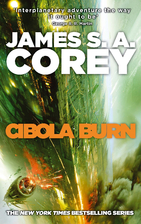
Review: The Expanse: Cibola Burn by James S.A. Corey

Trade paperback, 581 pages
Published 2015 (originally 2014)

Acquired and read June 2019
Cibola Burn: Book Four of The Expanse
by James S.A. Corey

This is the dullest Expanse novel by a long shot. Holden and company being sent to mediate between squabbling colonists is just not interesting; people bicker and blame each other again and again and again. It could have been an interesting allegory for real-world colonization issues, I suppose, but the lack of complexity for the principal characters in the dispute mean the dispute itself lacks complexity. The lack of the Roci characters in the early chapters also disappointed. I did like the surprise return of Miller's partner from Book One (how will the show handle this, given it killed him off during Season One?), but the other two new POV characters were pretty flat; Corey did a much better job coming up with new characters in Books Two and Three. Things pick up as they go, especially once Naomi and the rest of the Roci crew play a bigger role, but the overall plot never really excited me. Hopefully Book Five is stronger, because I'm seeing this through to the end.

07 October 2019

Review: Empty Space by Michael Jan Friedman and Calo Cacau

Comic PDF eBook, n. pag.
Published 2019 (contents: 2018-19)
Acquired and read June 2019
Empty Space

Writer: Michael Jan Friedman
Pencils and inks / Colors: Calo Cacau
Colors: Marcos Martins
Letters: Jim Campbell and Zaak Saam

This is the collected edition of an indie comic miniseries funded through Kickstarter, which I backed since it was written by Michael Jan Friedman, longtime writer of space opera in comics and prose (mostly Star Trek, of course, but also The Darkstars!). The series is about a ship's captain who wakes up to find out he died and was brought back to life as a weapon of war. The final result is fine. Friedman's heyday as a comics writer was the 1990s, and it shows here: the narration is repetitive and details are spelled out when they don't need to be. It's decent space adventure stuff, but the character work is thin, which is a shame because I feel like characterization was Friedman's strength as a writer: more could have been made of being an "Empty" but it's mostly a background element, and most of the side characters are pretty generic. Calo Cacau's art is solid and well done; I hope he goes places.

30 September 2019

Review: Secondhand Memories by Takatsu

Kindle eBook, 529 pages
Published 2015 (originally 2008)
Acquired February 2015
Read September 2019
Secondhand Memories by Takatsu

This begins melodramatically, and it never gets out of that mode. The narrator is a high schooler who is just super super in love-- then his girlfriend ends up in a coma. So then he is super super sad. Then another girl comes along, so he is super super torn. And it just goes on and on and on and on for 529 pages... and 852 chapters! The chapters are these short little things, and the paragraphs are tiny, too; sometimes less than a sentence apiece. For example, here's a page literally at random:
I no longer had any patience left.

These dark desires to strike

were horrifying to me.

My patience had worn thin with time.

And it seemed to get worse.

What seemed like a long time ago,

a far off land separated by the seven seas,

while everything was still summer,

where everything was still simple,

I had been agreeable to all.

Slowly, surely,

things changed

and it was eating me

from the inside out.

I was no longer a pleasant kid.

I was no longer an innocent boy.

Worse, I realized this,

in this moment,

staring into the eyes of the Devil,

I realized my own darkness. (ch. 804, p. 494)
Sorry for the lengthy quotation there, but I wanted you to get a sense of just how overwrought the prose is, and just how excruciating its choppy, overemphasized short sentences are to read.

The novel was serialized originally, and gives every indication of being made up as it goes along. Key concepts seem to spring up out of nowhere, especially the identity of the so-called culprit. The end is particularly unsatisfying. This is a short book, and it took me weeks to drag myself through it. Irredeemably painful.

23 September 2019

Review: The Undefeated by Una McCormack

Trade paperback, 109 pages
Published 2019

Acquired May 2019
Read June 2019
The Undefeated by Una McCormack

This Tor.com novella is by Una McCormack, who I know from her excellent work on Star Trek and Doctor Who tie-in fiction-- so excellent that I've long thought she needs to do more original stuff, so I'm happy to see her in such a high-profile venue as this. An aging journalist returns to her home planet, even as the area of the galaxy it's in has been evacuated in the face of an unstoppable onslaught. The book combines her youth with her return into one narrative. It is, as always, well written. I always like Una's narrative voice, and the book marshals a sense of inevitable tragedy in all its time frames, and its grasp of character and social dynamics is astute. I did find myself wishing the ending had been sharper; I felt like I ought to have learned something that I had not actually learned, and I don't know what.

16 September 2019

Review: Hexarchate Stories by Yoon Ha Lee

Trade paperback, 334 pages
Published 2019 (contents: 2012-19)

Acquired June 2019
Read July 2019
Hexarchate Stories by Yoon Ha Lee

This is a collection of stories set in the world of Lee's Machineries of Empire series (Ninefox Gambit, et al.), some previously published, several original to this collection. They kind of fall into four broad categories.

First, there are general scene-setting stories, pieces that aren't stories, really, but fragments of worldbuilding: "How the Andan Court," "Seven Views of the Liozh Entrance Exam," "Calendrical Rot." What you think of these will depend on what you think of the world of the series I suspect; I thought they were more curious than anything else, though I wish "Calendrical Rot" had served its original purpose as prologue to Ninefox, as maybe I would have understood that book more quickly.

Then there are prequel stories about the main characters of Ninefox Gambit, Shuos Jedao and Kel Cheris. These range from being just a couple pages to being full novelettes, and the Jedao ones go from the night he was conceived, through his childhood, up to key moments in his military career. Frustratingly, they are almost but not quite in chronological order. How interesting you find these will probably depend on how interested you are in Jedao. I'm not sure that learning he had a pet cat did a whole lot for me, but rereading "Extracurricular Activities" was fun, and "The Battle of Candle Arc" was the most straightforward explanation of calendrical warfare the series has ever provided. I would have liked more Cheris stories than the two we got, and honestly, I don't find Jedao terribly interesting. Give me some Kel Brezan prequels! I did really enjoy the Cheris story "Birthdays," which gives some insight into how the Hexarchate's calendar affects people's day-to-day lives.

Third, there are a few follow-ups to the original trilogy. A flash piece about Kel Brezan going to an aquarium; "Gamer's End," a second-person story about someone being trained by Jedao; and "Glass Cannon," a novella about Jedao's reunion with Cheris after the events of Revenant Gun. I wish the chronological placement of "Gamer's End" was clearer-- I couldn't figure out where it could possibly fit until I looked it up on-line after reading-- and the twist is kind of obvious. "Glass Cannon" is the longest story in the whole book, and it's an enjoyable high-stakes action piece with good character work and big implications for the future of this universe... should Lee ever choose to return to it.

Finally, there's a single story (the first in the book) that doesn't directly relate to the original trilogy, "The Chameleon's Gloves." I found this disappointing, and for a reason that relates to what makes some other of Lee's stories disappointing. "Chameleon's Gloves" sets up an interesting idea, that of a "haptic chameleon" who can perfectly imitate others' body language... but then tells a generic Star Wars-ish story where a wisecracking duo has to dispose of a gigantic superweapon, barely making use of its own concept. "Extracurricular Activities" is similar, mentioning its antagonists have a unique understanding of reality... but then telling a pretty straightforward (if enjoyable) caper story where the sfnal elements feel irrelevant. Most of the shorter pieces here are only nominally sf. Lee comes up with great worlds and great concepts, but I feel like the stories he tells make inadequate use of those worlds and concepts except as backdrop. I want the stories and concepts and plot twists to rise out of the sfnal stuff, but it doesn't consistently happen; one of the things that makes "Battle of Candle Arc" enjoyable is that it's the one Machineries of Empire space combat story where the fact that calendrical warfare is about the calendar actually feels relevant, instead of being flavor.

Anyway, this all makes it seem like I didn't like the book, but I actually did. In short form, Lee's writing is usually breezy fun, and the details of the worldbuilding are enjoyable to read about. The world of the Hexarchate is complicated and feels real, and has some interesting sfnal things to say about imperialism and oppression (it's not enough that we rule you, but you must think as we do). I would like to reread Ninefox Gambit now and see if it goes better for me than the first time.

09 September 2019

Review: The Legend of Korra: Turf Wars by Michael Dante DiMartino, Irene Koh, et al.

Comic hardcover, 239 pages
Published 2019 (contents: 2017-18)
Borrowed from my wife
Read May 2019
The Legend of Korra: Turf Wars

Written by Michael Dante DiMartino
Layouts by Irene Koh and Paul Reinwald
Art by Irene Koh
Colors by Vivian Ng
Color Assistance by Cassie Anderson and Marissa Louise
Lettering by Nate Piekos

Legend of Korra never quite clicked for me the way its parent series did, and to be honest, that seems to have carried over here; I'm just much less invested in where these characters end up than the original Team Avatar. That said, this is a solid graphic novel adventure. I'm kind of over the melding of the physical and spirit worlds-- by the end of the show it was pretty clear no one involved had an interesting take on what this might mean-- but Irene Koh's artwork is great, evoking the show's without slavishly reproducing it, and the best part of the writing is the characters, whose voices come through strongly and humorously. There are some good jokes, and good explorations of the place of non-heterosexual orientations in the Avatar world (I hope these can be expanded on someday), and the Korra/Asami relationship gets some much-needed development. It's pretty cute!