Showing posts with label creator: wayne faucher. Show all posts

04 December 2017

Review: Black Canary: New Killer Star by Brenden Fletcher, Sandy Jarrell, Moritat, Annie Wu, et al.

Comic trade paperback, n.pag.
Published 2016 (contents: 2016)

Acquired November 2016
Read December 2016
Black Canary, Volume 2: New Killer Star

Written by Brenden Fletcher, Matthew Rosenberg, Julie Benson & Shawna Benson
Art by Sandy Jarrell, Moritat, Annie Wu, Wayne Faucher, Claire Roe
Color by Lee Loughridge, Serge LaPointe, Allen Passalaqua
Letters by Steve Wands, Marilyn Patrizio

New Killer Star just isn't as good as Kicking and Screaming. Part of this is that it's kind of a hodgepodge: one four-issue story arc, one side story of the band visiting Gotham Academy, one flashback story (set before Kicking and Screaming), and one part of a story about Dinah being (re)united with Batgirl and Huntress to (re)form the Birds of Prey.

And part of that is that none of these components are particularly satisfying. The main four-part story is about Dinah being kidnapped by a ninja clan or something who want to know the martial art secret previously known only to Dinah's mother. There's a lot of backstory invoked here, some of it new (I don't think the New 52 Birds of Prey ever said a thing about Dinah's parents) and some of it old, but all of it isn't very illuminating to the Dinah of the present. I want to read about the band having wacky martial arts adventures on the road! But mostly the band is separated from Dinah during this adventure, and the story feels like it's ignoring the premise of the book more than it's using it.

It's kind of weird how this reinserts Dinah's post-Crisis backstory into the New 52, kind of, after Birds of Prey spent so much time developing her orphan backstory.
from Black Canary vol. 4 #10 (script by Brenden Fletcher, art by Sandy Jarrell)

The art, too, is disappointing. Sandy Jarrell isn't a bad artist, and neither is Moritat, but neither of their work compares to that of Annie Wu, the primary artist on volume 1 of Black Canary, who only draws two issues here-- they just lack the dynamism, fun, and sexiness that Wu brings. I know Wu did some well-received Kate Bishop Hawkeye comics for Marvel, but I don't know what else. She's clearly an up-and-coming dynamo (or ought to be), so I'll have to keep on top of her work.

30 March 2016

Faster than a DC Bullet: Project Crisis!, Part XLIX: Final Crisis Aftermath: Dance

Comic trade paperback, n.pag.
Published 2010 (contents: 2009)

Borrowed from the library
Read August 2015
Final Crisis Aftermath: Dance

Writer: Joe Casey
Pencillers: ChrisCross, André Coelho, Eduardo Pansica
Inkers: Rob Stull, Mick Gray, Wayne Faucher, ChrisCross, André Coelho, Sandro Ribeiro, Marc Deering
Colorists: Snakebite, Pete Pantazis
Letterer: Sal Cipriano

The Super Young Team was one of the more interesting aspects of Final Crisis, a group of Japanese super-teens designed as a contemporary version of Jack Kirby's Forever People, and as a result, Dance was the Final Crisis Aftermath tale that I was looking forward to the most.

Though this came out in 2009, Dance feels like it could sit alongside what Phil Sandifer calls the "New Pop" style of contemporary comics, like Batgirl and Young Avengers. Except that... it's just not as good. There could be some interesting ideas about the boldness of youth, what it means to grow up, how to be a superhero in the era of Twitter, but none of that's actually here. Rather, we watch the Super Young Team be manipulated by hackneyed PR managers for five issues when they suddenly get their crap together and save the day. It's not quite as cliche as it sounds-- I did like that Most Excellent Superbat doesn't decide to give up Twitter, but instead invents a replacement for it that joins people brain-to-brain, and I also liked the reveal of the grave threat facing Japan-- but it didn't really have anything to say.

There are glimpses of big ideas in it, but they don't come to fruition. Both Most Excellent Superbat and Shiny Happy Aquazon ultimately turn down heroes from the previous generation to forge their own paths, but there's no sense of why it's important, of what the younger generation gains by rejecting the older generation's identity and forging its own. Or, what about the fact that the supposed deficiencies of this generation come from the previous one: we're just living in the PR-fueled world our parents created. Nothing like this is really grappled with. The book just becomes generic superheroics without anything to say that you haven't seen before, even if it does occasionally want to try.

I feel like there's potential in these characters, so it's a shame this was it for them, as far as I know; the "New 52" reboot restored the original Forever People in an insta-cancelled series by Dan DiDio and Keith Giffen. All five of them seemed like they could be really interesting given the chance, and I also really liked the sense of a history of Japanese superheroics created by Morrison and Casey, with the JLA-esque Big Science Action, who shout delightful things like "Big Science Emergency"! The appearances of ur-hero Ultimon-Alpha, with his stereotypical doomsaying, was one of my favorite parts of the books. Hopefully someone tries something with the Super Young Team again one day; I really like it when DC takes that very American idea of the superhero and filters it through the sensibilities of other cultures.

Next Week: What will become of the Tattooed Man now that he's turned from villain to hero? Find out in Ink!

22 November 2013

Review: The Starman Omnibus, Volume Three by James Robinson

Comic hardcover, n.pag.
Published 2009 (contents: 1997-98)
Acquired June 2009
Read October 2013
The Starman Omnibus, Volume Three

Writer: James Robinson
Penciller: Tony Harris
Inker: Wade von Grawbadger
Colorist: Gregory Wright
Letterer: Bill Oakley
Additional Pencillers: Steve Yeowell, Gene Ha, Mitch Byrd, J. H. Williams III, Bret Blevins, Michael Zulli, Richard Pace, Dusty Abell, Mark Buckingham, Phil Jimenez, Lee Weeks, Stefano Gaudiano
Additional Inkers: Drew Geraci, Gene Ha, Bret Blevins, Michael Zulli, Dexter Vines, Norman Lee, Phil Jimenez, Robert Campanella, Steve Yeowell, Stefano Gaudiano, Ray Snyder, Wayne Faucher
Additional Colorists: Pat Garrahy, Dave Hornung, Gene Ha, Trish Mulvihill, John Kalisz, Noelle Giddings, Lee Loughridge
Additional Letterers: Chris Eliopoulos, John Babcock

Volume Three was the weakest installment of Starman for me thus far. Not that it's bad or anything, but that I felt there was a little too much Shade, not quite enough Starman. Throughout the series, I've felt that maybe James Robinson likes this character more than I do-- he strikes me as someone best used in small doses, but we lead off with a large one: four issues of "The Shade" miniseries, plus some diary excerpts, plus the Shade intervenes (yet again) at the end of a story in order to resolve it when it gets out of Jack's control. All of this is a shame, though, because "The Shade" miniseries, about the Shade's recurring rivalry with an English family, is actually very, very well done, especially the issue with the Flash. It's just that when you bundle the whole Starman series together, "The Shade" feels like a mistimed digression.

The first actual Starman story, "Infernal Devices," is only okay, which exacerbates the problem. The stuff with Solomon Grudy is fine, and I loved the appearances of Batman and Alan Scott, but there didn't feel like there was enough of a personal connection for Jack. (I did really like the Woody Allen movie metaphor, even if, unlike Batman, I have actually never seen a Woody Allen movie.)

Thankfully, a number of the one-shots are strong. "Stars in My Eyes!", where Jack tells his girlfriend three tales of superhero romance, was excellent: I liked the story of Scalphunter, but as a big Black Canary II fan, I was really pleased to see her mother's relationship with Jack's father fleshed out and expanded on, following on from two Silver Age tales where the characters team up. It's an oddly bittersweet story about fidelity and trust and truth. This year's "Talking with David," where Jack has dinner with the dead members of the Justice Society, was good too.

On the other hand, the issue where the Mist kills off Justice League Europe just to prove how badass she is is the most crass, cynical kind of superhero storytelling. "Oh, these characters are in limbo-- let's brutally murder them!" I expected better of Robinson (though maybe I shouldn't have, given he'd go on to kill kids to prove the situation was serious in the awful Cry for Justice).

Thankfully, that bad taste is leavened by the final story, the parallel "Talking with Ted..." and "...Talking with Jack...", where Ted tells Jack's girlfriend about Ted while Jack tells his tattoo artist about his dad. If Starman has an emotional core, it's the father-son relationship between these two, all the respect they can't bring themselves to say, and the parallel narratives here develop that beautifully. Jack might struggle with his father's superheroic identity, but we all struggle with our parents' identities. The final page, especially, got me right in the heart. Brilliant stuff, even if the volume as a whole seemed to tread water a bit.

23 January 2013

Faster than a DC Bullet: Birds of Prey, Part II: Old Friends, New Enemies

Comic trade paperback, 223 pages
Published 2003 (contents: 1997-99)
Borrowed from the library
Read January 2013
Birds of Prey: Old Friends, New Enemies

Writer: Chuck Dixon
Pencillers: Greg Land, Dick Giordano
Inkers: Drew Geraci, Wayne Faucher
Colorist: Gloria Vasquez
Letterer: Albert T. DeGuzman

The second volume of Birds of Prey collects the series' last two one-shots ("Wolves" and "Batgirl"), and then the first six issues of the ongoing series-- so popular had been the one-shots, that DC decided they could sustain an ongoing. Old Friends, New Enemies is perhaps more consistent and settled than Black Canary/Oracle/Huntress, but also less striking and less fun: fewer highs and fewer lows.

The good news is that the stories here don't feel curtailed. In part, that's because Dixon can write every story across multiple issues if it's that complex, but even the one-shots are more curtailed, as though he's finally gotten to grips with the format. The first of those, "Wolves," runs two largely parallel stories: Dinah meets up with her ex-husband(!), while Barbara almost gets mugged, almost gets hit by a car, almost goes on a date, and almost gets mugged. The common theme between the two plots is men, who are "wolves" who devour women. I don't know that we needed to give Dinah a one-year marriage in college except to give this story some extra emotional investment, but her plot is not too great: it basically hits all the beats any TV show does when a cast member's former lover shows up "in trouble." (I think Babylon 5 did this plot every other week its first two seasons.)

The Barbara story is more interesting, though. I am pretty sure that this is the first time we've seen here outside of her headquarters (what is that place with the clock on it, anyway? no one in this book ever says? and does she live there?) in the Birds of Prey series, and she's a little angry-- but then she's having a bad day. She gets to go on a date, which is quite sweet, and gives us a facet of her we've been deprived of in the series thus far. Of course, it all goes south, and then we get to see Dinah fight off a group of robbers while in a wheelchair while in her home. It maybe pushes the bounds of credulity a little, but probably no more so than that Dinah could do all the things she does; anyone who used to be Batgirl has to be the best of the best, after all. I'm curious to see how often Birds of Prey will end up going to the wheelchair-bound-Barbara-in-danger well by the end of the series, but I liked it here; it's a big change from the stories in the first volume. Dick Giordano's art is usually good, but I've seen better from him: there's the occasional bad angle, and both male characters look creepy and plastic-faced.

"Batgirl" features Black Canary teamed up with... Batgirl!? Why does Barbara have longer hair when she's an physically-active crimefighter? How is that safe? Anyway, it's not real, as you might imagine, and the villain looks so ridiculous that you can't even blame her on the '90s; she's just terrible.

We then launch into the ongoing with a three-part story: "Long Time Gone"/"One of Those Days"/"Hounded." Like a lot of the stories in the first volume, this one feature hijinks in a Third-World country. Is that the Birds of Prey's thing? The plot (which confused me) ultimately isn't the point here, though: the extra space and assurance of future stories mean that Dixon starts working in a lot of nice little touches: Dinah's technophobia, Barbara's ex-fiancé, Robin hanging out with Oracle and helping, Barabara's Internet romance. It's things like this that keep me interested and invested; actually, I was surprised how much I liked the ex-fiancé.

(On the other hand, there's constant cutting to a subplot about the Air Force finding someone using their computer-- implied to be Oracle-- and a guy with a big head who I may have been supposed to recognize but no one ever explains who he was. Also someone has been spying on Dinah, and then you find out it was just Batman. Not cool, dude.)

"Return of the Ravens" sees Dinah randomly bump into a group of terrorists called the Ravens, who include Cheshire, who was at some point (not sure if that's before or after this) the mother of Green Arrow's ward Arsenal's child. It's faintly ridiculous-- there's a dinosaur involved-- but in the way that superhero comics can be ridiculous, and I liked the banter between the three villains. It does have the worst map of the United States that I've ever seen, though.

"Batgirl," the "Long Time Gone" trilogy, and "Return of the Ravens" are all drawn by Greg Land and Drew Geraci. This is my first experience reading a Greg Land comic, I think, though I'm well familiar with his work from his Internet infamy. This comparatively early stuff isn't as bad as what he does now, it seems. There are definitely times where the characters looked posed and cheesecakey, but there's worse out there, and it often results in very nice art.

The real shame about Old Friends, New Enemies is not the book itself, but the fact it collects issue #1-6 of the ongoing... and the next collection of Birds of Prey doesn't pick up until issue #56. That's fifty uncollected issues, and I bet something important happens in there. Boo on you, DC. Where's my Birds of Prey Omnibus?

07 February 2010

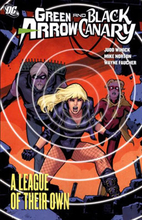
Faster than a DC Bullet: Project Star City, Part XV: Green Arrow and Black Canary: A League of Their Own / The Parting Shot

Comic trade paperback, 126 pages
Published 2009 (contents: 2002-09)

Borrowed from the library
Read January 2010
Green Arrow and Black Canary: A League of Their Own / The Parting Shot

Writer: Judd Winick
Pencillers: Mike Norton, Diego Barreto
Inkers: Wayne Faucher, Robin Riggs
Colorists: David Baron, Tom McCraw
Letterers: Steve Wands, Sal Cipriano, John Costanza

Like many of Judd Winick's Green Arrow plotlines, this long (extremely long) one ends with someone else solving the problem, namely Batman. But at least we finally rescue Connor. Except: Connor has amnesia, has lost his archery skills (but none of his other fighting skills), has a Wolverine-like healing factor, and is extremely violent. Okay, so maybe Connor wasn't working out as a second Green Arrow to Oliver's primary (though I remain unconvinced). But is the solution to reinvigorating a character really removing every single thing that makes this character interesting and appealing? Thank God that Judd Winick will never get anywhere near Connor (or any other Team Arrow one) ever again, as this is his last entry in the series. (Also not enjoyable reading in this volume: Mia's romance with the English guy whose name I forget. Can an ex-prostitute really not tell when a man is interested in her?) This volume also contains a "bonus" story of dubious extra value.

You might notice that I haven't talked about Dinah in these reviews; that's because despite the series title, it's pretty much The Green Arrow Show. Oliver and Dinah might as well not be married for all it has to do with anything.

At least Mike Norton's art is still nice, though it's a little less Chiang-esque here than in the previous volume.

Faster than a DC Bullet: Project Star City, Part XIV: Green Arrow and Black Canary: Family Business

Comic trade paperback, 128 pages
Published 2009 (contents: 2008)

Borrowed from the library
Read January 2010
Green Arrow and Black Canary: Family Business

Writer: Judd Winick
Artists: Cliff Chiang, Mike Norton, Wayne Faucher, Rodney Ramos, André Coelho
Colorist: David Baron
Letterers: Travis Lanham, Jared K. Fletcher, Steve Wands, Sal Cipriano, Pat Brosseau

After the strong The Wedding Album, Judd Winick returns to form: to add insult to injury, at the beginning of this book, the comatose and brain-dead Connor Hawke is kidnapped. Oliver, Dinah, and Mia spend the book hunting for him, aided by some British "bloke" and various other faces from around the DC universe. By the end of the book... they've actually pretty much accomplished nothing, because it's taken them five issues to find out who didn't do it. I could forgive this if other interesting things were going on, but they're not; mostly, Oliver is just snarling a lot. I did like the fakeout with the aliens, though.

The saving grace of this book is the artwork: Cliff Chiang is the best and most interesting artist this title has had since Phil Hester and Ande Parks left. Mike Norton takes over halfway through the book, but does such a good job that you'd barely know.