Showing posts with label creator: steve ditko. Show all posts

03 January 2024

Legion of Super-Heroes: Before the Darkness, Volume Two by Gerry Conway, Roy Thomas, Paul Levitz, Steve Ditko, Frank Chiaramonte, Bruce Patterson, Carmine Infantino, et al.

Legion of Super-Heroes: Before the Darkness, Volume Two

Collection published: 2022
Contents originally published: 1980-82
Acquired: February 2022
Read: October 2023

Writers: Gerry Conway, Roy Thomas, Paul Levitz
Artists: Jim Janes, Steve Ditko, Frank Chiaramonte, Bruce Patterson, Carmine Infantino, José Luis García-López, Dick Giordano, Howard Bender, Rodin Rodriguez

Containing Legion of Super-Heroes vol. 2 #272-83, this collection fills in the last part of the gap between the last of the Legion of Super-Heroes Archives and The Great Darkness Saga deluxe edition, meaning that DC has collected a full run of the Legion from 1958's Adventure Comics #247 to 1984's Legion of Super-Heroes #313, which is quite frankly astounding. (Now all I have to do is track down the last four archives I need...) As a friend of mine has pointed out, there's no series other than the Legion where DC kept going once the archives sputtered out.

What is less astounding is the actual stories collected here. While volume one had a certain madcap old-school sci-fi charm, thanks to that volume's main scripter Gerry Conway, this one was much more the typical pedestrian Legion of the 1970s. Don't get me wrong, there's a lot of the typical Legion melodramatics here, including an extended storyline where Ultra Boy seemingly dies but actually loses his memory and becomes a space pirate. But I found it hard to care, you know? The characters seemed to lack the solid grounding that makes the best Legion stories sing. I found it really hard to care about Reflecto or the Time Trapper here. Perhaps part of the issue is that none of the regular artists are among the Legion greats, even when they've done good work elsewhere.

I always enjoy some Blok.
from Legion of Super-Heroes vol. 2 #272 (script by Gerry Conway, art by Steve Ditko & Frank Chiaramonte)

The one thing you can say in favor of this saga is that it does also explain away Brainiac 5's turn into villainy and murder way back in Superboy and the Legion volume two. Perhaps we'd have been better off ignoring that, to be honest, but I guess it's good for one of our heroes to not be murdering women in squalid apartments, even when insane. This volume has a lot of the slow-simmering background plotlines that would be perfected during the Levitz and Giffen era, but they aren't so effective here; eventually I started to wonder if there would ever be any movement on the "Colossal Boy's mother is president of Earth" and "maybe Timber Wolf is going to leave the team" threads that never seemed to go anywhere.

It works well to find out Wildfire's bluster is balanced out by deep-set self-loathing.
from Legion of Super-Heroes vol. 2 #283 (script by Roy Thomas, art by Howard Bender & Bruce Patterson)

My favorite story was a small one, and surprisingly the work of Roy Thomas. I mean, I enjoyed Roy's work on DC's Earth-Two stuff, but I don't feel like he has a particular aptitude for the Legion. But he gives a solid and keen look into the origin of Wildfire, showing the insecurities of the Legion's most blustering member. Nice stuff.

I read a Legion of Super-Heroes collection every six months. Next up in sequence: Five Years Later Omnibus, Volume 2

03 April 2023

Legion of Super-Heroes: Before the Darkness, Volume One by Gerry Conway, Paul Kupperberg, E. Nelson Bridwell, J. M. DeMatteis, Jim Janes, Steve Ditko, Jim Sherman, Frank Chiaramonte, Dave Hunt, et al.

Legion of Super-Heroes: Before the Darkness, Volume One

Collection published: 2020
Contents originally published: 1979-81
Acquired: February 2021
Read: March 2023

Writers: Gerry Conway, Paul Kupperberg, E. Nelson Bridwell, J. M. DeMatteis
Artists: Jim Janes, Steve Ditko, Jim Sherman, Joe Staton, Ric Estrada, Frank Chiaramonte, Dave Hunt, John Calnan, Bob Wiacek

Before the Darkness is DC's most recent reprint series for Legion of Super-Heroes, the one that finally totally seals the gap before The Great Darkness Saga, thus giving us a complete collection of the Legion from 1958 to 1984! I feel like this era is often spoken of in pretty disparaging terms, the consensus being that when Levitz and Giffen took over, they saved the book. Even in this very volume, the introduction comes across as an apology for what you are about to read, explaining that Gerry Conway—who writes most of the stories collected here—did not really like the Legion. Conway's run actually began with issues collected in the previous collection, Superboy and the Legion, Volume Two, and I didn't like much of what I read there.

So... I was pleasantly surprised by this run! I don't think Conway is among the great Legion writers, but this volume shows him to be among the solid ones. He provides more character focus than I remember from some previous Legion volumes, particularly on lesser-used, often-forgotten characters like Timber Wolf and Light Lass. Timber Wolf had largely faded into the background since he joined the Legion, but Conway gives him lots to do; Light Lass I don't remember doing anything at all ever, but here she's a versatile, integral member of the team. He shows off the powers of some other Legionnaires to good effect; Princess Projectra, always one of my favorites, got a couple excellent moments across these stories. We get a nice return to what Bouncing Boy and Duo Damsel are up to, for example. Maybe Conway didn't love the Legion, but he clearly threw himself into its history and characters with a gusto that he probably could have got away with not having.

A bit of futurism where Gerry Conway totally whiffed it: the continued relevance of circuses. They didn't make it into the twenty-first century, much less the thirtieth.
from Legion of Super-Heroes vol. 2 #260 (script by Gerry Conway, art by Joe Staton & John Calnan)

Conway is also, I think, more of a science fiction fan than most comics writers: you can tell he was probably reading actual prose sf, not just reading other comics and watching bad films. He uses stuff like tachyons and explores how the President of Earth might be elected. Genuinely interesting worldbuilding, which is something that usually happens in Legion by accident... if at all. I particularly liked the climax of one story: the Legion, in space suits, grabs onto a spaceship when it enters hyperspace. Without a hull between hyperspace and them, their perceptions of its strange dimensions threaten to drive them mad, but Brainiac 5 has the bright idea that Projectra should cast an illusion of reality, so they all perceive themselves in a beautiful meadow. This includes the villain, who's there with them... and he, not understanding the illusion, runs away from them, thus letting go of the ship and losing himself in the depths of hyperspace.

Jim Sherman can balance the human and the cosmic alike.
from Legion of Super-Heroes vol. 2 #262 (script by Gerry Conway, art by Jim Sherman)

A lot of them are goofy, of course. Not sure what was up with the one about the guy who attacked the Legion with fake pirates! But every story by Conway has at least one solid moment of characterization, one clever twist. I particularly liked the saga of the "Dark Man."
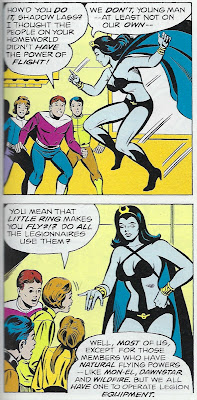
How can you know enough about the Legion to know who Shadow Lass is, what planet she's from, and what powers people have there, but not know that all the Legionnaires can fly?
from Legion of Super-Heroes vol. 2 #267 (script by Paul Kupperberg, art by Steve Ditko & Dave Hunt)

Conway also writes out Tyroc but tries to smooth out his history in the process. When originally introduced, it seemed as though Tyroc came from an island where all humans of African descent were segregated to—and ignored. This story establishes something very different, that it's a Brigadoonesque place that only appears every two centuries, and that it was settled by escaped slaves from the 1800s. I guess this is better? Unfortunately, it writes Tyroc out, so he never gets a chance to make much of an impact as a character. 
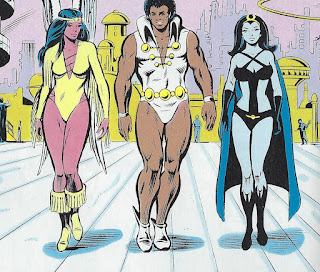
In the future, no one will wear pants.
from Legion of Super-Heroes vol. 2 #265 (plot by Gerry Conway, script by J. M. DeMatteis, art by Jim Janes & Dave Hunt)

Outside of Conway's stuff, there's a pretty bad fill-in by J. M. DeMatteis, which spends more time on overcomplicated exposition of the villain's backstory than the actual story, and three issues of Secrets of the Legion of Super-Heroes. This miniseries, written by Paul Kupperberg from a plot by E. Nelson Bridwell, with art by Jim Janes and Frank Chiaramonte, was I believe the first official attempt to put this history of the Legion into some kind of detailed order. With the way I dance around Legion history out of sequence, it's hard for me to know for certain, but I think this story is the source of many retcons we now take for granted.

...and she went on to be the best member that wasn't Saturn Girl.
from Secrets of the Legion of Super-Heroes #2 (plot by E. Nelson Bridwell, script by Paul Kupperberg, art by Jim Janes & Frank Chiaramonte)

The plot is thin: R. J. Brande is dying and his assistant Marla Latham sneaks into Legion H.Q. to steal files on the Legionnaires because he thinks one might secretly be related to him and thus be able to provide a blood transfusion. Like, why not just ask? But it's an excuse to watch some history tapes and for the Legion to reexplain their own backstories, and I appreciated that more than the mediocre attempt at drama. It's also the story that reveals Brande is secretly a Durlan and the father of Chameleon Boy.

Not really clear to me why the villain changed Dreamy into this outfit to murder her, to be honest.
from Legion of Super-Heroes vol. 2 #268 (script by J. M. DeMatteis, art by Steve Ditko & Bob Wiacek)

The art in this volume is generally quite solid, too. One story by Jim Sherman, which is always nice, but most of it is by the new-to-me Jim Janes, who I would say is above-average for the era is terms of doing character work with the art. I see he continues on into the next volume, but apparently has not done much other comics work, alas. I feel like he could have blossomed into quite a talent given time. Steve Ditko does one issue, and unlike most Legion artists, he gives the Legionnaires spacesuits, not just bubble helmets. But the spacesuits are colored to look like their costumes, which means any Legionnaire with bare arms or legs (which is most of the women and many of the men) has a spacesuit that is mostly flesh-colored. (I guess this could be the colorist's fault. On the other hand, the colorist was clearly told during some issues to make the outfits more modest, as parts of characters like Shadow Lass and Princess Projectra that are usually colored like skin are made to be part of their outfits.)

I read a Legion of Super-Heroes collection every six months. Next up in sequence: Before the Darkness, Volume Two

02 February 2018

Through DC's Time Warp: Doomsday Tales and Other Things

Working through DC's science fiction comics of the 1970s as I've been doing, I'm starting to come away with an impression of a publisher desperately trying to cash in on a wider cultural science fiction craze with no idea how. Over the past few months I've read IronWolf (lasted three issues), DC Super-Stars of Space (four issues), Star Hunters (eight issues), and Starfire (eight issues). Now I'm on to Time Warp, an anthology title... that lasted a whole five. DC sure kept trying to make these space comics work though, and in particular, editor Joe Orlando and associate editor Jack C. Harris did: they were behind Star Hunters, Starfire, and Time Warp.

Time Warp is different from some of these other efforts: instead of an ongoing science-fiction adventure, it was an anthology book. Each double-length issue included eight tales by an array of writers and artists. The book's cover line "Doomsday Tales and Other Things" gives you some idea of the focus; there were a lot of apocalyptic and postapocalyptic stories, especially in the first couple issues.

A tragedy I've grown used to in reading these Bronze Age sci-fi comics is the oblivious letter page in the final issue: the final letter page that doesn't know it's the final letter page. Jack C. Harris natters on about the next issue in #5, but there was no next issue, as Time Warp lasted only five issues (except for a one-issue 2013 revival). Reading it, it's not hard to see why. The lettercols speak of wanting to tap into the Star Trek/Star Wars-era zeitgeist... but in execution, these stories hearken back DC's horror comics of the early 1970s like House of Mystery and House of Secrets, which Orlando himself edited if I recall correctly.

It's basically sub-Twilight Zone stuff: lots of "twist" endings, and lots of stories where people are converted into horrific monsters. You've read much better science fiction, and in prose and on tv by 1979, the genre had evolved beyond this. Time Warp feels like it comes out of the pulps of the 1950s more than anything else, and hardly any of the stories here still stick with you.

What does work is the art-- much like in those early-decade horror comics. Give Steve Ditko a race of one-eyed alien monsters, and he will draw the hell out of them. Give Dick Giordano an underground society of sexy women, and he will draw the hell out of them. Give basically anyone spaceships and space monsters, and they will draw the hell out of them. There's some real inventive, impressive work here, starting with Michael Wm. Kaluta's sort-of-techno-fetish covers, and running all the way through the interiors. So probably a misguided experiment (I just kept wishing for real science fiction stories, not horror stories with sf trappings), but one that yielded some entertainment regardless.

Time Warp vol. 1 was originally published in five issues (Oct./Nov. 1979June/July 1980). The stories were written by Denny O'Neil, Michael Fleisher, George Kashdan, Mike W. Barr, Jack C. Harris, Bob Rozakis, Paul Levitz, Wyatt Gwyon, J. M. DeMatteis, Bill Kelly, Arnold Drake, Dan Mishkin, Gary Cohn, Bob Haney, Scott Edelman, David Allikas, Paul Kupperberg, Sheldon Mayer, Mimai Kin, and Elliot S. Maggin. They were pencilled by Rich Buckler, Steve Ditko, Dick Giordano, Tom Sutton, Jerry Grandenetti, Don Newton, Jim Aparo, Howard Chaykin, Gil Kane, Joe Orlando, Romeo Tanghal, Ed Barreto, Madz Castrillo, Fred Carillo, Mike Nasser, Joel Magpayo, Ernesto Patricio, Dick Ayres, Edgar Bercasio, Vic Catan, Charles Nicholas, Trevor Von Eeden, and Jerry Bingham, and they were inked by Dick Giordano, Steve Ditko, Tom Sutton, Jerry Grandenetti, Dan Adkins, Jim Aparo, Howard Chaykin, Gil Kane, Joe Orlando, John Celardo, Dave Simons, Madz Castrillo, Steve Mitchell, Fred Carillo, Mike Nasser, Joel Magpayo, Ernesto Patricio, Jimmy Janes, Edgar Bercasio, Vic Catan, Armondo Gil, Carl Potts, and John Celardo. Colors were provided by Gene D'Angelo, Adrienne Roy, Jerry Serpe, Tatjana Wood, and Bob Le Rose, and the issues were lettered by Ben Oda, Milton Snapinn, Todd Klein, Shelly Leferman, Esphidy Mahilum, and Albert De Guzman. The series was edited by Joe Orlando; his managing editor was Jack C. Harris.

01 August 2014

Faster than a DC Bullet: Project Crisis!, Part XXVII: 52: The Companion

Comic trade paperback, 224 pages
Published 2007 (contents: 1962-2006)
Acquired March 2013
Read June 2014
52: The Companion

Writers: Mark Schultz, Gardner Fox, Dan Jurgens, Jack Miller, Greg Rucka, Steve Ditko, Grant Morrison, Steve Gerber, David Goyer & Geoff Johns
Pencillers: Doug Mahnke, Carmine Infantino, Dan Jurgens, Alex Toth, Kano, Steve Ditko, Chas Truog, Murphy Anderson, Walter Simonson, Leonard Kirk
Inkers: Tom Nguyen, Carmine Infantino, Tim Dzon, Alex Toth, Stefano Gaudiano, Steve Ditko, Doug Hazlewood, Murphy Anderson, Walter Simonson, Keith Champagne

52 is, as you might know, an 52-part series filling in a year in the DC universe where Superman, Batman, and Wonder Woman are all gone. It draws on DC's vast tapestry of characters and concepts. 52: The Companion helps illuminate those backstories, making it useful preparatory reading for 52: here we see Steel's relationship with his daughter, Elongated Man solving a mystery, Booster Gold telling Blue Beetle his origin, Rip Hunter on a mission through time, Renee Montoya dealing with the death of her partner, the Question standing up for his principles, Animal Man on a trip to Paris with his wife, Adam Strange battling a threat to the planet Rann, the deaths of the Metal Men and the breakdown of their creator, and Captain Marvel learning the tragic history of Black Adam.

I'm about halfway through 52 now, and I can tell that some are directly relevant to it (Will Magnus's breakdown, Black Adam's past, Renee's emotional state, Booster's origin), while others are more general, just letting us see those heroes in action in younger days (Steel, Elongated Man, Rip Hunter, Adam Strange, the Question, Animal Man). But I find myself making note of things I learned from them frequently, so the time reading them was well spent. Also appreciated is the commentary from Mark Waid on why the characters were picked for 52, their place in DC history, and why the stories were picked for this volume. (Isn't Mark the greatest at continuity? It always feels like a useful foundation in his hands, never a prison.)

They're not all great stories, but most of them are good, and they reveal the breadth of what the DC universe has to offer at its best.