Showing posts with label topic: old hugos. Show all posts

01 October 2025

Hugos Side-Step: The Collected Short Stories of Philip K. Dick, Volume Four

As part of my project to read old Hugo winners and related books, I've also been reading the complete Philip K. Dick short stories; this year that brings me to the fourth of its five volumes, which covers stories published from 1955 to 1964. (The stories are collected in order of composition, though, so it actually overlaps with volume three.) None of these stories were ever Hugo finalists, though notably, one of the stories collected here takes place at a Worldcon! This volume was originally published under the title of The Days of Perky Pat, but when the Steven Spielberg film adaptation came out, it was retitled Minority Report.

Previous volumes of this series covered just two to three years of publication time; this one covers a whole decade, indicating a drop-off in how many short stories Dick wrote due to, I believe, his novel-writing career taking off. Perhaps thanks to that, this volume has the highest hit rate of any of these I've read before. I'll just give an overview of some of my favorites and other thoughts here. 

The Collected Short Stories of Philip K. Dick, Volume Four: Minority Report
by Philip K. Dick

Collection published: 2000
Contents originally published: 1955-64
Acquired: August 2025
Read: September 2025
You can see Dick's emerging interest in the figure of the media celebrity who controls the thoughts of the populace, a figure who would be a key character in some of his later novels, particularly Flow My Tears, the Policeman Said (1974); here, they pop up in "The Mold of Yancy" (based on Eisenhower, according to Dick's note), "If There Were No Benny Cemoli," "Novelty Act" (where the First Lady controls America, and the President is selected on the basis of who she'd most like to be married to), and the linked pair of "Stand-By" and "What'll We Do with Ragland Park?", where a literal clown with a news broadcast runs for President and only loses thanks to dirty tricks by his opponents. Dick was not exactly right about which media figures would dominate in the future (I don't think newsreaders or variety show hosts carry the cachet now they did in the 1950s and '60s!), but right about our culture's increasing parasocial interest in hollow celebrities. Give me a Philip K. Dick story about TikTok, please.

To be honest, I didn't like the actual story of "Stand-By" very much, but I was tickled by its central conceit: in a future where a computer is the impartial President of the United States, as a concession to the unions over the fact that a human job had been taken by a machine, there'd be a stand-by president, a human being whose job is to sit around just in case the computer fails.

As the title of my edition indicates, the book contains "The Minority Report," a masterpiece of time travel fiction, and the only short story by Philip K. Dick I'd read before embarking on this project back in 2022. It's very cleverly plotted, and the mechanics of how precognition works and what the "minority report" actually is and what the main character chooses to do in the end are all much much more interesting and thought-provoking than in the mediocre Steven Spielberg film. It was interesting to learn that "The Minority Report" was just one of several stories about the mechanics of precognition; it's also the basis of "Recall Mechanism," where a psychiatrist who thinks he's uncovering a patient's suppressed past trauma ends up realizing it's their suppressed future trauma.

I wanted to like "What the Dead Men Say," whose opening premise is about a world where the dead can persist in a half-life; people can visit facilities to wake them and ask for their advice. This would make a great tie-in to my ongoing teaching about "technologies of immortality"... except that the story is barely about that idea! (Dick also used this idea in his 1969 novel Ubik, but again the story isn't really about it.) It's a decent story, but it has a rushed ending.

I didn't particularly get much out of "The Days of Perky Pat," but Dick's reflection on it in his notes was fascinating; the story comes out of his aversion to Barbies. Why are kids playing with adult dolls? Surely adults should be!

I really enjoyed "Oh, to Be a Blobel!", Dick's weird satire on how war changes people and societies—complete with an AI therapist. An Earth soldier infiltrated the enemy Blobels, and so had metamorphose into one, a blobby, protean life-form... and now that the war is over, he can't control and keeps doing it, as do many other vets, ruining his chance of reintegrating into society. The psychiatrist hooks him up with a Blobel who can't control her transformations into a human, and the story explores the ups and downs of their odd relationship, as well as his growing self-loathing over what he's become. Great sf take on the consequences of war.

My favorite story, though, was "Waterspider." In this story's future time, they believe that twentieth-century sf writers were precogs who could genuinely see the future; Dick himself is hailed for his prediction of World War III in "Second Variety." The future people need a precog, so on the basis of a story they read, they travel back in time to abduct Poul Anderson! I often hate "meta," self-indulgent stuff like this (David Gerrold wrote a very bad pastiche of Dick along these lines in "Jellyfish," which I will forever hold against him), but this story is genuinely hilarious and has a very clever time-travel twist; I loved it. Lots of good time travel stuff; I couldn't believe how brazen Dick was with Anderson as a character! "Orpheus with Clay Feet" is similar, if not quite as good, but still very fun—and gets quite weirdly meta by the end. These stories point toward Dick's increasing interest in the barrier between fiction and reality we see in novels like The Man in the High Castle (1962) and VALIS (1981).

I read an old winner of the Hugo Award for Best Novel every year, plus other Hugo-related books that interest me. Next up in sequence: Lord of Light by Roger Zelazny

17 September 2025

Hugos Side-Step: Between Planets / Starman Jones / The Star Beast by Robert A. Heinlein

In order to read The Rolling Stones (1952), I picked up To the Stars, one of four hardcover volumes from the Science Fiction Book Club collecting the Heinlein juveniles (they have not really been kept in print). Of course, this meant that I then went on to read the other three books collected in the volume: Between Planets (1951), Starman Jones (1953), and The Star Beast (1954).

To the Stars: Between Planets / The Rolling Stones / Starman Jones / The Star Beast
by Robert A. Heinlein

Collection published: 2004
Novels originally published: 1951-54
Acquired and read: August 2025

I was glad I did, because in particular, I really enjoyed Between Planets and Starman Jones. I like a good bildungsroman, and these are indeed good ones. Between Planets is about a young man named Don Harvey who is born in space to scientist parents from Earth and Venus; he spent some time on Venus as a child, and is now attending boarding school on Earth while his parents do scientific work on Mars, but he feels no particular allegiance to any planet. (Hence, one of the meanings of the book's title.) The book begins when war is about to break out between Earth and Venus, and Don must get off Earth before his Venus-born status makes too much trouble for him; his goal is to join his parents on Mars, but he is thwarted at every turn, and finds himself not really belonging anywhere.

After the light, episodic nature of The Rolling Stones, I wasn't expecting how heavy this one could get. In an early chapter, before leaving Earth, Don meets up with a friend of his parents who can't speak freely but indicates something is up; they both get taken in by the Earth police, and when he asks to go back to his friend, the police grimly inform him that, alas, the friend died of a "heart attack" while in police custody! I didn't see that one coming! Unable to commit himself to any side, Don does his best to remain above it all while focusing on his goal of reuniting with his parents even while being sent to Venus. There are a number of excellent scenes as he struggles to stay afloat in the midst of all the political (and, later, military) chaos around him.

bildungsroman is all about growth, about a protagonist who figures out how society works and how to place himself in it. That's definitely what we get here from Don, and Heinlein keeps it pretty nuanced. Don's virtue is that he doesn't get swept up in the fervor of either side, Earth or Venus, even when he enlists in the Venus military... but always being "between planets" isn't a virtue either. Don must learn to believe in something, otherwise, what's the point? The last couple chapters are perhaps a bit of an anticlimax, but the final decision that Don must make leading up to them is very well done. I liked this book a lot, and sped right through it in a way that wasn't true of The Rolling Stones.

So too did I enjoy and speed through Starman Jones. Like Between Planets, the book has a rougher edge that was missing from The Rolling Stones; its main character, Max, lives with his stepmother on a farm. His father is dead, and he's keeping his promise to take care of his stepmother and the farm... but what he really yearns for is space. When his stepmother remarries to a lout who intends to sell the farm. Max runs away from home, hoping to take his late uncle's place in the guild of astronavigators. Unable to do so, he falls in with a con artist who helps him join a spaceship crew under false pretenses.

Like Between Planets, it's a novel of growth, and like Between Planets, it's surprisingly nuanced. It would be easy, I think, to write a book where Max had to renounce the lies he had told; it would also be easy, I think, to write a novel where Max never did. What Heinlein does in Starman Jones, though, is to weave a middle course, where Max has to learn when a man must lie and when a man must tell the truth in order to do right by both himself and others around him. It's got a bit of a Rudyard Kipling Captains Courageous vibe to it, which I very much appreciated, though here it's not so much that shipborn service makes you into a better person, as it reveals the better person you were always meant to be.

Both books are solid 1950s science fiction: we have space dragons, telepathic speech, weird life-forms, lots of details about FTL methods that require people to do math in their heads (computer? what's a computer?), future space politics, and so on. Heinlein is good at this kind of thing, and I think the worldbuilding holds up in the sense that these futures (plausibly the same future, actually) feel lived and complete, even if we know a lot of elements of it would no longer come to pass now; I can imagine handing these books off to my own children in a few years.

Compared to these two, I found The Star Beast a disappointment. Between Planets and Starman Jones are both bildungsromans... but if Star Beast is supposed to be one, then Heinlein did a very bad job of it. Johnnie has an alien space pet that the local community finds to be a menace, and the government wants to get hold of, but he doesn't really make any interesting decisions or grow in any kind of way; he just obstinately refuses to let anyone have his pet, Lummie. It's his girl friend (and later, girlfriend) who makes all the smart decisions on his behalf, and it's a middle-aged Earth bureaucrat who otherwise does all of the book's problem solving. I liked Mr. Kiku, the bureaucrat, a lot... but I feel like you've messed up if the best character in your juvenile novel is a middle-aged bureaucrat! When Johnnie gets rewarded at the end, it's almost nonsensical, because he didn't do anything to deserve it, like Don or Max did, he hasn't grown in any kind of way. And his reward is so disproportionate compared to theirs, too! I really struggled with this one, to be honest, the worst of the four in the volume.

Quite possibly, my reading of classic Hugo winners and related works is long and complicated enough (current estimated date of completion: 2052, current number of installments remaining: 93)... but based on how much I enjoyed To the Stars, I've decided to add the three other SFBC omnibuses of Heinlein juveniles to it, though it might be a couple years before I work them in.

I read an old winner of the Hugo Award for Best Novel every year, plus other Hugo-related books that interest me. Next up in sequence: The Collected Short Stories of Philip K. Dick, Volume Four

10 September 2025

Hugos Side-Step: The Rolling Stones by Robert A. Heinlein

If I read and enjoy a Hugo-winning novel, I like to follow that up with related books by the same author. Heinlein's The Moon is a Harsh Mistress won the Hugo Award for Best Novel in 1967, but it was actually a prequel of sorts to one of his earlier juveniles, The Rolling Stones (1952), a novel my wife actually remembers reading and enjoying as a kid. The Rolling Stones is about a family taking a trip around the solar system in their own spaceship: fifteen-year-old twins Castor and Pollux, their parents Roger (a writer) and Edith (a doctor), their older sister Meade, their baby brother Lowell, and their grandmother Hazel. We're told Hazel was a key figure in the revolution for Lunar independence, even helping write the constitution—and she appears as a minor character in exactly that role in MIHM.

To the Stars: Between Planets / The Rolling Stones / Starman Jones / The Star Beast
by Robert A. Heinlein

Collection published: 2004
Novel originally published: 1952
Acquired and read: August 2025

It's a fun book but not as sharp, I think, as some of the other Heinlein bildungsromans I have read (a category that would include his juveniles, but also books like Double Star and Starship Troopers, I would argue)... although actually, it's not clear to me that Heinlein is really going for a bildungsroman here the way he is in some other juveniles. Castor and Pollux are bright kids who want to do adult things, overestimating their own abilities; they want to go out on their own in a spaceship. Their parents aren't into this, but decide to go on a whole trip as a family. Basically the format of the book is that the family goes some place, there's some kind of scrape, they then extricate from it and move on. These include helping a nearby passenger liner deal with space plague, getting bicycles through customs on Mars, dealing with trade duties in the asteroid belt, and so on. While Castor and Pollux often overestimate their abilities (particularly at the end of the novel, where they very nearly kill their grandmother and kid sibling), the novel mostly seems to come at them from the outside, without the kind of emphasis on their interiority that you get in Heinlein bildungsomans like Double Star or Between Planets or Starman Jones. It's more focused on dialogue and action than personality.

To be fair, I don't think Heinlein was going for this. I could be wrong, of course, but the tone of it seems much lighter than his other books that I've read, and probably also the target audience younger. But that did mean there wasn't quite as much here to sustain my interest. I found it quite readable, but at his best, Heinlein is readable and deep. Still, the world is—as usual for Heinlein—well thought out. He makes the tax implications of importing bicycles both plausible and interesting! The family interactions are fun, and of course I enjoyed Hazel; I don't see how anyone couldn't. As a complaining dad myself, I definitely vibed with Roger (though I would have even before becoming a dad). To be honest, that's probably the book's problem, in that I think all the adult family members are more interesting than Castor and Pollux. Is that really what you want in a "juvenile"? It's certainly not what you want in a bildungsroman!

One of the subplots here is that Roger writes a weekly radio serial (later, Hazel takes it over); it make me think that the episodic, dialogue-heavy nature of this very book would make it work well as a radio drama. Adapt it as a podcast, someone!

Other thoughts:

  • I had known that, notoriously, Star Trek's tribbles were a rip-off of Heinlein's flat cats. I had not realized quite how much of a rip-off! I guess I had assumed that flat cats (because of the name) were more catlike, but no, they are physically exactly like tribbles... or rather, the other way around. The way the twins end up with a flat cat is basically exactly how it goes down in "The Trouble with Tribbles" too.
  • I found the treatment of the twins' older sister, Meade, quite weird. At the end of the book, we're told she's of "marrying height"! James David Nicoll sums up the issues well in his review.
  • When I got to the section set in the asteroid belt, I was like, "Surely James S.A. Corey read this." Not that The Expanse is ripping it off or anything, but the world of Corey's Belters feels like a natural extrapolation from it... and of course, the Expanse books have that same interest in orbital mechanics you see here. (I can't find a lot of specific stuff about Heinlein's influence on them, but it is occasionally mentioned.)

I will say my whole reason for reading this book now was kind of a lie. The backstory given for Hazel here is largely incompatible with the one that we actually see in The Moon is a Harsh Mistress! According to Rolling Stones, Hazel was a single mother on Earth, working as an engineer when she ran into a glass ceiling, less competent men being promoted above her, such that she made more money working in a casino; she emigrated to the Moon to get better opportunities for her and her son Roger. But in MIHM, she is a teenager when she gets swept up in the revolution, no abortive engineering career or kid she's raising on her own anywhere in sight!

(One thing I've noticed through this project of reading 1950s and '60s sf is the authors were clearly less hung up on "continuity" than contemporary ones. Authors were happy to reuse elements between stories without it meaning that all their books were set in the same "universe"; you see much the same thing in Philip K. Dick, whose works often have common worldbuilding elements but rarely line up in the details.)

I obtained my copy as part of an omnibus from the Science Fiction Book Club; from 2002 to 2006, the SFBC released all of Heinlein's juveniles in a series of four hardcover volumes. It's an attractive volume, and I'm going to pick up the lot of them now. Before then, though, I'll read the other three novels collected in this one.

I read an old winner of the Hugo Award for Best Novel every year, plus other Hugo-related books that interest me. Next up in sequence: Between Planets / Starman Jones / The Star Beast by Robert A. Heinlein

20 August 2025

Hugos 1967: The Moon Is a Harsh Mistress by Robert A. Heinlein

Every year after I vote in the Hugo Awards, I read the oldest Hugo-winning novel I haven't previously read. This year, that brings me to the winner for 1967, The Moon is a Harsh Mistress, which I picked up some five years ago (after really enjoying Heinlein's previous winner, Double Star) but never got around to.

If you're a fan of classic print sf, this book probably doesn't need a lot of introduction; it's set in the twenty-first century, when Earth's moon is a penal colony. The inhabitants of the moon decide to declare independence, and the novel follows the course of this revolution, told from the first-person perspective of Mannie, a maintenance worker who has a special relationship with the computer that runs the moon, which he nicknames Mike.

The Moon is a Harsh Mistress by Robert A. Heinlein

Originally published: 1966
Acquired: June 2020
Read: July 2025

I haven't read as much Heinlein as some, but I've read enough to know he was very much interested in what the obligations of government were to the people, what the obligations of people were to the government, and what the obligations of people were to each other; that's the key question in his earlier Hugo winners, Starship Troopers and Stranger in a Strange Land (neither of which I read as part of this project because I read them in high school), for example. The Moon is a Harsh Mistress reads as the ultimate extension of this line of thought, its most thorough explanation. I know enough about Heinlein to know he doesn't necessarily endorse every idea promulgated here, but more that he liked to explore a question and come at it from different angles. In The Pleasant Profession of Robert A. Heinlein, Farah Mendlesohn says that the book reflects "both the degree to which Heinlein believed in the community..." (which certainly sets him apart from most would-be libertarians!) "...and the degree to which he was beginning to despair of the ability of Americans as individuals to understand their role in creating that community."

Like any Heinlein book, it's highly readable. Mannie is an affable narrator, and the characters are fun (so long as you can filter Wyoh through Heinlein's ideas about women, which admittedly not every reader is going to be able to do; I also enjoyed the role of Hazel, so I know I will get to read more about in The Rolling Stones, which I plan to read next). The lunar society is well thought out, which interesting worldbuilding, and I enjoyed the mechanics of the revolution being front and center. I once thought about doing a study of revolutionary violence in science fiction (I'm doubtful I ever will do this now), and this surely would have been front and center if I had.

Unfortunately, as the novel goes on, I found it gets duller. It struck me about halfway through that The Moon is a Harsh Mistress was a variant of a novel I'd read before—or rather, a novel I'd read before was a variant on it—Ursula K. Le Guin's The Disposessed, which is also about an anarchist revolution on a resource-deprived lunar colony of a largely capitalist planet. Not in the sense that Le Guin ripped off Heinlein or anything, but in the sense that it seems to me Le Guin was clearly in dialogue with Heinlein. (I'm not the first person to make this connection, of course; there's a 1994 SFS article by Donna Glee Williams with the great line, "The similarities are impressive. Why then does Heinlein's book inspire some readers to run out, buy a gun, and vote Republican, while Le Guin's book opposes it (non-violently, of course) on every point?") The most noteworthy comparison to me was that, in Le Guin's book, everything is hard. Hard because of the realities of life on a hardscrabble satellite of course (and Le Guin even makes things easier for her anarchists by giving Anarres a breathable atmosphere), but also hard because taking political ideals and putting them into practice is never easy for any number of reasons: faults of logic, contingency, aspects of human nature.

In MIHM, though, nothing is hard, because you have Mike, the supercomputer who always knows the answer. Though some would argue the role is also distributed to the professor, Mike is probably the most extreme example I can imagine of Heinlein's "competent man," the person who can figure out anything and make it happen. You are never in doubt the revolution will succeed, because you soon come to realize that Mike will have the solution to every problem. To me, it feels like an admission that making a new society is very difficult, but instead of making that the topic of the novel, as Le Guin did, Heinlein elides it by having Mike solve every problem. So though MIHM remains readable throughout, because Heinlein is a strong writer, the book kind of got boring as it progressed.

Heinlein won the Best Novel Hugo Award four times, and this was the last of them. He would be a finalist three more times, though, in 1974 (Time Enough for Love), 1983 (Friday), and 1985 (Job). Of those, I've read Friday, and while it just predates when I took up book-blogging, so I have no review of it, I remember finding it overly long, aimless, and self-indulgent; Mendlesohn says that Moon is a Harsh Mistress is "short, sharp and punchy, the very last of Heinlein's novels to be so." In a phenomenon we continue to see in the present day, once a writer gets onto the Hugo ballot a few times, they often continue to recur on it even once they've passed the point where they're doing anything Hugo-worthy.

I read an old winner of the Hugo Award for Best Novel every year, plus other Hugo-related books that interest me. Next up in sequence: The Rolling Stones by Robert A. Heinlein

25 September 2024

Hugos Side-Step: The Collected Stories of Philip K. Dick, Volume 3

The Father-Thing: The Collected Stories of Philip K. Dick, Volume 3
by Philip K. Dick

The third volume of The Collected Stories of Philip K. Dick collects shorts he wrote in 1953 and 1954, which were published from 1953 to 1959; my edition is called The Father-Thing but it has also been published under the titles Second Variety (also used as the title of the second volume, confusingly) and Upon the Dull Earth. I had been collecting the 1999 Gollancz editions of this series, but I wasn't able to find one of volume 3 for a reasonable price, so I settled for a 1990 Grafton edition instead—now my collection won't match!

Collection published: 1990
Contents originally published: 1953-59
Acquired: August 2024
Read: September 2024

I found this less interesting than I remember the first two volumes being. There are a lot of stories here about that bugaboo of 1950s science fiction, the "evolutionary throw-forward," the super-advanced human "evolving" in our midst. It's a theme that's largely vanished from contemporary sf, and I think it's pretty much evolutionary nonsense—at the very least, even if it could be plausible, that work is rarely done. To his credit, Dick often attempts to undermine this idea, as he lays out in his notes on "The Golden Man," and this one I did enjoy; like Wells's The Time Machine, it understands that evolution is not a teleology, that to be "more evolved" doesn't mean "more advanced" but only "more capable of reproducing within a particular niche." But so many of the other stories go with this theme in various ways, and I quickly came to find it tedious.

I have previously opined that the thing I find most interesting about Dick as a writer is the way he captures the alienation of modern life; unfortunately, there's not a lot of that in these tales of throw-forwards, time travel, and galactic war. My favorite stories were "The Hanging Stranger," "The Eyes Have It," "Sales Pitch," and "Foster, You're Dead." "The Hanging Stranger" really captures that classic Dick feeling of alienation, particularly in its early stages, when the main character realizes there's a dead body hanging in the town square... and no one thinks it's weird but him. What happened? Why? How did everyone around him suddenly become a terrible person? I wish this part had been drawn out more but it's still an effective story.

Both "Sales Pitch" and "Foster, You're Dead" hit the idea of consumerism gone horribly wrong that you get from a lot of Dick's best stuff. The surreal robot in "Sales Pitch" that goes around destroying the protagonists' home as a demonstration (and they still purchase one!) is great; I also really liked the premise of "Foster," where salesmen go around selling nuclear bomb shelters, and buying one is seen as a sign of great patriotism. If you can't afford to buy one and the war comes... well, too bad! Great satire on the military-industrial complex. 

"The Eyes Have It" is a simple tale, but a good one—probably technically not sf at all, but commenting on the way that sf takes metaphorical language and literalizes it. It would be fun to teach, I think.

Overall, though, I'm hoping the next volume (which coincides with the part of Dick's career where his novel writing took off) contains more of what I like about his work.

I read an old winner of the Hugo Award for Best Novel every year, plus other Hugo-related books that interest me. Next up in sequence: The Moon is a Harsh Mistress by Robert A. Heinlein

12 August 2024

Hugos Side-Step: Flowers for Algernon by Daniel Keyes

American Science Fiction: Four Classic Novels 1960-1966: The High Crusade by Poul Anderson / Way Station by Clifford D. Simak / Flowers for Algernon by Daniel Keyes / ...And Call Me Conrad [This Immortal] by Roger Zelazny
edited by Gary K. Wolfe

I picked up this Library of America volume because it contained two winners of the Hugo Award for Best Novel; I decided to read the other two books it contained as part of my project to read winners of the Hugo Award for Best Novel I haven't already read—plus side-steps into other relevant books that interest me. The second of these was the novel version of Flowers for Algernon by Daniel Keyes.

Collection published: 2019
Novel originally published: 1966
Acquired: February 2022
Read: July 2024

"Flowers for Algernon" was originally a short story, which I have read at least twice before and remember really enjoying; it won the Hugo Award for Best Short Story in 1960. Keyes later expanded it into a novel. The novel was a finalist for Best Novel in 1967, but lost out to Heinlein's The Moon is a Harsh Mistress. (It did tie with Delany's Babel-17 for the Nebula, however. The notes in this LOA edition mistakenly state the two tied for the Hugo.)

I am sure there are lots of people who complain the novel loses the elegant simplicity and thus the power of the short story. It has been over fifteen years since I read the short story, so it's hard for me to do a direct comparison. But even without that, I am sure they are right; it's hard for me to imagine it could be otherwise. A good short story is a thing of power, and the premise of "Flowers for Algernon" is perfectly calibrated to make it a great one. 

And yet, I don't think that invalidates the novel. The novel doesn't replace the short story, after all, but exists alongside it. Based on my vague memories of the short story, I think what the novel adds is the material about Charlie's family, his "escape" from the experiment, and his different encounters with women. Though like a lot of 1960s sf, it comes at sex from an angle a bit disconcerting to a modern reader (we are more prudish now, I think), I otherwise found a lot of this material highly effective, particularly the stuff about his family. The flashbacks to his family trying to—not very well—deal with their low-IQ child was very interesting. The climax of this subplot, where Charlie goes to see his father (who doesn't recognize him) and his mother (who does but ultimately rejects him) were great, tough scenes.

The last twenty pages or so of the novel are some of the most emotionally charged writing I've ever read. Keyes very expertly shows you the disintegration of Charlie's intelligence in a way that only prose can manage. Because the first-person perspective puts you in the mind of Charlie, you experience the backslide of his intelligence firsthand—you lose your intelligence. My eyes got misty reading it.

If there's one thing that doesn't work for me, it's that Keyes seems to be pushing some kind of idea of intelligence and empathy, that intelligence makes it harder to have empathy. We see this with the various scientists working on Charlie, who treat him as an object not a person, and also with Charlie himself. I'm not totally convinced; the novel tries to make you think that the suspicion of other people Charlies acquires is some kind of tragedy... but people were awful to him. It's totally justified! Something I'd like to chew on at more length if I ever give the book another read.

There's a lot to like here. I'll be curious to see next year if The Moon is a Harsh Mistress really does exceed it for me.

I read an old winner of the Hugo Award for Best Novel every year, plus other Hugo-related books that interest me. Next up in sequence: The Collected Stories of Philip K. Dick, Volume 3

05 August 2024

Hugos 1966: …And Call Me Conrad by Roger Zelazny

American Science Fiction: Four Classic Novels 1960-1966: The High Crusade by Poul Anderson / Way Station by Clifford D. Simak / Flowers for Algernon by Daniel Keyes / ...And Call Me Conrad [This Immortal] by Roger Zelazny
edited by Gary K. Wolfe

In 1966, the Hugo Award for Best Novel was won by Frank Herbert's Dune, still a staggering titan of the genre that has cast a long shadow over science fiction. According to the voters of the 1966 Worldcon, however, there was another novel that was every bit as good as Dune: ...And Call Me Conrad, the debut novel of Roger Zelazny. Though Zelazny is an acclaimed writer, ...And Call Me Conrad is mostly remembered now as the novel that somewhat inexplicably tied with Dune.

(The novel was originally serialized in F&SF, cut down a little for length; it was later republished in full under the title of This Immortal as a standalone novel. I read it in an Library of America edition that reprints the full text, but reinstates the title of the serial, which Zelazny preferred. I do think the editor of the novel was right. While I don't think "This Immortal" is any great shakes, "...And Call Me Conrad" works as a title for a magazine story, but it's impossible for me to imagine a reader seeing it emblazoned on the cover of a novel and thinking it sounds intriguing. I might have gone with Zelazny's proposed subtitle, "The Reluctant Immortal." It was the serial publication that won the Hugo, technically.)

Collection published: 2019
Novel originally published: 1965
Acquired: February 2022
Read: July 2024

I'm reading it as part of my project to read winners of the Hugo Award for Best Novel I haven't already read—and I read Dune twenty years ago, back in high school, so I'll be skipping that. (I probably really ought to reread Dune, because I don't think I appreciated it at the time, but I must press on, no going back!) Despite that, it's hard not to wonder what the voters of 1966 were thinking, and hard not to compare it to Dune.

The thing about Dune that made it impactful and influential is its total immersion in an alien (future) way of life—it's lead to a style of sfnal storytelling we now totally take for granted. ...And Call Me Conrad is set in a future world, but on Earth. It's not quite as disorienting as Dune, but it's still light on exposition in its early stages; the reader isn't given a lot to go on from the beginning. The editor of F&SF made Zelazny add a page of exposition, which this Library of America edition includes in an end note; I read it where it was supposed to fit into the narrative but found it didn't really clarify anything at all! But it's not immersive in the way Dune is immersive; it didn't reinvent science fiction.

The novel has an interesting set-up; the Earth has become subjugated by the alien Vegans, not through militaristic conquest, but through economic domination. Most humans have emigrated to Vegan planets, Earth itself is owned by the Vegans, and Earth is largely dependent on Vegan tourism. There are some humans, however, who are resentful of Vegan control, and want humanity to return to its home. A book about forms of empire and domination and cultural imperialism and native uprisings and violent resistant to hegemonic power. So while it may not be told in the way Dune was told, it was very much interested in the same kinds of ideas as Dune. Something in the air in 1965! (This was the same year Kwame Nkrumah published his book Neo-Colonialism: The Last Stage of Imperialism.) In some ways, though, Call Me Conrad does something more interesting, in making Earth the "Africa" of its colonial allegory—it very much is in the War of the Worlds vein of "what if aliens did to Earth what the West is always doing to other countries?" (Jo Walton has an interesting take over on Tor.com, of course, but I particularly liked this comment by @relogical.)

It resonates with other novels I've read as part of this project. In its contemplative tone, it reminds me a lot of what Clifford D. Simak was doing in books like City (1944-73) and Way Station (1963). Indeed, like both of those novels its focuses on an emotionally isolated immortal! The somewhat pulpy depiction of the Vegans reminded me a lot of what Philip K. Dick was doing in novels like Now Wait for Last Year (1966), using old-school tropes to quickly sketch in a background of cosmic war but then telling the kinds of stories that went in much more interesting directions.

I would say that overall, I liked it but did not love it. Very well written, neat backstory, lots of keen moments of observation and insight. My favorite moment was probably the argument over what was being done to the Great Pyramid in Egypt, some excellent thoughtful satire there. But I never felt a strong interest in its protagonist; the idea of the world-weary immortal has probably been done better elsewhere. I've read some of his short fiction before, but this was my first novel by Roger Zelazny; I look forward to reading Lord of Light for the 1968 awards, which most people seem to consider his best work.

I read an old winner of the Hugo Award for Best Novel every year, plus other Hugo-related books that interest me. Next up in sequence: Flowers for Algernon by Daniel Keyes

05 February 2024

Hugos Side-Step: The Collected Short Stories of Philip K. Dick, Volume Two

The Collected Short Stories of Philip K. Dick, Volume Two: Second Variety
by Philip K. Dick

The second volume of Philip K. Dick's complete short stories has been variously published under the titles Second Variety, We Can Remember It for You Wholesale (not actually included in the 1999 Gollancz edition I have, and confusingly also the title of volume five in the Gollancz editions), and Adjustment Team, and contains stories originally published from 1953 to '55 (the collections overlap in publication date a little bit because they are collected in sequence of composition). I'm reading it as part of my project of reading old Hugo winners and related books; it's a "related book" on the grounds that The Man in the High Castle won the 1963 Hugo and I liked it enough that I've kept going with Dick's stuff since.

Collection published: 1999
Contents originally published: 1953-55
Acquired and read: November 2023

I didn't find this quite as strong as the first volume. There are a lot of fantasy stories in this one, which are less to my taste, and a few too many stories where some spooky happens at the end and then the story stops, also a few too many stories about people exploring space. Which is usually my favorite subgenre of sf, but not one that plays to Dick's strengths. Some are undermined by seventy years of subsequent science fiction: "Second Variety" could be great, but if you've read later stuff, or even just another stuff by Dick, you'll see the twist coming. A similar complaint can be lodged at some of the time travel stuff here. Some of the stories have good concepts but don't totally convince on the worldbuilding, like one about a father in a world where robots do the childrearing... only he's somehow never heard of this dramatic change in social norms, or another about robots that are discriminating against humans, but ends up making everything too easy for a human to push against it.

That said, when Dick hits, he scores. There's some good satire of military imperialism in "Some Kind of Life," where every year some new excuse is thought of for good Terrans to go off to war—for the benefit of the Earth economy, of course. "The World She Wanted" is a weird story about someone convinced she can arrange the world the way she wants... and maybe she really can! "Breakfast at Twilight" is a neat glimpse of an ordinary suburban family suddenly plunged into a world at war. "Human Is" is a little bit predictable but effective all the same, about a man who may have been replaced by an alien. Dick loves this theme, of course; "Human Is" focuses on a wife uncertain about her husband but there's another where the replaced person themself is uncertain. On slightly similar lines, there's "Small Town" about a guy who obsessively builds a model of the town he lives in in his house's basement, taking out his dissatisfaction with his real life on the model...

My favorite here, though, was "The Commuter," where the main character begins slipping into another world, a world where a commuter town was built in the suburbs that never existed in his own. Like Dick's best stories, it captures the unease and uncertainty of modern life.

I read an old winner of the Hugo Award for Best Novel every year, plus other Hugo-related books that interest me. Next up in sequence: ...And Call Me Conrad by Roger Zelazny

29 January 2024

Hugos 1965: The Wanderer by Fritz Leiber

The Wanderer by Fritz Leiber

Every year, when I finish my Hugo voting, I pick up the oldest Hugo-winning novel I haven't read yet. For 2023, that brings me to Fritz Leiber's The Wanderer, which beat out three novels I haven't read (though one, Cordwainer Smith's The Planet Buyer, I will get to someday) to win the 1965 Hugo Award for Best Novel. Leiber is my first repeat winner in this sequence of posts, as he won Best Novel or Novelette in 1958 for The Big Time.*

Originally published: 1964
Acquired: September 2023
Read: October 2023

As the epigraphs and some of the early dialogue in the novel makes clear, this is an attempt to take the space opera concept of planets that can move through interstellar space (as seen in, for example "Doc" Smith's Lensman novels) and apply some real-world logic to it. If a mobile planet appeared in Earth's solar system, what would be the result? The book unfolds like a disaster movie, following a number of parallel plotlines about different people dealing with effects like the break-up of the moon and some incredibly high and low tides.

I was very into it at first, but the more I read it, the less interested I was; at 346 pages (in my Gollancz edition, at least), the book is just too long proportional to the amount of interesting things that happen. Leiber reminds me of his contemporary Clifford Simak, good at both mood and character, but it felt like not much was actually happening. Groups of people very slowly make it from point A to point B. And it just keeps going on and on and on. The beginning of the book, as the disaster begins to unfold, it utterly captivating, but having grabbed you, Leiber assumes you will continue to be captivated by the same thing slowly unspooling for hundreds of pages. Probably could have been a cracker of a novella, but my least favorite of the seven novels I've read in this sequence thus far, except for The Forever Machine.

I read an old winner of the Hugo Award for Best Novel every year, plus other Hugo-related books that interest me. Next up in sequence: The Collected Short Stories of Philip K. Dick, Volume Two

* Though not the first repeat of winner of the award; that was Robert A. Heinlein, with Double Star in 1956 and Starship Troopers in 1960. However, I skipped Starship Troopers as I've read it before.

28 June 2023

Hugos Side-Step: The Collected Short Stories of Philip K. Dick, Volume One

The Collected Short Stories of Philip K. Dick, Volume One: Beyond Lies the Wub
by Philip K. Dick

So when I enjoy a book by a winner of the Hugo Award for Best Novel, I tend to seek out other work by the same writer; that led to me supplementing the winner for 1963, The Man in the High Castle, with twelve other novels by Philip K. Dick. My feeling was at that point that I had probably read all of Dick's worthy novels... but I remained curious about his short fiction, of which I had read very little. Conveniently, all of his stories are available in five cheap mass-market paperbacks from Gollancz, so I decided to add them on as occasional supplements to my Hugo journey, timing things so that I would read the collection with "Faith of the Fathers," which was a finalist for Best Novelette in 1967, alongside the 1967 winner for Best Novel. So that means I started last year with the first volume of The Collected Short Stories, which contains Dick's short fiction originally published from 1952 to 1954, sorted in order of original composition. The Gollancz edition titles this volume Beyond Lies the Wub, but (mostly) the same set of stories have been released by other publishers under the titles The Short Happy Life of the Brown Oxford, Paycheck, and The King of the Elves. (It's not at all confusing.)

Collection published: 1999
Contents originally published: 1952-54
Acquired: October 2022
Read: November 2022

There's a lot in here: twenty-five stories across almost four hundred pages in not very large print. If you've read Philip K. Dick before, you have some idea of what to expect, but this material isn't consistently like the weirdness of his 1960s novels. It's not atypical 1950s science fiction: weird ideas explored, but too often the weird idea itself seems to be the point, and the story doesn't have much of interest to say. The very first story, "Stability," is a good example of this. On the other hand, I think the stories—once you get past the first few, which are perhaps a little on the bumpy side—are always fairly well told, in Dick's typical sharp but matter-of-fact prose style that pulls you in. "The Crystal Crypt" is one of these: it's a kind of Campbellian/Asimovian puzzle story, but it's a good one. Or, say, "The Preserving Machine": a weird idea explained, then undermined at the last moment. Some might make you roll your eyes a bit, like the twist endings of "The Builder" or "Prize Ship," but you know, Dick can still make it work. I did have good fun with "The Indefatigable Frog," where a group of scientists test Zeno's paradox by shrinking themselves smaller and smaller as they try to cross through a tube.

There's a lot more people zipping around interstellar space on starships than you would expect from Dick's most famous novels, which tend to be his Earthbound (or at least solar systembound) ones. "Mr. Spaceship," about living spaceships trying to find an end to war, is like this. "The Infinities," about hyper-evolving humans is a cheeseball example of an idea that doesn't really make any scientific sense. But at its best, the interstellar backdrop is just a backstory, largely irrelevant, for whatever weird story Dick wants to tell in the foreground, such as in "Colony," about people going paranoid as their objects are seemingly plotting against them.

Though there are occasional glimpses of it, we don't get much of what Dick's best novels reveal as his strength: people dealing with the bullshit and the weirdness of seemingly ordinary life. But there are fragments of this theme in stories like "The Little Movement" (about living toys) and "The Short Happy Life of the Brown Oxford" (about living shoes). I liked "Nanny," about mechanical nannies who fight each other, and the only choice you have as a parent is just to buy a bigger and stronger mechanical nanny than the other families, so that yours can win any fights! I also liked "The King of the Elves" a lot, about an ordinary guy who becomes just what the title promises.

There's a lot of time travel here, often dealing with predestination paradoxes or some other kind of twist, the kind of stuff that these days you perhaps can't move without running into, especially post–Steven Moffat's Doctor Who, but in those days must have been much more original. "Meddler," where people go into the future to find out why humanity is doomed and thus doom humanity, is a good example of this, and so is "The Skull," about a man who travels back in time to kill a dissident but discovers something unexpected about him, but the best of them is surely "Paycheck," where a man quits his job, loses his memory, and then receives the exact seven items he needs to carry out a plan he doesn't remember devising; all of the items seem like worthless junk, but each one proves handy at the exact right moment.

There are a number of stories about apocalypses, on both Earth and elsewhere: "The Great C," "The Gun," and so on. The one that stuck out to me the most, though, was "The Defenders," about people living in underground bunkers because the surface of the Earth has been rendered uninhabitable... only there's a bit of a twist that will be familiar to anyone who's ever seen the 1967-68 Doctor Who serial The Enemy of the World! Dick expanded "The Defenders" into the novel The Penultimate Truth in 1964, and I have to imagine David Whittaker had read it. Hopefully whoever does the Doctor Who Magazine "Fact of Fiction" for Enemy of the World doesn't miss this.

Dick at his best is both dark and humorous; I enjoyed "Beyond Lies the Wub," about a space crew who brings an animal on board to eat... only to discover that it's sapient, and even more besides.

I read an old winner of the Hugo Award for Best Novel every year, plus other Hugo-related books that interest me. Next up in sequence: The Wanderer by Fritz Leiber

21 June 2023

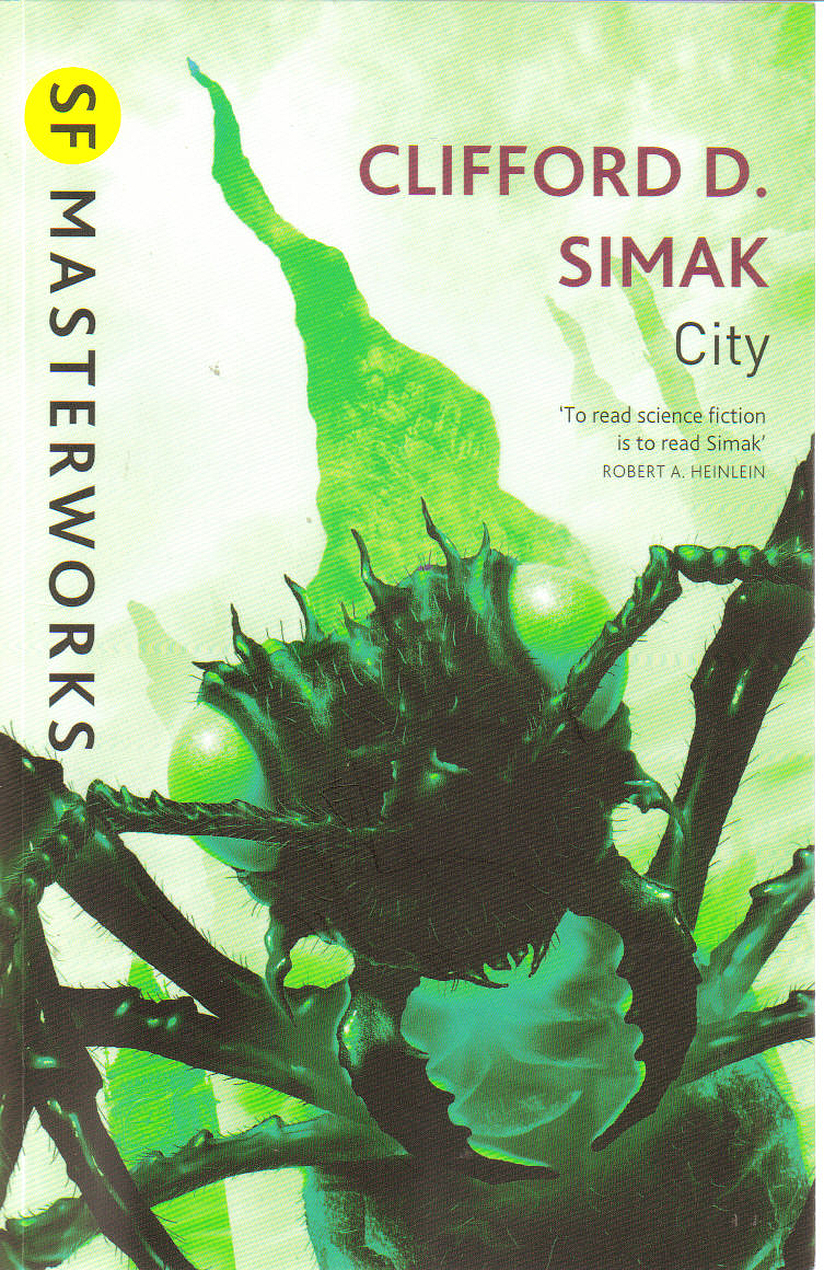
Hugos Side-Step: City by Clifford D. Simak

City by Clifford D. Simak

As I read through the Hugo Award for Best Novel winners, I often supplement by reading significant books that were written by winning authors, but did not win themselves. So, after enjoying Way Station by Clifford Simak, I decided to pick up his City. City is a fix-up: it was originally published as a series of short stories chronicling a future history, mostly in Astounding, from 1944 to 1951. In 1952, Simak collected them in a book, adding introductions to each story written by some scholar from the far far future, making it into a work that exists in the future history. Simak wrote one extra City story in 1973, which was incorporated into editions of the book published in 1981 onward, including my 2011 Gollancz edition.

Collection originally published: 1952
Contents originally published: 1944-73
Acquired and read: October 2022

It's certainly of its era: I feel like a lot of sf writers in this period wrote series of short stories covering vast swathes of human history. In that sense, City reminded me of Isaac Asimov, Robert Heinlein, and especially Cordwainer Smith. But what is different than those other future histories is the scope of City: while Asimov, Heinlein, and even Smith chronicle the history of humanity, Simak considers what comes after humanity... and then what comes after that. The only person who really matches Simak for scope is Wells. This is a series of vignettes, linked by some common characters and some related ones, that take us from the abandonment of the cities to the abandonment of the planet Earth itself.

Simak's futurism isn't always right, but the futurism isn't the point, so it doesn't matter. There's a lot to like here, but my favorite was "Hobbies," which I've already written about here. The story focuses on the dogs and robots left on Earth by humanity. Both were created to serve humanity; even though dogs have been raised to sapience, that's still what a dog is. There are also a last few humans. But all of these beings have no work to do—there is nothing left but the "hobbies" of the title. Simak is often praised for his pastoral style, and this thoughtful story is it at its moving best. The last couple stories point toward the fact that things never stop developing. Watch out for the ants!

I also really enjoyed the introductions to each story, written by the dog scholars of the far future attempting to put each story into its original context... but they are from so far in the future that they are not convinced any such creature as man actually existed. Surely he is just part of a creation myth? I'm often a sucker for this kind of faux apparatus, and this is a good example of it, extending the distance between the world of the text and ours.

I read an old winner of the Hugo Award for Best Novel every year, plus other Hugo-related books that interest me. Next up in sequence: The Collected Short Stories of Philip K. Dick, Volume One

05 December 2022

Hugos Side-Step: The High Crusade by Poul Anderson

American Science Fiction: Four Classic Novels 1960-1966: The High Crusade by Poul Anderson / Way Station by Clifford D. Simak / Flowers for Algernon by Daniel Keyes / ...And Call Me Conrad [This Immortal] by Roger Zelazny
edited by Gary K. Wolfe

I read the Hugo Award for Best Novel winner for 1964, Clifford Simak's Way Station, in a Library of America collection of "four classic novels" of American sf. One of the other books in the volume was also a Hugo winner, This Immortal by Roger Zelazny, so I'll get around to that in a couple more years. If I was reading half of the book, I might as well go all the way, so I decided to follow Way Station up with Poul Anderson's The High Crusade (1960). The High Crusade was a Hugo finalist itself in 1961, but lost to A Canticle for Leibowitz by Walter M. Miller, Jr. (This I did not read and review as part of this project, because I had read it already.)

Collection published: 2019
Novel originally published: 1960
Acquired: February 2022
Read: September 2022

Poul Anderson isn't an author I have much experience with, but I did love his time travel fantasy There Will Be Time (1972), which I read many times as a kid. But on the other hand, my copy was part of a Signet double with The Dancer from Atlantis (1971), which I never even got through the first chapter of despite several attempts! LibraryThing tells me I own many anthologies with his stories in them, but most of the time I don't mention his contributions in my reviews, so I must not have found them notably good or bad. Thus, I was very curious how I would take this book.

It turns out that I took it very well! The High Crusade opens in medieval England, where an alien spaceship lands in a country village, ready to frighten the locals. However, guile, brutality, and sheer luck lead to an upset when the villagers manage to slaughter all of the aliens bar one and take over the ship. The local baron loads most of his village's population onto the massive ship. He intends to fly the ship to the Holy Land and "liberate" it, but the surviving alien tricks him and engages the autopilot, taking the ship back to the alien colony from whence it came, with no reference coordinates to enable a return to Earth.

It's hilarious and charming. The humans are outclassed and outgunned, but keep going anyway. The baron doesn't even know how to use a napkin, but manages to outwit aliens who have hand-held nuclear weapons through superior strategy and a propensity to bluff outrageously. The novel is narrated by a monk named Brother Parvus. Would the novel's plausibility hold up to strict scrutiny? Perhaps not, but it's such a joy to read that you won't want to hold it up to strict scrutiny. It zips along (only 140 pages long in this edition) and doesn't outwear its welcome, as it continuously escalates. Soon the baron is organizing an interstellar alliance against the invading aliens and converting other aliens to Christianity! Jo Walton has a great tribute to the novel here, and says it better than I can.

It is a bit funny that this lost to A Canticle for Leibowitz, also a science fiction novel about a Catholic monk (or monks) recording information for posterity. Must have been something in the air in 1960! I think it would be pretty difficult to argue that Canticle wasn't the right choice—it's certainly the one of the finalists I would have voted for—but this is a worthy finalist for sure, and well worth reading, and I'm glad editor Gary K. Wolfe included it in this Library of America anthology of 1960s sf. Poul Anderson was a finalist for Best Novel seven times, but never won, which means I won't read much more of his work as part of my Hugo journey, but I do feel it would be nice to seek it out otherwise. (He did win many times in the various short fiction categories, however: twice in Best Novella, thrice in Best Novelette, and twice in Best Short Story.)

I read an old winner of the Hugo Award for Best Novel every year, plus other Hugo-related books that interest me. Next up in sequence: City by Clifford D. Simak

28 November 2022

Hugos 1964: Way Station by Clifford D. Simak

American Science Fiction: Four Classic Novels 1960-1966: The High Crusade by Poul Anderson / Way Station by Clifford D. Simak / Flowers for Algernon by Daniel Keyes / ...And Call Me Conrad [This Immortal] by Roger Zelazny
edited by Gary K. Wolfe

Every year, after I vote in the Hugo Awards, I then read the oldest book to win the Hugo Award for Best Novel I haven't previously read. In 1964, the award was given to Clifford Simak's Way Station. Simak is an author I haven't read much of; last year, I read his 1967 novel Why Call Them Back from Heaven?, but other than that it's just pieces of scattered short fiction in anthologies like The Science Fiction Hall of Fame. (I do remember liking his story "Immigrant" in Galactic Empires, Volume I.)

Collection published: 2019
Novel originally published: 1963
Acquired: February 2022
Read: September 2022

Way Station is an odd book: after the American Civil War, a Union soldier named Enoch returns home to Wisconsin and is recruited to operate a "way station" for Galactic Central, a place where aliens can materialize and rest on their way to destinations further out in the spiral arm. For this, he is essentially granted immortality. At the time the book takes place (much of it is told in flashback), four things converge: the CIA discovers and takes an interest in this immortal man, a political faction in Galactic Central wants to close the way station on Earth by any means necessary, Enoch takes a woman into his home when she's abused by her father, causing the locals to end their longstanding policy of ignoring him, and an important peace conference is breaking down, meaning the Cold War may be about to turn hot.

Like Fritz Lieber's The Big Time (1958), also a Hugo winner from this era, it has big ideas, but takes a subdued, personal, perhaps even slow approach to them. That said, many like to point to Simak's style as "pastoral sf." (Searching "pastoral, science fiction" as a tagmash on LibraryThing brings up sixty-nine works, though only the top dozen would really seem to count. Simak is its top practitioner with his 1965 novel All Flesh Is Grass, and Way Station itself comes in sixth.) It's a defense I buy: I imagine that even in 1963, this felt like a story from another era. Simak's style captures the emotions Enoch must feel as a man out of his own time and the tone really communicates his isolation without slipping into being maudlin. The flashbacks we go into about Enoch's life over the years, encounters he's had with various aliens especially, are effective and Simak manages to evoke a world that is beyond Enoch's comprehension (and ours) but tantalizing and promising. Probably one of the most admirable parts of the novel is the way Simak communicates Enoch's orientation toward the universe, one of wonder and hope.

Given that even good contemporary sf often seems to want to emulate streaming television programs rather than play to the strengths of prose, I appreciated how different this book was. (Oddly, a Netflix film adaptation of this book was announced in 2019, though nothing has been heard since.) That said, I occasionally found myself wanting to skim—the pacing is a bit too languid from time to time!

There is, in the end, a lot going on here, and at the novel's conclusion, all those things kind of collide. Simak handles this very effectively, as elements of different plots and strands cross with one another in unexpected ways. But there's not just a unity of plot but also one of theme. People these days like to talk about "hopepunk" (thanks, I hate it), but sf has always provided us with hope. In Way Station, hope comes from caring: Enoch cares of course, but so does the woman Enoch rescues, and so do many of the various aliens Enoch meets, and so does Enoch's postman, and even the CIA agent assigned to shadow Enoch does, and without all of these people caring about things, the ending would have gone much differently. Near the end, Enoch thinks this:

A million years ago there had been no river here and in a million years to come there might be no river—but in a million years from now there would be, if not Man, at least a caring thing. And that was the secret of the universe, Enoch told himself—a thing that went on caring.

It's a sentiment worth awarding.

(I read this in a Library of America edition, collected with three other early 1960s sf novels, all of which were Hugo finalists, and one other of which also won. More on that in the next post in this sequence.)

I read an old winner of the Hugo Award for Best Novel every year, plus other Hugo-related books that interest me. Next up in sequence: The High Crusade by Poul Anderson

21 November 2022

Hugos Side-Step: The VALIS Trilogy by Philip K. Dick

VALIS and Later Novels by Philip K. Dick: A Maze of Death / VALIS / The Divine Invasion / The Transmigration of Timothy Archer
edited by Jonathan Lethem

So every time I vote in the Hugo Awards, I read the oldest Hugo-winning novel I haven't already read. If I like it, I tend to pick up other stuff in the same series or by the same author. Hence, my reading of The Man in the High Castle (winner for 1963) has caused me to spend the year working my way through every single Philip K. Dick novel that was republished by the Library of America. So after eight months and thirteen novels, these three stories finally draw my Dick journey to a close.

Collection published: 2009
Novels originally published: 1981-82
Acquired: August 2014
Read: August 2022

The so-called "VALIS trilogy" is more of a duology plus a third book with thematic links to the first two. VALIS (1981) and The Divine Invasion (1981) are both science fiction novels where people have encounters with pink laser beams that impart to them the existence of God, and where the existence of the movie-within-a-book, VALIS, is discussed. On the other hand, The Transmigration of Timothy Archer (1982) is a non-sf novel about an Episcopal bishop trying to find proof of the existence of God. But in terms of how the novels work, I think VALIS and Transmigration are closer together, and Divine Invasion is the outlier.

VALIS and Transmigration are both about the search for God and the search for meaning. VALIS begins with a story about the science fiction author Horselover Fat, but the first-person narrator quickly admits that Fat is him, it's just that these events are too painful to recount directly. But as you keep reading, it seems that the narrator must be a separate person from Fat because they have conversations, and then you realize that the first person narrator is Dick himself! But eventually all this is explained (well, as much as anything is explained in a Dick novel), and I really enjoyed the play with narration. I also just really enjoyed the story in general: Fat is someone with marriage issues, with drug issues, but most of all, with meaningfulness issues. He's chasing after meaning, and maybe he finds it in VALIS... but then there are aspects of VALIS that turn out to be disappointing. Like the best Dick novels, it balances trippiness with ordinariness, and it's definitely in the top tier of his work.

The Transmigration of Timothy Archer is very similar to VALIS in many ways: it's about our desperate search for religious truth and our disappointment when we think we've found it. It is also, like VALIS, told in the first person—maybe I am forgetting something, but I think these are the only two Dick novels to be? If so, it's a real shame, because it's highly effective here. The narrator here is Angel Archer, the daughter-in-law of Timothy Archer, a radical bishop who soon becomes involved in a sexual relationship, a discovery of the origins of Christianity that might disprove the divinity of Christ, and supposed communications from the spirits of dead loved ones. What do we chose to believe in, and what do we not? Angel is a great narrator, with the strong sense of personality and voice; the events of the novel are tragic but often kept at a remove, in a way that feels very emotionally honest. There are lots of great bits: I really liked a conversation between the bishop and a car enthusiast about making the link between cause and effect; I liked how Angel (who was an English major in college) continually reflected on the way that literature gave her something to believe in, how it served as a sort of substitute religion—but also how that substitute keeps her at a remove from reality. As an English major (and, now, English professor), I can empathize, and I find the critique interesting. The last bit of the novel is really great.

Dick believed himself to have experienced a divine revelation in reality, but you wouldn't know it from these two novels. They're both about the limitations of belief in a way that I found very interesting. VALIS is technically sf, but I felt you could probably read it as a realist novel if you wanted to; on the other hand, there is the possibility that something supernatural actually did happen in Transmigration. (Angel doesn't think so, though, and neither did I.) Though they grapple with similar themes to much of his early work, I had a real sense that Dick had "leveled up" as a writer.

The Divine Invasion is different from the other two, because instead of being about belief, it's about the things one might believe in. It's also more like Dick's earlier novels, being set in the future, about colonists on other planets. A space colonist has to marry a woman who's undergoing a virgin birth; the child is God apparently. The child undergoes an experience much like the Temptation of Christ, though Dick puts a nice little spin on it. This book had its moments. Probably my favorite is that much of the novel is a flashback that the colonist has while he's in cryogenic suspension, only a malfunction in the mechanism means that his tube is picking up a radio station broadcasting string versions of music from Fiddler on the Roof. So the whole time the story is unfolding, he keeps asking other characters if they can hear the music. Which means we never see how things "actually" went! (If you believe Dick's VALIS cosmology, though, I think everything happens all at once, so there is no difference between the actual events and the recalled events.)

I liked all the stuff about the colonist; it was solid, mid-tier Dick, about an ordinary guy trying to stay afloat, work through a bad marriage, and deal with extraordinary things happening to him. A lot like, say Martian Time-Slip (1964) or Now Wait for Last Year (1966), both favorite novels by Dick. On the other hand, the religious discussions between the kid and other characters were frequently dull. I prefer reading about someone searching for truth, I guess, to hearing what Dick's supposed truth actually was. VALIS and Transmigration are skeptical in a way that Divine Invasion is not. So a decent work, but clearly (to me anyway) the weakest of the three.

Dick died after he wrote Transmigration but before it was published. It's a real shame for any number of reasons, but particularly because you have the impression Dick was about to kick into a third phase of his literary career. After the early write-tons-of-novels-and-some-will-be-great-and-some-will-not phase (1955-70) and the drugs-have-slowed-me-down phase (1970-77), he was picking up the speed again, and also developing his technique and talent in ways he had not done before. Alas, the final phase consists only of these three novels. I would have loved more sf novels like VALIS and more realist novels like Transmigration.

I've really enjoyed this journey... but I also have the vague sense that even though Dick published some thirty-plus novels while he was alive (and several more were published posthumously), that in these thirteen I've read the best of what he has to offer, and I'd be better off not chasing down, say, Time Out of Joint (1959) or The Penultimate Truth (1964). But if anyone thinks there's some Dick novel I haven't read that I really ought to, let me know! On the other hand, I've never read any of his short fiction except "The Minority Report," and it's been collected in its totality in five volumes, so I will be going through it. Not immediately, though; I need to take a break and tackle (now that I've voted in the 2022 Hugos), the Hugo-winning novel for 1964...

I read an old winner of the Hugo Award for Best Novel every year, plus other Hugo-related books that interest me. Next up in sequence: Way Station by Clifford D. Simak

02 November 2022

Hugos Side-Step: A Maze of Death by Philip K. Dick

VALIS and Later Novels by Philip K. Dick: A Maze of Death / VALIS / The Divine Invasion / The Transmigration of Timothy Archer
edited by Jonathan Lethem

My continuing journey through the Philip K. Dick Library of America collections is nearing its end; the final one collects his "VALIS novels" from the 1980s... but despite the "later novels" subtitle, throws in also A Maze of Death, which was published in 1970 and thus chronologically goes back between Ubik (1969) and Flow My Tears, the Policeman Said (1974). It comes from the very end of what I think of as his early period (1955-70), when he publishing two or three novels most years.

Collection published: 2009
Novel originally published: 1970
Acquired: August 2014
Read: August 2022

It also feels like one of those early period novels; it clearly predates the shift that came with Flow My Years and A Scanner Darkly (1977). It's about ordinary people on another planet; a discontented group of space colonists have all been resettled on the uninhabited planet of Delmak-O... only they don't know why, because the message that's supposed to tell them this is damaged. You can see how this comes out of the same sort of area as, say, Martian Time-Slip (1964), though it's the first of Dick's novels that I've read where interstellar travel is in the foreground, not just interplanetary. (Certainly interstellar travel is an element in many of his other novels, but this is the first I've read where the narrative predominantly takes place outside of Earth's solar system.)

So it's clearly early Dick... and it's clearly also weaker Dick. It starts promisingly enough, and there's a bit of a trippy twist... but then there's another and another, and it felt more like a formula than something disconcerting. Like, Dick knew what people liked about his books was reality being upended, and so dutifully wrote a book that did it, but didn't put the work into making the reader feel upended. None of those moments here land the way similar ones did in Martian Time-Slip, Do Androids Dream of Electric Sheep? (1968), or Ubik (1969). I don't know that I could tell you why without digging more deeply into A Maze of Death than I really feel motivated to do, but there it is.

So, I'm left a bit baffled as to why Library of America included this here. As I write this, I'm not quite done with VALIS, but I've read enough of it to know that what Dick is doing here, stylistically and thematically, is not really what he was doing in A Maze of Death at all. I guess they wanted the volume to be a bit longer, and A Maze of Death does have an attempt at creating an original religion in it. But honestly I wonder if a short volume omitting it would have been preferable; definitely weakest of the ten Dick novels I've read thus far.

Side note: once character is said to wear a "peek-n-squeeze bra." Other than the text of the novel itself, the only Google hit for this is a guy on Twitter wondering what a "peek-n-squeeze bra" is, and a bunch of people replying to him who also googled it and found him to be the only hit, going back to 2014! One commenter: "Every couple of years I get a notification in this thread - it’s like being in a bookclub for the most baffling phrase in science fiction." I think, though, that it might be a different term for a "peek-a-boo bra," where there's a cut-out for the nipples. It would make sense in context. I spent way too much time researching this (though it is mentioned at least twice in the text), and probably should have done it in private browsing! Who knows where Dick got the term from.

I read an old winner of the Hugo Award for Best Novel every year, plus other Hugo-related books that interest me. Next up in sequence: VALIS / The Divine Invasion / The Transmigration of Timothy Archer by Philip K. Dick