Showing posts with label creator: guy davis. Show all posts

28 September 2016

Faster than a DC Bullet: The Houses of Mystery and Secrets, Part XVIII: House of Secrets Omnibus

Comic hardcover, 733 pages
Published 2013 (contents: 1996-2001)
Borrowed from the library
Read April 2016
House of Secrets Omnibus

Writer: Steven T. Seagle
Artists: Teddy Kristiansen, D'Israeli, Guy Davis, Duncan Fegredo, Christian Højgaard, Dean Ormston, The Pander Bros.
Colorist: Bjarne Hansen
Letterer: Todd Klein

About two years ago, I read Foundation, the collection of the first five issues of the 1990s revival of House of Secrets. At the time, the omnibus of all 25 issues plus assorted extras had recently come out but I was unable to source it via interlibrary loan, but on this pass back through Sandman tie-ins I was able to finally secure it. It's a mammoth work: at 733 pages of story, plus unnumbered behind-the-scenes pages, you could really do damage to someone else with this book. Or to yourself if you carry it around in a backpack.

There's a lot to take in here, so probably this review will spiral out of control; I'll begin by not reviewing the opening arc Foundation again, since I already have. (Click on the link in the first paragraph if you care.) I should note that the issues are reordered from publication order here, apparently hitting some kind of ideal reading order, and I read them in the order they're placed here. As a result, book opens not with Foundation, but with what was originally issue #7, "Blueprint: Elevation A," which chronicles the building of the house that eventually became the House of Secrets, intertwining tales of the architect who designed the house, the actual builder of the house and the owner's wife, the House itself, an Indian tribe who used to own the land it was built on, and the blueprint. As you might imagine if you've ever read a 1990s Vertigo comic, they're all dark stories that end in tragedy, but they entertain in a sort of macabre Twilight Zone fashion.

The story rotates through each story, one half-page panel at a time, each with its own distinctive style of lettering.
from House of Secrets vol. 2 #7 (art by Teddy Kristiansen)

Foundation is followed by The Book of Law, a six-part story that fills in the backstories of the dead souls who make up Rain Harper's fellow members of the Juris, the mysterious court in the House's pantry who judge people for the secrets they hold. These are Digol, a Babylonian warlord-turned-court-official; Ruby, a black woman from the 1960s South who gets involved with a white man; Pfaultz, a Middle Ages charlatan who exploits fears of the plague to get money and sex; NiAn, the wife of a dead Japanese warlord suspected of his murder; Clius, a young Roman who gets sexually involved with the Emperor; and the concept of the number five. I liked most of these stories on their own merits-- each draws a nice, one-issue tragedy, some about sweet characters (Ruby) and some about genuinely awful ones (Pfaultz). Though Teddy Kristiansen drew most issues of House of Secrets, The Book of Law lets some guest artists step in to enhance each story with its own distinctive tone, most successfully, Guy Davis (of Sandman Mystery Theatre fame) on Ruby's story. But it was a little weird for the narrative to swerve into covering five side characters after only five issues of the series's regular characters. I think these would have worked better interspersed throughout the series (like the "Times Past" segments of Starman) as opposed to all at once.

12 April 2011

Faster than a DC Bullet: Sandman Mystery Theatre, Part X: The Blackhawk and The Return of the Scarlet Ghost

Comic trade paperback, 221 pages
Published 2010 (contents: 1996-97)

Borrowed from the library
Read March 2011
Sandman Mystery Theatre: The Blackhawk and The Return of the Scarlet Ghost

Writers: Matt Wagner, Steven T. Seagle
Artists: Guy Davis, Matthew Smith, Richard Case, Daniel Torres
Colorists: David Hornung, Daniel Torres
Letterers: John Costanza, Gaspar Saladino

The first story contained here, "The Blackhawk," continues Sandman Mystery Theatre's recent trend of including characters from DC universe. Janos Prohaska, however, is no superhero and never is-- he's the future leader of Blackhawk Squadron, an international group of fighter pilots resisting the Nazis. In this story, Janos has come to America to seek funding for his resistance efforts, and Wesley Dodds finds himself drumming up said funding, while as the Sandman, he is investigating Janos for his involvement in (of course) a series of mysterious murders.

Plot-wise, it's definitely one of the better SMT stories, with a well-executed mystery. It also finally completely dispenses with the subplot about Dian not wanting Wesley to be the Sandman; in this story, she acts as "Sandy" for the first time, actively assisting the Sandman with one of his plots. Oh, and it's got a good Lieutenant Burke subplot. I'm gonna miss that guy; Wesley Dodds pops up in JSA stories, but I sure bet he doesn't. The art is even pretty all right; Matthew Smith is the least terrible fill-in artist the series has had, and when he's joined by Richard Case on inks, he gets even better. His Dian is kinda ugly, okay, but he nails Wesley in a way that most artists on this series do not.

The next story is all weird and metafictional. "The Return of the Scarlet Ghost" reveals that the Sandman's exploits have become so well known that he's become a character in pulp magazines-- the kind of magazines this comic book strives to emulate! It's a neat idea, though it's undercut by the fact that in no previous story has anyone ever said, "Hey, you're the guys from those stories!" while in this one it happens all the time. Of course, there's death threats and murders in the publishing biz, but that's all a side show to a story about adaptation and appropriation. Not only is the Sandman fodder for pulp fiction, but some of the publishers are starting to do comic books about him! There's even an interlude where Wesley and Dian read one of the comics-- a harsh-but-relatively-accurate parody of how the Sandman was written by Joe Simon & Jack Kirby-- and make fun of their fancifulness. (I think this must've been intended to take those adventures-- especially the Sandman's kid sidekick, Sandy the Golden Boy-- out of continuity, but later comics have used both the SMT characterization of Wesley and Dian and the existence of Sandy and the Simon/Kirby gold-and-purple costume. But having both SMT and the Simon/Kirby stories be "canon" is just awkward. Does this mean the comic artist just happens to accurately predict the existence of Sandy? Let's just ignore it.) The story even ends with them making a none-too-accurate film out of the whole thing. Minus the Sandman!

It's fun, and I also enjoyed the subplot about Dian trying to make it as a writer of pulp fiction. The mystery itself is so-so, but enough about the story is entertaining that that doesn't really bother me. I am really ticked off, though, that this is apparently the last reprint of Sandman Mystery Theatre that DC is doing; not only were there another eighteen issues after this, but this volume ends on a tremendous cliffhanger that I will apparently never read the resolution to!

08 March 2011

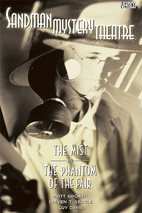
Faster than a DC Bullet: Sandman Mystery Theatre, Part IX: The Mist and The Phantom of the Fair

Comic trade paperback, 200 pages
Published 2009 (contents: 1996)

Borrowed from the library
Read March 2011
Sandman Mystery Theatre: The Mist and The Phantom of the Fair

Writers: Matt Wagner, Steven T. Seagle
Artist: Guy Davis
Colorist: David Hornung
Letterer: John Costanza

The other DC characters come thick and fast in this volume, which features Ted Knight (the future Starman), the Mist (a future Starman villain), Jim Corrigan (the future Spectre), and the Crimson Avenger, not to mention a passing reference to the Flash himself. I don't know if Sandman Mystery Theatre was in trouble or what, but it's a little jarring in what had been a fairly self-contained series. Wagner and Seagle work most of them in just fine, though; Knight, the Mist, and Corrigan don't have their powers yet, while the Crimson Avenger doesn't have any at all. (Oddly, he's the most disconcerting-- with his flamboyant posturing and public presence, he's a very different kind of superhero to the Sandman.)

Both stores in this volume are good but disjointed. "The Mist" suffers from the same problem as "The Hourman," in that the tale of the other characters is often more interesting than Wesley's; I loved the rise and fall of the villainous scientist known as the Mist. Meanwhile, Wesley is rebuilding his relationship with Dian and investigating a series of mysterious crimes, but he only finds the Mist by accident. Plus there's just too many shady characters to keep track of. It's not a satisfying mystery, but I still enjoyed reading it.

"The Phantom of the Fair" takes the Sandman back to where he began in the Golden Age-- the New York World's Fair-- and it's a neat story, especially in how it shows Wesley confronting his own homophobia. The explanation for it is a bit too pat, though: he saw a friend of his forced to give a man oral sex when they were children. The roots of such prejudice are much less easily traced and destroyed than that. I did like all the ruminations on utopia in this story. This story isn't really a mystery as such, though; Lieutenant Burke does more work on the case than Wesley again. (Though it's one of the most enjoyable Burke stories in Sandman Mystery Theatre so far. I love it when Burke is allowed to be an all-out asshole.) So again, The Mist and The Phantom of the Fair is a mixed bag; Wagner and Seagle seem to have a difficult job balancing the personal plots and the mystery plots without compromising the latter.

Faster than a DC Bullet: Sandman Mystery Theatre, Part VII: The Hourman and The Python

Comic trade paperback, 199 pages
Published 2008 (contents: 1995-96)

Borrowed from the library
Read February 2011
Sandman Mystery Theatre: The Hourman and The Python

Writers: Matt Wagner, Steven T. Seagle
Artists: Guy Davis, Warren Pleece
Colorist: David Hornung
Letterer: John Costanza

This is the first volume of Sandman Mystery Theatre to draw connections with the wider DC universe-- in this case, the appearance of Rex Tyler, here called the "Man of the Hour," but eventually to become the superhero "Hourman." The Hourman is an oddly imbalanced story; half of it is about Wesley and Dian's evolving relationship, as usual, and half of it is about the Hourman's attempts to begin a crime-fighting career. They cross over in that Wesley discovers the Hourman in the course of his own activities as the Sandman, and the Hourman's investigations lead him to the same crime the Sandman is hearing about in his dreams. The relationship stuff is good, especially now that Dian is actively helping Wesley's crime-fighting, but it's overshadowed by the stuff with Hourman; I love a good origin story, and this is an excellent one. It doesn't help that the mystery here is perfunctory; Wesley spends more time investigating Rex Tyler than he does the crime, and the crime itself is stealing jewelry from an immoral and obnoxious rich person. It's hard to get worried about this. Far more interesting is Rex's fumbling attempts to help a family in trouble with local gangs.

The second story here, "The Python," is the first SMT story that completely did not work for me. To start with, it suffers from the same problem as every story with a fill-in artist: Warren Pleece is not Guy Davis. His art is simpler than Guy Davis's and more cartoony, which isn't really appropriate for the gritty atmosphere of SMT, but it's also just less accomplished. There's a lot of ugly or distorted faces, and not always in spots where they're wanted, I think. But also, the mystery this one just doesn't work-- earlier SMT stories suffered from a superfluity of suspects; this one has almost none, and then the murderer is someone completely different, with no previously indicated means, motive, or opportunity. (But still a contrived link to Dian.) It's lame, and the Sandman scarcely contributes until the obligatory fight scene at the end; everyone's favorite asshole cop Lieutenant Burke does most of the work again. Which is cool, I like Burke, but this isn't Lieutenant Burke Mystery Theatre. The other thing that doesn't work about "The Python" is that while Dr. Death and The Night of the Butcher showed Dian's initial horror at Wesley's secret life and then acceptance, and "The Hourman" showed her actually helping him, she all of a sudden backslides here for no readily apparent reason. Call my cynical, but I think Wesley and Dian's split is solely to set up the crossover in the next installment...

12 February 2011

Faster than a DC Bullet: Sandman Mystery Theatre, Part VI: Dr. Death and The Night of the Butcher

Comic trade paperback, 197 pages
Published 2007 (contents: 1994-95)

Borrowed from the library
Read January 2011
Sandman Mystery Theatre: Dr. Death and The Night of the Butcher

Writers: Matt Wagner, Steven T. Seagle
Artists: Guy Davis, Vince Locke
Colorist: David Hornung
Letterers: John Costanza, Gaspar Saladino

Like The Face and The Brute, Dr. Death and The Night of the Butcher includes two complete tales of the Sandman, a.k.a. Wesley Dodds, as he fights crime in the dark underbelly of New York City. And as if the writers read my objection to the fact that every victim in this series deserves it, the book even opens up the murder of an innocent man! (Um, yay?) But as was the case in the last couple stories, the murder mystery (which as usual is coincidentally linked to Dian Belmont's social circle) is a sideshow to the developments in the relationship between Wesley and Dian. Dian has figured out that Wesley is the Sandman, but doesn't quite know what to do about it. And Wesley doesn't quite know how to integrate her needs into his already-structured life.

Wesley actually has very little to do with solving "The Night of the Butcher" especially, but that's okay, as it allows Lieutenant Burke to really shine, along with Hubert Klein. But as Wes's personal life disintegrates, so does his crimefighting one-- Burke discovers the radio hidden under his desk that transmits all his conversations to the Sandman! What's a masked mystery man to do? And what's Dian to do? There are no easy answers here, and the series swings back and forth between tender and painful, as they try to negotiate their strange new status quo. Especially effective here are the recurring dreams of the Sandman, a staple of the series from the beginning, that in this one hit a new high in disturbingness, probably thanks to some nice comic book tricks (Scott McCloud would be proud).

The only downside to this volume is that Guy Davis only does layouts for "Dr. Death," with the somewhat inferior Vince Locke on art. On the other hand, the brutal fight at the end of "The Night of the Butcher" is probably the series' best action sequence so far, nicely showcasing the Sandman's determination, Lieutenant Burke's antagonism, and Dian Belmont's passion. Sandman Mystery Theatre continues its string of successes.

Faster than a DC Bullet: Sandman Mystery Theatre, Part V: The Scorpion

Comic hardcover, 100 pages
Published 2006 (contents: 1994)

Borrowed from the library
Read January 2011
Sandman Mystery Theatre: The Scorpion

Writers: Matt Wagner, Steven T. Seagle
Artist: Guy Davis
Colorist: David Hornung
Letterer: John Costanza

The Scorpion continues the high standard set by its predecessor, with Dian and Wesley's relationship continuing to progress-- as a vicious serial killer is on the loose, of course. The strong character work is again the highlight; this volume probably gives us more of Wesley's thoughts than the previous three combined, and it's fascinating: a quiet, shy man driven by forces he cannot comprehend to do what he does, who wants to do right by Dian, but held back by fear. If there's any downside to this installment, it's that the murderer is completely obvious. Also, every installment of this series features completely despicable people being murdered, so it's hard to be too engaged in the hunt for their killers. Some innocent victims would be nice. (That's not something you say a lot.) But on the whole, there's a lot to enjoy here; this is probably the most proactive the Sandman's been in an investigation, and it's also the start of a new, more pivotal role for Dr. Hubert Klein, the NYPD's medical examiner, the first character to actively assist the mysterious vigilante.

Faster than a DC Bullet: Sandman Mystery Theatre, Part IV: The Vamp

Comic hardcover, 98 pages
Published 2005 (contents: 1994)

Borrowed from the library
Read January 2011
Sandman Mystery Theatre: The Vamp

Writers: Matt Wagner, Steven T. Seagle
Artist: Guy Davis
Colorist: David Hornung
Letterer: John Costanza

With this, its third volume, Sandman Mystery Theatre has jumped above the lackluster performance of The Face and The Brute and even exceeded its strong debut in The Tarantula. There are two important creator changes in this volume. The first is that Guy Davis, who illustrated The Tarantula, returns to the series, and it is all the better for it. The fellows who did The Face and The Brute just didn't have his skill; Davis draws some of the most real people in comics. I shudder to think how the cute Dian Belmot would look in the hands of your typical superhero artist. Perhaps more importantly, Steven T. Seagle joins Matt Wagner as co-writer.

I dunno if he's responsible for the subtle changes that made this story really work, but it really really does. One of the recurring themes of SMT has been prejudice, a natural enough topic for a story set in upper-crust 1930s New York City, but unfortunately it had a tendency to get a little bit obvious, with its protagonists (Wesley and Dian) being properly undiscriminating in a world where everyone else tosses off ethnic slurs against the Chinese. The Vamp handles this with a bit more nuance, such as scenes where Dian is repulsed by the idea of lesbianism, showing that she's not quite the hero we "enlightened" 21st-century readers might like her to be. And Lieutenant Burke, who in the first volume revealed that he considered his sister dead to him because she married a black man, is himself the target of racism, when he's stared at upon entering a social club. One of the members tells him they don't have any Italians, and Burke growls back, "I'm Sicilian." The club member simply replies, "Well, whatever you are, we don't have any of those either. At least I don't think we do." The take on 1930s racism feels much more complex as a result. Also, I laughed at that scene, and indeed, I found The Vamp much more prone to humor than its predecessors, though that never came at the cost of atmosphere-- all of the light moments were well-placed.

The characters are also on fine form here. Wesley and Dian's relationship continues to grow, and the theme of Dian "waking up" from her long sleep also continues, as she even does some amateur sleuthing of her own. Wesley and Dian's relationship is one of the better-portrayed relationships I've read in comics. The two characters love each other madly, but that doesn't make things magically easy for them, yet the conflict and misunderstandings in their relationship all come across completely naturally. Lieutenant Burke also gets fleshed out, going from yet another random cop to a competent detective who also happens to be a complete asshole. He's the sort of character you love to hate-- or in my case, you just love.

Story-wise, this is probably one of the better mysteries the series has given us. Though the perpetrator of the murders is pretty obvious to the reader from around the halfway point, the detection by the Sandman, Burke, and Dian all feels logical, and the end of the story works particularly well, with none of the leaps that made some of the previous stories unsatisfying. All told, The Vamp was a brilliant piece of work that left me immediately looking forward to the next installment of Sandman Mystery Theatre.

22 January 2011

Faster than a DC Bullet: Sandman Mystery Theatre, Part II: The Tarantula

Comic hardcover, 111 pages
Published 2004 (contents: 1993)

Borrowed from the library
Read January 2011
Sandman Mystery Theatre: The Tarantula

Writer: Matt Wagner
Artist: Guy Davis
Colorist: David Hornung
Letterer: John Costanza

After the success of Neil Gaiman's The Sandman, DC revisited the original Sandman with Sandman Mystery Theatre, a pulp-influenced reworking of Wesley Dodds. In these stories, Wesley is not a playboy, but a shy, retiring man plagued by terrible dreams to fill the gap in the cosmos caused by the capture of Dream. Instead of the array of shorts we got in the 1940s, Matt Wagner gives us a sprawling, complicated tale of the Sandman trying to track down a mysterious murderer known only as "the Tarantula." (There was a Tarantula in one of the original Golden Age Sandman stories, but he isn't related to this one as far as I can tell.)

Dodds, though, is largely an enigma in this story, driven by strange dreams and mostly seen from an outside perspective, even when a scene focuses on him. The viewpoint character of The Tarantula is very much Dian Belmont, no longer a safecracker, but still the daughter of the District Attorney. One of her friends is one of the victims of the Tarantula, and her efforts to assist in the case-- and her interactions with the mysterious Sandman, not to mention the charming Wesley Dodds-- begin to give some aim and purpose to her until-now aimless life.

The plot of The Tarantula is a labyrinthine mystery, mostly taking place at night in New York City. The mystery is well-done, cutting the difficult line between obvious and impossible just right. The primary things that makes this story work, though, is the atmosphere that it oozes-- these are the dark, decadent adventures the Sandman should have been having all along. The Sandman inhabits a world every bit as frightening as his visage, tormented by dreams that show him the worst things he can imagine.

I really like Guy Davis's art. It's a little cartoony, but it works. He has a nice command of human faces, especially, and his characters look like real people: you can see Wesley's slight slump, and Dian is attractive but not a supermodel, more cute (and plump) than a knockout. On the other hand, he handles the dark and the creepy just exactly right as well. Moody and mysterious, The Tarantula is everything the original Sandman should have been all along.