08 March 2011

Faster than a DC Bullet: Sandman Mystery Theatre, Part IX: The Mist and The Phantom of the Fair

Comic trade paperback, 200 pages
Published 2009 (contents: 1996)

Borrowed from the library
Read March 2011
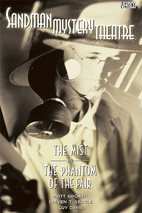
Sandman Mystery Theatre: The Mist and The Phantom of the Fair

Writers: Matt Wagner, Steven T. Seagle
Artist: Guy Davis
Colorist: David Hornung
Letterer: John Costanza

The other DC characters come thick and fast in this volume, which features Ted Knight (the future Starman), the Mist (a future Starman villain), Jim Corrigan (the future Spectre), and the Crimson Avenger, not to mention a passing reference to the Flash himself. I don't know if Sandman Mystery Theatre was in trouble or what, but it's a little jarring in what had been a fairly self-contained series. Wagner and Seagle work most of them in just fine, though; Knight, the Mist, and Corrigan don't have their powers yet, while the Crimson Avenger doesn't have any at all. (Oddly, he's the most disconcerting-- with his flamboyant posturing and public presence, he's a very different kind of superhero to the Sandman.)

Both stores in this volume are good but disjointed. "The Mist" suffers from the same problem as "The Hourman," in that the tale of the other characters is often more interesting than Wesley's; I loved the rise and fall of the villainous scientist known as the Mist. Meanwhile, Wesley is rebuilding his relationship with Dian and investigating a series of mysterious crimes, but he only finds the Mist by accident. Plus there's just too many shady characters to keep track of. It's not a satisfying mystery, but I still enjoyed reading it.

"The Phantom of the Fair" takes the Sandman back to where he began in the Golden Age-- the New York World's Fair-- and it's a neat story, especially in how it shows Wesley confronting his own homophobia. The explanation for it is a bit too pat, though: he saw a friend of his forced to give a man oral sex when they were children. The roots of such prejudice are much less easily traced and destroyed than that. I did like all the ruminations on utopia in this story. This story isn't really a mystery as such, though; Lieutenant Burke does more work on the case than Wesley again. (Though it's one of the most enjoyable Burke stories in Sandman Mystery Theatre so far. I love it when Burke is allowed to be an all-out asshole.) So again, The Mist and The Phantom of the Fair is a mixed bag; Wagner and Seagle seem to have a difficult job balancing the personal plots and the mystery plots without compromising the latter.

Faster than a DC Bullet: Sandman Mystery Theatre, Part VIII: Sandman Midnight Theatre

Perfect-bound comic, n.pag.
Published 1995

Borrowed from the library
Read February 2011
Sandman Midnight Theatre

Written by Neil Gaiman
Plotted by Matt Wagner
Story by Wagner and Gaiman
Painted by Teddy Kristiansen
Lettered by Todd Klein

There was a time when Neil Gaiman's The Sandman and Wagner and Seagle's Sandman Mystery Theatre were running alongside one another, so it must have seemed logical to cross the two series over. But despite an appearance by Dream (one of many mainstream DCU appearances in SMT of late), this is definitely a Sandman Mystery Theatre tale, albeit one filtered through a Neil Gaiman style. With Dian gone to England to find herself, Wesley eventually pursues a mystery there, and the two have a number of confrontations while solving a mystery and then reconciling. The mystery is a bit thin, and the reconciliation comes out of nowhere, but I enjoyed the story all the same. It just oozed atmosphere, partially because of Gaiman's dreamlike writing, but mostly because of Teddy Kristiansen's amazing artwork. He's the first artist who's not Guy Davis to do successful work on Sandman Mystery Theatre, and I really liked the story as a result. He is the only other person to get Wesley's dashing-but-awkward, young-but-pudgy appearance just right, and the way he does Wesley's glasses was especially great. Sometimes Wesley was as impenetrable as his disguise.

What really bothered me, though, was the Wesley referred to "the Sandman" as a different person throughout the story. Which is a neat idea, but Dian claims it's something he always does-- when he's never done it in Sandman Mystery Theatre ever! Nor does he do it again, to my knowledge. A weird little inconsistency.

Faster than a DC Bullet: Sandman Mystery Theatre, Part VII: The Hourman and The Python

Comic trade paperback, 199 pages
Published 2008 (contents: 1995-96)

Borrowed from the library
Read February 2011
Sandman Mystery Theatre: The Hourman and The Python

Writers: Matt Wagner, Steven T. Seagle
Artists: Guy Davis, Warren Pleece
Colorist: David Hornung
Letterer: John Costanza

This is the first volume of Sandman Mystery Theatre to draw connections with the wider DC universe-- in this case, the appearance of Rex Tyler, here called the "Man of the Hour," but eventually to become the superhero "Hourman." The Hourman is an oddly imbalanced story; half of it is about Wesley and Dian's evolving relationship, as usual, and half of it is about the Hourman's attempts to begin a crime-fighting career. They cross over in that Wesley discovers the Hourman in the course of his own activities as the Sandman, and the Hourman's investigations lead him to the same crime the Sandman is hearing about in his dreams. The relationship stuff is good, especially now that Dian is actively helping Wesley's crime-fighting, but it's overshadowed by the stuff with Hourman; I love a good origin story, and this is an excellent one. It doesn't help that the mystery here is perfunctory; Wesley spends more time investigating Rex Tyler than he does the crime, and the crime itself is stealing jewelry from an immoral and obnoxious rich person. It's hard to get worried about this. Far more interesting is Rex's fumbling attempts to help a family in trouble with local gangs.

The second story here, "The Python," is the first SMT story that completely did not work for me. To start with, it suffers from the same problem as every story with a fill-in artist: Warren Pleece is not Guy Davis. His art is simpler than Guy Davis's and more cartoony, which isn't really appropriate for the gritty atmosphere of SMT, but it's also just less accomplished. There's a lot of ugly or distorted faces, and not always in spots where they're wanted, I think. But also, the mystery this one just doesn't work-- earlier SMT stories suffered from a superfluity of suspects; this one has almost none, and then the murderer is someone completely different, with no previously indicated means, motive, or opportunity. (But still a contrived link to Dian.) It's lame, and the Sandman scarcely contributes until the obligatory fight scene at the end; everyone's favorite asshole cop Lieutenant Burke does most of the work again. Which is cool, I like Burke, but this isn't Lieutenant Burke Mystery Theatre. The other thing that doesn't work about "The Python" is that while Dr. Death and The Night of the Butcher showed Dian's initial horror at Wesley's secret life and then acceptance, and "The Hourman" showed her actually helping him, she all of a sudden backslides here for no readily apparent reason. Call my cynical, but I think Wesley and Dian's split is solely to set up the crossover in the next installment...

12 February 2011

Faster than a DC Bullet: Sandman Mystery Theatre, Part VI: Dr. Death and The Night of the Butcher

Comic trade paperback, 197 pages
Published 2007 (contents: 1994-95)

Borrowed from the library
Read January 2011
Sandman Mystery Theatre: Dr. Death and The Night of the Butcher

Writers: Matt Wagner, Steven T. Seagle
Artists: Guy Davis, Vince Locke
Colorist: David Hornung
Letterers: John Costanza, Gaspar Saladino

Like The Face and The Brute, Dr. Death and The Night of the Butcher includes two complete tales of the Sandman, a.k.a. Wesley Dodds, as he fights crime in the dark underbelly of New York City. And as if the writers read my objection to the fact that every victim in this series deserves it, the book even opens up the murder of an innocent man! (Um, yay?) But as was the case in the last couple stories, the murder mystery (which as usual is coincidentally linked to Dian Belmont's social circle) is a sideshow to the developments in the relationship between Wesley and Dian. Dian has figured out that Wesley is the Sandman, but doesn't quite know what to do about it. And Wesley doesn't quite know how to integrate her needs into his already-structured life.

Wesley actually has very little to do with solving "The Night of the Butcher" especially, but that's okay, as it allows Lieutenant Burke to really shine, along with Hubert Klein. But as Wes's personal life disintegrates, so does his crimefighting one-- Burke discovers the radio hidden under his desk that transmits all his conversations to the Sandman! What's a masked mystery man to do? And what's Dian to do? There are no easy answers here, and the series swings back and forth between tender and painful, as they try to negotiate their strange new status quo. Especially effective here are the recurring dreams of the Sandman, a staple of the series from the beginning, that in this one hit a new high in disturbingness, probably thanks to some nice comic book tricks (Scott McCloud would be proud).

The only downside to this volume is that Guy Davis only does layouts for "Dr. Death," with the somewhat inferior Vince Locke on art. On the other hand, the brutal fight at the end of "The Night of the Butcher" is probably the series' best action sequence so far, nicely showcasing the Sandman's determination, Lieutenant Burke's antagonism, and Dian Belmont's passion. Sandman Mystery Theatre continues its string of successes.

Faster than a DC Bullet: Sandman Mystery Theatre, Part V: The Scorpion

Comic hardcover, 100 pages
Published 2006 (contents: 1994)

Borrowed from the library
Read January 2011
Sandman Mystery Theatre: The Scorpion

Writers: Matt Wagner, Steven T. Seagle
Artist: Guy Davis
Colorist: David Hornung
Letterer: John Costanza

The Scorpion continues the high standard set by its predecessor, with Dian and Wesley's relationship continuing to progress-- as a vicious serial killer is on the loose, of course. The strong character work is again the highlight; this volume probably gives us more of Wesley's thoughts than the previous three combined, and it's fascinating: a quiet, shy man driven by forces he cannot comprehend to do what he does, who wants to do right by Dian, but held back by fear. If there's any downside to this installment, it's that the murderer is completely obvious. Also, every installment of this series features completely despicable people being murdered, so it's hard to be too engaged in the hunt for their killers. Some innocent victims would be nice. (That's not something you say a lot.) But on the whole, there's a lot to enjoy here; this is probably the most proactive the Sandman's been in an investigation, and it's also the start of a new, more pivotal role for Dr. Hubert Klein, the NYPD's medical examiner, the first character to actively assist the mysterious vigilante.

Faster than a DC Bullet: Sandman Mystery Theatre, Part IV: The Vamp

Comic hardcover, 98 pages
Published 2005 (contents: 1994)

Borrowed from the library
Read January 2011
Sandman Mystery Theatre: The Vamp

Writers: Matt Wagner, Steven T. Seagle
Artist: Guy Davis
Colorist: David Hornung
Letterer: John Costanza

With this, its third volume, Sandman Mystery Theatre has jumped above the lackluster performance of The Face and The Brute and even exceeded its strong debut in The Tarantula. There are two important creator changes in this volume. The first is that Guy Davis, who illustrated The Tarantula, returns to the series, and it is all the better for it. The fellows who did The Face and The Brute just didn't have his skill; Davis draws some of the most real people in comics. I shudder to think how the cute Dian Belmot would look in the hands of your typical superhero artist. Perhaps more importantly, Steven T. Seagle joins Matt Wagner as co-writer.

I dunno if he's responsible for the subtle changes that made this story really work, but it really really does. One of the recurring themes of SMT has been prejudice, a natural enough topic for a story set in upper-crust 1930s New York City, but unfortunately it had a tendency to get a little bit obvious, with its protagonists (Wesley and Dian) being properly undiscriminating in a world where everyone else tosses off ethnic slurs against the Chinese. The Vamp handles this with a bit more nuance, such as scenes where Dian is repulsed by the idea of lesbianism, showing that she's not quite the hero we "enlightened" 21st-century readers might like her to be. And Lieutenant Burke, who in the first volume revealed that he considered his sister dead to him because she married a black man, is himself the target of racism, when he's stared at upon entering a social club. One of the members tells him they don't have any Italians, and Burke growls back, "I'm Sicilian." The club member simply replies, "Well, whatever you are, we don't have any of those either. At least I don't think we do." The take on 1930s racism feels much more complex as a result. Also, I laughed at that scene, and indeed, I found The Vamp much more prone to humor than its predecessors, though that never came at the cost of atmosphere-- all of the light moments were well-placed.

The characters are also on fine form here. Wesley and Dian's relationship continues to grow, and the theme of Dian "waking up" from her long sleep also continues, as she even does some amateur sleuthing of her own. Wesley and Dian's relationship is one of the better-portrayed relationships I've read in comics. The two characters love each other madly, but that doesn't make things magically easy for them, yet the conflict and misunderstandings in their relationship all come across completely naturally. Lieutenant Burke also gets fleshed out, going from yet another random cop to a competent detective who also happens to be a complete asshole. He's the sort of character you love to hate-- or in my case, you just love.

Story-wise, this is probably one of the better mysteries the series has given us. Though the perpetrator of the murders is pretty obvious to the reader from around the halfway point, the detection by the Sandman, Burke, and Dian all feels logical, and the end of the story works particularly well, with none of the leaps that made some of the previous stories unsatisfying. All told, The Vamp was a brilliant piece of work that left me immediately looking forward to the next installment of Sandman Mystery Theatre.

22 January 2011

Faster than a DC Bullet: Sandman Mystery Theatre, Part III: The Face and The Brute

Comic hardcover, 206 pages
Published 2004 (contents: 1993-94)

Borrowed from the library
Read January 2011
Sandman Mystery Theatre: The Face and The Brute

Writer: Matt Wagner
Artists: John Watkiss, R. G. Taylor
Colorist: David Hornung
Letterer: John Costanza

The second volume of Sandman Mystery Theatre is decidedly weaker than the first. The first story, "The Face," sees a series of brutal murders in Chinatown escalating tensions between rival gangs to the point of war as the Sandman tries to find the murderer before that happens. Unfortunately, though the story often criticizes many of its characters for racist thinking, the story still falls victim to many Orientalist tropes itself, especially in John Watkiss's artwork, where the Chinese characters are so slanty-eyed they don't have any pupils. "The Face" of the title (again, not the same Face as in the Golden Age Sandman stuff, though quite similar) barely has any interaction with the Sandman, and the resolution of the mystery is a bit underwhelming. As in the first volume, Dian Belmont was probably the best thing about this story, especially the part where she takes matters into her own hands and steals her father's gun.

The second story, "The Brute," is a bit better but still not as successful as The Tarantula. The Sandman himself feels lost here, doing little actual investigation until things suddenly fall into place for him at the end of the story. The focus on Dian's growing conscience works well, though, as does her growing relationship(s) with Wesley Dodds and the Sandman. A lot of the story is taken up by the travails of a boxer and his daughter that, though gripping, keep the focus solidly off the Sandman himself. And the "Brute" of the title is kind of random and pointless; I'm not sure why each Sandman Mystery Theatre story has to have a gimmicky villain when the series is otherwise uninteresting in the conventions of superhero comics. R. G. Taylor's art is too stiff, and his Wesley looks too middle-aged. Overall, The Face and The Brute fails to follow up the strong beginning of the series, though it's entertaining enough on its own merits, mostly for Dian Belmont's continued growth and presence.

Faster than a DC Bullet: Sandman Mystery Theatre, Part II: The Tarantula

Comic hardcover, 111 pages
Published 2004 (contents: 1993)

Borrowed from the library
Read January 2011
Sandman Mystery Theatre: The Tarantula

Writer: Matt Wagner
Artist: Guy Davis
Colorist: David Hornung
Letterer: John Costanza

After the success of Neil Gaiman's The Sandman, DC revisited the original Sandman with Sandman Mystery Theatre, a pulp-influenced reworking of Wesley Dodds. In these stories, Wesley is not a playboy, but a shy, retiring man plagued by terrible dreams to fill the gap in the cosmos caused by the capture of Dream. Instead of the array of shorts we got in the 1940s, Matt Wagner gives us a sprawling, complicated tale of the Sandman trying to track down a mysterious murderer known only as "the Tarantula." (There was a Tarantula in one of the original Golden Age Sandman stories, but he isn't related to this one as far as I can tell.)

Dodds, though, is largely an enigma in this story, driven by strange dreams and mostly seen from an outside perspective, even when a scene focuses on him. The viewpoint character of The Tarantula is very much Dian Belmont, no longer a safecracker, but still the daughter of the District Attorney. One of her friends is one of the victims of the Tarantula, and her efforts to assist in the case-- and her interactions with the mysterious Sandman, not to mention the charming Wesley Dodds-- begin to give some aim and purpose to her until-now aimless life.

The plot of The Tarantula is a labyrinthine mystery, mostly taking place at night in New York City. The mystery is well-done, cutting the difficult line between obvious and impossible just right. The primary things that makes this story work, though, is the atmosphere that it oozes-- these are the dark, decadent adventures the Sandman should have been having all along. The Sandman inhabits a world every bit as frightening as his visage, tormented by dreams that show him the worst things he can imagine.

I really like Guy Davis's art. It's a little cartoony, but it works. He has a nice command of human faces, especially, and his characters look like real people: you can see Wesley's slight slump, and Dian is attractive but not a supermodel, more cute (and plump) than a knockout. On the other hand, he handles the dark and the creepy just exactly right as well. Moody and mysterious, The Tarantula is everything the original Sandman should have been all along.

Faster than a DC Bullet: Sandman Mystery Theatre, Part I: The Golden Age Sandman Archives, Volume 1

Having read all of Neil Gaiman's The Sandman, I'm going backwards in DC history to read the stories of the other superheroes who have functioned under that name, beginning with one of the first in the 1930s: Wesley Dodds. The majority of these tales come from Sandman Mystery Theatre, but I'll be taking some sidesteps along the the way:

Comic hardcover, 221 pages
Published 2004 (contents: 1939-41)

Borrowed from the library
Read December 2010
The Golden Age Sandman Archives, Volume 1

Writers: Gardner Fox
Artists: Bert Christman, Creig Fessel, Chad Grothkopf, Ogden Whitney

This is the only collection of the original adventures of Wesley Dodds as the Sandman. Wesley is a millionaire playboy who owns the Dodds-Bessing Steel Corporation, but spends his nights fighting crime as the Sandman. Why? Who knows; there's no origin story of any stripe given here.

The reason why the Sandman would become such an enduring character can be instantly seen in his visual design. Dressed in a fedora, wearing a gas mask, and bearing a gas gun, he creates a potent and spooky image. One imagines adventures in the dead of night, with the Sandman's expressionless face looming at you out of the darkness. Unfortunately, the stories collected here struggled with capitalizing on that. Two early stories, "Sandman at the World's Fair" and "On the Waterfront," both feature the Sandman swimming, which means he looks goofy, a man wearing a gas mask along with his swim trunks.

Several other early tales are also jarring. "The Three Sandmen" feature Dodds recruiting two comrades from his naval aviator days to dress up as the Sandman to stop an heist in their airplanes. I'm not sure why they even have to dress up as the Sandman, given no one can see their faces in their airplanes! "Island Uprising" has the Sandman knocking out native tribes in the South Seas; hardly a creepy urban vigilante. (Though, oddly for a later Sandman story, "To Hammer the Earth" still features the Sandman battling a man planning to move the Earth out of orbit with a giant radiation gun.) "The Sandman Meets the Face" is probably the story where things finally begin to come together, with the Sandman facing off against deadly criminals in the urban underworld. The story's ruined by its goofy ending, though, where the Sandman runs the Face off a railroad bridge, crowing that it was fun while it lasted. Great, Wesley, glad you find murder so entertaining. It's a shame they kill him off, actually, as the Face has some style and could have made a good recurring villain.

The story where things really do come together is "Lady in Evening Clothes," which introduces the other element that raises the Sandman above your garden-variety superhero: Dian Belmont. Dian is Wesley's love interest, but she's no Lois Lane; Dian is a skilled safecracker who breaks into Wesley's mansion only to find out his secret identity. Raised her entire life by a criminal gang, the Sandman figures out that she's actually the long-ago-kidnapped daughter of the District Attorney, and he reunites them, the two promptly becoming recurring characters in the strip. Though the writer(s) seem to forget Dian's safecracking skills and criminal origins in later stories, she frequently accompanies the Sandman on her adventures, often instigating them by her insistence that he help her investigate a certain crime. She's as much in the fight as he is-- in "The Crook Who Knew the Sandman's Identity" she even dons the Sandman costume herself-- and their interplay is a highlight of otherwise formulaic stories of defeating gangsters.

The art is pretty typical Golden Age comics stuff, often stiff and formulaic, though it gets better as it goes, especially once the artists break out of the two-by-eight grid of the earlier stories, developing more dynamic page layouts. The colors are frequently the downfall of this art, the restrictions of the time putting the Sandman in bright green or orange suits that don't exactly ooze frightening. It's hard to give proper credit to the writers or arists here; not every story has credits, and for some reason, Jim Amash's introduction mentions artists and writers who aren't actually credited in the book. Like many collections of Golden Age comics, The Golden Age Sandman, Volume 1 (there is as of yet, no Volume 2) is fun but lightweight, with glimpses of promise that writers of later eras would capitalize on.

14 December 2010

Faster than a DC Bullet: Gotham Central, Part V: Dead Robin

Comic trade paperback, 184 pages
Published 2007 (contents: 2006-07)

Borrowed from the library
Read December 2010
Gotham Central: Dead Robin

Writers: Greg Rucka with Ed Brubaker
Penciller: Kano
Inker: Stefano Gaudiano
Letterer: Clem Robins
Colorist: Lee Loughridge
Fill-In Artist: Steve Lieber

After some of the lackluster stories of the previous volumes, Gotham Central goes out on the top of its game. Unfortunately, writer Ed Brubaker leaves early in the volume, and longtime artist Michael Lark isn't here at all, but that doesn't dampen these excellent stories. The first is one of those Batman's-relationship-with-the-police tales I love so much, "Dead Robin." The G.C.P.D. finds a corpse wearing a Robin outfit-- but he couldn't be the Robin, could he? They're forced to confront just how little they know about the Batman and his "family," and their already sour relationship is further tested when Romy Chandler shoots the Batman, still on edge after the death of her partner in the previous volume. There's even an appearance by the Teen Titans, which is fun if a bit dissonant, and Robin himself puts in his only appearances in the series, with some nice scenes between him and Stacy, the Major Crime Unit's temp. And the climax of the mystery was just great; Kano and Gaudiano draw an amazingly frightening Batman.

The story I wasn't expecting to like here was "Sunday Bloody Sunday," which tells what effect the Infinite Crisis had on Gotham. Though I know that things like that have to affect the city, it just seemed like the multiverse being remade would be so tonally inconsistent with this series. To my surprise, it wasn't-- the whole story is told first-person from the perspective of Crispus Allen, and he doesn't understand what's going on one tiny bit, but he still knows he has to do his duty getting Montoya to safety and finding his family, even if he did just run into Captain Marvel and the Spectre. It's the story of Allen's faith, as he begins by ruminating on how he doesn't believe in God anymore... and ends by praying with his family. I don't think the story of the Infinite Crisis could have been told in Gotham better than this.

The last story is "Corrigan 2," and it follows up on the events of the Corrigan story of the previous volume. The focus of the story is again on Renee Montoya and Crispus Allen, as Allen tries to stem Montoya's descent into anger and violence, with disastrous consequences for them both. This is completely a traditional cop story, with no Batman elements at all, but it really works here, with many of the character elements seeded throughout the series coming into play. The story is riveting and moving, a fantastic end to what had been a strong concept.

My only complaint is that there are some character threads from earlier volumes we'll never get to see now, not unless Sarge gets a larger part in your average Batman comic than I suspect he actually does. It's a real shame this series came to an end. But this was a great way to go out-- though I preferred "Soft Targets" in Jokers and Madmen, this is the most consistently strong of all the installments.