29 April 2013

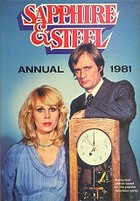
Review: Sapphire & Steel Annual 1981 by Peter J. Hammond

Hardcover, 63 pages
Published 1980
Acquired September 2011
Read September 2012
Sapphire & Steel Annual 1981
by Peter J. Hammond

This book is copyrighted to P. J. Hammond, creator of Sapphire & Steel, though he certainly didn't write it. It's mostly a series of illustrated stories loosely based on the television series: Sapphire and Steel investigate various breakages in time, though most of the stories fail to capture the tone of the television series completely, with stories that are (oddly) too sf or too fantastic. A robot rampaging over the countryside is not very Sapphire & Steel, but then neither is out-and-out magic. These tales have a lot of the trappings of the show, but they don't understand what makes it tick. A couple of them could be the foundation for legitimate adventures, though.

I did like the illustrations, though-- moody and in shadow, they're exactly what every Sapphire & Steel story should look like. Except for the one about the giant robot, where the robot itself has been ripped off of Doctor Who's K-1 robot. On the other hand, the "puzzles" and "informational features"-- one of which is about black holes for some reason!-- are as terrible as you might imagine. (The back cover photo is also a nice one.)

A curio for the curious, this book is nothing more. Reading it means I have read every book ever based on Sapphire & Steel (there are three). Audio dramas next, I guess?

26 April 2013

Faster than a DC Bullet: Birds of Prey, Part XV: End Run

Comic hardcover, n.pag.
Published 2011 (contents: 2010-11)
Borrowed from the library
Read April 2013
Birds of Prey: End Run

Writer: Gail Simone
Pencillers: Ed Benes, Adriana Melo, Alvin Lee
Inkers: Ed Benes, Mariah Benes, J. P. Mayer, Jack Purcell
Colorist: Nei Ruffino
Letterer: Steve Wands

Can you go home again? That's the question asked by End Run, as Oracle, Black Canary, the Huntress, and Lady Blackhawk reunite as the Birds of Prey once more. Black Canary is fresh off of a disastrous Justice League tenure and an even more disastrous divorce... who knows what everyone else has been up to, except that Misfit is sadly nowhere to be seen despite being left in the care of the Huntress in The Cure. The answer seems to be yes, as we're treated to about eight thousand caption boxes where Oracle, Black Canary, and Huntress express their happiness as the reunion ad nauseam.

It's also the question asked outside of the comic, as this brings Gail Simone back to the title-- alongside Ed Benes, her original art partner. End Run provides a decent story, as the Birds battle the mysterious "White Canary," and it seems like some very near and dear to them have suffered because of them. (They have, though not quite in the way they imagined.)  The plotline with Oracle trying to figure out what happened to Savant and Creote is probably the best part of this; I found myself less enamored with the Birds' field team being constantly attacked again and again.

For all that parts of this book work, other parts just don't add up. Black Canary is threatened with exposure of her civilian identity... but back in Simone's first run on the title, Dinah actually published a book about her life as the Black Canary! She also frets over being a murderer like Ollie... you know, the guy who killed a man who killed millions but is demonized for it for no readily apparent reason. Also, Hawk and Dove join the team, and as to who Hawk and Dove are and why you should care and why Oracle picked them... well, don't look for any answers here. I guess it's because they've got bird-themed names?

(There are captions for the first appearance of each character. Not just in the book, but in every. single. issue.  But I've read "Hawk: Avatar of War" six times now, and I'm no closer to knowing what it means or who he is. Cut these things out of the collection, for goodness sake!)

I did like the two-issue story at the end, where Dinah is forced to fight Lady Shiva for the sake of her adopted daughter Sin... only the Huntress has other plans. Any plotline that showcases how awesome the Huntress is is fine by me, and this is definitely one of them.

Like I said earlier, Ed Benes is back, but I'm not sure why. He manages to complete one whole issue; a couple more he starts, and someone else finishes. (I can't tell who, because there's no individual art credits.) Benes, of course, can't draw a picture undefined by the male gaze, but he did good work on this title in the past, and this isn't up to those standards-- his faces are blank and dull and filled with pouty lips. The storytelling is confusing and sloppy, and as always, anyone pretending to be Benes is even worse than Benes. The overly-done coloring seems to work against the whole effect, too.

End Run isn't maybe as bad as this review makes it sound, but it could be a lot better, and I don't of yet see the point of the Birds' breaking up and reunifying. (I'm sure there wasn't one, but still...) This great return hasn't yet convinced me it was worth the effort.
24 April 2013

Faster than a DC Bullet: Birds of Prey, Part XIV: Oracle: The Cure

Comic trade paperback, 126 pages
Published 2010 (contents: 2009)
Borrowed from the library
Read March 2013
Oracle: The Cure

Writers: Tony Bedard, Kevin VanHook
Pencillers: Claude St. Aubin, Fernando Pasarin, Julian Lopez
Inkers: John Floyd, Matt Ryan, Bit, David Bryant, Norm Rapmund, Fernando Pasarin
Letterer: Steve Wands, Pat Brosseau

This collection bridges the gap between the first and second iterations of Birds of Prey, breaking up the original team and then showing us Barbara operating on her own. The Birds get their final showdown with the Calculator, who has been dogging them on-and-off since Perfect Pitch. I liked this, though it was obviously very rushed, and Barbara is forced to blow up yet another headquarters. Less convincing was Babs breaking up the Birds-- she just smashed the Joker in the face (and played a key role in the Final Crisis if I have my timeline right)! How could she be lacking in self-confidence now?

Mopey-for-no-reason Barbara drives the rest of this book, in a solo adventure where she tries to stop the Calculator from getting hold of the anti-life equation. Barbara has been written better, for sure-- characters always seem to be telling her tech-stuff here. There's a good idea here, but the story never really engages the reader. Except maybe with a good twist at the end... but then it's too late, and the staging is very awkward and sudden.

Also: gratuitous shower scene. What the hell? And Guillem March's covers are like 50% beautiful, 50% skeevy.

(Point of interest: as I usually do with comics, I acquired my copy of this book via interlibrary loan. The library my copy came from? That of the Christopher and Dana Reeve Paralysis Resource Center.)

22 April 2013

Faster than a DC Bullet: Birds of Prey, Part XIII: Platinum Flats

Comic trade paperback, 137 pages
Published 2009 (contents: 2008-09)
Borrowed from the library
Read March 2013
Birds of Prey: Platinum Flats

Writer: Tony Bedard
Pencillers: Michael O'Hare, Nicola Scott, Claude St. Aubin
Inkers: John Floyd, Doug Hazlewood
Letterers: Sal Cipriano, Jared K. Fletcher, Pat Brosseau, Travis Lanham, Swands

Tony Bedard, writer of Club Kids, returns to Birds of Prey with this volume, and though his approach is more plot-driven and less character-focused than his last time out, he still demonstrates that he understands the characters of the Birds of Prey and sets up some strong scenarios for them. As this book opens, the Birds have just relocated to Platinum Flats, the Silicon Valley of the DC Universe, and it's a decent setting, fitting enough for Oracle, and indicative of a new direction the book will never get to carry out, as this is its last volume (in this incarnation). There are some definite cool parts to it, especially the potential of Misfit attending a high school where the Huntress is a teacher, that's a shame will never go anywhere.

The main plot of the book, picking up from what was set up in Metropolis or Dust, initially concerns the evil tech syndicate at the heart of Platinum Flats, but this is soon derailed by the arrival of the Joker. The tech folks are good villains in and of themselves, especially the half-dead Gizmo, and Bedard has done some good work with the Calculator, but the arrival of the Joker is what makes the book-- it's the first real rematch between Barbara and the Joker since the legendary events of The Killing Joke. Physically inferior to the Joker, Barbara has to rely on her wits and her determination in fighting him, and she shows what an awesome character she's become since she stopped being Batgirl in the course of this showdown-- especially its end, which is fantastic.

Also: I love Carface. Shame this guy never became a recurring villain.

Misfit is as fun as always in this volume-- I love it when she shows up with Huntress's bike-- and the appearance of Dinah was a little gratuitous, but welcome. On the other hand. Manhunter continues to feel like she's only on the periphery of this team, and Infinity is just kinda there.

The first issue here is, alas, the last of long-running art team Nicola Scott and Doug Hazlewood, who have definitely been the best to grace this title. No one draws Huntress quite so well, I think. But Michael O'Hare and Claude St. Aubin are both able replacements-- a little sketchier in style, but still quite good.

I don't really understand why Birds of Prey had to end, but if it did, this is a good way to go out.

18 April 2013

Review: Scott Pilgrim in his Finest Hour by Bryan Lee O'Malley

Comic digest, 247 pages
Published 2010
Acquired January 2012
Read September 2012
Scott Pilgrim in his Finest Hour
by Bryan Lee O'Malley

Contrary to what the whole Internet seems to think, this book is called Scott Pilgrim in his Finest Hour according to the title page, not Scott Pilgrim's Finest Hour. (Worldcat gets it right, of course. Go librarians.) This is the complicatedest of the Scott Pilgrim books, and though I can't quite parse the metaphorical significance of what happens as well as I could in the previous volumes, everything explodes nicely in the end. There's a lot of good stuff here; "IT WAS HORRIBLE FOR EVERYONE AND THAT INCLUDES YOU" is probably one of the best medium-based gags the series does, and those last few pages are great.

17 April 2013

Review: Scott Pilgrim vs. the Universe by Bryan Lee O'Malley

Comic digest, 179 pages
Published 2009
Acquired January 2012
Read August 2012
Scott Pilgrim vs. the Universe
by Bryan Lee O'Malley

This one's good too. I like the insights we're finally starting to get into Ramona, though she's maybe still a little bit too much Manic Pixie Dream Girl. "You're just another evil ex-boyfriend waiting to happen" maybe says more about her than Scott. Also: Scott fights robots, and the use of page borders in the last twenty pages is very adept.

16 April 2013

Review: Scott Pilgrim Gets It Together by Bryan Lee O'Malley

Comic digest, 206 pages
Published 2007
Acquired January 2012
Read August 2012
Scott Pilgrim Gets It Together
by Bryan Lee O'Malley

More Scott Pilgrim! More jokes! This one even has some color, which is nice.  I think Kim Pines is my favorite. The videogame logic world continues to delight. "That must have caused my dad's brain to break in half, replaced by a purely mechanical engine of revenge!" Scott really does get it together in this one in a lot of ways, which makes some of the movement in the last two feel a little redundant.

15 April 2013

Review: Scott Pilgrim & the Infinite Sadness by Bryan Lee O'Malley

Comic digest, n.pag
Published 2006
Acquired January 2012
Read August 2012
Scott Pilgrim & the Infinite Sadness
by Bryan Lee O'Malley

This is another volume of Scott Pilgrim, with all that that entails. I think the jokes about veganism might make Todd the funnest of the evil ex-boyfriends that Scott has to face. Scott has to grow up, but in the meantime I'll take this.

12 April 2013

Review: (The Best of) Shooty Dog Thing by Paul Castle and Friends

Trade paperback, 256 pages
Published 2010 (contents: 2007-10)
Acquired November 2011
Read April 2013
(The Best of) Shooty Dog Thing
by Paul Castle and… Jon Arnold, Elizabeth Burak, Lawrence Burton, Lee Catigen-Cooper, Danielle Ellison, Terry Francis, James Gent, Angela Giblin, Stephen Gray, James Hadwen, Tim Hirst, Arfie Mansfield, Iain Martin, Nick Mellish, Patrick Mulready, Wesley Osam, Richard Parker, Erik Pollitt, and James Powell

This volume collects the best material from the first few issues of Shooty Dog Thing, a now-defunct fanzine devoted to all things Doctor Who. And I mean all things-- old and new, televised and audio and books and God knows what else, it's all in here. There's an astonishingly wide variety of material here: some stuff rehashes old continuity debates (there's an article about Season 6B, and another about Ace), but there's personal reminiscences, some strong reviews of old material, ideas for stories and episodes that could have been, and some flat-out new and unusual approaches to Doctor Who.

Highlights:
  • Iain Martin imagines what crap monsters the new show could have brought back other than the Macra
  • Patrick Mulready picks apart what Doctor Who has told us about the twenty-first century
  • Paul Castle provides an overview of every Sontaran story-- truthfully, from every genre
  • [my favorite] Lawrence Burton uses his knowledge of Nahuatl to suggest what the vaguely Aztec-sounding names John Lucarotti made up fro The Aztecs might actually mean
  • James Hadwin reviews some sixth Doctor Doctor Who Magazine comic strips, while Wesley Osam looks at how the novel Time of Your Life (one of my favorites, though not one of his) tried to relaunch the sixth Doctor after The Trial of a Time Lord, and Jon Arnold discusses the best-ever Doctor Who short story, "Teach Yourself Ballroom Dancing"
  • Paul Castle gives an overview and analysis of the Cybermen in every 1960s stories... including some rather awful-sounding comics
  • Nick Mellish and Paul Castle explore some ways Doctor Who could have gone differently, the most interesting being how it could have attempted to continue if "regeneration" hadn't been introduced in The Tenth Planet
  • Paul Castle looks at all of Doctor Who's various "hiatuses," which aren't always in the places and of the lengths you'd expect
Continuity, monsters, linguistics, love, jokes, this book has it all. I've never read a fanzine before, but this book makes me want to.

10 April 2013

Review: Numbers in the Dark and Other Stories by Italo Calvino

Trade paperback, 276 pages
Published 1996 (contents: 1943-84)
Acquired March 2008
Read August 2012
Numbers in the Dark and Other Stories
by Italo Calvino

This collects a number of different Italo Calvino short stories, ranging across his entire career. I think they're all stories that haven't been previously published in English. At least, they were all new to me, and I've read a fair few Calvinos at this point. The book opens with a number of goofy 2-3-page stories on various absurd topics (the town where everything was forbidden, or the country where everyone is a thief). These are fun, if flimsy. A lot of later authors have done stuff that reminds me of this (such as Jonathon Keats in The Book of the Unknown, or Michael Ajvaz in The Golden Age, though there are probably better examples), but Calvino was first, and let's be honest, he's probably the best.

The later stuff is longer, and it's all your typical Calvinoesque meanderings, but it's usually good, and when it's not, there's another one along in ten pages or so. I was a big fan of "The Lost Regiment," where an entire regiment goes missing in a very confusing town, or "A General in the Library," where a library is occupied by the military to find subversive material, only they turn out to like reading a whole lot. Come to think of it, there's a lot of stories here that satirize military thickheadedness, which makes sense for someone who resisted the Italian government during World War II. There are also interviews with a Neanderthal, Montezuma, and Henry Ford, which is a weird selection, but entertaining enough.

I have a fondness for his stories that are just ordinary (or seemingly ordinary) people overthinking very small moments. Mostly because I assert that that's what all of us do, or at least it's what I do, which is close enough.

Also good: "The Workshop Hen," about a crackdown on a hen in a workshop and the sadness and bureaucracy that ensues; "Beheading the Heads," about a gruesome tradition in a foreign country; "The Burning of the Abominable House," which reads like Calvino's take on the Clue film; and "Implosion" and "Nothing and Not Much," a couple Qfwfq stories (the same guy/entity/thing who starred in Cosmicomics and t zero).

The best story was "World Memory," about a computer that records all things, and the implications that has for a jealous husband. It actually feels very Stanislaw Lemesque, but then, I always assert that Calvinoesque is Lemesque.