01 April 2016

Reading Roundup Wrapup: March 2016

Pick of the month: The Time Machine by H. G. Wells. I don't think I've read this one since I was a kid-- certainly I haven't reread it since 2009, when I began my descent into obsession with all things Herbert George Wells. My review will go up in a couple weeks, but this slim volume is yet another demonstration of why Wells was always the best at what he did.

All books read:
1. Sailor & Lula: The Complete Novels by Barry Gifford
2. Doctor Who: Remembrance of the Daleks by Ben Aaronovitch
3. The Time Machine by H. G. Wells
4. The Transformers Classics, Vol. 2 by Bob Budiansky with Len Kaminski
5. Art and Illusion: A Study in the Psychology of Pictorial Representation by E. H. Gombrich
6. Diamonds are Forever by Ian Fleming
7. Batman: Gordon of Gotham by Chuck Dixon and Dennis O’Neil
8. The Story of an African Farm by Olive Schreiner
9. Free Country: A Tale of the Children’s Crusade by Neil Gaiman with Toby Litt & Rachel Pollack, Alisa Kwitney, and Jamie Delano

All books acquired:
1. Diamonds are Forever by Ian Fleming
2. The Time Machine by H. G. Wells
3. The Story of an African Farm by Olive Schreiner
4. Supergirl and the Legion of Super-Heroes: Strange Visitor from Another Century by Mark Waid
5. Miracleman: The Golden Age by Neil Gaiman
6. The Food of the Gods, and How It Came to Earth by H. G. Wells
7. Legion of Super-Heroes Archives, Volume 6 by Jim Shooter with E. Nelson Bridwell and Otto Binder
8. Showcase Presents The Elongated Man, Volume One by John Broome and Gardner Fox
9. Showcase Presents Amethyst, Princess of Gemworld by Dan Mishkin & Gary Cohn with Ernie Colón

Books remaining on "To be read" list: 632 (up 5)
Books remaining on "To review" list: 109 (down 4)

31 March 2016

Review: Dying to Know: Scientific Epistemology and Narrative in Victorian England by George Levine

Hardcover, 326 pages
Published 2002
Borrowed from the library
Read January 2013
Dying to Know: Scientific Epistemology and Narrative in Victorian England
by George Levine

George Levine's book here is one of the three to have the most influence on me and my scholarship. Something that frustrates me about the field of Victorian literature and science is how focused it is on disciplines and discoveries: people write about evolution and literature (Levine included), astronomy and literature, thermodynamics and literature, geology and literature. Much of this work is great, but to only pursue this kind of work neglects the fact that science is more than a series of discoveries that scientists pick over to employ in their novels-- it's an epistemology and an orientation towards truth.

Levine's book is probably the most prominent monograph that looks at the Victorian scientist in literature from a general epistemological perspective rather than as embodiments of particular disciplines. Levine examines how self-abnegation figures into epistemology beginning in the 1830s, both within literature and within the work of actual scientists, drawing on the writing of scientists such as Tyndall who claimed “a self-renunciation that has something lofty in it… is often enacted in the private experience of the true votary of science” (qtd. in Levine 4). Levine does not examine any specific discipline, but examines both scientists and scientist-like figures during the Victorian period to see how self-abnegation functions as a narrative: how does science create a narrative of self-abnegation, and how do literary narratives incorporate self-abnegation?

This is important (Levine argues, and I agree) because the Victorian realist novel's very project is about finding epistemologies. Levine argues that “the problem of how to find things out, of uncovering what is hidden, is pervasive in Victorian fiction” (148). He goes on to note that there is a “remarkable consistency with which ‘truth’ is registered in Victorian fiction as the most fundamental of Victorian values” (149), citing novels as diverse as Bleak House, Jane Eyre, Great Expectations, Middlemarch, Adam Bede, Vanity Fair, and Shirley. Drawing on these works, Levine says that the practice of realism “suggest[s] how central to the Victorian novel was the enterprise of knowledge seeking and truth telling, how often plots turn on the power of protagonists to develop the proper temper and state of mind to allow realistic confrontations with the ‘object’—what one might see as the acquisition of the proper ‘method’” (149). And our ways of telling truths and seeking knowledge have a moral dimension: he says in a discussion of Sartor Resartus that “the ethical and the epistemological are, in the nineteenth century, sanctioned by the same values” (70).

There's a lot to like in Levine, in that in his focus on what novels aim to do moralistically, he highlights a lot of what I like about realist novels, especially those by George Eliot and Elizabeth Gaskell. (Though Dying to Know doesn't mention Gaskell, which feels to me its a glaring omission. But then it would.) This is the best sort of literary criticism: the kind that leads you to return to familiar texts with a greater understanding of what makes you like them so much. I really must get around to properly reading his The Realistic Imagination: English Fiction from Frankenstein to Lady Chatterley (1981) someday, which Dying to Know continues the project of.

30 March 2016

Faster than a DC Bullet: Project Crisis!, Part XLIX: Final Crisis Aftermath: Dance

Comic trade paperback, n.pag.
Published 2010 (contents: 2009)

Borrowed from the library
Read August 2015
Final Crisis Aftermath: Dance

Writer: Joe Casey
Pencillers: ChrisCross, André Coelho, Eduardo Pansica
Inkers: Rob Stull, Mick Gray, Wayne Faucher, ChrisCross, André Coelho, Sandro Ribeiro, Marc Deering
Colorists: Snakebite, Pete Pantazis
Letterer: Sal Cipriano

The Super Young Team was one of the more interesting aspects of Final Crisis, a group of Japanese super-teens designed as a contemporary version of Jack Kirby's Forever People, and as a result, Dance was the Final Crisis Aftermath tale that I was looking forward to the most.

Though this came out in 2009, Dance feels like it could sit alongside what Phil Sandifer calls the "New Pop" style of contemporary comics, like Batgirl and Young Avengers. Except that... it's just not as good. There could be some interesting ideas about the boldness of youth, what it means to grow up, how to be a superhero in the era of Twitter, but none of that's actually here. Rather, we watch the Super Young Team be manipulated by hackneyed PR managers for five issues when they suddenly get their crap together and save the day. It's not quite as cliche as it sounds-- I did like that Most Excellent Superbat doesn't decide to give up Twitter, but instead invents a replacement for it that joins people brain-to-brain, and I also liked the reveal of the grave threat facing Japan-- but it didn't really have anything to say.

There are glimpses of big ideas in it, but they don't come to fruition. Both Most Excellent Superbat and Shiny Happy Aquazon ultimately turn down heroes from the previous generation to forge their own paths, but there's no sense of why it's important, of what the younger generation gains by rejecting the older generation's identity and forging its own. Or, what about the fact that the supposed deficiencies of this generation come from the previous one: we're just living in the PR-fueled world our parents created. Nothing like this is really grappled with. The book just becomes generic superheroics without anything to say that you haven't seen before, even if it does occasionally want to try.

I feel like there's potential in these characters, so it's a shame this was it for them, as far as I know; the "New 52" reboot restored the original Forever People in an insta-cancelled series by Dan DiDio and Keith Giffen. All five of them seemed like they could be really interesting given the chance, and I also really liked the sense of a history of Japanese superheroics created by Morrison and Casey, with the JLA-esque Big Science Action, who shout delightful things like "Big Science Emergency"! The appearances of ur-hero Ultimon-Alpha, with his stereotypical doomsaying, was one of my favorite parts of the books. Hopefully someone tries something with the Super Young Team again one day; I really like it when DC takes that very American idea of the superhero and filters it through the sensibilities of other cultures.

Next Week: What will become of the Tattooed Man now that he's turned from villain to hero? Find out in Ink!

29 March 2016

Return of the New Jedi Order, Episode XXVII: Refugee by Sean Williams and Shane Dix

Mass market paperback, 397 pages
Published 2003

Acquired 2003(?)
Reread June 2015
Star Wars: The New Jedi Order: Force Heretic II: Refugee
by Sean Williams and Shane Dix

Year Four of the Invasion (Month 9)
"Force Heretic" continues its inexplicable move of making sure we know how planets from the least-interesting Bantam-era novels are holding up; Refugee specifically fills us in on the Ssi-ruvvi, the violent xenophobic reptiles last seen in The Truce at Bakura. It is not remotely interesting.

Also Luke and Mara and company get bogged down in Chiss politics while visiting a library. This subplot is possibly even duller than that synopsis makes it sound. I can't even begin to describe how uninteresting it is.

Next Week: A dangling loose end you didn't care about is tied up in "Or Die Trying"!

28 March 2016

Review: The Walking Dead: Compendium Three by Robert Kirkman, Charlie Adlard, and Stefano Gaudiano

Comic trade paperback, n.pag.
Published 2015 (contents: 2012-15) 

Acquired October 2015
Read February 2016
The Walking Dead: Compendium Three

Creator, Writer: Robert Kirkman
Penciler, Inker: Charlie Adlard
Inker: Stefano Gaudiano
Gray Tones: Cliff Rathburn
Letterer: Rus Wooton

I have sort of a hate-love relationship with The Walking Dead. I don't know if it's Stockholm Syndrome, but I found this volume pretty enjoyable. Basically, my main problem with it at this point is all the boring characters. Like, huge swathes of the cast are interchangeable nobodies that I can't muster enough enthusiasm about to even tell them apart from one another. But Robert Kirkman must realize this himself, because Compendium Three sees a bunch of them get killed, and other just fade out of the narrative, leaving mostly the interesting and distinctive characters, as well as adding some good ones.

This is the guy who's having the most fun in the postapocalypse.
from The Walking Dead #108 (art by Charlie Adlard)

Basically, my favorites were introduced in this volume. The first is Ezekiel, ruler of a community called "The Kingdom," a guy who has set himself up as a king and has a pet tiger and knights who ride around on horses. He adds a splash of color to this usually subdued and grim series, and it is amazing every second of it. Kirkman backs off on this as the volume goes, though, unfortunately, and Ezekiel becomes more "normal." Second there's Negan. Now, Negan might be an awful person (he totally is), but he's hugely entertaining because he's entertained. He seems to treat this whole postapocalyptic survival thing as a personal lark, and he finds everything funny, and I found that funny. The Governor irked me to no end, but Negan is amazing. Mostly I think it's the cursing.

The cursing, and that I love villains who are the smartest guy in the room.
from The Walking Dead #114 (art by Charlie Adlard)

Do you know who's not amazing? Rick Grimes. There's a part of this book where everyone's like, "Rick Grimes will save us!" and I like, "Why would you think that?" Whenever Rick has a plan, it's a terrible plan. Yet he's the leader, I guess because everyone knows he's the main character. I can't decide if this is Kirkman's commentary on a certain type of straight white cismale, or if Kirkman's just bad at writing Rick as a good leader.

Like, why is anyone surprised by this? Has Rick Grimes ever known what to do? Has he ever had a good plan?
from The Walking Dead #98 (art by Charlie Adlard)

The story seems to be shifting, from one of sheer survival to one about rebuilding, though the ending promises some wrinkles in that. This has potential, though so far, it's pretty un-nuanced: whenever someone disagrees with Rick or Maggie's decisions, Kirkman writes them as sniveling, evil idiots. It'd be nice to see how the new society emerging here handles disagreements between reasonable people.

26 March 2016

DC Darkstars Reading Order

Here's an appendix to yesterday's essay:

Of all the ongoing series I've read over the past couple years, The Darkstars has been the hardest to follow, thanks to an incessant series of crossovers throughout its run. And since there's not much out there on the Internet about it, I didn't have a lot to go off when buying it, and I inevitably ended up missing stuff, and would only realize when I read an issue and it made a footnote referring to an issue of another series. So, for anyone who comes after me (?), here's a complete reading order including major and minor crossovers.
  • Prequels / Side Stories
    • Showcase '95 #10
    • Martian Manhunter Special #1
  • Darkstars #1-6
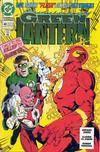
  • Green Lantern (vol. 3) #40
  • Darkstars #7-10
  • Trinity
    • DC Universe: Trinity #1
    • Green Lantern (vol. 3) #44
    • L.E.G.I.O.N. '93 #57
    • Darkstars #11
    • Green Lantern (vol. 3) #45
    • L.E.G.I.O.N. '93 #58
    • Darkstars #12
    • DC Universe: Trinity #2
  • Darkstars #13-20
  • Guy Gardner: Warrior #20-21
  • Darkstars #21-24
  • Darkstars #0
  • Darkstars #25-29
  • Green Lantern (vol. 3) #61
  • Darkstars #30-31
  • The Crimelord-Syndicate War
    • Deathstroke (vol. 1) #48
    • New Titans #122
    • Darkstars #32
    • Deathstroke (vol. 1) #49
  • Darkstars #33
  • The Siege of the Zi Charam
    • New Titans #124
    • Green Lantern (vol. 3) #65
    • Darkstars #34
    • Damage #16
    • New Titans #125
  • Darkstars #35-36
  • Green Lantern (vol. 3) #69
  • Darkstars #37
  • Guy Gardner: Warrior #37
  • Darkstars #38
  • Green Lantern (vol. 3) #70
  • Green Lantern (vol. 3) #74-75

25 March 2016

The Darkstars: A Forgotten DC Space Heroes Comic

Over the past year or so I've been reading uncollected DC Comics superhero comics that take place in space; thus far, I've read The Omega Men (1983-86) and L.E.G.I.O.N. (1989-94). None of these have exactly been well-known to contemporary comics readers, but they have their dedicated fans. But most recently I read The Darkstars (1992-96), which pushed obscurity to a whole new level. Both Omega Men and L.E.G.I.O.N. have had multiple, subsequent revivals; Darkstars is lucky if anyone even remembers characters were in it.

SENSATIONAL, you say?
Darkstars #1 (Oct. 1992, cover by Travis Charest, Larry Stroman, and Scott Hanna)
Darkstars was the brainchild of Michael Jan Friedman, best known as the author of numerous Star Trek stories in both prose and comics; at the time, he was the writer of DC's Star Trek: The Next Generation comics (a position he held from 1989 to 1996). Pretty impressively, Friedman wrote all 39 issues of Darkstars himself, without a single fill-in. But exactly what Darkstars was supposed to be is unclear from the beginning. The premise is that the Darkstars are a space law-enforcement organization, part of an organization called NEMO (the Network for the Establishment and Maintenance of Order), created by the Controllers, an offshoot of the same alien race as the Guardians of Oa, the power behind the Green Lantern Corps. They fly around the galaxy fighting crime with the aid of their exo-mantles, suits with built-in masers and force fields.

The problem with this is that it's never really clear what makes Darkstars distinct from Green Lantern. They're both about lone members of big space organizations working on Earth. The Darkstar of Darkstars is Ferrin Colos, recently off a failure to save the planet of Genuwyne, which he angsts over occasionally; he sets up in Dallas, Texas when he finds out that the alien Syndicate he's been pursuing has set up on operation there on Earth. Darkstars is a little distinguished from Green Lantern in that Darkstars deputize locals with their own exo-mantles: in Colos's case, John Flint, a local cop with an "attitude" problem, and Mo Douglas, a homeless man.

This cover shows off both the original main characters (Colos, Mo, Carla, Flint) and the weird faces.
Darkstars #7 (Apr. 1993, cover by Travis Charest)
"Green Lantern with attitude" is how the notes of the writer and editor describe the series on occasion... but with all due respect, Michael Jan Friedman is the exact wrong man to hire to write such a series. I grew up with his Star Trek work, and the only attitude Friedman possesses is "nice," and the same usually goes for his characters. Which makes him a great fit for Star Trek: The Next Generation and spin-offs thereof (I was a fan of his Stargazer prequel novels), but I would never on my life hire him for anything described as "[x] with attitude" (which is maybe the most 1990s description I can imagine).

Phase I: Ferrin Colos on Earth (Issues #1-22)

Darkstars divides neatly into two distinct phases. The first concerns Colos and his two human deputies on Earth. At first these are Flint and Mo, as I said above; later, Colos fires Flint because he's reckless and replaces him with Carla White, a black lawyer who quit her job because she realized she was defending the wrong people. (Flint is later kidnapped by aliens and mutated into a killing machine.) This part of the comic is pretty fun, if you put aside the hints of "attitude," it's mostly a light-hearted superhero adventure comic. The best issue is clearly #8, "My Heroes Have Always Been Cowboys!", where Carla takes Colos to a local dive bar for fun, and Colos ends up arguing with locals, riding the mechanical bull, and fighting an alien bounty hunter. I don't know if this is what Friedman was aiming for, but it felt like the platonic ideal of the comic to me.

The cover is sort of amazingly terrible, whereas the story is terribly amazing.
Darkstars #8 (May 1993, cover by Travis Charest)
The characters are mostly pretty fun, too. Colos is your typical sort of alien straight-man, except for his occasional angst about the deaths he didn't stop on Genuwyne, which was always difficult for me to take seriously, because "Genuwyne" seems like what Peter David would name a planet as a set-up for a terrible pun on "genuine." I liked both Mo and Carla, though I felt the characters never got to live up to their potential because most of the plots in the early issues are generic punch-ups, usually against original, undistinguished villains, henchmen of the alien Syndicate. (The leader of the Syndicate himself, Sla Daniiki, was fun, but he rarely directly meets our heroes.)

The extent to which they're minimized as characters is perhaps most driven home in Trinity, an eight-part crossover with L.E.G.I.O.N. and Green Lantern (issues #11-12 of Darkstars) where the two of them just stand around and nothing at all is done with them being humans on an alien planet for the first time. They both have interesting backstories that rarely are dealt with: like, what was the effect of homelessness and then the lack thereof on Mo? Who knows. I also really liked Annie, the non-superhero who they hire to be their secretary. She never had enough to do, but was always fun when she was there with her matter-of-fact attitude toward the odd job she'd been hired for.

What the hell is this?
Darkstars #11 (Aug. 1993, cover by Travis Charest)
The thing that really hurts the early issues is the series's inability to maintain a consistent art team, which is comically embarrassing. No one lasts more than one or two issues, even though the editor is constantly trumpeting each new penciller/inker combo as the new team. Here's how they fare:
  • #1-3: Larry Stroman and Scott Hanna (3 issues)
  • #4-7: Travis Charest and Scott Hanna (4 issues)
  • #8-9: Patrick Zircher and John Lowe (2 issues)
  • #11-12 & 14: Mitch Byrd and Ken Branch (3 issues)
  • #15 & 17: Christopher Taylor and Ken Branch (2 issues)
  • #19-38 & 0: Michael Collins and Ken Branch (21 issues)
This obviously doesn't count one-issue fill-ins (on issues #10, 13, 16, & 18) or art assists (on issues #7-8 & 14). Thankfully, once Michael Collins turns up, he never misses an issue and never requires an assist, but more on him later. The inconsistent art is also a problem because most of the early artists are terrible, working in the 1990s Rob Liefield idiom of warped waists and squashed faces.

I like this cover artist in a general sense, but he felt like a tonal mismatch for Darkstars.
Darkstars #18 (Mar. 1994, cover by Randy DuBurke)
Despite its issues, the early issues of Darkstars show potential for enjoyable light comic, even if it seems slightly purposeless.

Phase II: Donna Troy in Space (Issues #23-24, 0, 25-38)

Then, suddenly everything changes. I don't know if Darkstars was in a steep sales decline (figures on The Comics Chronicles begin with issue #29, alas), but Colos is implicated (unjustly) in a conspiracy and suddenly ends up exiled to another universe. Just as suddenly, Donna Troy (formerly Wonder Girl and then Troia of the Teen Titans/New Teen Titans/New Titans, but now powerless) is recruited as the new Darkstar of Earth, and John Stewart (formerly a Green Lantern, but since the cancellation of Green Lantern: Mosaic and the destruction of the Green Lantern Corps in Emerald Twilight, without a book or purpose) is recruited as the new head of NEMO by the Controllers.
I also looked for a John Stewart cover, but apparently the guy never got one, despite essentially being co-lead with Donna.
Darkstars #23 (Aug. 1994, cover by Mike Deodata, Jr.)
The book goes from being its own little corner of the DC universe (with occasional, but largely self-contained crossovers with Hawkman, Green Lantern, and The Flash) to being a home for left-over characters from other books and being constantly involved in crossovers, especially with New Titans (as Donna is also a member there) and Green Lantern (as Donna is dating new Green Lantern Kyle Rayner). It makes the book a pretty difficult read, as you have to follow three or four other books to get the full story of crossovers like The Crimelord-Syndicate War (which finishes off some key plot points from Darkstars) and The Siege of the Zi Charam (which is terrible). Plus Darkstars is not Donna's primary book, so most of the important things that happen to the main character of this book are going on over in New Titans, which just leaves Darkstars as a repository for emotionally empty fight scenes. Darkstars is constantly reacting to the agenda of other books, never setting its own. [Tomorrow, I'll be posting a full reading order for Darkstars that shows the ridic number of crossovers it was involved in.]

So much crossover!
Darkstars #34 (Sept. 1995, cover by Michael Collins and Ken Branch)
Sadly, Mo Douglas and Carla White are written out pretty perfunctorily in issue #29, with Mo joining a Battlestar Galactica-esque refugee space fleet and Carla returning to legal work. Mo puts in the occasional two-page appearance throughout the rest of the run, but Carla gets a one-page cameo on the last page of #38 and that's it. Annie pops up here and there occasionally (she even moves into the New Titans HQ at one point), but vanishes too. One gets the feeling the Friedman never got to write these characters (or the other recurring characters, like Prigatz, the immediate supervisor of Colos and Donna, or the nun who was friends with Mo) the way he really wanted to.

Interestingly, interior artist Michael Collins would later homage this cover with his cover for Star Trek: Early Voyages #12
Darkstars #29 (Mar. 1995, cover by Mike Deodata, Jr.)
This did improve sales figures:
data courtesy The Comics Chronicles
I don't know what figures were like prior to #29 (Jan. 1995), but you'll see that the crossovers The Crimelord-Syndicate War in #32 (Jul. 1995) and The Siege of the Zi Charam in #34 (Sept. 1995) both pull the series from an average sales rank in the 240s up to one in the 170s. But it must have been too little or too late, as the series was cancelled with #38 (Nov. 1995).

The one bright spot in this era is the consistent artwork of Michael Collins. Collins has a bold, traditional superhero style that really suits Friedman's writing; I know Collins's later work on titles like Star Trek: Early Voyages and a huge number of stories for Doctor Who Magazine, so I was pleased to see him here.

I really like the visual callback to the cover of issue #1, with the background now including all of the series's significant guest stars.
Darkstars #38 (Jan. 1996, cover by Michael Collins and Ken Branch)
I will admit that the last issue made me a little misty-eyed, as Colos finally reunites with Carla White (apparently they're in love, but I was never really sure why). Despite this series's myriad problems, it had potential, and I like its protagonists.

Afterlife

Donna Troy and John Stewart are still Darkstars when the series ends, and they pop up occasionally in that capacity for a little bit, until a two-part story in Green Lantern (vol. 3) #74-75, where Kyle Rayner fights the illegitimate son of Darkseid. Basically the Darkstars turn up to be gunned down to prove the situation is serious. When the story begins, all but a dozen are already dead, and all but four are dead by the end of the series. Given Mo Douglas was still a Darkstar in Darkstars #38 but doesn't appear here, that means one of our main characters got killed offscreen without even a mention. Some of the surviving Darkstars, which include Colos, do put in occasional appearances in other DC space stories, but Carla White is never seen again, apparently, so who knows what happened to her.

Um, none of these characters, actually.
Green Lantern (vol. 3) #74 (June 1996, cover by Darryl Banks and Romeo Tanghal)
Donna and John retire at the end of this story, and Darkstars really only continues to remembered as a footnote in their convoluted histories, like in this installment of Comics, Everybody! about Donna.

Poor Darkstars. You could have been something great.

24 March 2016

Early SF Tales from the Eaton Collection: The Next Crusade by Robert Cromie

Brief prelude to point out that my attempt to catch up on audio reviewing continues, with the second meeting of the Eighth Doctor and River Song this month, in the second volume of DOOOOOOOOOOOM COALITION.

Hardcover, 240 pages
Published 1896
Borrowed from the Eaton Collection
Read January 2015
The Next Crusade by Robert Cromie

This is, without a doubt, the best of the books I read at the Eaton Collection. It's apparently a sequel to an 1889 novel called For England's Sake, but stands alone from it, as I never was confused. I don't know if they share any characters, or just a future history. I did like what Cromie says of his project in the preface: "I make no apology for taking upon myself to write the history of the future. This method already has many students; and certainly some advantages over that of writing the history of the past. It can hardly be so full of errors" (v). Basically, it's Turkey and Russia and Germany vs. England and Austria, which isn't quite the way the next war lined up, but whatever.

Cromie's story doesn't have the fantastic inventions that George Griffith would bring to the future war genre the next year, but Cromie groks what few of his contemporaries did: that he could have actual character stories playing out against his future-history backdrop. The Next Crusade isn't really the tale of the Anglo-Turkish War, but of the poor gentleman Charlie Cameron, his friend John Jackson, and the delightfully crotchety sergeant-major Joe Huggins. In some ways it's a very pessimistic story, in other ways it's very jingoistic (Cromie really hates on the Turks*), but on the whole, it's a rollicking war story of one of the better kinds: good characters and great naval battles!

* "The purpose of this enterprise was intrinsically barbaric and brutal, but, alas! necessary. Absolutely it was wrong. Relatively it was right. It was the least wrong possible, for it would displace a greater wrong. It was a New Crusade, the grandest that had ever sailed from the West unto the East" (72-3).

23 March 2016

Faster than a DC Bullet: Project Crisis!, Part XLVIII: Final Crisis Aftermath: Run!

Comic trade paperback, 144 pages
Published 2010 (contents: 2009)

Borrowed from the library
Read July 2015
Final Crisis Aftermath: Run!

Writer: Matthew Sturges
Artist: Freddie Williams II
Colorists: The Hories
Letterer: Travis Lanham

A few months after the end of Final Crisis, the Human Flame-- for whom Libra murdered the Martian Manhunter, thus convincing Earth's criminal fraternity to join his side-- wakes up in the hospital. He decides, small-time idiot that he is, to go on the run. And soon, everyone's after him: the Justice League, bounty hunters, criminals angry that Libra's plan didn't work out. And he picks up more enemies as he goes, including mobsters and the Endangered Army of General Immortus.

The Human Flame is purposefully portrayed as a pathetic villain here: not a has-been, but a never-was. He's not smart, he's not funny, he's not lovable. He's just a scumbag who thought he got lucky, but it blew up in his face, as almost everything does. Run! keeps him continuously on the move, escalating his situation, with more and more people pursuing him as he gains more and more power. I can't say I finished Final Crisis wondering what would happen to the Human Flame next, but this is a pretty diverting way to find out. The book is amusing, but not a laugh riot. I enjoyed the art of Freddie Williams II; it's somewhat grotesque, but also somewhat cartoonish, which is perfect for the subject matter. There's some gruesome violence here, but by and large it doesn't convince you of its reality, which is what I think this book really calls for.

Its essential problem is twofold: on the whole the book is pretty substanceless. You don't really learn anything about the Human Flame by chapter 6 that you didn't already know in chapter 1. Run! isn't really a book with anything to say. This might be okay, except that the book is six issues long. You could have substanceless three-issue runaround, or a substantial six-issue one, but as it is, it feels like a decent idea has been spread too thinly. Hopefully future Final Crisis Aftermath stories (they're all six issues long) have more to say than this one.

I did, however, really enjoy the Human Flame's short-lived ally, the Condiment King. A villain whose entire modus operandi is based around condiment puns ("mayo I intercede," "I'm soy glad to meet you," "you mustard up the courage"), this guy deserves all the exposure he can get. And surely he ought to ally himself with the greatest of supervillain teams, the Wurstwaffe.

Next Week: The aftermath of the Final Crisis continues as we catch up with the Super Young Team in Dance.

22 March 2016

Return of the New Jedi Order, Episode XXVI: "Equals & Opposites" by Nathan P. Butler and James Raiz

Digital comic issue, 58 pages
Published 2004
Acquired December 2014

Read June 2015
Star Wars Tales #21: "Equals & Opposites"

Script: Nathan P. Butler
Art: James Raiz
Colors: Michael Atiyeh
Letters: Michael Heisler

Year Four of the Invasion (Month 8)
This issue of the Star Wars Tales comic contains another New Jedi Order-era tale, specifically, "Equals & Opposites," which takes place between volumes I and II of "Force Heretic." This story is about Kyle Katarn and Jan Ors, stars of the Dark Forces/Jedi Knight computer games, which I've never played-- but I have read the novellas and heard the audio dramas based on them. They're en route to an intelligence conference in the Empire, following the alliance forged by Luke and company in Remnant, when they divert to help an Imperial platoon save an insignificant planet from the Yuuzhan Vong and the Peace Brigade.

This story is, as far as I know, Nathan P. Butler's first and only professional fiction work; he and I used to be members of the "fan audio" community together, where Butler wrote a timeline, was a prolific podcaster, and wrote/directed/edited a number of fan audio dramas. Unfortunately, "Equals & Opposites" is a bit on the clunky side. Like this:
KYLE KATARN FACT: Kyle Katarn doesn't feel pain, pain feels Kyle Katarn.

Like, maybe the reason he mentioned the first kid is because she was standing right in front of you. It's an attempt at subtlety in characterization that sledgehammers in its actual consequences. Aside from that moment, there's not much to this 14-page story, which features two multi-page fight sequences and a number of banal aphorisms from Kyle to a green Imperial lieutenant. Of course, this might not be Butler's fault entirely: he is trying to make use of a character primarily designed as a blank for videogames, not as someone with a lived interior life. James Raiz's artwork is often equally clunky, as you can see from Kyle's extremely wonky proportions in the second panel above.

Next Week: Back to Luke and Mara, Leia and Han, Nom Anor, and companies in Force Heretic II: Refugee!