07 March 2017

Review: The Transformers: Robots in Disguise, Volume 2 by John Barber, et al.

Comic PDF eBook, 98 pages
Published 2012 (contents: 2012)
Acquired August 2014
Read February 2017
The Transformers: Robots in Disguise, Volume 2

Written by John Barber
Art by Livio Ramondelli, Brendan Cahill, and Andrew Griffith
Colors by Joana Lafeunte, Josh Perez, and Livio Ramondelli
Letters by Shawn Lee


Physically, all IDW trade paperbacks are thin. IDW as a company just doesn't like collecting more than four issues at once, and this is as true of The Transformers as it is for Star Trek, Doctor Who, or My Little Pony. And besides, I'm reading these Transformers volumes electronically. But despite that, this one collects four issues and still manages to feel thinner than most. Probably at least partially because the first issue collected here is not about the Autobots forging a new future on Cybertron, but Orion Pax nee Optimus Prime following up on clues from crazed Decepticon scientist Jhiaxus about Monstructor. Though I'm sure it'll play into events on Cybertron in the long run, it feels like filler: Orion is not a main character in this series, and I barely know who the other robots on this mission-- on either side-- even are. Livio Ramondelli's art doesn't help; his painterly style is attractive, but the storytelling is often difficult to follow.

Give him an amazing discovery in an ancient ice cavern, though, and he'll draw the hell out of it.
from The Transformers: Robots in Disguise vol. 1 #6 (art by Livio Ramondelli)

The remaining three issues here advance some of the plotlines of post-peace Cybertron: Wheeljack investigates a mysterious Decepticon recently arrived on Cybertron, while Ironhide and the Dinobots brave the wilderness of post-reformatting Cyberton and Bumblebee tries to balance his desire to be inclusive with his fear of giving Decepticons a bigger role in the global government. The stories are decent if not great, enlivened by the stuff Barber and his artistic collaborators do with voice and structure. One issue, for example, parallels happenings in Autobot HQ depicted in conventional comics formats with Wheeljack's explorations in a sixteen-panel grid filled with narration:
Forget the nine-panel grid, Alan Moore. John Barber is here!
from The Transformers: Robots in Disguise vol. 1 #7 (art by Brendan Cahill)

Also, the little touches make it sing, like the former Decepticon who produces terrible poetry at open mic night, or just how goddamned smug Starscream is all the time:
I also dig every little crack he makes about the elections.
from The Transformers: Robots in Disguise vol. 1 #7 (art by Brendan Cahill)

I've never really paid much attention to Bumblebee before, but I like him here-- a nice guy harried by every person, trying to live up to an impossible ideal in a difficult decision, always too hopeful that there will be an easy way out, and completely lacking confidence in himself. There's a lot simmering in this book, and it's an enjoyable simmer, but I look forward to seeing it boil over. Too often I feel like something interesting is about to happen, not actually happening.

Next Week: Meanwhile, in space... as always the Lost Light crew encounters something that's More than Meets the Eye!

06 March 2017

Review: Lynton Abbott's Children by Florence Fenwick Miller

Speaking of the late John Hurt, I have a review of his last hurrah as the Doctor up on Unreality SF.

PDF eBook, 249 pages
Published 1879
Read July 2016
 
PDF eBook, 238 pages
Published 1879
Read July 2016
 
PDF eBook, 268 pages
Published 1879
Read July 2016
Lynton Abbott's Children
     I am arguing neither for nor against heredity. I am stating facts only; their interpretation does not come within my province. But I have been compelled to think upon this subject of the strange differences between children of one family: happier would my life have been had transmission of qualities been indeed an exact law! And in the course of suffering and eventful years I have learnt to be infinitely pitiful, and to blame society and environment rather than the individual for most crimes and cruelties. (3: 57)
This three-volume Victorian novel was published anonymously, but Rosemary T. Van Arsdel's Florence Fenwick Miller: Victorian Feminist, Journalist and Educator indicates it was the work of Florence Fenwick Miller, who sought a medical degree at the University of Edinburgh but was turned away, though she eventually took a degree from the Ladies' Medical College and conducted a medical practice in London for a time. Van Arsdel says the book was well reviewed but cost her money, leaving her feeling depressed. She says little of what Fenwick Miller's motivation was beyond "her own amusement, as well as to try her hand at other subject matter" than the scientific writing she'd been selling in the periodical press (92). But it seems that Fenwick Miller must have intended more than that.

The protagonist and narrator is a girl who is the seventh of eight children-- all the others are boys, and her father was one of ten boys, and his father similarly so. Her father has picked out names and occupations for the ten sons he plans on having in advance, based on their uncles' names and occupations: number seven should be named Henry and can be either a doctor or a clergymen. He deals with the unexpected arrival of a daughter by naming her "Henrietta," calling her "Henry," and raising her to be a doctor anyhow. Henry is thus raised and educated like a boy until she turns ten and her aunt discovers this is going on and takes her away to be raised properly. Henry is a charming, fun narrator-- apparently some of the contemporary reviews compared the book to Jane Eyre, and I can see it.

Things take a dark turn, however, when in living with her brother Marshall at the home of her Uncle Marshall (the Marshalls of the Abbott family must become clergymen), she discovers that even at the tender age of ten, he has already discovered vivisection! Marshall wants to become a doctor, not a clergyman, and thus acts out medical experiments in secret, dissecting frogs and a stray dog alive, and soon turning his eyes upon Henry's dog: “his wrath was the white heat of burning metal. Only his eyes flamed far away, his skin kept that violet hue, and his teeth were tightly set” (1: 80-1).

This is no Victorian scientist novel, however. Time elapses and soon Henry is twenty and about to debut in society. Marshall has been set up with a vicarage close to the ancestral seat, and when she goes home for the first time in years, Henry discovers that he mentally abuses and tortures his wife. Much of the second volume covers Henry's attempts to help her sister-in-law and avoid Marshall, who tries to discredit her and besmirch her character in order to stop her from informing on him, along with side plots like one of Henry's brother falling in love with Henry's best friend, and a physically repulsive genius proposing marriage to Henry (she refuses, and is kind of a jerk about it). Marshall is a creepy villain, and Fenwick Miller draws a straight line from vivisection to spousal abuse-- a wife is just an even more powerless creature to toy with.

Things get more desperate in the third volume, as Henry convinces her father to arbitrate between her and Marshall, only Marshall proves too clever for her. I rather liked Lynton Abbott, Sr., a man set in his ways but of fundamental morality. Then the murders start happening, and the novel becomes a bit melodramatic; the ending is probably its most unsatisfactory part.

There's a lot of ruminating on the diseased mind, and what makes Marshall so awful as he is: nature or nurture? At one point it's suggested that if Marshall had been allowed to be a doctor as he liked, then everything would have turned out okay for him, but given how creepy he already was as a child, it's hard for me to buy this. The book's feminist leanings don't just come through in the discussion of abusive marriages; it also argues that women should be allowed to do what they like, and not held back out of nonsensical ideas of purity or womanliness. Unfortunately, the world isn't ready for that, and the very ending of the book sends Henry to Paris, the only place she can study and practice medicine. Her and one of her brothers do serve together in the Crimea, which sounds badass. Where's Lynton Abbott's Children at War? I'd read it!

03 March 2017

Recasting Doctor Who

John Hurt died last month.

Of course, Doctor Who fans being what they are, they immediately started wondering about recasting. John Hurt played an incarnation of the Time Lord otherwise known as the Doctor who fought in the Time War in the Doctor Who 50th anniversary special, "The Day of the Doctor" (2013) and in 2015, he surprisingly reprised the role for a series of audio dramas for Big Finish Productions, racking up an additional twelve episodes across four box sets.

Recasting the Doctor has never made a whole lot of sense to me. Or rather, the Doctor is already recast all the time. In 1966, a desperate production team invented television's most amazing method of recasting. They didn't replace William Hartnell with a guy doing a William Hartnell impression, they replaced him with a guy who was almost playing a totally different character... except he wasn't. And thus the mechanism that would allow Doctor Who to last 53 years (and counting) was born.

So at this point, the actors who played the first three television Doctors are dead. Some fans have been after recasts for a long time at this point. Probably since 1999, when Big Finish began producing original audio stories featuring the fifth, sixth, and seventh Doctors, opening up the possibility for new adventures for other "classic" Doctors. Big Finish finally bowed to the pressure in 2014, with Peter Purves and William Russell sort of playing the first Doctor, Frazer Hines sort of playing the second, and Tim Treloar playing the third.

I never wanted this.

Some people object to recasts on moral grounds. "It's disrespectful!" they cry. Others point out it happens all the time in other media franchises-- no one thinks Sean Connery has been disrespected when Daniel Craig turns up, or William Shatner by Chris Pine.

I object on the basis of two interrelated reasons: 1) Doctor Who already has a built-in method of recasting, called regeneration, and 2) I'm not convinced that incarnations of the Doctors are actually distinct characters. Now, obviously, there are some differences in characterization and background. The third Doctor is a snob, the fifth Doctor likes cricket and gets overwhelmed easily, the seventh Doctor is a master manipulator, the tenth Doctor mopes about Rose, but I'm sympathetic to Terrance Dicks's claim that the differences between Doctors are really about the actors.*

For me "the fourth Doctor" has little meaning outside of "the Doctor as played by Tom Baker." And when you put it that way, it seems silly. Would you hire someone to play "the Doctor as played by Tom Baker"? Probably not outside of a comedy sketch. Yes, James Bond gets recast all the time, but Daniel Craig wasn't asked to play Sean Connery playing James Bond, he just plays James Bond. Why hire an actor and then just ask them to do a Jon Pertwee imitation, rather than a bona fide performance? And if you hire an actor and just ask them to play the Doctor, they're not playing "the second Doctor" or "the sixth Doctor," they're just playing their own version of the Doctor.

The Doctor on television has never been recast outside of the context of regeneration, with two exceptions. The first is Richard Hurndall, who played William Hartnell playing the Doctor in The Five Doctors (1983), since Hartnell was dead. Now, I enjoy The Five Doctors a lot, but Hurndall is one of its worst parts. I don't think he does a good job capturing Hartnell's performance at all, and watching him "reunite" with his granddaughter Susan is hollow. And honestly, what's the point: The Five Doctors is fundamentally nostalgic (here's Patrick Troughton! the Brigadier! a Yeti! Jon Pertwee! Sarah Jane Smith! K-9! Cybermen! stock footage of Tom Baker and Lalla Ward!)... but I have no nostalgia for Richard Hurndall. Why is this guy I don't care anything about wasting time and space in my precious 20th anniversary celebration? I'm not "offended" by it, but I do think it's a poor creative choice. The other exception is that John Guilor recorded one line as "the first Doctor" for "The Day of the Doctor," which was played over stock footage of William Hartnell. This didn't bother me because I'm not expected to take it seriously as a performance, it's just a neat little cameo.

Now, I'm willing to believe other people perceive the character of the Doctor differently than me, and if they want to listen to Frazer Hines playing Patrick Troughton playing the Doctor, they're welcome to do so, but I think this is all especially silly in the context of John Hurt as the "War Doctor." Like, a lot of accomplished actors and Colin Baker have played the Doctor over the years, but John Hurt is surely the most accomplished of them all. He was nominated for two Oscars, which is two more than anyone else who played the Doctor (I think; probably someone is going to turn up and tell me that Sylvester McCoy was nominated for an Oscar for The Hobbit), and David Lynch called him "simply the greatest actor in the world" (thanks Wikipedia). The idea that you could replace this man with a guy doing his best John Hurt imitation, and I would think, "Sure, that's what I want" just seems fundamentally absurd. Like, either you thought having a great actor in the role was meaningful or you did not.

I get it. John Hurt was great. That's why you want more of him. In fact, all the Doctors are great. But the very things that make each actor great make them inimitable. Recasting is a pointless chasing after an illusion, an invocation of false nostalgia. There is no War Doctor, except when he is played by John Hurt.

* I think Steven Moffat has said this too-- that he basically wrote the same for the ninth, tenth, and eleventh Doctors. Indeed, when he tries to write the Doctor distinctively different, it misfires. I feel like he tried to write the twelfth Doctor as distinctly different at first, what with all the "AM I A GOOD MAN?" stuff, and it weakened the character somewhat. 

† I say "little meaning" because obviously the fourth Doctor is different from the eleventh Doctor in prose even though Tom Baker has never come anywhere near Festival of Death.

02 March 2017

Review: Red Planets edited by Mark Bould and China MiƩville

Hardcover, 293 pages
Published 2009
Borrowed from the library
Read May 2013
Red Planets: Marxism and Science Fiction
edited by Mark Bould and China MiƩville

This is one of those books that's not as good as the title makes you think it will be. I guess I wanted more Marxism? I feel like the book was more a discussion of class and utopia in science fiction, without the Marxist lens being as prominent as the (delightful) title implies. I also wanted more on revolution. Like any critical anthology, it's a bit of a mixture, and every now and again a little nugget would shine through, like Carl Freedman's observation in "Marxism, Cinema and Some Dialectics of SF & Film Noir" that some sf is deflationary (life is not what you expected) and some is inflationary (it's more than expected), but Marxism is both, in that it destroys illusions but also promises a better humankind. I feel like there's a better book on this topic to be written-- the futurist orientations of Marxism and science fiction seem similar-- but I know I'm not familiar enough with Marx to be the one to write it. Though maybe if I was, I'd've gotten more out of this book as it was written.

01 March 2017

Reading Roundup Wrapup: February 2017

Pick of the Month: More than Meets the Eye, Volume 3 by James Roberts, Alex Milne, et al. Tough one this month, so much so that I had to use Preference Revealer to help me make up my mind. Ended up with what I would say is a pretty tight top three: More than Meets the Eye, Holes, and Blue Beetle: Road Trip, all excellent books. Dr No and Time Trips were also quite solid. Any one of the five could have won in a different month. But I guess I had to give the edge to the only book I read this month where a life-or-death situation is resolved by the Duly Appointed Enforcer of the Tyrest Accord cracking a smile. I should also point out that there was kind of a tight race for the bottom. Three books that could have lost in a different month: The Sea Fairies, Timewyrm: Apocalypse, and The Rise of Endymion. Though Rise is the clear, far and above, loser.

All books read:
1. The Rise of Endymion by Dan Simmons
2. Dr No by Ian Fleming
3. Manhunter: Unleashed by Marc Andreyko
4. The Transformers: Robots in Disguise, Volume 2 by John Barber
5. The New Doctor Who Adventures: Timewyrm: Apocalypse by Nigel Robinson
6. Blue Beetle: Road Trip by John Rogers & Keith Giffen
7. The Hero and the Crown by Robin McKinley
8. Doctor Who: Time Trips by A. L. Kennedy, Jenny T. Colgan, Nick Harkaway, Trudi Caravan, Jake Arnott, Cecelia Ahern, Joanne Harris, and Stella Duffy
9. Doctor 13: Architecture & Mortality by Brian Azzarello
10. Holes by Louis Sachar
11. The Sea Fairies by L. Frank Baum
12. The Transformers: More than Meets the Eye, Volume 3 by James Roberts
13. Feed by M. T. Anderson
14. Bringing Down Gaddafi: On the Ground with the Libyan Rebels by Andrei Netto
15. Black Widow: Deadly Origin by Paul Cornell
16. Elsewhere by Gabrielle Zevin
17. The Transformers: Robots in Disguise, Volume 3 by John Barber

All books acquired:
1. Doctor Who: The Emperor Dalek's New Clothes by Justin Richards
2. Doctor Who: Snow White and the Seven Keys to Doomsday by Justin Richards
3. Doctor Who: Little Rose Riding Hood by Justin Richards
4. Doctor Who: Cinderella and the Magic Box by Justin Richards
5. Doctor Who: The Gingerbread Trap by Justin Richards
6. Doctor Who: Helana and the Beast by Justin Richards
7. Doctor Who: Andiba and the Four Slitheen by Justin Richards
8. Doctor Who: Sirgwain and the Green King by Justin Richards
9. Doctor Who: The Garden of Statues by Justin Richards
10. Doctor Who: Frozen Beauty by Justin Richards
11. Doctor Who: Three Little Sontarans by Justin Richards
12. Doctor Who: The Three Brothers Gruff by Justin Richards
13. Doctor Who: The Grief Collector by Justin Richards
14. Doctor Who: The Scruffy Piper by Justin Richards
15. Doctor Who: The Twins in the Wood by Justin Richards
16. Doctor Who: Jak and the Wormhole by Justin Richards
17. The Sea Fairies by L. Frank Baum
18. Star Trek: Mirror Universe: Rise Like Lions by David Mack
19. Time Capsule by Lalla Ward with Paul W.T. Ballard
20. Sky Island: Being the Further Exciting Adventures of Trot and Cap'n Bill after Their Visit to the Sea Fairies by L. Frank Baum

Books remaining on "To be read" list: 653 (no change)
Books remaining on "To review" list: 52 (down 1)

28 February 2017

Review: The Transformers: More than Meets the Eye, Volume 2 by James Roberts, Alex Milne, et al.

Comic PDF eBook, n.pag.
Published 2012 (contents: 2012)
Acquired August 2014
Read December 2016
The Transformers: More than Meets the Eye, Volume 2

Written by James Roberts
Art by Alex Milne & Nick Roche
Colors by Josh Burcham & Joana Lafuente
Letters by Shawn Lee & Chris Mowry


Even when reading a good Transformers comic, I still struggle. I guess I'll just have to accept this as a fact of life. But seriously, it is hard to tell robots apart when they don't have voice actors to provide you with another dimension of recognition. The problem with volume 2 of More than Meets the Eye is that the first two issues here are part of a story about medical robots-- and most medical robots are colored red. So keeping track of which guy is which was very taxing, and sometimes I made bad identifications that hampered my enjoyment of the story. The third story here introduces a group of scrappy Decepticon deserters, an idea I fundamentally enjoy, but man if keeping track of a whole new set of characters is just a bit too taxing for me. On the whole I didn't like this as much as the first volume, and I think it might be because of those factors; it's hard to get emotionally invested if you can't remember which robo-guy is which!

However, there's still a lot to enjoy. I do like Ratchet, the Lost Light's chief medical officer, a lot, and there's even a nice throwback to the Furman-written -ations series when Ratchet manifests his holomatter avatar, which I (like the characters) had totally forgotten about. Plus the way Ratchet gets his hands back is awesome and unexpected and dark.

The second story here was very good-- it's a hostage tale, where Rung the unassuming psychoanalyst is captured by Fortress Maximus, and the crew has to figure out a way to liberate him (as well as Whirl, Rung's current patient). A recurring theme of More than Meets the Eye is how psychologically damaged all these bots are by years of unremitting war, and this story brings a lot of that to the surface. My favorite moments are often those where the characters forge real connections between themselves, like when the hostage situation causes Whirl to confess something he never would in years of sessions with Rung:
Aw, poor Rung.
from The Transformers: More than Meets the Eye #6 (art by Nick Roche)

And like I said, though I found all the new characters hard to keep track of, I was predisposed to like a tale of Decepticon failures (the Scavengers) working to avoid the Decepticon Justice Division coming after them for desertion. The story is simultaneously dark and hilarious, something I'm quickly learning is a trademark of both James Roberts in general and this series in particular. Take for example this exchange:

27 February 2017

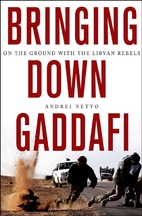
Review: Bringing Down Gaddafi by Andrei Netto

Hardcover, 302 pages
Published 2014 (originally 2012)

Acquired June 2014
Read February 2017
Bringing Down Gaddafi: On the Ground with the Libyan Rebels
by Andrei Netto

I now know more about the Libyan Civil War of 2011 than I did before, which is good, but I don't think Netto told his story as well as he might have. (Though, of course it could always be the fault of his translator.) Netto spent some time with Libyan revolutionary forces during the Arab Spring, and his firsthand experience is valuable, but sometimes I felt like I was drowning in dull details. Periodically, though, a striking event or image manages to break through the monotony: the actual death of Gaddafi, Netto's own time in a Libyan prison (and the events leading up to it), time spent in an overwhelmed hospital after the revolution (the description of how the hospital's pool changed color as people started to bathe in it will stick with me), the discovery that Gaddafi's daughter (supposedly killed in American airstrikes in the 1980s) was alive and well and working as a doctor. A lot of interesting tidbits, but not as interesting an overall package as I'd hoped.

24 February 2017

Well, if you can't get a tenured professor, why not just hire the next guy to break into your headquarters?

My wife and I must be watching tv unusually briskly, because it's been less than a month since we finished series 2 of Primeval, and we're already done with series 3.


It's just not the same without him
saying "anomalies" in his Scottish accent.
You know how television programmes go off the rails sometimes? Just, like, they totally abandon what kind of sense underpinned them? Series 3 of Primeval is like that. You may recall that it's about a crack team of evolutionary biologists hunting temporally displaced animals. Well, one of those biologists (Steve the Sexy Postdoc) died at the end of series 2. Another one (the professor and team leader) dies in episode 3. This leaves just Connor and Abby as the biology experts on the team-- and Connor, I should point out, has suffered the kind of character drift that takes someone from "knows a lot about dinosaurs and Star Trek" to "knows how to hack things and build incredibly complicated technological devices." I mean, he looks geeky, obviously he can do anything the plot requires.

Do military officers really carry
shells on them at all times?
There's a whole sequence of tumultuous cast changes during the series. At the beginning of series 3, Captain Hilary Becker debuts, replacing Steve the Sexy Postdoc as the Sexy Man of Action. Only I could never even remember his name, so nondescript is his character, and generally just called him "Captain Sexy." They make a joke in episode 10 about how he's obsessed with guns and nothing else-- and the joke doesn't land at all because his characterization doesn't even rise to the level of "obsessed with guns and nothing else," as mostly he just stands there.

Danny Quinn first appears in episode 2 of series 3 as a policeman who doesn't play by the rules-- he then forces his way into the team's adventure in episode 4 and ends up becoming the new team leader. Look, I know Primeval was never a sophisticated television show to begin with, but it's completely impossible for me to take seriously. Like, this guy's only credential is that he's a stereotypical television cop, and you're just like, "sure, this guy's suitable for replacing a professor of evolutionary biology as the head of our crack animal-hunting team." In his second episode, he steals a helicopter and fights a Gigantosaurus rex with it. And he's hired! I can't say I ever really warmed to Danny.

Even if you give her a gun, she's still
just too dang nice.
At the end of series 1, Primeval did something genuinely clever: because of a timeline change, Claudia Brown was erased from history and replaced by a new character, Jenny Lewis, played by the same actress. The characters were intended to contrast, I think: Claudia was a mild-mannered civil servant, warm and supportive, while Jenny was a sparky P.R. specialist focused on glamour and with a disdainful attitude toward the team's scientists. Unfortunately, Lucy Brown is, I suspect, just too dang nice, and it never comes off quite like it should, no matter how many times they dress her up in power heels and pencil skirts. By series 3, they seem to have given up on the Claudia/Jenny differences completely, as Lucy Brown is just basically playing the same nice character she played in series 1. Additionally, her role as the team's interface with the lay world seems to have been completely forgotten-- she's just another character. She leaves in episode 5 in any case: the third main character departure in six episodes, meaning the show is down 50% of its original cast.

Sitting around: the only power of the historian.
There's one more new character this season: episode 1 introduces Sarah Page, an Egyptologist who is brought onto the team to help them identify anomaly openings in the historical record. She promptly spends five episodes staying at the base contributing nothing at all, and only one of the ten episodes makes any use of her historical abilities (an almost decent episode where a medieval knight comes through to the present day). I really don't get the point of her character, as she builds almost no rapport with the other team members until the last couple episodes. It's like the writers added her to the team and then forgot about her. Partially I think this is because of the death of Nick: Nick spends the first two episodes of the series obsessing over this time map he's creating with her help, but it's destroyed when he dies. I feel like something was being set up there that was derailed by the unexpected departure of the actor who plays Nick.

The post-Nick team never really clicked for me, and series 3's background plot is terrible. It partially rehashes series 2's, in that the team is up against a conspiracy led by an evil civil servant, but her goals make no sense, and seemingly significant actions have no consequences. In one episode, she actually takes over the ARC, abusing her authority... at the end of the episode, everyone just takes their old jobs back! Like, she ordered them killed on a flimsy pretext, and everyone laughs it off and goes back to work. Long-running villain Helen Cutter completes her descent into irrelevance as well. Early in series 1 she seemed to be working to some kind of mysterious agenda not necessarily contrary to Our Heroes'; by series 3, she just does random shit that's evil (including building a clone army!?).

My wife pointed out that while series 1 and 2 had a succession of exotic locations, series 3 seems to have a succession of interesting vehicles: we have a racecar episode, a dirtbike episode, a helicopter/airport baggage train episode.

Couldn't get their money's worth out of this cast shot, huh?
I guess what I'm saying here is that the third series was not very good. I mean, how many times does their impregnable top-secret facility get broken into?

23 February 2017

Review: The Raw Shark Texts by Steven Hall

Trade paperback, 428 pages
Published 2007

Acquired July 2014
Read October 2014
The Raw Shark Texts by Steven Hall
since his death my Granddad had become more a collection of scenes than a real man to me. (79)
When I was assigned to teach The Modern Novel, I wanted to teach a novel about being a book-- in the physical sense. Novels are often books, of course, but in this electronic age they don't have to be. My students were pretty split on the far-out ideas Hall advances in The Raw Shark Texts-- some thought the book was baffling in the extreme, others thought it was the coolest thing they'd ever read. I'm okay with such a contradiction.

We read the book in the context of what N. Katherine Hayles in Writing Machines calls the "technotext": "When a literary work interrogates the inscription technology that produces it." (An "inscription technology" is a device that initiates material changes that can be read as marks, e.g., print books, computers, telegraphy, video and film, basically any technology that produces interpretable, linguistic information.) When a print book calls attention to the fact that it is a print book, it is a technotext, and Hayles argues that you should look at technotexts not just to see what the text "means," but how that meaning interacts with the material form of the text. (Hayles has actually written about The Raw Shark Texts herself, but ended up going in a different direction than what I'm going to do with her ideas here.)

The Raw Shark Texts is preoccupied with inscription technologies and how we're remediated through them: there's the quotation I opened this review with, but also: the idea that when a person dies, they leave an afterimage in the machinery they set up to run their life, which slowly runs down and dies itself (101); "I think we’re going to wear away from the world, just like the writing wears off old gravestones in the aisles of churches" (229); the narrator, Eric, reading the guidebook of Clio, a woman he supposedly had a relationship with but doesn't remember (266); Eric's admission that the journal we're reading is incomplete: they were never that witty or cool, Clio wasn’t always sexy, and all he has now is stories: "well edited tall tales with us in the starring roles," as the characters in the journal aren’t the two of them but actors regurgitating Hollywood clichĆ©s (412-13). And of course The Raw Shark Texts itself is a life remediated through an inscription technology: we only know what happened to Eric Sanderson because we have this book to tell us.

The book ends ambiguously. Did Eric die? Was anything Eric experienced even real? My students wanted to say "no" to the latter question, that he was hallucinating to cope with grief, but I reject that interpretation on the grounds of it not being very interesting. As for the first question, I think it depends on what you mean by "die." As the book emphasizes over and over again, we are the marks we make on the world. We are the scrapbooks, the gravestone inscriptions, the journals, the stories we wrote down about ourselves. Eric Sanderson didn't die fighting the conceptual shark, and we know this because we're holding Eric Sanderson in our hands. The Raw Shark Texts records his very existence. He is the sum of the inscription technologies used to mark his place in the world, much as we all are. The postcard at the end of the book-- another inscription technology-- shows that he continues to exist, that he hasn't worn away from the world yet.

22 February 2017

Faster than a DC Bullet: Project Crisis!, Part LXIV: Futures End: Five Years Later Omnibus

Comic hardcover, n.pag.
Published 2014 (contents: 2014)
Borrowed from the library
Read November 2016
The New 52: Futures End: Five Years Later Omnibus
by Daniel H. Wilson, Eddy Barrows, Eber Ferreira, Dan Jurgens, Alvaro Martinez, Raul Fernandez, Sean Chen, Mark Irwin, Robert Venditti, Van Jensen, Brett Booth, Norm Rapmund, Jeff Lemire, Andrea Sorrentino, Jed Dougherty, Paul Levitz, Yildiray Cinar, Ray Fawkes, Juan Ferreyra, Dan DiDio, Keith Giffen, Philip Tan, J. M. DeMatteis, Len Wein, Jason Paz, Andrew Guinaldo, Walden Wong, Justin Gray, Jimmy Palmiotti, Scott Hampton, Charles Soule, Jesus Saiz, Tom Derenick, Francis Portela, Phil Winslade, Martin Coccolo, Aaron Lopresti, Igor Lima, Ruy Jose, Rodney Buchemi, Geraldo Borges, Justin Jordan, Diogenes Neves, Marc Deering, J. Calafiore, Cullen Bunn, Tom King, Tim Seeley, Stephen Mooney, Sholly Fisch, Pat Olliffe, Tom Nguyen, Scott Lobdell, Scott Kolins, Christy Marx, Robson Rocha, Oclair Albert, Julio Ferreira, Gail Simone, Javier Garron, Marc Andreyko, Jason Masters, Eduardo Pansica, Amanda Conner, Chad Hardin, Derek Fridolfs, Brian Buccellato, Scott Hepburn, Cliff Richards, Fabrizio Fiorentino, Scott Snyder, ACO, Greg Pak, Jack Herbert, Vicente Cifuentes, Sean Ryan, Andre Coelho, Scott Hanna, Will Pfeifer, Andy Smith, Keith Champagne, Rags Morales, Jose Marzan Jr., Matt Banning, Bart Sears, Frank J. Barbiere, Ben Caldwell, Tony Bedard, Emanuela Lupacchino, Ray McCarthy, Pascal Alixe, Lee Weeks, Moritat, Will Conrad, Steve Lightle, Stephen Thompson & Ron Frenz

Five years before the "present," the New 52 version of the DC Universe came to life in Zero Year; now, five years after, it comes to an end. The Five Years Later Omnibus presents endpoints for the 52-ish comic books of the New 52. The future in which these stories take place is somewhat obscure: the back cover actually gives the history of a world thirty-five years later, and talks about Batman Beyond, who appears in literally zero of the issues collected here. The blurb ends by saying "Learn how all this and more could come to pass," but the book is actually very poor at filling in backstory; it took me around half the book to piece together that the Prime Earth had been overrun by refugees from Earth-2, and that Darkseid's forces had invaded at some point. I'm not sure if more things happened to create the dark timeline we see, though. Plus, some of the stories aren't consistent with one another: Justice League Dark: Futures End #1 claims that Etrigan is trapped in the House of Mystery outside time and space, but Etrigan also appears in Gotham City in Batwoman: Futures End #1, where he is killed.

Unlike the previous New 52 omnibi, this one isn't subdivided, so I'll just be reviewing the stories en masse, first with some comments on the overall set-up and then hitting up some specific stories. Of the three New 52 omnibi I've read, I found this one the most frustrating. Even though none of the stories in the first omnibus came to an end, they were all designed for new readers; most of the stories in the Villains Omnibus were easily grasped one-shots. But despite being set five years into the future, most of the stories here seemed really embedded in the continuity of the ongoings they span out of-- so too bad for me if I haven't been keeping up with Aquaman and the Others. I pick on it here because it was one of the first stories in the book, and it's filled with characters I knew nothing about, depicting alterations to a status quo I'd never seen before. Unfortunately a lot of the early stories in the book are like this: Flash, Green Arrow, Infinity Man and the Forever People, Star Spangled War Stories were also virtually impossible for me to understand.

I do feel like the artistic quality was higher across the board in this one-- take this nice linework and coloring as Billy Batson talks to Lois Lane, for example.
from Superman: Futures End #1 (script by Dan Jurgens, art by Lee Weeks)

The best stories, I found, drew on nothing more than the basic premises of their characters, meaning that I could be oriented without much effort. For example, the Phantom Stranger tale didn't really depend on me knowing anything particular to the New 52 version of the Phantom Stranger-- it worked as a standalone final Phantom Stranger story, as the Stranger (who you may know better as Judas Iscariot) is called up for judgement a second time, but the jury is made up of the worst demons Hell has to offer. I enjoyed its spooky, weird, mythical tone, even though the last Phantom Stranger stories I read were from his Action Comics Weekly feature back in the 1980s.