07 January 2008

Archival Review: A Portrait of the Artist as a Young Man by James Joyce

Trade paperback, 400 pages
Published 2005 (originally 1914-15)
Acquired January 2007

Read December 2007
A Portrait of the Artist as a Young Man
by James Joyce

I read this in high school.  I liked it all right, but I like Joyce's short fiction better.  I had to read it again in a class I took in the spring of 2007, but a misunderstanding in our assignments meant I fell behind and had to skip sections 3 and 4 so I could give a presentation on section 5.  So I slotted the book into my list, and finally got around to reading those missing sections.  They're the parts where Stephen renounces sin (following the amazing description of hell) and then, some time later, also rejects the priesthood.  Which ties into what our professor told us-- Stephen has to reach a point where he doesn't make one of two choices, but rejects the choice altogether.  Whatever.  It's James Joyce, and he really needs to discover the quotation mark.

Archival Review: Star Trek: Titan: Sword of Damocles by Geoffrey Thorne

Mass market paperback, 352 pages
Published 2007
Acquired November 2007

Read December 2007
Star Trek: Titan: Sword of Damocles
by Geoffrey Thorne

I think that, of all the current ongoing concepts in the world of Trek fiction, it is that of Titan that excites me the most.  I will very likely renege on that with some other review, but it's true enough now.  The latest installment in the series was my favorite yet.  It's got some complicated time travel stuff that made my head hurt (and normally I like those sort of things), but the handling of the characters, especially Vale, Dakal, Modan, Xin, Huilan, and (most of all) Jaza made it shine; Dakal is rapidly shaping up to be a favorite character of mine. The amount of exploration that can be done within Titan as well as without continues to impress; I look forward to the series continuing after the Destiny mega-event at the end of the year.

Reading Roundup Wrapup: December 2007

At the beginning of last month, I maintained a high reading rate-- about one book per day!  Of course, you shall soon see that wasn't a difficult rate to maintain, though, given the books I read.  The Dragonriders of Pern killed all that, as did Christmas festivities and trips to exotic lands.  Still, I eked my way through a couple more books.

In the month of December, I read fifteen books, and this is what they were:

1. Star Trek: Titan: Sword of Damocles by Geoffrey Thorne
2. Wisdom: Rudiments of Wisdom by Paul Cornell
3. Case Studies in Contemporary Criticism: A Portrait of the Artist as a Young Man by James Joyce
4. Star Trek: Klingons: Blood Will Tell by Scott Tipton and David Tipton
5. The New Doctor Who Adventures: Just War by Lance Parkin
6. The Positronic Man by Isaac Asimov and Robert Silverberg
7. Doctor Who: The Completely Useless Encyclopedia (Incorporating the Junior Doctor Who Book of Lists) by Chris Howarth and Steve Lyons
8. The Malcontent by John Marston with John Webster
9. The Naked Sun by Isaac Asimov
10. Marvels by Kurt Busiek
11. Angels & Insects by A. S. Byatt
12. The Dragonriders of Pern by Anne McCaffrey
13. Troubled Waters by C. Cuadra and R. Miel
14. Star Wars: Legacy of the Force: Fury by Aaron Allston
15. Doctor Who: Short Trips 15: The History of Christmas edited by Simon Guerrier

Books acquired in the month of December:1. Star Trek: Klingons: Blood Will Tell by Scott Tipton and David Tipton
2. Better Home and Gardens Step-By-Step Household Repairs3. Isaac Asimov's Caliban by Roger MacBride Allen
4. A Case of Conscience by James Blish
5. Star Trek: Corps of Engineers: Creative Couplings by John S. Drew, Glenn Greenberg, Glenn Hauman, Aaron Rosenberg, David Mack, Dayton Ward, Kevin Dilmore, J. Steven York, and Christina F. York
6. Star Wars: Legacy of the Force: Fury by Aaron Allston
7. Troubled Waters by C. Cuadra and R. Miel
8. Doctor Who: The Encyclopedia: A Definitive Guide to Time and Space by Gary Russell
9. Tales from Earthsea by Ursula K. Le Guin
10. Deception on His Mind by Elizabeth George
11. In Pursuit of the Proper Sinner by Elizabeth George
12. The Dord, the Diglot, and an Avocado or Two: The Hidden Lives and Strange Origins of Words by Anu Garg
13. Doctor Who: The Visual Dictionary by Andrew Darling, Kerrie Dougherty, David John, and Simon Beecroft
14. Doctor Who: Short Trips 18: Time Signature edited by Simon Guerrier
15. Wessex Tales: That Is to Say, The Three Strangers, A Tradition of Eighteen Hundred and Four, The Melancholy Hussar, The Withered Arm, Fellow-townsmen, Interlopers at the Knap, The Distracted Preacher by Thomas Hardy

I have some stories to tell about some of these acquisitions, but those will probably come later, in another entry.

Books remaining on "To be read" list: 117

01 December 2007

Archival Review: Star Wars: Republic Commando: True Colors by Karen Traviss

Mass market paperback, 482 pages
Published 2007
Acquired and read November 2007
Star Wars: Republic Commando: True Colors
by Karen Traviss

The Republic Commando series continues from strength to strength-- I thought the first volume, Hard Contact, was all right, but the second, Triple Zero, was excellent, and though this one is not quite as good as that, it is by no means bad.  It's less focused than the second book, gathering in a number of characters in unrelated situations across the galaxy, which is its biggest flaw, but it does have more rocking commando action.  As always, Traviss's biggest strength is the ability to get inside the heads of her characters.  The viewpoint of each one is strong and distinct, almost overpoweringly so-- you find yourself believing whatever the viewpoint character believes quite often.  It's a different perspective than most other novels-- focusing on Jedi characters-- give us on the Clone Wars, and it's a welcome one, too.  These are a group of clones with a little more awareness of their plight, and that raises some intriguing questions about the morality of the Clone Wars. 

I look forward to the further of adventures of Delta Squad, Omega Squad, the Nulls, and the Cuy'val Dar in Order 66, though I'm bummed out that that has to be a hardcover.  I really must pick up Traviss's original sf someday.

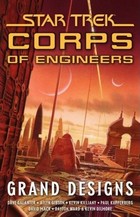
Archival Review: Star Trek: Corps of Engineers: Grand Designs by Dave Galanter, Allyn Gibson, Kevin Killiany, Paul Kupperberg, David Mack, and Dayton Ward & Kevin Dilmore

Trade paperback, 640 pages
Published 2007 (content: 2004)
Acquired August 2007
Read November 2007
Star Trek: Corps of Engineers: Grand Designs
by Dave Galanter, Allyn Gibson, Kevin Killiany, Paul Kupperberg, David Mack, and Dayton Ward & Kevin Dilmore

This collection only holds six S.C.E. stories (probably because Kevin Killiany writes so much), but that's all right-- includes three of my favorites.  Ring Around the Sky by Allyn Gibson is a beautiful look into new character Mor glasch Tev, Orphans by Kevin Killiany is a distinctively-written tale featuring Klingon engineers (who have disappointingly not yet returned), and Sargasso Sector by Paul Kupperberg is just plain fun.  And this time around, I enjoyed the other three stories more so than I remember previously, making this quite possibly the best stretch of S.C.E. stories in the series's existence-- the events of Wildfire certainly paid off in spades from a storytelling perspective, as its ramifications inform almost all of the tales in this volume.

Archival Review: Star Trek: Corps of Engineers: Aftermath by Christopher L. Bennett, Loren L. Coleman & Randall N. Bills, Robert Greenberger, Michael A. Martin & Andy Mangels, and Aaron Rosenberg

Trade paperback, 640 pages
Published 2006 (content: 2003-04)
Acquired November 2006
Read November 2007
Star Trek: Corps of Engineers: Aftermath
by Christopher L. Bennett, Loren L. Coleman & Randall N. Bills, Robert Greenberger, Michael A. Martin & Andy Mangels, and Aaron Rosenberg

This is the first of the rebranded, trade paperback collections of the S.C.E. series, collecting the first eight eBooks following the da Vinci's return to space after the Galvan VI disaster.  As always (am I possibly biased?), the series provided cracking adventures, intriguing dilemmas, and solid character work.  My favorite from this volume is The Demon by Loren L. Coleman and Randall N. Bills, the intense story of a journey deep into a black hole, almost to its event horizon.  What struck me most, reading these all at once for the first time, is the (welcome) increased focus on Soloman in this volume-- Ishtar Rising is all about him, of course, but Buying Time and Collective Hindsight also contain some very good moments for my favorite Bynar, who seems to fall by the wayside a little more often than one might like.

Archival Review: I, Robot: The Illustrated Screenplay by Harlan Ellison with Isaac Asimov

Trade paperback, 288 pages
Published 2004 (originally 1974)
Acquired March 2007
Read November 2007
I, Robot: The Illustrated Screenplay
by Harlan Ellison with Isaac Asimov

This isn't the script of the dreadful Will Smith film from a few years ago, but rather Ellison's 1970s straight adaptation of the Asimov "story-cycle", which never got produced because Ellison doesn't know when it pays to be polite to people.  It's an interesting thought experiment, though-- visually, it would have made a magnificent film, as the gorgeous illustrations show, though it's hard to imagine it satisfactorily being pulled off in the 1970s.  Nowadays, though... 

The adaptation of the chosen short stories is handled quite well-- inserting Calvin into "Robbie" is an obvious but excellent choice; I was surprised but happy to see "Runaround" included, as it's one of the best "Law problem" stories, and the addition of Calvin works; "Liar!" is adapted almost exactly, which makes sense, as it's probably the best Calvin story Asimov ever wrote; and "Lenny" might not actually be in the original book, but its method of inclusion here is inspired.  All in all, it makes for an excellent (and ultimately much more optimistic than Asimov's own) vision of the future of mankind.  The world is clearly not a Asimov one, though, but rather an Ellison one, and though that bothered me at times, it's the nature of adaptations.  If there's any substantial flaw, it's that the frame story is a little too long and involved; not everything that that happens in it is particularly relevant to the story Ellison is trying to tell.  But as for Calvin, Byerley, Powell, Donavan, and the rest, this is the cinematic treatment they deserved.

Archival Review: The New York Trilogy by Paul Auster

Trade paperback, 400 pages
Published 2006 (content: 1985-86)
Acquired January 2007
Read November 2007
The New York Trilogy
by Paul Auster

After a number of quick and easy reads, it was time for something more substantial-- and substantial is what this book has in spades. In a class I took last fall, we read the comic book adaptation of Paul Auster's City of Glass by Paul Karasik and David Mazzucchellil, and having thoroughly enjoyed it, I picked up a (extraordinarily handsome) omnibus edition of the original novel and the other two installments in the series.  There's something about Auster's prose that keeps you reading, even though you have no idea what's happening at times.  Well, that's not fair-- I always knew what was happening, but rarely why, as some pretty dang bizarre things happened.  But I suspect that's not the point.  What links these three pseudo-detective stories together far more than their setting is their ideas-- about identity and about language, primarily, but a lot else, too. (As a side note, I was astounded at how accurate an adaptation the comic book was, despite its length.  Very rarely did I come across anything in the novel that I didn't remember from the comic, and if anything, the excellent art in the comic only added to the effect of the story.)

Archival Review: [nemesis], Volume One: Chapters 1-4 by Greg Holkan

Comic trade paperback, 104 pages
Published 2006
Read November 2007
[nemesis], Volume One: Chapters 1-4
by Greg Holkan

[nemesis] is possibly my favorite webcomic and certainly the one with the best art, but it suffers in its weekly Internet format-- as this collection shows, it's really meant to be read in large, continuous chunks. It's about superheroes; the world it occurs in is basically a combination of ideas from the DC and Marvel universes. But this world's "Superman"-- Mister Zenith-- has been murdered. And in a world where only "numen" can serve as law enforcement officers, it's up to Rick Murphy, the only normal human on the police force, to solve the case. After all, who would want to murder Superman? Holkan's vaguely manga-ish art is excellent, and his writing extraordinary-- he deftly weaves together disparate stories about a number of different characters affected directly and indirectly by the death of Mister Zenith. I will continue to eagerly read this story (usually) every week online, and will certainly buy another collected edition when it comes.

Archival Review: Norby Through Time and Space by Janet and Isaac Asimov

Mass market paperback, 202 pages
Published 1988 (content: 1986-87)
Acquired March 2007
Read November 2007
Norby Through Time and Space
by Janet and Isaac Asimov

This YA series about Norby, the Mixed-Up Robot, was one of my favorite reads as a child, not to mention my introduction to Isaac Asimov (even if Janet actually did do all the writing). Occasionally, I come upon paperback versions in used bookstores that collect two of them together, and I snatch them up instantly. This one collects Norby and the Queen's Necklace (what I remembered as my favorite) and Norby Finds a Villain.

It's excellent YA literature, with a decent breadth of imagination on display in just these two stories. Jeff and Norby and a variety of other characters find themselves in the near future, pre-Revolutionary France, Roman times, prehistoric times, far-future utopias, far-future dystopias, hyperspace, aberrant future versions of Mars, and dangerous alternate realities just within the confines of these two short tales! Norby himself is as fun as ever, and the supporting cast doesn't disappoint. The Queen's Necklace isn't quite as good as I remember (not all of the temporal shenanigans actually work out in the end), but it's solid fun, as is Finds a Villain.