03 May 2022

Reading Roundup Wrapup: April 2022

Pick of the month: True Believer by Abraham Riesman. I was dithering over this, wondering what I would pick just a couple days ago. Then I sped through this book and knew right away. It was my first Hugo Award for Best Related Work finalist, and I found this Stan Lee biography compelling, insightful, sad reading. We'll see how things go, but I feel like it's the one to beat in Related Work.

All books read:

  1. The James Bond Omnibus, Volume 002 by Jim Lawrence, Yaroslav Horak, et al.
  2. Ground Zero: Collected Comic Strips from the pages of Doctor Who Magazine by Scott Gray, Martin Geraghty, Alan Barnes, Gareth Roberts, Adrian Salmon, et al. 
  3. JSA by Geoff Johns, Book One by Geoff Johns, David Goyer, Stephen Sadowski, Michael Bair, et al. 
  4. Rinkitink in Oz by L. Frank Baum, illustrated by John R. Neill 
  5. Once & Future, Volume Three: The Parliament of Magpies by Kieron Gillen and Dan Mora 
  6. The Galaxy, and the Ground Within by Becky Chambers 
  7. A Psalm for the Wild-Built by Becky Chambers 
  8. True Believer: The Rise and Fall of Stan Lee by Abraham Riesman 

A bit of a slow beginning had me worried, but you can see my Hugo reading taking off with #5 had me regaining lost ground.

All books acquired:

  1. Rinkitink in Oz by L. Frank Baum, illustrated by John R. Neill
  2. Transformers: Way of the Warrior by Simon Furman, Simon Coleby, Staz Johnson, et al.
  3. Terra Ignota, Book IV: Perhaps the Stars: A Narrative of Events begun in the year 2454 by Ada Palmer
  4. Aspects by John M. Ford
  5. Monstress, Volume Six: The Vow by Marjorie Liu and Sana Takeda
  6. Strange Adventures by Tom King, Mitch Gerads, and Evan "Doc" Shaner
  7. The Galaxy, and the Ground Within by Becky Chambers
  8. A Master of Djinn by P. Djèlí Clark
  9. Far Sector by N. K. Jemisin and Jamal Campbell
  10. The Lonely Computer and Other Internet Doctor Who Short Trips, 2004-21
  11. The Lost Princess of Oz by L. Frank Baum, illustrated by John R. Neill
  12. The Tin Woodman of Oz: A Faithful Story of the Astonishing Adventure Undertaken by the Tin Woodman, assisted by Woot the Wanderer, the Scarecrow of Oz, and Polychrome, the Rainbow's Daughter by L. Frank Baum, illustrated by John R. Neill
  13. The Magic of Oz: A Faithful Record of the Remarkable Adventures of Dorothy and Trot and the Wizard of Oz, together with the Cowardly Lion, the Hungry Tiger and Cap'n Bill, in their successful search for a Magical and Beautiful Birthday Present for Princess Ozma of Oz by L. Frank Baum, illustrated by John R. Neill

A lot! #5-9 were all Hugo finalists, with more to come.

All books on "To be read" list: 685 (down 1)

02 May 2022

"One day, Grant Emerson was just an ordinary teenager—until he suddenly discovered that he possessed explosive powers that he could barely control [...]. Now Grant uses his amazing powers as the super-teen DAMAGE!"

Damage was a 1994-96 ongoing comic series, part of what was a bit of a "super-teen" boom at the time (e.g., Impulse, The Ray, &c.). I have only read one previous issue of it, its contribution to the Siege of the Zi Charam crossover, which also involved The Darkstars. My impression was not very flattering: I had the vibe that it was one of those Imageesque 1990s comics, lots of "attitude" and explosions and bulging muscles. I would never have read it if it wasn't for a comment on my review of The Young All-Stars, where the mysterious CE of Collected Editions asked if its Iron Munro appearances "address or tie up anything from Young All-Stars." Iron Munro appearances!?, I asked. And it was duly added to my ever-expanding reading list. (This series of posts has just about ended its second year, and is on its twenty-fourth regular installment; I currently estimate it will run at least twenty more!)

The series opens with some pretty typical teen superhero stuff: Grant feels awkward in school, mostly because his parents move around a lot for work (his dad works for the Symbolix Corporation*), so he's never in one place for long. There's a mean jock, a nerdy friend, and a hot girl all in his supporting cast. Then he discovers he has superpowers... and then his parents are killed... and then he learns they weren't his parents at all, but raising him as an experiment for Symbolix. Soon Grant inadvertently blows up his high school, plays a key role in Zero Hour: Crisis in Time, gets exiled from Atlanta, learns he's the result of a genetic experiment by Vandal Savage, and joins the Teen Titans! The seeming Spider-Manesque premise of the opening couple issues is nothing but a feint.

Unfortunately, I think I would have enjoyed the feint more than I did the actual direction of the series. It becomes too much about what Grant's origin was... a question that really does not matter to him as a character! I mean, once you know he was a genetic experiment from Symbolix, does it matter what character was his natural-born parent, or who his genetic donors were? Ultimately, we find out that he was the child of the Al Pratt, the Golden Age Atom, and his wife Mary; Mary died in childbirth and Vandal Savage spirited away the child Al never knew he had and infused him with the DNA he'd collected from about twenty other members of the JSA and JLA. This takes two different storylines to figure out, but it's totally irrelevant. Like, does it matter if he has Martian Manhunter DNA? How could it? Especially given Al Pratt died during the Crisis in Time, so Grant will never know his real parents.

On top of that, the origin is pretty distasteful in the way it disposes of Mary Pratt, turning her into a female victim to give angst to its male lead. This is something the series excels at, because Grant's would-be girlfriend is brutally murdered to give him something more to angst about. I was like, "Wow, this is textbook fridging"... and then a couple issues later Kyle Rayner turns up to commiserate about his girlfriend was brutally murdered to give him something to angst about! Don't worry, though, by the end of the series Grant has hooked up with her hot college-age sister! (The nerdy friend is also brutally murdered.)

I did like the character of Wyldheart, another Symbolix experiment who is implied to be a foundling from New Genesis, but she vanishes after issue #8. (The DC wiki tells me she will pop up over a decade later in a JSA All-Stars story, but that's it.) The last few issues have Damage having visions of a mysterious figure, but who this is is never explained. There was obviously a lot of stuff this series wanted to do that it never got to in its twenty-one issues.

Too much of the series is given over to long fight scenes, which I quickly found dull. There's also a confusing proliferation of mediocre 1990s "xtreme"-style villains. You know the type. I just ultimately found little in this series that interested me, despite a promising start. The issue I liked the most was #7, "Control...", where Grant is put on trial for the destruction he caused in his opening story arc. It's one of the few times this series slows down and examines Grant as a person and lets us see how events are actually affecting him without incessant boring fight scenes. I also liked the issue where Grant visits his (adoptive) uncle in prison... who turns out to be the supervillain Doctor Polaris! Again, we get some nice conversations that focus on the characters. More like these, and I would have liked this series a lot more.

As for Iron Munro, Arn Munro of The Young All-Stars? In the opening story arc, he's based in Tampa (where I live!), working as an agent for the U.S. government. He gets involved in Damage's problems, and Grant briefly thinks he might be the child of Iron Munro and the original Phantom Lady, who we learn eventually became romantically. (No mention is made of any of Arn's teammates, not even Helena "Fury" Kosmatos, who he was romantically involved with last we saw.) Both characters ran afoul of perennial All-Star Squadron and Golden Age Wonder Woman foe Baron Blitzkrieg, which was a nice callback. For a few issues, Iron Munro even gets a cover feature! I was pretty amazed that five years on, anyone remembered him enough to use him, even if just as a red herring. Given he's fifty years older than last we saw him, though, he's a pretty different person. It is a nice touch that his files are code-named "Gladiator."

* Not, as I thought based on the lettering in the first couple issues, the Symboux Corporation. A sloppy handwritten "LI" can easily look like a "U"! I figured they were French.

This post is twenty-fourth in a series about the Justice Society and Earth-Two. The next installment covers The Justice Society Returns! Previous installments are listed below:
  1. All Star Comics: Only Legends Live Forever (1976-79)
  2. The Huntress: Origins (1977-82)
  3. All-Star Squadron (1981-87)
  4. Infinity, Inc.: The Generations Saga, Volume One (1983-84)
  5. Infinity, Inc.: The Generations Saga, Volume Two (1984-85)
  6. Showcase Presents... Power Girl (1978)
  7. America vs. the Justice Society (1985)
  8. Jonni Thunder, a.k.a. Thunderbolt (1985)
  9. Crisis on Multiple Earths, Volume 7 (1983-85)
  10. Infinity, Inc. #11-53 (1985-88) [reading order]
  11. Last Days of the Justice Society of America (1986-88)
  12. All-Star Comics 80-Page Giant (1999)
  13. Steel, the Indestructible Man (1978)
  14. Superman vs. Wonder Woman: An Untold Epic of World War Two (1977)
  15. Secret Origins of the Golden Age (1986-89)
  16. The Young All-Stars (1987-89)
  17. Gladiator (1930) ["Man-God!" (1976)]
  18. The Crimson Avenger: The Dark Cross Conspiracy (1981-88)
  19. The Immortal Doctor Fate (1940-82)
  20. Justice Society of America: The Demise of Justice (1951-91)
  21. Armageddon: Inferno (1992)
  22. Justice Society of America vol. 2 (1992-93)
  23. The Adventures of Alan Scott--Green Lantern (1992-93)

29 April 2022

Jessie Sima Does It Again

A friend of mine recently asked on facebook for children's board books recommendations, and I recommended Three Grumpy Trucks by Todd Tarpley and Guy Parker-Rees, which is a favorite of mine that I haven't seen people discuss elsewhere, so I often recommend or buy it when the opportunity arises. One thing I couldn't recommend in this context, though, was the work of Jessie Sima, which skews a bit older than the asker was looking for.

Last week, I was at Barnes & Noble with our two kids, looking for a book: Son One had been invited to the birthday party of a classmate, and we needed a present. We ended up buying Joseph Kuefler's The Digger and the Duckling, the sequel to The Digger and the Flower (both great books, very charming), but in the back of my mind I had the idea that we'd grab a book for ourselves as well.

What book this would be was foreordained the moment I saw that Jessie Sima had a new book out, and that it was just $10 if you bought it with any other kid's book. I am fairly certain that our first Jessie Sima book was Not Quite Narwhal, gifted to us by our friends Kim and Mike when Son One was due. It's about a unicorn who lives under the ocean with narwhals and feels like he doesn't fit in; eventually, he discovers there's a group of creatures like him on the surface... but maybe he doesn't quite fit in with them either. Double consciousness in children's picture book form!

It quickly became a favorite of mine for reading aloud. Good message about accepting yourself and difference, but also I think Sima has an incredibly strong sense of visual storytelling. I felt quite certain they must have had some background in comics or film or something, because all of their books do interesting things with "camera angles" and pacing, using them to emotional effect. I feel like even well-illustrated picture books often "shoot" everything from the same angle, like a tv show that doesn't have the time to do the interesting camera set-ups you see on film. Sima goes high or low as needed. Not too much, but enough to translate the feelings of their characters in illustrated format. But nope, no comics background... they didn't even go to, say, art school. Entirely self-taught!

Here's another one of my favorite pages from Not Quite Narwhal...
In this interview, they talk about the importance of the page turn, and that's certainly my favorite moment in Not Quite Narwhal. Kelp goes back into the ocean, but feels sad he is away from his new surface friends. Does he have to choose? We get a three-page sequence that explains how he does not:

  1. On the first page, there's a lot going on (you would say it has three "panels" if it was a comic), but it ends with the words, "But then he realized that maybe..."
  2. Then you go to the next page, which is a big two-page spread. On the left, Kelp is riding on the back of one of his narwhal friends, going toward the beach, which is on the right, with the unicorns waiting. The camera is placed high, looking over Kelp's shoulder down at the beach. The only words here are "just maybe..." The image is mostly empty, filled with the surface of the sea.
  3. Then there's a final, busy two-page spread of a beach party, joined by unicorn and narwhal alike. The book ends with the words, "he didn't have to choose."

To me, the "just maybe..." page really captures the emotion of anticipation; almost four years later, I still get shivers every time I read it. Just a masterpiece of visual storytelling. It's not flashy, I don't think, but it is supremely effective.

Since then, we've kept an eye out for new Jessie Sima books, and have enjoyed every one of their books we've gotten. Harriet Gets Carried Away is about a girl whose tendency to be distracted accidentally sends her to Antarctica (an incidental detail is that her parents are a mixed-race, same-sex couple). Like Not Quite Narwhal, it has a great anticipatory two-page spread at the end as some penguins carry Harriet back to New York City. Spencer's New Pet is a largely textless book, a humorous story about a boy and his balloon dog. It has a twist that made me jump and laugh on my first read. Love, Z is my favorite other than Not Quite Narwhal, about a young robot who discovers the word "love" and when his family tell him the word "DOES NOT COMPUTE," goes on a quest to discover its meaning. It has a great two-page spread where Z is drifting aimlessly on a boat, despairing that he will ever learn the meaning of the word.

...a page quite cleverly echoed by Perfectly Pegasus.
I see now, looking them up on LibraryThing, that a couple Jessie Sima books have actually passed us by, but in B&N last week, prominently displayed on a shelf was their newest one, Perfectly Pegasus. This is actually a sequel to Not Quite Narwhal, thematically complementary to the original, as well as borrowing its structure; it's about a pegasus named Nimbus who grows up in the sky... all by herself, but her pursuit of a wishing star takes her down to the Earth, where she meets Kelp.

It echoes the original without being derivative, and even Son One realized this. Before I read him the book, he paged through it himself in his carseat on the drive home, and he provided a running commentary, and noted some similarities in structure/technique with Not Quite Narwhal. Plus, he was totally delighted when Kelp made his reappearance. It has a great "just maybe..." moment, a heartwarming message, and a nice sense of humor.

No one ever asks me this, but were they to do so, I would tell them that Jessie Sima is my favorite working picture book author/illustrator. So yeah, they've done it again! (Hold on, gotta go add Hardly Haunted and Jules vs. the Ocean to my kids' Amazon wishlist.)

These books are just a tad too big for the bed of my scanner, so they are cut off and blurry... and it is totally impossible for me to get a scan of any of the two-page spreads I discuss here.

27 April 2022

The Age of Chaos (From Stockbridge to Segonus: A Doctor Who Magazine Comics Marathon, Part 22)

 The Age of Chaos: Collected comic strips from the pages of Doctor Who Magazine
by Colin Baker, John M Burns, Barrie Mitchell, Paul Cornell, Gareth Roberts, Lee Sullivan, et al.

Collection published: 2021
Contents originally published: 1991-2001
Acquired: December 2021
Read: January 2022

I debated a bit where I should read this. By my usual rules, it would clearly go much later, as the one DWM strip it contains was published in 2001, among those reprinted in the Oblivion collection. But that seemed silly. Given I was skipping The Age of Chaos itself (having already read it on its own between The World Shapers and A Cold Day in Hell!), I decided to violate my usual rules and read where it made the most narrative sense: as the other strips collected here are all seventh Doctor ones in the New Adventures era, I read it as the coda to that run, prior to the transition to "past" Doctors that would come with the strips collected in Land of the Blind.

Under Pressure, from Doctor Who Yearbook 1992
story by Dan Abnett, pencils by Vincent Danks, inks by Cam Smith, colour by Louise Cassell, letters by Glib

The seventh Doctor tells Ace a story of the time the fourth Doctor (on a submarine) secretly helped the third and Jo (on a surface vessel) avert a crisis with the Sea Devils. It's pretty charming: Abnett captures the voices of both past Doctors pretty well, and the ways the fourth Doctor helps the third are fun. There are some good moments, such as the fourth ingratiating himself with the submarine's captain. My main issue is the Sea Devils never feel like much of a threat, as we barely see them. I did really like the panel of them all swimming around the sub, the kind of thing you could never afford to do onscreen, but it comes after they've been neutralized. But it's enjoyable enough.
from Doctor Who Yearbook 1993
Metamorphosis, from Doctor Who Yearbook 1993
story by Paul Cornell, art by Lee Sullivan, colour by Louise Cassell, letters by Annie H.
The seventh Doctor and Ace battle (spoiler) Daleks on a space freighter. As Cornell says in his notes, this is pretty generic action-adventure stuff, but it's good anyway, lifted by some cool ideas (there's a reason Steven Moffat stole the "eggs" bit, and the Doctor becoming a Dalek is good, too), some horrific ones (human embryos mutated into Daleks!), and some excellent artwork from Lee Sullivan. Sullivan draws great Daleks, but also a strong Doctor and Ace, capturing their facial expressions well, and clear action sequences. Generic... but solid. The last line is a groaner, in the most delightful way.
from Doctor Who Magazine #305
The Last Word, from Doctor Who Magazine #305 (June 2001)
story by Gareth Roberts, art and colours by Lee Sullivan, lettering by Roger Langridge
And here, the comic strip adventures of the seventh Doctor, Ace, and Benny come to an end. For reasons I didn't understand, this is framed as the Doctor writing up an account (in the third person) of a recent adventure the TARDIS crew had. The adventure itself is somewhere between a parody and a pastiche of the Virgin New Adventures: Gareth Roberts lists all the tropes in the notes at the end, but I picked out most of them myself. Journeys into 1970s pop culture, overcomplicated plots, a voyage into "puterspace," and the Doctor being mentally tormented by all the people and planets he's let die. I had fun, and it mostly comes across as good-spirited. It's funny, though, that despite being a DWMification of the VNAs, it doesn't feel anything like the actual DWM strips that tied into the VNAs! I feel like it makes a better finale to this era than Cuckoo/Uninvited Guest, so I'm glad I read it here. With a wink and tounge-in-cheek, it's time to switch to something completely different!
Stray Observations:
  • Since all these are outside of the usual DWM context, there's no clear chronological placement; what I can see online (from the "Interweaving with the New Adventures" article and various fan sites) disregard the clues in the stories themselves. Under Pressure's Ace seems to be pre-Spacefleet, while Metamorphosis's is afterwards (though Benny is not around). The Last Word could go pretty much anywhere during Ace and Benny's travels, as long as enough time has passed for Ace and Benny to become aware of the clichés of their own lives.
  • from Doctor Who Yearbook 1992
  • I found Vincent Danks and Cam Smith's art on Under Pressure kind of flat, but looking at the uncolored pages in the back, it seems that this is down to the coloring eliminating some of the finer linework.
  • Gareth Roberts in the notes: "imagine a world where you could not even know what a minority of random noisy strangers were saying on the internet, and where nobody cared about them, took them seriously, or reacted to them." Gee, why would you hope for such a thing, Gareth?

This post is the twenty-second in a series about the Doctor Who Magazine comic strip and Marvel UK. The next installment covers Land of the Blind. Previous installments are listed below:

  1. The Iron Legion
  2. Dragon's Claw 
  3. The Transformers Classics UK, Volume One
  4. The Tides of Time
  5. The Transformers Classics UK, Volume Two
  6. Voyager
  7. The Transformers Classics UK, Volume Three
  8. The World Shapers
  9. The Transformers Classics UK, Volume Four
  10. The Age of Chaos
  11. The Transformers Classics UK, Volume Five
  12. A Cold Day in Hell!
  13. Death's Head: Freelance Peacekeeping Agent (part 1)
  14. Nemesis of the Daleks
  15. Death's Head: Freelance Peacekeeping Agent (part 2)
  16. The Good Soldier
  17. The Incomplete Death's Head
  18. Evening's Empire
  19. The Daleks
  20. Emperor of the Daleks
  21. The Sleeze Brothers File

25 April 2022

The Sleeze Brothers File (From Stockbridge to Segonus: A Doctor Who Magazine Comics Marathon, Part 21)

The Sleeze Brothers File

Collection published: 1990
Contents originally published: 1989-90
Acquired: November 2021
Read: December 2021

Masterminds: John Carnell and Andy Lanning*
Writer: John Carnell
Blueprints: Andy Lanning, with Dave Hine and Stephen Baskerville
Colour-Man: Steve White
Calligraphic Crimes: Helen Stone and Bambos

Now that I've finished (mostly) tracking Death's Head's trajectory out of Doctor Who Magazine, I wanted to follow a different Marvel UK spin-off, the Sleeze Brothers, the shady P.I.s introduced in Follow That TARDIS! back in A Cold Day in Hell! At the time, I wrote, "The Sleeze Brothers went on to have their own comic series from Marvel. The Tardis wiki doesn't count it as part of the Doctor Who universe, but who knows why. [...] You can get it pretty cheap on the secondary market, but I am not sure I am motivated to do so..." And yet, I was! I am not sure if I could explain why, except that I found something charming and uniquely Marvel UK-ish about the whole thing. The pastiche-heavy future world of these strips struck me as being very much of a piece with Russell T Davies's "New Earth" setting, and thus something that fit into the Doctor Who universe in spirit, if not in continuity. (Though, having read them all now, they totally could be part of the Doctor Who universe.)

This contains six single-issue stories, plus an eight-page prologue establishing how the Sleeze Brothers—formerly minor criminals—became private investigators. If you read interviews about this series, it's often stated that despite the fact that though it seems like a Blues Brothers rip-off, it's really not; this is totally belied by this story, which opens just like the film, with El Ape Sleeze (or "El'ape" in some of the stories) meeting his brother Deadbeat after he's released from the penitentiary, following by a gratuitously destructive car chase. So who knows.

This is from the prologue, which if I understand correctly, was made specially for this collection. The inker credit is an informed guess. The usually reliable Grand Comics Database for some reason lacks detailed information on this series...
from The Sleeze Brothers File (art by Andy Lanning & Stephen Baskerville)

The six stories here are fine. None are works of genius, though by the end of the volume, I found there was a certain weird charm. Blues Brothers may have been a starting point, but it was never this weird. They get involved in gang wars, in attempts to use holotelevision to brainwash the city, in attempted presidential assassinations, in Clueesque murder mystery dinners, in behind-the-scenes shenanigans at award shows, in intergalactic peace conferences. Most of the time, they are almost gleefully unaware of the stories unfolding around them, not understanding why anything has actually happened.

I am always a sucker for detective parodies for some reason.
from The Sleeze Brothers vol. 1 #4 (art by Andy Lanning & Stephen Baskerville)

 I wouldn't say I loved any of these stories, but there was only one I didn't like, the presidential assassination one, which seemed to have little panel time for the ostensible main characters, and was too much on the convoluted side. (I think the cases should be beyond their understanding, but not mine!) Most of the time, I was enjoying the inane details and strange pastiche that makes up their universe. I mean, it's not high art, but it's so completely itself that I couldn't help but be charmed by it. 

Holding the book open flat to scan this page caused a 44-page section to detach itself from the binding! The things I do for blog posts no one will ever read...
from The Sleeze Brothers vol. 1 #3 (art by Andy Lanning & Stephen Baskerville)

As you watch the Sleeze Brothers going up against a two-headed pig police sergeant, crawling through sewers, ending up in an Alien pastiche, satirizing the sexual intrigues of the Kennedy administration, revealing the killer is a parasitic life-form living on his brother's back, encountering an army of ninja cats, it's clear that no one made this comic book to appeal to a preexisting trend or perceived gap in the market. No one here was out to make a quick buck, because this is not the comic that could make anyone one. This exists because John Carnell and Andy Lanning wanted it to exist, and because they loved it. And I think that comes through at its best moments.

I mean, it's not even clever parody!
from The Sleeze Brothers vol. 1 #2 (art by Andy Lanning & Stephen Baskerville)

I also tracked down the 1991 Sleeze Brothers one-shot, "Some Like It Fresh." This was a double-length story about the Sleeze Brothers going undercover at a temperance convention. It's nuts, in a delightfully madcap way; it was probably my favorite of all their stories, as it does that slapstick thing of just escalating throughout every time its protagonists make a bad decision. Shame that this was the last Sleeze Brothers tale, aside from an eight-page in Epic #2 I haven't yet tracked down, because it seems like they were beginning to perfect the whole thing.

* The credits in this collection are actually given narratively on the first page in the form of a police report. For example: "Up until the start of the second case (the so called 'Real to Reel' scam) it is believed suspect HINE, DAVE collaborated with LANNING on the blueprint work. After that point we believe BASKERVILLE, STEPHEN took over and was connected to the affair until the end." So I've done my best to convert this back into credits you can understand... sort of.

This post is the twenty-first in a series about the Doctor Who Magazine comic strip and Marvel UK. The next installment covers The Age of Chaos. Previous installments are listed below:

  1. The Iron Legion
  2. Dragon's Claw 
  3. The Transformers Classics UK, Volume One
  4. The Tides of Time
  5. The Transformers Classics UK, Volume Two
  6. Voyager
  7. The Transformers Classics UK, Volume Three
  8. The World Shapers
  9. The Transformers Classics UK, Volume Four
  10. The Age of Chaos
  11. The Transformers Classics UK, Volume Five
  12. A Cold Day in Hell!
  13. Death's Head: Freelance Peacekeeping Agent (part 1)
  14. Nemesis of the Daleks
  15. Death's Head: Freelance Peacekeeping Agent (part 2)
  16. The Good Soldier
  17. The Incomplete Death's Head
  18. Evening's Empire
  19. The Daleks
  20. Emperor of the Daleks

22 April 2022

Reading Tik-Tok of Oz Aloud to My Son... and He Devises His Own Oz Book!

Tik-Tok of Oz by L. Frank Baum, illustrated by John R. Neill

Tik-Tok of Oz is an odd book, though I knew none of it when I was a child. Baum adapted Ozma of Oz into a stage musical, just as he had Wonderful Wizard and Marvelous Land. But the stage rights to any characters who appeared in those musicals still belonged to those musicals' producers, so the new musical couldn't feature any of those characters. Thus, while Ozma of Oz is about Dorothy and her pet chicken Billina washing up on the shores of a land near Oz after a shipwreck, The Tik-Tok Man of Oz is about Betsy Bobbin and her pet mule Hank washing up on the shores of a land near Oz after a shipwreck. Princess Ozma of Oz's army of many officers and one private becomes Queen Ann of Ooogaboo's army of many officers and one private. Ozma herself, though, becomes Ozga the Rose Princess. The Shaggy Man and Polychrome the Rainbow's Daughter (from Road to Oz) are added to flesh out the cast of characters; in Ozma of Oz, the characters seek to liberate the Royal Family of Ev from captivity by the Nome King, while here the Nome King holds the Shaggy Man's brother as prisoner. Dorothy finds Tik-Tok abandoned in a cave; Betsy finds Tik-Tok abandoned at the bottom of a well. Plus one incident from Dorothy and the Wizard is adapted as well.

Originally published: 1914
Acquired and read aloud: January 2022

The resulting musical was evidently different enough that Baum, always looking to take shortcuts while writing, adapted it back into a novel! Yes there are quite a lot of similarities to Ozma of Oz... but I actually don't think I noticed as a kid! What I did notice was that the Shaggy Man clearly meets Polychrome for the first time here, even though the two were travelling companions in Road. As I sometimes do, I edited it while reading it aloud to my son to make it clear that they did know each other. (Beside, the whole meeting scene is a set-up for a torturous bow/beau pun that would have gone right over his head.)

That said, as a kid it never was one of my favorites. I might blame the fact that it's one of two Oz books where my edition was an illustration-less Puffin Classic, but I didn't get much more out of it this time around. It has its moments: I like Queen Ann, especially at first, the Nome King and Kaliko are always fun.

But on the other hand, it has a lot of characters who don't do anything; I imagine Ozga and Private Files had some romantic duets on stage, but here they just stand around. Even more unfortunately, Tik-Tok is barely in it. I'd guess he made a great spectacle on stage, but again, he's just here most of the time. The main characters don't really do anything to defeat the Nome King; it's Quox the dragon sent by Tititi-Hoochoo who does all the work there. Betsy is pretty much a nonentity compared to Baum's other child protagonists like Dorothy and Trot and Ojo.

(Betsy knows what Oz is and that Dorothy is a princess there, indicating she must have read the Oz books. This fits with the conceit Baum introduced a couple books back, most notably Emerald City, that he was an historian receiving updated from a real place that he published in book form. However, Betsy doesn't know who the Nome King or Shaggy Man are... yet the only two books where Dorothy is a princess already are Emerald City and Patchwork Girl, and the Nome King appeared in the former and the Shaggy Man the latter!)  

For the first time, my son expressed some aesthetic opinions on an Oz book. After the first couple chapters, all about Queen Ann wanting to conquer things, he told me he didn't want them to conquer anything. He doesn't like things to be broken! And once it was over he actually said it wasn't his favorite Oz book!

And yet... after we finished, he had a brief period of wanting to make his own Oz book, and he drew pictures for it, and enlisted me and Hayley to do it too. What was this Oz book called? Hank of Oz! Inspired by the recent Sea Fairies, we had to draw Hank underwater, and inspired by the next book we went on to, Sky Island, we had to draw Hank flying in the sky. So it seems the book made a positive impression after all...

Hayley's cover for Hank the Mermule of Oz, definitely the best of the lot.

My cover for Hank above Oz, where I messed up by first doing the overlapping "OZ" element, then Hank's balloon, meaning it looks like "ZO" from a distance. Also pictured: a sky island, a sky snake, Button-Bright on his Magic Umbrella, and some kind of wizard tower.

My son's three "Hank in Oz" images, with some explanatory captions from me. The first is "Hank in the sky" (I think the "putter-inner" is what put Hank in the air-ship?), the second "Hank underwater,"and the last is just "Hank outside." Definitely a master of drawing mules!

20 April 2022

Doctor Who: The Many Lives of Doctor Who by Richard Dinnick et al.

 Doctor Who: The Thirteenth Doctor: The Many Lives of Doctor Who

Published: 2018
Acquired: March 2020
Read: November 2021

Writer: Richard Dinnick
Letterers: Sarah Jacobs and John Roshell
Artists: Mariano Laclaustra, Giorgia Sposito, Brian Williamson, Arianna Florean, Claudia Ianniciello, Iolanda Zanfardino, Neil Edwards, Pasquale Qualano, Rachael Stott
Inker: Fer Centurion
Colorists: Carlos Cabrera, Adele Matera, Dijjo Lima, Enrica Eren Angiolini

This story (which is a volume 0 to Titan's Thirteenth Doctor series) takes place while the twelfth Doctor is regenerating into the thirteenth. As this happens, they think about various aspects of their life, leading to a series of mini-stories about all the previous Doctors. I will be honest, I pretty much hated it, mostly thanks to the narration of the Doctor. The twelfth Doctor's speech at the end of "Twice Upon a Time" was ponderous enough; it didn't need this added to it. "Earth. You have a fondness for it. Especially London," they'll think to themself, and then we get a third Doctor adventure. No shit! "Remember Gallifrey. Your home planet?" As the book goes on, they seem to get increasingly strained. "You're not ill all that often. And human medicine isn't really your thing." Is this really stuff intrinsic to the Doctor that they need to be reminded of?

The mini-adventures are fine, but pretty insubstantial, and kind of over-stuffed with continuity callbacks. I get that Titan was trying to capitalize on the thirteenth Doctor hype, and needed some stuff to draw attention to its new offerings, but both this and The Road to the Thirteenth Doctor seemed pretty pointless. The best way to introduce a new Doctor is just to introduce a new Doctor! They don't need all this palaver.

I read an issue of Titan's Doctor Who comic every day (except when I have hard-copy comics to read). Next up in sequence: The Thirteenth Doctor: A New Beginning

18 April 2022

Doctor Who: The Year of Intelligent Tigers by Kate Orman

Doctor Who: The Year of Intelligent Tigers
by Kate Orman
story by Jonathan Blum & Kate Orman

Following on a few books from EarthWorld, this is another adventure for the amnesiac eighth Doctor with Fitz and Anji. Like Jacqueline Rayner, Kate Orman is a deft hand when it comes to characterization, especially Anji; I also really liked Orman's eighth Doctor, who you can imagine as being played by Paul McGann, but who also does the kind of things that are unique to this prose version of the Doctor, a man obsessed but who also doesn't know his own past. I liked him on the music-obsessed space colony, trying to figure out a piece of music he could remember; the visual of the Doctor literally curling up with tigers and adopting cat body language is something one can't imagine the tv show actually being willing to do, but fits beautifully.

Published: 2001
Acquired: November 2009
Read: November 2021

The story is a good one, with a human space colony discovering that native "tiger" life-forms they'd thought benign and nonsentient are actually intelligent and possess their own agenda; the Doctor and his friends must work to minimize loss of life and bring two sides together. Some good jokes, some beautiful prose, well written throughout. In general, I've picked and chosen from the post-Burning Eighth Doctor Adventures, but every one I have read shows off Doctor Who prose fiction at its best.

I read an Eighth Doctor Adventure every three months. Next up in sequence: The City of the Dead

15 April 2022

It's a Citation. But Probably Not the One You Were Expecting.

Every now and again when bored (usually when I should be grading) I search my own name on Google, Google Scholar, and Google Books to see what comes up. Are people talking about me? More specifically, are people citing me and I don't know about it? Google Scholar indexes some of this, but it doesn't catch everything, especially if your name is spelled wrong. If you have a more common name, this is probably a waste of your time, but I am one of exactly two Steven Mollmanns who has ever existed, so there aren't really any false positives, except for "Steve Mollman," who probably wonders why people ask him about his Star Trek books from time to time.

The most recent time I did this, I was surprised to find that I had been cited in a work of science fiction scholarship... surprised because the work of mine that was cited was not a work of sf criticism, but one of my Star Trek novels! Google Books' snippet view didn't yield much insight, so I requested the book from ILL.

Gary Westfahl's book is called The Rise and Fall of American Science Fiction, from the 1920s to the 1960s, but its last chapter is actually about the present day. Westfahl's point is that those who invented the genre of sf, and those scholars who study it, see it as a genre of endless possibilities, but that the sf that actually gets sold and read the most is formulaic: "science fiction today has finally become what Gernsback, Campbell, and others vigorously resisted, a genuine form of popular fiction, as an overwhelming majority of its works now rigidly follow some standard conventions" (243).

He decides to document this by going into a Barnes & Noble in January 2012 and cataloguing every single sf book on the shelf in the "New" area. There are 75 books in total... and one of them was my and Michael Schuster's own Star Trek novel, A Choice of Catastrophes. What dismays him is that 75% of the books are in series; what interests him is that the majority of authors are ones that are "unknown to scholars" (243). (He seems to take "in a series" as shorthand for "formulaic," which seems a bit unfair to, say, N. K. Jemisin.)

He does not mention A Choice of Catastrophes specifically; it only appears in an end note giving the complete list of books he saw (266-7n18). He does, however, say this:

However, optimists might continue, one cannot dismiss all series fiction as derivative junk until one has read it, for talented writers may find ways to stimulatingly stretch generic boundaries even within such confines.... It does seem more probably, though, that all of these novels are no better or worse than others of their kind, despite the best efforts of their writers. (As evidence, I note that I once began reading a Star Trek: Deep Space Nine novel, Warchild [1994], written by the iconoclastic fantasy writer Esther M. Friesner, hoping to find a fresh and original approach to the franchise; however, I abandoned the book when I found that the book utterly lacked Friesner's trademark humor and was just as dull as all of the other Star Trek novels I had read.) (244)

Ouch! I, actually, really like Warchild and think it's one of the better "numbered" DS9 novels, but the things that appeal to me about the book are, I think, pretty unlikely to appeal to him, which is how well it captures the characters and world of the series, but with the added depth you can get from prose. Is it "fresh and original," does it "stretch generic boundaries"? Kind of, but in the somewhat limited way of Star Trek novels at their best.

That said, I do kind of agree with this:

Writers in earlier generations shared certain ideas about science fiction..., that they endeavored to apply when writing.... [M]ost contemporary writers grew up without any exposure to the genre's traditions, having learned their trade almost exclusively from watching Star Trek and Star Wars, and they never even attempt to write anything exceeding those expectations.... (245)

He phrases it pretty uncharitably, but whenever Hugo season comes around, I do end up feeling like there's a subset of contemporary sf writers (especially those writing Tor.com novellas) who learned everything they know about writing from watching Joss Whedon television shows. Which, okay, fine, whatever... but prose sf can do something else and something different, and I am sympathetic to Westfahl's desire for more of that. Maybe someday I will read the whole book. (Who am I kidding? It's due back to the library May 1, and probably at that point I will forget all about it.)

As my friend Cari pointed out, though, a citation is a citation. Though Google Scholar doesn't seem to have scraped it, of course, and I have no idea how to inform it that Steve Mollmann the Star Trek writer is also Steven Mollmann the sf critic in any case!

13 April 2022

"His eye may be on you or me, who will he bang? We shall see": The Man with the Golden Gun

The Man with the Golden Gun was Roger Moore's second film as Bond, but in our weird, book-based sequence, it's his last, not to mention the second-last film to use a book as its basis... at least hypothetically, anyway. This is one of those Bond films that uses very little from its literary antecedent: the idea that there's an assassin out there with a golden gun is basically all the comes over. Which makes sense, because the book is pretty small-stakes, even for a Bond novel. Bond just shuts down a money laundering operation on Jamaica.

The film makes Francisco Scaramanga into an international assassin, and shifts the action to Lebanon, Hong Kong, and China, as Scaramanga works with an evil Chinese corporation to exploit the energy crisis by monopolizing the ability to use solar power.

It doesn't hang together entirely. At the beginning, it seems as though we're watching a personal conflict between Bond and Scaramanga; Scaramanga has seemingly dared Bond to come and get him, and M pulls Bond off the the energy crisis because he doesn't want the increased liability of someone coming after Bond when he's on his missions. So Bond goes after Scaramanga on his own, without authorization. This is the kind of move a lot of later Bond films would make, but I think this is its first use. Roger Moore doesn't really pull it off here; he doesn't seem like he's off the books, pursuing his own agenda, he's just Roger Moore-ing it up like usual. He does have the range to do it because he does it in For Your Eyes Only, but maybe he didn't know how to stretch the character yet on what was only his second outing.

Then, halfway through the film, we learn Scaramanga does have a connection to the whole energy crisis thing, but because we only heard about the energy crisis thing in one tossed-off line over an hour ago, it's like, "wait, what?" and suddenly we're watching a different movie and having to absorb a lot of exposition. It's not a very effective transition.

I think this film's problem is that it's frequently dull; the serious stuff isn't serious enough to care about, the goofy stuff (often the strength of the Moore films) isn't goofy enough to be truly enjoyable. The climax especially is not very interesting. The duel between Bond and Scaramanga isn't very intense, and the threat of the giant solar beam and the energy complex being in danger of exploding is blatantly tacked on.

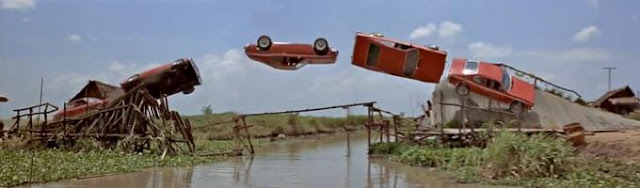
Still, when it leans into the ridiculousness it gets it right. The best part of the film is probably the chase sequence where Bond contrivedly bumps into the yokel sheriff from Live and Let Die, who accompanies him on an extended chase sequence that culminates in Bond's car doing a corkscrew jump across a river and Scaramanga converting his car into an airplane in a secret hangar. Why is the sheriff guy in the movie? I don't know but I came to love it.


Really, its biggest fault is the waste of its villain and its title character. Scaramanga is played by Christopher Lee, and Christopher Lee ought to play a delectable Bond villain... but why cast someone with such an amazing voice and then have him barely speak? Scaramanga is a silent thug for most of the film, and when he finally does get some good dialogue sequences, it's too little, too late.

Other Notes:

  • This film introduces an MI6 agent named Mary Goodnight. (This is the name of Bond's secretary in the books, but she's never appeared before in the films, what she does usually being merged into Moneypenny.) The film never seems to be able to decide if she's a competent agent or, you know, a woman. She gets trapped in a car trunk trying to bug it; she accidentally triggers the self-destruct of the solar energy facility; she almost kills Bond by bumping a switch with her butt. The Roger Moore films would do somewhat better with women agents in The Spy Who Loved Me and (especially) For Your Eyes Only.
  • Other genius moments:
    • Bond tries to get a golden bullet turned into a piece of jewelry out of a woman's navel with his teeth, and inadvertently swallows it, meaning the scene ends with him rushing off to the pharmacy. Can't believe they never got Daniel Craig to do something like that!
    • Bond is about to sleep with Mary Goodnight when Scaramanga's girlfriend turns up, and Bond needs to sleep with her to get information. So first Goodnight has to pretend to be pillows under the sheets, and then Goodnight must hide in a cupboard for hours while Bond and the woman have sex!
    • MI6 turns the wreck of the Queen Elizabeth liner in Hong Kong harbor into a base, so a bunch of scenes take place on an askew ship.
    • For reasons that aren't clear, Bond is at one point dropped into a martial arts school by the villains. What does work is a sequence where two schoolgirls beat up all the martial artists while Bond mostly just stands there.
  • There is a lot of delightful technical nonsense about the solar energy facility that we got a big kick out of.
  • Apparently Lee was suggested by Ian Fleming as a candidate to play the villain in Dr. No. How good would that have been!
 Film Rankings (So Far):
  1. Casino Royale
  2. Dr. No
  3. From Russia with Love
  4. For Your Eyes Only 
  5. On Her Majesty's Secret Service
  6. Thunderball 
  7. The Living Daylights
  8. Spectre
  9. You Only Live Twice
  10. Goldfinger
  11. The Spy Who Loved Me
  12. Moonraker
  13. The Man with the Golden Gun
  14. Octopussy
  15. Never Say Never Again
  16. A View to a Kill
  17. Live and Let Die 
  18. Diamonds Are Forever