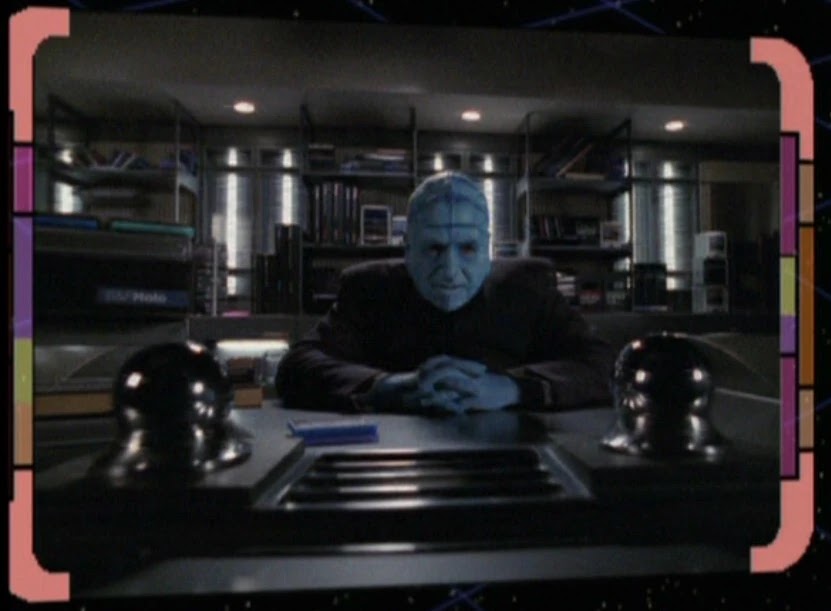
Star Trek: The Next Generation: The Light Fantastic
by Jeffrey Lang
November 2385, plus copious flashbacks (including to September 2384, immediately after
Cold Equations)
When
The Light Fantastic came out, Jeffrey Lang had been absent from
Star Trek fiction for eight years, since his short story in
Constellations (2006). By the mid-2010s, he was no longer in the
Star Trek fiction "stable." But suddenly he was back: it feels like a bit of compensation. "Well, Jeff, we heavily mined your novel
Immortal Coil for a trilogy, but of course you don't get anything for
that.
Would you like the chance to write a new novel at least?" If this is
what happened, I don't mind the results, because I like Jeff Lang's
writing, and the editors must not have minded either, because they would later
invite him to do a
DS9 novel as well.
Cold Equations brought Data back to life, of course, but one of
my big complaints about that trilogy was that it actually didn't really
do much with him as a character. Data was rarely a viewpoint character,
and when he was, things were usually plot focused. It was hard for me to
tally this coldly Lal-obsessed person with the inquisitive, friendly
android we'd known before he died. I'm pleased to say that one of the
big strengths of
The Light Fantastic is how it joins the dots
here and makes this work. Data has permanent emotions now, and he is
still learning how to handle them, and not altogether certain about how
to express them. The book really benefits from pairing him with Geordi
La Forge, who as Data's best friend, can both empathize with him and
call him out when he's going into dark places.
The main plot of the book is that Professor Moriarty, confined to the
Daystrom Institute in a memory module with the Countess Regina, has
figured out a way to reach out of his prison—and now he wants a
real body so he can really explore the universe, as he was promised by Picard and Data. Since
Cold Equations,
Data and Lal have settled down on Orion Prime, where Data manages his
father's casino (among other things) while Lal explores her newfound
life. Moriarty kidnaps Lal to force Data to assist him, and so Data and
La Forge travel the galaxy, looking both for clues as to where Moriarty
is and for leads on what can give him a real body.
Like
Immortal Coil, it loops in a number of previous
Star Trek
stories about AI: most notably this time, "I, Mudd," "The Most Toys,"
"What Are Little Girls Made Of?", and most notably "Elementary, Dear
Data" and "Ship in a Bottle." Plus, it features appearances by
Star Trek's two other most famous holograms,
Voyager's Doctor and
Deep Space Nine's
Vic Fontaine. In the abstract, there's a real danger that this kind of
thing could feel gratuitous, but I think the novel just about gets away
with it. Each of the returns comes across as a natural extension of what
we've seen so far, and serves to deepen the novel's exploration of what
kind of rights one has to exist when one is "merely" a program. I liked
the return of Kivas Fajo, for example, and Alice—one of the Mudd
androids—is probably the novel's best original character. The one thing I
would cut is that the conversations with Vic and the Doctor felt
redundant; we probably could have done just fine with only one of them.
Lang's novel feels like an actual novel, not an ersatz tv episode; it
jumps around in time and focuses on the characters and their thoughts,
not the actions. I really enjoyed the story of Moriarty and his growing
disillusionment with the universe. His is a tragic tale, and he
ultimately makes a strong antagonist. The story of Alice and Mudd is
good, as I said. The character of Albert Lee is a fun one, though I did
have to look him up to see if he was from a
TNG episode I'd
missed! I enjoyed Data here, though I still occasionally found him
off-puttingly strange. I like, for example, him posing as a fry cook and
him struggling to work out parenthood, but his single-minded
ruthlessness as a parent didn't always ring true. I get characters in
the novels have to evolve beyond what we see on screen, but there's a
balance to keep in that they also have to feel like those screen
characters, and I think Lang got this most of the time, but not all.
That said, La Forge calls him out on some of it near the end, and that
helped me.
The weak point of the novel is the ending, which is abrupt. I didn't
totally get where Moriarty was / where he had brought Lal and Alice to,
and Data's deception of him seemed surprisingly easy. I did like, on the
other hand, that Moriarty ultimately didn't suffer for his decision. I
did
not like the way the characters cavalierly treated Alice.
Given the whole book focused on the consequences of how even Data could
disregard the sentience of another AI, it seemed weird for them to
repeat that mistake with Alice, in allowing her to become reenslaved to
Harry Mudd.
There is some fun dialogue here, and some snappy cons and heists, which I
always enjoy. Lang is good at small moments that show character and
don't necessarily relate to the big plot while also not feeling
gratuitously wodged in because the author suddenly realized their
characters should be people, like Moriarty trying not to stare at
Alice's legs, or Mudd thinking he can still con Uhura. The stuff about
color in Moriarty's world is a nice detail, very evocative. Kivas Fajo
becoming a Data fanboy was a logical development (not so keen with what
his release implies about 24th-century mental health).
It's not as good as I remember
Immortal Coil being... but then, I harbor a suspicion that
Immortal Coil might not be as good as I remember
Immortal Coil being! I am not convinced that what I valued in
Star Trek
fiction in 2002 still holds true today. On the whole, though, this is
fun with some interesting moments, and I am happy to see the return of
Jeff Lang's voice after an eight-year gap. Unfortunately, though this
book sets Data up to be his own person and even gives him a new mystery
to investigate, and though Data would turn up in some more novels, he
was never a main character again as far as I know. I would have liked to
see where he would have gone next.
Continuity Notes:
- An engineer named "Lee" is mentioned, but does not appear in, "All
Good Things..." during the 2363 flashbacks. I guess this must be Albert;
the character is really named after Jeff Lang's dog!
- There are multiple references to Indistinguishable from Magic here, a book that seemed kind of glossed over in earlier Destiny-era
novels. Suddenly La Forge is in a relationship with Leah Brahms again;
he thinks briefly about Tamala Harstad, but agrees with me that she's
too boring to be bothered with. There's also a reference to the apparent
death of Captain Scott in that novel, though Picard speculates he might
return some day—as, indeed, we know he must from Engines of Destiny.
- Interestingly, the book would seem to be incompatible with basically
any post-"I, Mudd" stories we've ever seen, as it establishes Harry
Mudd was trapped with the androids on their planet for decades. No Mudd in Your Eye, no "The Business, as Usual, during Altercations," even no "Mudd's Passion"! This idea would be invalidated by the Short Treks episode "The Escape Artist"... at least, if you buy my arguments about that story's chronological placement!
- Vic says Miles was pretty busted up when Data died. But at that
time, O'Brien would have been living on Cardassia Prime, and nowhere
near Vic!
- Sentences no one in this book ever utters: "The galaxy is on high
alert for small, fast vessels thanks to a galactic terrorism crisis.
Doesn't that make your ship a bit suspicious, Mr. Data?" Hmmmmm...
Other Notes:
- There's a weird scene at the beginning of chapter 15. The scene is captioned "Aboard the Archeus"
(that's Data's ship), where Data and La Forge are, and they are
comm-linked to Lee back on Earth. All of Lee's dialogue is in italics,
the Star Trek fiction convention for people who are speaking on a communicator. But
the scene is told from Lee's perspective, describing his thoughts and
actions throughout; nothing in the scene is actually narrated from the
perspective of anyone on the Archeus! It's very odd and off-putting.
I read Destiny-era Star Trek books in batches of five every
few months. Next up in sequence: Deep Space Nine: Lust's Latinum Lost (and Found) by Paula M. Block and Terry J. Erdmann