20 December 2011

Faster than a DC Bullet: Lucifer, Part II: Devil in the Gateway

Lucifer: Devil in the Gateway

Writer: Mike Carey
Artists: Scott Hampton, Chris Weston, James Hodgkins, Warren Pleece, Dean Ormston
Colorist: Daniel Vozzo
Letterers: Todd Klein, Ellie de Ville


Since we last saw Lucifer in Murder Mysteries, mulling over the injustice of the Lord, some 13 billion years have passed. More than that if Murder Mysteries takes place before the creation of the universe, which it probably does. Since then, Lucifer has rebelled against the Lord, been consigned to Hell, given up Hell (its dominion passing into the hands of a pair of angels), and set up in a piano bar in L.A. because, you know, what else would you do? His former consort, Mazikeen, works there with him.

And he'd probably be there, enjoying himself just fine, if Amendiel, an angel himself, didn't pop into Lucifer's bar, Lux, from the Silver City to ask Lucifer to undertake a mission that the Lord can't be seen to directly intervene in. In "The Morningstar Option," someone's granting wishes, or something. It's all very vague and cosmological. Lucifer recruits a human girl who tied into the phenomenon and strikes out to put a stop to it. The story actually reminded me a lot of "The Thessaliad" in The Sandman Presents: Taller Tales in that Lucifer, like Thessaly, knows the ways these kinds of stories work, and therefore undertakes the story in line with the way it should go.

In the second story here, "A Six-Card Spread," Lucifer heads off the Germany to get another former angel to read some cards for him. Of course, there's trouble afoot, what with a bunch of racist thugs running around and the cards themselves gaining intelligence. And Lucifer's not the only person after them... (Who would have guessed that?)

In both good and bad ways, these remind me of the early Sandman stories. There are big, neat ideas being played with. But there's also a protagonist for whom no problem ever seems to exist. As in the Sandman stories, I found myself focusing on the minor mortal characters, because they had lives and problems and such. Lucifer only has smugness, and that works much of the time... but not all of it. I found "The Morningstar Option" more interesting, but "A Six-Card Spread" got bogged down in all the mythology of the cards, which I didn't find very interesting. Part of the problem (again, like early Sandman) is that the story often doesn't seem to operate by rules the reader is aware of. Lucifer and all the myriad demons do things when they need to, and that is that.

The villains of "The Morningstar Option" bothered me, in that they were gods from before our universe or something... but that didn't really matter. They could have been wish-granting Star Trek space aliens for all the difference it made to the story being told. Just saying "gods" didn't do a whole lot to make the story different.

The book ends with a short story, "Born with the Dead," about a girl whose dead grandmothers give her advice, which comes in handy when her best friend is murdered. I liked it a lot, probably for the same reason I liked a lot of the Sandman fill-in stories-- it had a protagonist I could identify with. Lucifer's here, but it's a small bit at the end.

Last time I read a Mike Carey take on a Sandman spin-off, I got the excellent The Furies. So far, this isn't bad, but it's no rival either.

19 December 2011

Faster than a DC Bullet: Lucifer, Part I: Murder Mysteries

And here we are, starting off on a new installment of Faster than a DC Bullet! I've survived my journey into Marvel, so it's back into the DC universe with yet another Sandman spin-off. (Man, there are an awful lot of these.) It's time to meet Lucifer...

Neil Gaiman's Murder Mysteries

Original Short Story and Radio Play: Neil Gaiman
Graphic Story Script and Art: P. Craig Russell
Coloring: Lovern Kindzierski
Lettering: Galen Showman


Before reading Lucifer proper, I decided to read Murder Mysteries, a graphic novel by P. Craig Russell adapting a short story by Neil Gaiman. Murder Mysteries tells the story of the first murder-- the first murder, even before Abel and Cain, when one angel killed another. It's not technically part of the Sandman/Lucifer canon, since the short story was standalone, and the comic book was published by Dark Horse, but it's Gaiman writing Lucifer, and the story even refers to its environs as the Silver City, which is the domain of the Lord and his angels in the DC universe as well.

The story revolves around an angel named Raguel, the Vengeance of the Lord. He is assigned by Lucifer, the commander of the Host, to investigate the murder of Carasel, one of the angels working to create the universe. From this point on, the story unfolds like your typical murder mystery. Raguel interviews witnesses, those who knew the victim, those who may have had a motive. There's all the detective stuff, like where he interviews people who don't seem to have a connection to the case, but he and you know better.

(There's also a frame story about a slightly weird 20-something Brit, who visits a female friend of his in L.A. and gets a blow job, hearing the whole story from an old guy on a park bench who is actually Raguel. I like the frame, but I don't quite know how integrates with the main story, especially in the slightly disturbing way that it all ends.)

The great thing about this whole detective story thing is how it ends. Raguel calls everyone together into a room (of course he does): Lucifer; Phanuel, the senior designer of the universe; Saraquel, Carasel's partner; and Zephkiel, the other senior designer, who never leaves his cell in the Silver City. Raguel solves the murder, of course, and enacts the Vengeance of the Lord, distintegrating the murderer. (I'm not going to tell you who the murderer is, but there are some pretty big spoilers here, so be careful if you don't want it ruined.) Lucifer reacts badly to the whole thing. "Perhaps Saraquel was the first to love," Raguel says, "but Lucifer was the first to shed tears." Lucifer begins to wonder if the Lord's will is just after all and flies off. It's a powerful scene.

But what comes is even more powerful. Raguel realizes that there is another murder in the room. The Lord Himself.
"Because nothing occurs without a reason, and all the reasons are Yours."
And just like that, Gaiman , in mixing a murder mystery with theology, creates something new out of both. Because at that moment I realized, There is always another murderer in the room, and that murderer is always the Lord. It's one thing to know this-- certainly Gaiman is not the first person to observe the theological problems that result from having an omnipotent creator managing a universe with injustice in it-- but in depicting it through the generic tropes of murder mysteries, Gaiman makes it real to me all over again.

Just like that. I've sometimes been skeptical of Gaiman. I mean, I liked The Sandman a lot, but it took me half the series before I was finally sold on it. This, though, is powerful, creative stuff.

Of course, it's not all Gaiman. He wrote the story on which this was based, but Russell did all the work not only of illustrating it, but converting it into the format of a comic story. I don't know how much the latter involved, but he does a magnificent job at the former. His art is clean and beautiful, everything a story about angels at the beginning of Creation requires. Russell was also the illustrator for Don McGregor's run on Killraven, but suffice it to say that that never sang like this does.

Lucifer is only a small part of this story, but just like that, you understand so much more about him. Lucifer, the comic series, has a lot to live up to if it's going to follow on from this...

18 December 2011

Audio Catchup: The Bellotron Incident, The Draconian Rage

Bernice Summerfield and the Bellotron Incident (#4.1)
written by Mike Tucker
directed by Gary Russell
starring Lisa Bowerman as Bernice Summerfield, Miles Richardson as Irving Braxiatel, Stephen Wickham as Joseph the Porter, Louise Faulkner as Bev Tarrant
released June 2003

Here it is — the “monster season.” After a successful outing with the Ice Warriors in Season 3’s The Dance of the Dead, in Season 4 of Professor Bernice Summerfield, all four plays star a monster that previously appeared in televised Doctor Who. The first of these, Mike Tucker’s Professor Bernice Summerfield and the Bellotron Incident, brings back the Rutans, the oft-mentioned but little-seen enemies of the Sontarans — they’ve only actually popped up once, in Horror of Fang Rock.

The Bellotron Incident has a potentially interesting premise, but goes about introducing it in a completely uninteresting way. It opens with a native fellow on Bellotron running around and shouting about something uninteresting, then it goes to the crew of the Earth Empire battlecruiser Rites of Passage having a long debate about the Prime Directive, then the captain of the Rites of Passage calls Braxiatel, and finally, 20 minutes in, Bernice Summerfield shows up in the audio drama that bears her name in the title.

( Read more... )


Bernice Summerfield and the Draconian Rage (#4.2)
written by Trevor Baxendale
directed by Edward Salt
starring Lisa Bowerman as Bernice Summerfield, Miles Richardson as Irving Braxiatel
released August 2003 

The second instalment of Professor Bernice Summerfield’s “monster season” is The Draconian Rage by Trevor Baxendale, seeing the return of the Draconians from 1973’s Frontier in Space. The Draconians would go on to appear in many of Big Finish’s audio dramas, many of them in the Bernice series, and even one appearance in the Doctor Who monthly range, 2009’s Paper Cuts. I haven’t seen Frontier in Space, but the Draconians are often lauded for being one of Doctor Who’s rare attempts in creating a “monster” that is no such thing; rather, the idea behind the Draconians is that they are a complex alien species.

The Draconian Rage takes Benny to Draconia itself, a doubly rare experience, given that she is 1) human and 2) female. She’s been brought in to examine an ancient artefact of human origin unearthed by the Draconians on a world where the entire population committed suicide overnight. Of course, some folks are up to no good, and Bernice is soon embroiled in conspiracies and ancient cults and being tortured.

( Read more... )

12 December 2011

What If There's Others on the Ship We Missed? Or if He's Triplets?

Starslip: A Completely Accurate Portrayal of the Future
by Kris Straub


This is the first (and so far only) volume of Starslip to cover what happens after the universe is rest after the battle with Deep Time.  For the most part, it's a return to glory for the strip, which is simplified back to its roots: stuffy curator Memnon Vanderbeam in charge, with ex-pirate Cutter Edgewise and the strange Mr. Jinx at his side.  There's even a couple of new characters, Doctor Dahk Tohrr and Protocol Officer Quine, both of whom are good additions to the cast.  (Engineer Holiday, alas, still has nothing to do besides be the only girl.)

There are some good storylines here: the war games exercises, the locked-room mystery, and especially the ship's hijacking by space pirates when only Quine can stop them. (Kinda like "Starship Mine" from The Next Generation but with a total dweeb instead of Patrick Stewart.) But unfortunately, the spark is not quite at the same level as it was back at the beginning-- with the crew now serving on the exploration cruiser Paradigm instead of the starship museum Fuseli, it is a little more accessible like Straub says... but it's a little bit more generic sci-fi parody.  It never quite goes all the way, though; the opening storyline here is a rewrite of the bonus story at the back of Volume 3, and with Vanderbeam instead of that generic Kirk-parody, it's ten times as funny, so clearly Straub is doing something right.

That's all the Starslip I've got for now, because it's all that's been collected.  I hope Straub releases another one soon, 'cause I'll buy it, even though I don't read it as a webcomic anymore. (I don't read any, actually, because I don't have the time.)

09 December 2011

Too Late, Peacenik! You're Coming Downtown in Our Service Blimp

Starslip Crisis, Volume 3
by Kristofer Straub


Volume 3 of Starslip Crsis claims to be 115 pages, but in actual story, it is only 73 pages long, making it the shortest Starslip volume of them all.  This is one of the strip's weaker periods, something Straub himself acknowledges in his afterword.  The strip began to be overtaken by its own storylines; while the Fuseli crew being at war with their own future was epic and funny, the characters being split up into multiple locations dampened both the drama and the humor.

Straub's afterword is honest and thoughtful, and there are times where I feel like Steven Moffat would do well to read it as he constructs the next twist in his ongoing Doctor Who saga:
I had thought that added storyline complexity would be a challenge to write, which was what I wanted, but it turned out to be easier than I expected. Too easy. Not because I was a genius, but because at a certain depth complexity begins to look arbitrary.  Something readers kicked around was the increasing likelihood that Vanderbeam would actually become so twisted in his time-travelling search for Jovia that he turns into Katarakis. And it's a wonderful idea.
But what bothered me wasn't that it was a wonderful idea -- what was troubling me was knowing that, if I needed to take the story there, I could.  And if I needed to reverse that plot point somehow, I could.... All the plot loops and time travel had made things too straightforward.
When you can reveal that two of your protagonists' daughter was actually their childhood best friend with seeming no consequences, you've fallen into this trap I think.

My complaints about the River Song storyline aside, the slimness of this volume comes from the fact that it ends at the point the universe is reset, jettisoning all that continuity, but keeping the character histories in tact.  (DC Comics, take note.)  Some "extras" take up the slack, but at 40 pages, there's too many of them.  There's some extra strips, which is good, and there's also a few pages of art for a potential monthly Starslip comic, which looks nice, but the formatted-to-take-up-a-lot-of-room script for it shows that it was nowhere near as funny as the original; the whole art museum/critic angle is dropped, and it's a pretty generic and toothless Star Trek parody.  I can't say I'm sorry it didn't come to pass.

08 December 2011

And That Shifts the Context to a Metadiscussion on the Commodification of Power!

Starslip Crisis, Volume 2
by Kristofer Straub


Having finally read (or reread, rather), the first Starslip Crisis collection, I had to go straight into the second-- which is even better than the first.  It's in the second volume where the series hits my favorite sequence, Lord Katarakis's attempted invasion of Earth.  Lord Katarakis has a sculpture called the Spine of the Cosmos, and anyone who sees the work of art will fall under his mental thrall... but only if they fully comprehend it, which requires knowing its context.  So, having acquired the Spine, Katarakis has labored to discover it context.  To do this, he's conquered the planet Cirbozoid, whose inhabitants can parse the meaning of art, but cannot actually understand it.  They're the only ones who can stop him or help him.

So naturally, the only ship that can stop Katarakis is the Fuseli, an luxury-battlecruiser-turned-art-museum, which is co-captained by Memnon Vanderbeam, the best curator in known space, and Cutter Edgewise, somewhat reformed pirate and alcoholic.  Who else can fight against art?  The climactic battle happens halfway through Volume 2, and it's everything I want out of Starslip Crisis: there are jokes, there are some epic twists and unforgettable scenes, and Straub brings them together into one.

07 December 2011

If Something Doesn't Take up at Least a Hundred Pages, and Require Defense in Front of a Board of Experts, It's Not Worth Saying

Starslip Crisis, Volume 1
by Kristofer Straub


Starslip Crisis is one of three webcomics where I've bought the content in print despite being able to get it all on the Internet for free.  (The other two are the epic Narbonic and the sadly short-lived [nemesis].)  It's about an art museum in space, and so it combines two things I like: space opera and theory about how the presentation of a work of art affects its meaning.  A lot of it is science fiction parody, but it just as often has character-based humor, not to mention a lot of jokes at the expense of academia. (In the future, Earth's greatest export is culture, and as a result, its government is a critocracy.)

Starslip Crisis starts out a little rough, I think,  but it quickly settles down, alternating between daily gags and longer storylines.  And when I say "quickly," I mean quickly; about a dozen pages in, and Straub is already starting to hit his groove, with a tale that explains how humans finally stopped robot uprisings by making machines that were smarter than people.  Unlike machines just as smart as people, who wanted to kill humans and rule the cosmos, machines who were smarter were all philanthropists and serve humankind out of free will.  There's also the Firefly parody (the space rogue Zillion speaks a strange dialect where you always drop the last word of every), and the Cirbozoids, the strange species who have a new biological ability every time the crew needs a new way out of a situation, but best of all is the ongoing conflict with Lord Katarakis of the Dreadnox Cluster.

Now, Lord Katarakis is an evil despot who wants to control the universe, and only Captain Vanderbeam and the crew of the Fuseli stand in his way... but he wants to do it through art.  And this means jokes written by someone who has clearly read Walter Benjamin and John Berger.  I don't know who this comic's target audience is, but I'm clearly part of it, and it's amazing.  Kris Straub has good gags, great sci-fi ideas, fun characters, and an epic plot; Starslip Crisis is one of those works where everything just comes together, and I love it.

05 December 2011

Aprill, with His Shoures Soote

The Canterbury Tales
by Geoffrey Chaucer
adapted by Seymour Chwast


Seymour Chwast is a cartoonist who apparently made a splash with a graphic novel version of Dante's Divine Comedy; he's followed it up with this, an adaptation of Geoffrey Chaucer's The Canterbury Tales.  The whole poem is here: every tale and every prologue, condensed down into 143 pages.  It's a bit of an odd project: not innately so, but I'm not sure what Chwast's mission is in adapting The Canterbury Tales, and as a result, I'm not so sure how I think about his adaptation.

As you can see on the cover, the pilgrims are all on motorcycles.  That's the Wife of Bath there; the back cover and the front/endpapers of the book show the rest of the pilgrims on their own bikes. (On the back, we see the Host driving his cycle, with Chaucer in his sidecar!) It's a delightful bit of imagery, and it's maintained throughout the rest of the book; the pilgrims always scoot around on their motorcycles as they tell their tales.  But other than that, these stories are clearly set during medieval times, as everyone's dress and attitude is medieval.  The tales themselves are told pretty straight visually; there's no attempt to transpose them to time or places other than the ones within which they are set.  Why then the motorcycles?  I don't know, but I like them.

The stories themselves are pretty condensed; they're also transposed into modern English, so you're certainly not reading this book for Chaucer's language.  (Which is disappointing sometimes; "The Franklin's Tale" loses almost all of its punch without Dorigen's beautiful ruminations.)  The condensing makes a lot of funny moments, since neither the narrators nor the characters have time to explain things in detail.  Everything is communicated very matter-of-factly, such as when Lady Constance is delivered to the Syrian sultan in "The Man of Law's Tale":
The Sultan's mother was not happy with this marriage. "When we are Christians we will be slaves of the Church and we will have to renounce the Koran."

The truth was that she was an evil reptile.
I feel like I shouldn't like the condensing, but I don't mind it in general (once you get past the language, most of the tales don't feel like they lose a whole lot), and the matter-of-factness often serves to reveal the inherent absurdity of the situations, as above.  It really doesn't work where the original humor of The Canterbury Tales gets undermined (I didn't laugh at this rendition of "The Miller's Tale," for example), but there were a couple other tales that felt flimsy.

The sense of this work primarily functioning as a commentary on the original is enhanced by Chwast's main innovation (since the stories remain unchanged and the art is played straight): what I came to consider the pop-up Chaucer commentary.  Some of the tales would have Chaucer (or occasionally the Host) appear in borderless panels with comments about what was happening.  Chaucer tells us that "The Knight's Tale" is "complete with swash and buckling" while before the Reeve speaks, he begs, "Gentlemen, I don't want my book banned in Birmingham."  When Constance is about to murdered by another lover's mother, the Host asks, "What about all these terrible mothers?"  These were my favorite moments in the book-- though The Canterbury Tales is a classic of English literature, there's no denying that it's a strange and unusual set of tales, often absurd to a modern audience, and playing this up is fun.

I haven't talked about the art much-- it's good.  Chwast has a simply, sketchy style, which works well for the broad stories being told here.  It emphasizes the coarseness of the sexual happenings, which is appropriate: this is The Canterbury Tales, after all.  The lettering, on the other hand, is just a pain to read.

But like I said, I don't know what it's all for.  I liked the commentary moments best, but there's not a lot of it.  The art doesn't put too much of a spin on the story, and though it does its job, it's not particularly nice to look at.  The motorcycles are nice, but they don't go anywhere.  The condensation means you lose the language of Chaucer.  On the whole, it's nice to read, but I want it to be more for some reason.

01 December 2011

Reading Roundup Wrapup: November 2011

Pick of the month: Daniel Deronda by George Eliot. Not as good as Adam Bede, but that just means it's not in the Top Ten of books written in English.  (What are the other nine? Good question.)  A Vision of Modern Science was my pick for up until 30 minutes ago, but I leaned toward Deronda most of the time.  Some of the most magnificent writing, though I think it all peters off near the end.  The Structure of Scientific Revolutions and Heart and Science were the other standouts-- a good month all around.

All books read:
1. About Time 4: The Unauthorized Guide to Doctor Who, 1975-1979 / Seasons 12 to 17 by Lawrence Miles & Tat Wood
2. Mary Jane by Judith O'Brien
3. Daniel Deronda by George Eliot
4. The Structure of Scientific Revolutions by Thomas S. Kuhn
5. Doctor Who: The King's Dragon by Una McCormack
6. Heart and Science: A Story of the Present Time by Wilkie Collins
7. Mary Jane 2 by Judith O'Brien
8. The 1988 Annual World's Best SF edited by Donald A. Wollheim
9. A Vision of Modern Science: John Tyndall and the Role of the Scientist in Victorian Culture by Ursula DeYoung
10. The Man who would be King and Other Stories by Rudyard Kipling
11. The Canterbury Tales by Geoffrey Chaucer, adapted by Seymour Chwast

A decent number, especially consider Thanksgiving break and seminar paper season make November tough.  And Deronda was a three-week behemoth.

All books acquired:
1. Heart and Science: A Story of the Present Time by Wilkie Collins
2. Faction Paradox: A Romance in Twelve Parts edited by Stuart Douglas & Lawrence Miles
3. (The Best of) Shooty Dog Thing by Paul Castle and… Jon Arnold, Elizabeth Burak, Lawrence Burton, Lee Catigen-Cooper, Danielle Ellison, Terry Francis, James Gent, Angela Giblin, Stephen Gray, James Hadwen, Tim Hirst, Arfie Mansfield, Iain Martin, Nick Mellish, Patrick Mulready, Wesley Osam, Richard Parker, Erik Pollitt, and James Powell
4. Iris Wildthyme: The Panda Book of Horror edited by Stuart Douglas and Paul Magrs
5. Enter Wildthyme by Paul Magrs
6. Star Trek: Seven Deadly Sins by Dayton Ward & Kevin Dilmore, David A. McIntee, James Swallow, Keith R.A. DeCandido, Britta Burdett Dennison, Marc D. Giller, and Greg Cox
7. The Shallows: What the Internet is Doing to Our Brain by Nicholas Carr
8. Packing for Mars: The Curious Science of Life in the Void by Mary Roach
9. Life Ascending: The Ten Great Inventions of Evolution by Nick Lane
10. The Mismeasure of Man by Stephen Jay Gould
11. The Swerve: How the World Became Modern by Stephen Greenblatt
12. Narbonic: The Perfect Collection: Book One by Shaenon K. Garrity
13. Narbonic: The Perfect Collection: Book Two by Shaenon K. Garrity
14. The Annotated Wizard of Oz: Centennial Edition by L. Frank Baum, edited by Michael Patrick Hearn
15. News from Nowhere, or An Epoch of Rest, Being Some Chapters from a Utopian Romance by William Morris
16. The Wood Beyond the World by William Morris
17. Agent Q, or The Smell of Danger!: A Pals in Peril Tale by M. T. Anderson
18. The Norumbegan Quartet, Volume 2: The Suburb Beyond the Stars by M. T. Anderson
19. Thirsty by M. T. Anderson

This actually brings me back to even on "reading balance," so I can't get any books this month (theoretically), but I'm not in the negative.  #1-6 were what I got for having a positive balance last month.  #7-11 and 14-16 were all free stuff from the publishing reps at the Freshman English Book Fair.  (And how awesome is #14!)  And #17-19 I bought when seeing M. T. Anderson two nights ago.

Books remaining on "To be read" list: 363

M. T. Anderson and Reading Widely: Half of a Manifesto, Maybe

So last night, I saw one of my favorite authors, M. T. Anderson, speak at Eastern Connecticut State University here in Willimantic.  Anderson is a children's/YA writer, but he's absolutely one of my favorites, maybe in my top five ever.  (Who else is in that top five?  Good question.)  I saw him speak at UConn back in 2008, but I couldn't pass up another opportunity, and I convinced Hayley to go along with me.  (Hayley actually really likes him too, so I just needed to tip the scales against going to her Tuesday evening class.)

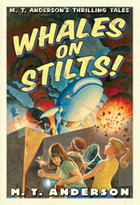
One of the things I like about him is his diversity of voice-- this is a guy who can write all sorts of things.  My introduction to him was Whales on Stilts, the first book in the Pals in Peril series, a satire on formula series fiction, aimed at 10-12 year olds.  But he's also written Feed, a gorgeous if slightly problematic dystopia aimed at teenagers, and the Octavian Nothing duology, set during the Revolutionary War and really capturing the prose style of the era (maybe too well) in what almost seems like a dark fantasy, but turns out to be something very different.  And he has other stuff I've yet to read, but even within the Pals in Peril books he shows a diversity of style.  But he's not just diverse-- he's very very good.  Feed is moving at the same time it satirizes contemporary consumer culture; it contains an extraordinary passage that recreates the drama, the facileness, and the beauty of teenage love.  (I actually taught Feed to my Freshman English class this summer, and some of them even liked it, but I completely forgot to pass on the announcement to them.  Whoops.)

He spoke for about 45 minutes and then took questions.  Some of what he said, I knew already, but that was fine.  Much of what he said was funny, and that was good.  He's also clearly very intelligent, and very imaginative, in the best of ways, able to take idle wonderings and transform them into universal sentiments.  Even Whales on Stilts, where mind-controlled whales on mechanical stilts with laser eyes invaded the continental United States, has one of my favorite statements on friendship.  He's had a good career, and he's one of those rare authors I just don't like or love; in some ways, I wish I could have written his books.  Hayley and I brought two books to be signed, and bought three more there.  While he signed all five to both of us (after a debate over whose books they were), Hayley talked with him about the beauty of Linnaeus's scientific writing while I tried to be cool and name-dropped Erasmus Darwin ineffectively.

One of the things he said that impressed me most, even though I've heard it elsewhere before, is that one of the best things an author can do is read widely.  I did like how he said it though, which was different: (paraphrasing from memory here) "Go into the bookstore and look.  Every book there is someone's favorite.  Read it and find out why.  If you don't like science fiction, read a science fiction book.  Read a romance novel.  If there's How to Play the Tuba, that's someone's favorite book.  Why is that?  What speaks to them?"

I think this is what irks me about some of the genre and tie-in fiction I read-- it reads like it's written by someone who only reads other genre and/or tie-in fiction.  (And one Shakespeare play, a Dan Brown novel, and a book of profound quotations.)  M. T. Anderson's work doesn't.  It's enmeshes in a large, complicated world, and this is shown in overt and subtle ways.  The third thrilling Pals in Peril tale, Jasper Dash and the Flame-Pits of Delaware, is not just a send-up of children's books about people on adventures in dinosaur-infested "exotic" lands in Africa/South America, but it also exposes (subtly but very effectively) the way that European travel fiction can render the "other" and make a "foreign" landscape into something to be dominated by a colonial observer.  And then it makes fun of people who know about all these problems and try to seek an "authentic" experience in foreign countries!  He's not only read his Richard Burton, Frank Reade Jr., and Edward Said, he's read his Stuff White People Like, and he's engaged with all of the above in interesting ways.  Even if you don't recognize the references, I think you still absorb something.  And even if you don't, there's still a fight scene where pacifist monks defeat an army of gangsters with haikus.

I try to read widely myself, as best I can.  I can't say I read How to Play the Tuba or Harlequin romances, but this month I read:
- a cultural criticism Doctor Who episode guide
- two YA Spider-Man novels
- two Victorian writers, George Eliot and Wilkie Collins
- a Doctor Who tie-in based in part on Beowulf (someone else has read widely)
- a 1988 sf anthology
- a critical analysis of the philosophy of a Victorian scientist
- a Rudyard Kipling collection
- a graphic novel adaptation of The Canterbury Tales

Obviously some of this reading is more wide than others, and the requirements of coursework and my fetish for Doctor Who and serialized comic books conspire to constrain me somewhat, but I try pretty hard.  When I was writing the acknowledgements page for A Choice of Catastrophes, I briefly considered listing every author whose book I had read while working on it (I thought better fairly rapidly) because I knew and could point to ways in which David N. Wilson, Barry Unsworth, Jim Starlin, Doris Lessing, Margaret Wander Bonanno, Paul Cornell, and Geoff Ryman had all influenced what I had come up, large and small, positive and negative.  (Of course, it's a book in which Captain Kirk gets into a fist fight with an octopus, and a continuity conundrum about Mister Leslie's name is resolved by referencing a 1975 Peter Pan record, so let's not get too grandiose.)

One of my friends got to chat with M. T. Anderson for ten minutes about Cotton Mather and was invited to e-mail him, of which I suspect I will be eternally jealous.  But I forgot my copies of Burger Wuss and Jasper Dash and the Flame-Pits of Delaware, so I will be seeking him down again for sure.  And you know, he might read Edward Said, but he's also the man who the Governor of Delaware called "buster" in formal correspondence.