10 May 2013

Faster than a DC Bullet: Birds of Prey, Part XVII: Trouble in Mind

Comic trade paperback, n.pag.
Published 2012 (contents: 2011-12)
Borrowed from the library
Read May 2013
Birds of Prey, Volume 1: Trouble in Mind

Writer: Duane Swierczynski
Artist: Jesus Saiz
Additional Art: Javier Pina
Colorists: Nei Ruffino, Allen Passalaqua, June Chung 
Letterer: Carlos M. Mangual

Things have changed a lot since we last saw the Birds of Prey: the Huntress and Lady Blackhawk are nowhere to be seen, and Barbara Gordon is walking again, having resumed the role of Batgirl. Dinah Lance a.k.a. the Black Canary is still wanted for murder, though, and so in order to fight a new threat she's uncovered, she's put together her own "covert ops team run by a bunch of supercriminal hotties": herself, Ev Starling, Katana, and Poison Ivy. And Barbara Gordon wants to help, even if she won't be seen with them in public.

While it's quite a jump from The Death of Oracle to Trouble in Mind (some might say it's a whole new universe), the recognizable threads of Birds of Prey are still there, and Trouble in Mind is their best outing since Tony Bedard's Club Kids. The action is fast without ever being too frenetic, there are some great set-pieces (particularly the train fight), the narration keeps character without ever becoming overwhelming, there's an intriguing mystery. Though the story doesn't fit within this seven-issue volume, it never stops moving, and it doesn't feel decompressed; every chapter adds a new wrinkle or complication to the mix. The story's choppy sometimes, but that's never not on purpose, and it's good comics, serving to disorient the reader in the same way that the characters are.

The characters really shine even though the action doesn't stop moving. Dinah is still recognizably Dinah, an action hero with the right amount of compassion to get the job done, and Ev Starling is a lot of fun from panel one: kind of a crazier version of the Huntress. Both seem to have something lurking in their backstories-- the murder for Black Canary, something we don't quite know yet for Starling. Poison Ivy works surprisingly well. She might be a "villain," but it's obvious that in her own mind and own world she's a hero fighting the good fight, and she integrates well. Katana we don't know enough about yet, but her gimmick is entertaining enough all on its own.

Jesus Saiz also turns out to be the best artist on Birds of Prey since Nicola Scott left. Clean pencils and inks, great with facial expressions, resists the tendency to cheesecacke, draws cool and coherent action. I hope he sticks with this title a long time. (Maybe he'll get the pull to simplify Jim Lee's overly busy redesign for the Black Canary. Just losing the shoulderpads would be an improvement.) Javier Pina fills in for one issue, and proves up to the task, too.

This is my last volume of Birds of Prey for a while: the next volume, Your Kiss Might Kill, is out, but too recently for me to pick up via ILL. It's a series that's had its occasional false start and misdirection, but at its best it's delivered some fun comics with some entertaining characters. I look forward to coming back to it some day, and to picking up more stories about these same characters-- especially Black Canary and the Huntress-- elsewhere.

08 May 2013

Faster than a DC Bullet: Birds of Prey, Part XVI: The Death of Oracle

Comic trade paperback, n.pag.
Published 2012 (contents: 2011)
Borrowed from the library
Read May 2013
Birds of Prey: The Death of Oracle

Writers: Gail Simone, Marc Andreyko
Artists: Ardian Syaf, Vicente Cifuentes, Guillem March, Inaki Miranda, Pere Pérez, Jesus Saiz, Diego Olmos, Billy Tucci, Adriana Melo, JP Mayer, Eber Ferreira
Colorists: Nei Ruffino, Bob Schwager  
Letterers: Travis Lanham, Dave Sharpe, Swands, Carlos M. Mangual

Like some of the previous Birds of Prey volumes, this is a loose collection of individual stories, so I'll handle them one by one. The first of these is the titular one, "The Death of Oracle," where Barbara decides that these days too many people know there is an Oracle, and that just that bare fact opens her up to too much, and so she executes a masterplan that will allow the world to think that Oracle is dead. Of course, this masterplan goes awry, as the Calculator pulls some unexpected allies in, but not too awry. It's an okay story, with a couple good moments (I love the roles of Savant and Creote in the reconstituted Birds of Prey, and Dove getting drunk for the first time is enjoyable), but mostly it feels like one long fight scene stretched out over four issues. The way the Calculator's henchmen turn on him in the last part comes out of nowhere, too.

It's let down by some inconsistent and often-terrible art. Ardian Syaf and Vicente Cifuentes do a good job on the first chapter, and Guillem March isn't bad on the second, but I find Inake Miranda's work to be plastic and artificial, especially his faces, which seems incapable of conveying real emotion, and his linework is all the same thickness. Especially bad is the scene where Oracle reveals the full extent of her plan to Batman, Batman, Batgirl, Red Robin, and Misfit,* and all the characters stand in a succession of poses.

It's also let down by the fact that it doesn't really matter. The Birds don't seem to operate any differently with a "dead" Oracle, and indeed, they're pretty sloppy about keeping her up the necessary appearances, talking about Oracle right in front of villains they're fighting. What's more, at first Manhunter is specifically shown as one of the characters they're deceiving, but by the end of the book, she's not only in on the deception, she knows that Barbara Gordon is Oracle-- something she didn't know before Oracle was "killed." Some heightening of security.

"Which Reason Knows Not Of" continues the development of the flirtation between the Huntress and Catman begun in Dead of Winter. Their interplay is good, though Catman's triple-bluff plan here is a little too complicated to be believable, and I'm not sure why he even wants the result that he gets, which seems unnecessary given how superficial his relationship with the Huntress is.

"Hostile Takeover" is probably the best story in the book, a simple two-issue caper featuring the Birds teaming up with the Question. Fun and not too complicated, just like I prefer my stories, though there are too many characters. (On the other hand, this is the only time Hawk ever feels interesting.) Jesus Saiz does good art on the first issue, though Diego Olmos's backgroundless panels feel phoned-in. I don't get why the Huntress replaces the Black Canary as field leader, though.

The book (and this incarnation of Birds of Prey) wraps up with "War and Remembrance," a two-part callback to the Golden Age. A post-WWII mission of the original Black Canary, the Phantom Lady, and Lady Blackhawk turns out to have modern-day repercussions. A good idea, but ultimately the story's kind of a muddle, and it ends on a lame "joke" where all the characters laugh. Also, since when was the original Black Canary active during World War II? The art is done by like five different people, and I liked some of it.

Ultimately, I don't know how necessary this revival of Birds of Prey was. Though I didn't like the way that the original series wrapped up, this reincarnation seemed to stagger around without clear direction or purpose. And why go to the bother of getting Gail Simone back if you're just going to pair her with an ever-changing cadre of subpar artists?

* Speaking of Misfit, why is this her only appearance in this whole book? She supposedly moved in with Helena during Oracle: The Cure, but we haven't actually seen her since then, and End Run mentioned she was with foster parents. I miss her!

06 May 2013

Review: Urban Realism and the Cosmopolitan Imagination in the Nineteenth Century: Visible City, Invisible World by Tanya Agathocleous

Hardcover, 266 pages
Published 2011
Borrowed from  the library
Read April 2013
Urban Realism and the Cosmopolitan Imagination in the Nineteenth Century: Visible City, Invisible World
by Tanya Agathocleous

Agathocleous's monograph has at its center a great idea: the "world-city" concept, the idea that an individual city can stand in for the shape and state of the entire world. She traces this idea's emergence in the nineteenth century, specifically in the form of novels and other writings about London in the genre she dubs "cosmopolitan realism." It's a great idea, well-articulated, especially in the introduction and the first couple chapters, as well as the last one. There's definitely some potential for our understanding of utopian fiction, which Agathocleous mines for a reading of News from Nowhere, but could apply to many more examples beside.

03 May 2013

Review: Making a Social Body: British Cultural Formation, 1830-1864 by Mary Poovey

Trade paperback, 255 pages
Published 1995
Acquired  April 2012
Read September 2012
Making a Social Body: British Cultural Formation, 1830-1864
by Mary Poovey

Mary Poovey’s Making a Social Body: British Cultural Formation, 1830-1864 examines the way that British society was consolidated in the early nineteenth century, particularly through practices dependent on the metaphor of the “social body,” practices that she refers to with the term “aggregation,” and many of which are scientific practices: “The image of a single culture had begun to seem plausible in 1860… because the technologies capable of materializing an aggregate known as the ‘population’ had been institutionalized for several decades. These technologies included the census… and statistics” (4). These technologies of aggregation are a form of scientific detachment, because they allow aspects of culture to be approached from a distance, not bound up in individuals.

Poovey repeatedly considers the gendered dimensions of aggregation. She seems to predominantly consider the practice of aggregation a male one, perhaps because of the metaphors aggregation employed. In discussing Edwin Chadwick’s Sanitary Report (1842), she points out that his “plan for improving the sanitary conditions, and hence the productivity, of Britain’s working poor cast the city (and society more generally) as a giant body that required a physician’s care” (37); on the other hand, writers such as Charles Babbage employed the metaphor of the social machine or factory (38). Either one of these metaphors makes the detached observer male, for the typical doctor and typical (if not all) factory operator were men. Poovey later generalizes that by the early nineteenth century, “the abstract reasoning of political economy was considered a masculine epistemology, while the aesthetic appreciation of concrete particulars and imaginative excursions was considered feminine” (133). Her discussion of this separation, however, throughout Making a Social Body seems to set up an implicit preference for the feminine epistemology over the masculine: Poovey seems to consistently privilege “the aesthetic appreciation of concrete particulars” and view instances of abstract reasoning with suspicion or hostility, recalling Donna Haraway’s characterization of feminist critiques of objectivity as being only about “what they have meant and how it hurts us.”

In discussing James Philip Kay’s The Moral and Physical Condition of the Working Classes Employed in the Cotton Manufacture in Manchester (1832), Poovey characterizes his work as being “[e]mpirical observations of specific instances of working-class distress, gathered and interpreted by a middle-class (white male) expert” (57). The construction of the phrase, especially the parenthetical insertion of “white male” seems to indicate that the reader is mean to take it as read that a middle-class, male examination of working-class subjects is innately flawed.

Poovey presents as an alternative to this “anatomical realism” (74) the actions of Ellen Ranyard, the founder of the Female Bible Mission, which undertook to place a Bible in every home. Though Poovey admits that Ranyard too “contributed to the rationality associated with abstraction” (50), she seems to praise Ranyard for her determination “that the knowledge generated by the mission about the poor should not be used to facilitate either the kind of aggregation that let Chadwick to calculate the tons of waste produced by poor bodies each year or the kind of science whose systematic nature was its chief criterion for its success” (51). Poovey claims that Ranyard was “adapting a practice associated with women to a science dominated by men” and thus “preserved an alternative model of knowledge that challenged the claim to superiority advanced by the science she practiced” (54), but does not really substantiate why Ranyard’s endeavor was superior to the masculine efforts of Chadwick it contrasted against. Chadwick’s work was aimed at reducing the suffering of the poor, even if in aggregate and even if it was unsuccessful; Ranyard’s work resulted in the dissemination of a number of Bibles among the lower classes, but does not seem to have been particularly helpful in reducing the suffering of the poor, either. The praise for Ranyard’s efforts seems to mostly rest on an unquestioned belief that her “feminine” epistemology was somehow superior to the masculine one that it was challenging (but nevertheless being replaced by). Though Poovey’s analysis of the gendering of specific forms of knowledge is useful and strong, the problem I see with Poovey’s approach is that she seems to have bought into the dualism that the nineteenth century set up—only she has just reversed its significance.

01 May 2013

Reading Roundup Wrapup: April 2013

Pick of the month: The Treason of Isengard by J. R. R. Tolkien. Not my favorite installment of The Lord of the Rings so far, but a good one in a month where I didn't read a whole lot. Gimli is awesome, Aragorn sings, Merry and Pippin actually do something smart. What's not to like?

All books read:
1. (The Best of) Shooty Dog Thing by Paul Castle and… Jon Arnold, Elizabeth Burak, Lawrence Burton, Lee Catigen-Cooper, Danielle Ellison, Terry Francis, James Gent, Angela Giblin, Stephen Gray, James Hadwen, Tim Hirst, Arfie Mansfield, Iain Martin, Nick Mellish, Patrick Mulready, Wesley Osam, Richard Parker, Erik Pollitt, and James Powell
2. Mizora: A World of Women by Mary E. Bradley Lane
3. The Treason of Isengard: Being the Third Book of The Lord of the Rings by J. R. R. Tolkien
4. Birds of Prey: End Run by Gail Simone
5. Careless in Red by Elizabeth George
6. Harvey Pekar’s Cleveland by Harvey Pekar
7. The Annotated Wizard of Oz: Centennial Edition by L. Frank Baum, edited by Michael Patrick Hearn
8. Urban Realism and the Cosmopolitan Imagination in the Nineteenth Century: Visible City, Invisible World by Tanya Agathocleous
9. Iris Wildthyme: The Panda Book of Horror edited by Stuart Douglas and Paul Magrs

All books acquired:
1. Superman: The Music (1978–1988) by Mike Matessino, Lukas Kendall, and Jeff Elridge
2. The Pelican History of England: 3. English Society in the Early Middle Ages (1066-1307) by Doris Mary Stenton
3. The Pelican History of England: 4. England in the Late Middle Ages by A. R. Myers
4. Bernice Summerfield IX: Old Friends by Jonathan Clements, Marc Platt & Pete Kempshall
5. Shooty Dog Thing: 2th & Claw by Paul Castle and Jon Arnold with Colin Brake, Simon Bucher-Jones, Finn Clark, Stuart Douglas, Angela Giblin, James Hadwen, Tim Lambert, David MacGowan, Arfie Mansfield, Chris McKeon, Nick Mellish, Mike Morgan, Cathleen O’Neill, Wesley Osam, James Powell, David Turner, Jo Whineray, and Alex Wilson-Fletcher
6. My Beloved Brontosaurus: On the Road with Old Bones, New Science, and Our Favorite Dinosaurs by Brian Switek

Books remaining on "To be read" list: 513

Review: The Treason of Isengard by J. R. R. Tolkien

Hardcover, 252 pages
Published 2000 (originally 1954)
Acquired February 2011
Read April 2013
The Treason of Isengard: Being the Third Book of The Lord of the Rings
by J. R. R. Tolkien

I didn't realize/remember the way that The Lord of the Rings was structured in detail, so I was surprised by intrigued when I discovered that Frodo and Sam were completely absent from this book, which instead follows the adventures of Aragorn, Legolas, and Gimli and Merry and Pippin following the disintegration of the Fellowship. One of my problems with The Ring Goes South was that there were too many characters caught up in the narrative; the splitting of the Fellowship into three distinct groups gives everyone more space to breathe and become their own people.

Merry and Pippin on their own was fantastic, and I wish we'd gotten to see more of it directly (much of their adventures are reported by the two hobbits to the other characters late in the novel). They turn out to be surprisingly resourceful when captured by the orcs; the bit where they pretend to the have the Ring on them was one of my favorite parts. Their encounters with the Ents, too, are good fun.

Most of the book is spent on the Aragorn/Legolas/Gimli trio (who are later joined by Gandalf), and it is time well spent. Gimli is my favorite character-- always ready to threaten someone with his axe and competing with Legolas over his number of kills, but also grumpy when he thinks Galadriel hasn't sent him a message, and wistful about the beauty of the caverns behind Helm's Deep. (Also, he refuses to sing over Boromir's grave. Unlike Aragorn, who sings every ten pages-- something I have a hard time picturing his film counterpart doing!)

While the Battle of Helm's Deep isn't the spectacle it is in the films, it's still one of the highlights of the books so far. Tolkien shifts his usual style; rather than long passages of description, the events come at us in short sections, sometimes only a couple paragraphs at a time, imbuing both the buildup to the battle and the battle itself with tension and a slight sense of disconnection and choppiness that really works.

Each book of The Lords of the Rings so far has been different to the once preceding it; this one is a high fantasy war story. I don't know if I prefer it to The Ring Sets Out's more rustic tone, but it's well-executed, enjoyable, and fast-paced.

29 April 2013

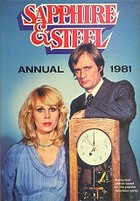
Review: Sapphire & Steel Annual 1981 by Peter J. Hammond

Hardcover, 63 pages
Published 1980
Acquired September 2011
Read September 2012
Sapphire & Steel Annual 1981
by Peter J. Hammond

This book is copyrighted to P. J. Hammond, creator of Sapphire & Steel, though he certainly didn't write it. It's mostly a series of illustrated stories loosely based on the television series: Sapphire and Steel investigate various breakages in time, though most of the stories fail to capture the tone of the television series completely, with stories that are (oddly) too sf or too fantastic. A robot rampaging over the countryside is not very Sapphire & Steel, but then neither is out-and-out magic. These tales have a lot of the trappings of the show, but they don't understand what makes it tick. A couple of them could be the foundation for legitimate adventures, though.

I did like the illustrations, though-- moody and in shadow, they're exactly what every Sapphire & Steel story should look like. Except for the one about the giant robot, where the robot itself has been ripped off of Doctor Who's K-1 robot. On the other hand, the "puzzles" and "informational features"-- one of which is about black holes for some reason!-- are as terrible as you might imagine. (The back cover photo is also a nice one.)

A curio for the curious, this book is nothing more. Reading it means I have read every book ever based on Sapphire & Steel (there are three). Audio dramas next, I guess?

26 April 2013

Faster than a DC Bullet: Birds of Prey, Part XV: End Run

Comic hardcover, n.pag.
Published 2011 (contents: 2010-11)
Borrowed from the library
Read April 2013
Birds of Prey: End Run

Writer: Gail Simone
Pencillers: Ed Benes, Adriana Melo, Alvin Lee
Inkers: Ed Benes, Mariah Benes, J. P. Mayer, Jack Purcell
Colorist: Nei Ruffino
Letterer: Steve Wands

Can you go home again? That's the question asked by End Run, as Oracle, Black Canary, the Huntress, and Lady Blackhawk reunite as the Birds of Prey once more. Black Canary is fresh off of a disastrous Justice League tenure and an even more disastrous divorce... who knows what everyone else has been up to, except that Misfit is sadly nowhere to be seen despite being left in the care of the Huntress in The Cure. The answer seems to be yes, as we're treated to about eight thousand caption boxes where Oracle, Black Canary, and Huntress express their happiness as the reunion ad nauseam.

It's also the question asked outside of the comic, as this brings Gail Simone back to the title-- alongside Ed Benes, her original art partner. End Run provides a decent story, as the Birds battle the mysterious "White Canary," and it seems like some very near and dear to them have suffered because of them. (They have, though not quite in the way they imagined.)  The plotline with Oracle trying to figure out what happened to Savant and Creote is probably the best part of this; I found myself less enamored with the Birds' field team being constantly attacked again and again.

For all that parts of this book work, other parts just don't add up. Black Canary is threatened with exposure of her civilian identity... but back in Simone's first run on the title, Dinah actually published a book about her life as the Black Canary! She also frets over being a murderer like Ollie... you know, the guy who killed a man who killed millions but is demonized for it for no readily apparent reason. Also, Hawk and Dove join the team, and as to who Hawk and Dove are and why you should care and why Oracle picked them... well, don't look for any answers here. I guess it's because they've got bird-themed names?

(There are captions for the first appearance of each character. Not just in the book, but in every. single. issue.  But I've read "Hawk: Avatar of War" six times now, and I'm no closer to knowing what it means or who he is. Cut these things out of the collection, for goodness sake!)

I did like the two-issue story at the end, where Dinah is forced to fight Lady Shiva for the sake of her adopted daughter Sin... only the Huntress has other plans. Any plotline that showcases how awesome the Huntress is is fine by me, and this is definitely one of them.

Like I said earlier, Ed Benes is back, but I'm not sure why. He manages to complete one whole issue; a couple more he starts, and someone else finishes. (I can't tell who, because there's no individual art credits.) Benes, of course, can't draw a picture undefined by the male gaze, but he did good work on this title in the past, and this isn't up to those standards-- his faces are blank and dull and filled with pouty lips. The storytelling is confusing and sloppy, and as always, anyone pretending to be Benes is even worse than Benes. The overly-done coloring seems to work against the whole effect, too.

End Run isn't maybe as bad as this review makes it sound, but it could be a lot better, and I don't of yet see the point of the Birds' breaking up and reunifying. (I'm sure there wasn't one, but still...) This great return hasn't yet convinced me it was worth the effort.

24 April 2013

Faster than a DC Bullet: Birds of Prey, Part XIV: Oracle: The Cure

Comic trade paperback, 126 pages
Published 2010 (contents: 2009)
Borrowed from the library
Read March 2013
Oracle: The Cure

Writers: Tony Bedard, Kevin VanHook
Pencillers: Claude St. Aubin, Fernando Pasarin, Julian Lopez
Inkers: John Floyd, Matt Ryan, Bit, David Bryant, Norm Rapmund, Fernando Pasarin
Letterer: Steve Wands, Pat Brosseau

This collection bridges the gap between the first and second iterations of Birds of Prey, breaking up the original team and then showing us Barbara operating on her own. The Birds get their final showdown with the Calculator, who has been dogging them on-and-off since Perfect Pitch. I liked this, though it was obviously very rushed, and Barbara is forced to blow up yet another headquarters. Less convincing was Babs breaking up the Birds-- she just smashed the Joker in the face (and played a key role in the Final Crisis if I have my timeline right)! How could she be lacking in self-confidence now?

Mopey-for-no-reason Barbara drives the rest of this book, in a solo adventure where she tries to stop the Calculator from getting hold of the anti-life equation. Barbara has been written better, for sure-- characters always seem to be telling her tech-stuff here. There's a good idea here, but the story never really engages the reader. Except maybe with a good twist at the end... but then it's too late, and the staging is very awkward and sudden.

Also: gratuitous shower scene. What the hell? And Guillem March's covers are like 50% beautiful, 50% skeevy.

(Point of interest: as I usually do with comics, I acquired my copy of this book via interlibrary loan. The library my copy came from? That of the Christopher and Dana Reeve Paralysis Resource Center.)

22 April 2013

Faster than a DC Bullet: Birds of Prey, Part XIII: Platinum Flats

Comic trade paperback, 137 pages
Published 2009 (contents: 2008-09)
Borrowed from the library
Read March 2013
Birds of Prey: Platinum Flats

Writer: Tony Bedard
Pencillers: Michael O'Hare, Nicola Scott, Claude St. Aubin
Inkers: John Floyd, Doug Hazlewood
Letterers: Sal Cipriano, Jared K. Fletcher, Pat Brosseau, Travis Lanham, Swands

Tony Bedard, writer of Club Kids, returns to Birds of Prey with this volume, and though his approach is more plot-driven and less character-focused than his last time out, he still demonstrates that he understands the characters of the Birds of Prey and sets up some strong scenarios for them. As this book opens, the Birds have just relocated to Platinum Flats, the Silicon Valley of the DC Universe, and it's a decent setting, fitting enough for Oracle, and indicative of a new direction the book will never get to carry out, as this is its last volume (in this incarnation). There are some definite cool parts to it, especially the potential of Misfit attending a high school where the Huntress is a teacher, that's a shame will never go anywhere.

The main plot of the book, picking up from what was set up in Metropolis or Dust, initially concerns the evil tech syndicate at the heart of Platinum Flats, but this is soon derailed by the arrival of the Joker. The tech folks are good villains in and of themselves, especially the half-dead Gizmo, and Bedard has done some good work with the Calculator, but the arrival of the Joker is what makes the book-- it's the first real rematch between Barbara and the Joker since the legendary events of The Killing Joke. Physically inferior to the Joker, Barbara has to rely on her wits and her determination in fighting him, and she shows what an awesome character she's become since she stopped being Batgirl in the course of this showdown-- especially its end, which is fantastic.

Also: I love Carface. Shame this guy never became a recurring villain.

Misfit is as fun as always in this volume-- I love it when she shows up with Huntress's bike-- and the appearance of Dinah was a little gratuitous, but welcome. On the other hand. Manhunter continues to feel like she's only on the periphery of this team, and Infinity is just kinda there.

The first issue here is, alas, the last of long-running art team Nicola Scott and Doug Hazlewood, who have definitely been the best to grace this title. No one draws Huntress quite so well, I think. But Michael O'Hare and Claude St. Aubin are both able replacements-- a little sketchier in style, but still quite good.

I don't really understand why Birds of Prey had to end, but if it did, this is a good way to go out.