 |
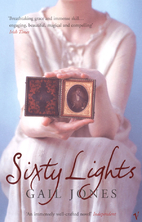
Trade paperback, 249 pages
Acquired October 2013Published 2005 (originally 2004)
Read January 2015
|
23 June 2016
Review: Sixty Lights by Gail Jones

22 June 2016
Faster than a DC Bullet: Project Gotham, Part XXVII: Huntress: Year One
 |
| Comic trade paperback, 143 pages Published 2009 (contents: 2008) Borrowed from the library Read December 2015 |
Writer: Ivory Madison
Penciller: Cliff Richards
Inkers: Art Thibert, Norm Rapmund, Rebecca Buchman
Colorist: Jason Wright
Letterer: Sal Cipriano
Year Eleven, February
Retcons are a weird thing, but they're a constant of the superhero comic book world. Helena Bertinelli was introduced as the Huntress in the 1989-90 ongoing series The Huntress, a dark, sort of moody noir series that stood on its own, though she did meet Batman once and was also a member of the Justice League International's American branch (since she lived in New York City). She faded away, but in 1992, Chuck Dixon brought her back for a two-issue story in Detective Comics, and then a key role in Robin III: Cry of the Huntress (1992-93), and finally her own miniseries (1994). Each of these tweaked her origin a little bit: soon she was from Gotham, not New York, and the exact details of how her family had been murdered fluctuated with each new story. Her origin got a wholesale retelling in 2000 with Batman/Huntress: Cry for Blood (the only one of these I haven't actually read), and then another one in 2008 with this series, Huntress: Year One.
As you read new versions, it's sometimes hard to judge them on their own merits. The original Huntress series by Joey Cavalieri and Joe Staton isn't perfect, but it is distinctive, with dark, moody artwork and a heroine who's not always attractive, physically or elsewise. Though later takes on the Huntress would be darker and more violent, and though the plots of the ongoing sometimes got silly, there's a real sense of the series trying something not because it's tried and true, but because it's new and distinctive. The 1990s would take "dark and gritty" in bad directions sometimes, but I enjoyed what The Huntress seemed to be striving towards, even if it didn't always hit it.
 |
| I guess this explains why Batman doesn't like the Huntress. from Huntress: Year One #5 (art by Cliff Richards and Norm Rapmund & Rebecca Buchman) |
So, my problems with Huntress: Year One aren't really its own fault. Its Huntress is a different character than the one created by Cavalieri and Staton, and she has a somewhat different history. I'm not sure what I think of her being raised in Sicily, or having a lost love: I liked the damaged, lonely warrior of the original series that didn't have anyone to support her. But the story Madison Ivory and Cliff Richards tell here is not bad, just different, and on its own merits, it's pretty good-- if nothing exceptional.
Instead of the gritty urban vigilante aspects of the character, this really focuses on mafia princess components, as Helena untangles a conspiracy to deprive her of her inheritance, and much worse, that runs from Sicily to the Vatican to Gotham, and leads to her meeting Batman, Batgirl, Barbara Gordon, Bruce Wayne, and Catwoman, among others. Like a lot of conspiracy stories, some of it went over my head, and there's a lot of characters to keep track of, but Ivory keeps things pretty interesting, and I enjoyed the clean linework of Cliff Richards, Art Thibert, and Norm Rapmund, especially their regal, statuesque Helena.
 |
| Here's a weird fact: people would write into the letter column of the Cavalieri/Staton Huntress complaining Helena was too ugly. As a result, the editor asked people to write in about whether they thought that mattered! But I'm pretty sure Staton didn't intend Helena to be unattractive; that was just the way he drew everybody. Anyway, seems unlikely anyone wrote in complaining about that this time out. from Huntress: Year One #2 (art by Cliff Richards and Art Thibert) |
But I just couldn't shake the versions I'd read before from my head. Usually, I feel like I'm better at this. Oh, well.
Next Week: It's Year One again again as Nightwing makes his debut on the Gotham stage!
21 June 2016
Review: Doctor Who: Spore by Alex Scarrow
 |
| Mass market paperback, 67 pages Published 2014 (originally 2013) Acquired December 2014 Read August 2015 |
by Alex Scarrow
Despite the fact that he originated in a very different style of television, Big Finish and BBC Books both wasted no time forcing the eighth Doctor into the mold of classic Doctor Who: BBC Books' Eighth Doctor Adventures felt of a piece with the Virgin New Adventures, while Big Finish locked him into the same 4x25 format as the classic Doctors, despite him never having appeared in such a format on telly! The eighth Doctor, after all, originally appeared in a 90-minute telemovie of the week. One could imagine an alternate world where Fox commissioned a series of them, the eighth Doctor periodically appearing on American television screens for a standalone adventure, like how The Librarian was originally. If that had happened, I think you'd have ended up with stories very much like Spore: the Doctor turns up in contemporary America, discovers something odd is going on, befriends a local woman, and puts a stop to it. Slight, like a lot of these novellas, but an intriguing glimpse of a version of Doctor Who that never was.
Next Week: A missing adventure for the ninth Doctor in The Beast of Babylon!
20 June 2016
Review: Lemistry edited by Ra Page & Magda Raczyńska
 |
| Trade paperback, 292 pages Published 2011 (contents: 1959-2011) Acquired June 2012 Read April 2016 |
edited by Ra Page & Magda Raczyńska
When I picked this book up, I thought it was a collection of essays about Stanisław Lem with a couple Lem stories thrown in. It turns out to mostly be works of fiction assembled in tribute to Lem. This genre of anthology is always a bit tricky, I think-- I remember not being a very big fan of Foundation's Friends, for example, which was written in tribute to Isaac Asimov, and the fiction in the Ursula K. Le Guin tribute 80! was its weakest part. The problem here is that Lem is in my Top Five science fiction authors and that the contributors here, well, aren't. So when they attempt direct pastiche of Lem, they come up short, and when they try to do something more oblique, you wonder what it has to do with Lem at all.
The book begins, however, with three stories by Lem-- for all of them, this is their first appearance in English. The best of them is definitely "The Lilo," about a man who starts to wonder if he's been placed in virtual reality without his consent or knowledge, and wants his psychiatrist to help him out of this dilemma, but the psychiatrist can't... or won't. Like a lot of Lem stories, this takes a strange premise to its logical conclusion with perfection.
The pastiche of the other authors is at its most direct with Ian Watson's "The Tale of Trurl and the Great TanGent," a tale of Trurl and Klapaucius of The Cyberiad fame. It's okay. It feels more random and arbitrary than the actual Cyberiad tales that I remember, like Watson doesn't quite grasp what makes those stories work so well. I was surprised that this was the only story to reuse Lem characters directly: there are no tales of (say) Pirx the Pilot or Ijon Tichy here, no return to (thankfully, I suppose) Solaris.
Some just seem to be about robots with little else that makes them obviously Lemmian, like Toby Litt's "The Melancholy." Annie Clarkson's "Toby" is about a man who married a robot woman contemplating adopting a robot boy: I'm not sure what it has to do with Lem, though I did find the central conceit pretty interesting. It just kind of fizzles out at the end, though, after an interesting start. "Terracotta Robot" by Adam Marek is just kind of baffling, about a guy, his son, a newly married woman, and her husband all on a sightseeing tour of an ancient robot factory. The guy keeps hitting on the newly married woman even though it's her honeymoon. It's more like a piece of literary fiction that has a robot in it for no explicable reason. Take the robot out and put it in a different book, and I probably would have liked it a lot; as it is, I was baffled.
Others, and these ones felt more Lemmian, play with concepts of reality. "The 5-Sigma Certainty" by Trevor Hoyle is about a journalist who interviews Philip K. Dick, who tells him that Lem isn't a real person but a Communist committee. (This is a thing that Dick actually believed.) The journalist decides to go to Poland to investigate for himself. I liked the story at first, but in the end, it didn't seem to have much to say; there's a punchline of sorts, but it doesn't justify the buildup. The best along these lines is "Stanlemian" by Wojciech Orliński, about people who gamble in a virtual reality simulation of pre-9/11 New York City. The title is mean to be in opposition to "phildickian": whereas phildickian describes situations where reality is difficult to determine, stanlemian is used to describe situations where the problem has been solved. The premise of the story is that everything goes when it comes to getting money out of the simulation back into the real world, and so the protagonist is a guy hired on behalf of a gambler to extract the money from the simulation without running afoul of the gambler's crooked girlfriend. Great ideas that develop some stuff Lem played with, especially in Summa Technologiae, but in directions I don't think Lem would or could have gone, which is surely what you want out of this kind of volume, but it rarely achieves.
Some of the stories ape the way Lem would play with genre: "'Every Little Helps' by Frank Cottrell Boyce, reviewed by Stanisław Lem," for example, is Boyce writing as though he's Lem reviewing a nonexistent story by Boyce. I like the idea, but the execution is not very compelling: you're basically just reading a synopsis of a story that seems somewhat interesting, but not interesting enough.
It's one of these, though, that's the best story in the whole book: "The Apocrypha of Lem by Dan Tukagawa, J. B. Krupsky, and Aaron Orvits, reviewed by Jacek Dukaj" reviews a book about the novels written by three different computer simulations of Lem. One was programmed with the conditions of Lem's life, one was programmed with Lem's DNA and brain scans, and one is but one of millions of people simulated in a construct of twentieth-century Europe as a whole. Dukaj is playful and inventive in the best Lem tradition; this is like the best parts of Imaginary Magnitude, but playing with Lem himself. For example, he points out that one might want one's Lem simulation to write more Lem books (naturally), but Lem decided he had said all he wanted to: "the more faithful their postLem was to the original, the less likely it was that he would write anything new." The different postLems end up suing each other for copyright over their works, and the review attacks the idea the biological Lem is the best instantiation of Lem, anyway: "Where does the certainty that Stanisław Lem, born 12th September 1921 and deceased 27th March 2006 in Krakow, is such an ideal model of Lemness, come from? Simply because he was reflected in a biological form and not in a digital one? But that is pure racism!" All the works of all the postLems together will give you the data you need to isolate who Lem really was, and why should it happen to be the one that was a physical human being? It's a very fun little thought experiment.
And then there are the ones that have no obvious reason to be here, like Brian Aldiss's "Less Than Kin, More Than Kind," which feels like he just sent the editors a story he hadn't been able to get published anywhere else.
The book ends with a few nonfiction pieces. The best was "Stanisław Lem - Who's He?" by Andy Sawyer. I didn't expect to like this, since I thought I knew already, but Sawyer provides a nice overview of Lem's fiction and its major themes, and I especially liked his consideration of Lem's place within the genre of science fiction itself, given Lem's disdain for the genre.
The book has its highlights, but it really does illustrate the peril of its own project: Lem is too good at what he does for most others to be able to touch him. The few good stories show it can be done, but most of what's here reveals what an immense achievement it was to write and think like Stanisław Lem.
17 June 2016
Alert New London!: The Lost Names of the Backroads of Rural Ohio
I recently had cause to be driving around the backroads of Butler and Hamilton Counties, Ohio, right on the Indiana border, in this area:

It's a pretty undeveloped area, lots of farmland and tiny little towns that consist of one stop light and three stores. It was a nice, sunny day, so it was a good drive, made especially so because I got to drive past one of my favorite roads, Alert New London Road. It's not important enough for Google Maps to label at the zoom level I was using when I took this screenshot, but you can see it there. It's the road that connects the towns of Alert and Shandon. I like it because it sounds like an order: "Alert New London! The Indians are coming!"
The road's name's origins are pretty mundane, however. A lot of roads in this region (and I can't imagine this is an uncommon thing nationwide) are simply named for the two places they connect: Alert New London Rd., Cincinnati Brookville Rd., Okeana Drewersburg Rd., Hamilton Scipio Rd., Peoria Reily Rd., Reily Millville Rd., and so on.
This may seem like a boring naming scheme, but I will tell you as someone whose belief in his own sense of geography sometimes outstrips his actual abilities, these naming schemes sure could help you in the pre-smartphone era when you were driving around lost in the backroads of Butler County. I remember coming upon Oxford Middletown Road in the middle of the night and arbitrarily picking which way to turn on it, figuring that a 50% chance of ending up where I wanted to be (Oxford) was better than the minuscule chance I'd had up until that point.
A lot of these roads are the only remaining signs of the existence of the places they once connected. Scipio is a sort of nonplace on the Ohio-Indiana border, for example, one of those places Wikipedia calls an unincorporated community, and there's nothing to indicate any real town-ness other than that houses cluster there. As far as I can tell (admittedly just from an evening's electronic research), according to the book Thunder in the Heartland: A Chronicle of Outstanding Weather Events in Ohio, Scipio was destroyed in 1884 by a tornado:
 Now all that remains of Scipio is its name on roads and cemeteries, little bits of history that have escaped overwriting but lost their context.
 Like I said above, Alert New London Road connects Alert to the town of Shandon, but as you might guess if you've been following me so far, Shandon used to be called New London. In fact, Shandon is ostensibly the Butler Community to have had the most names, having also been known as Paddy's Run, Vaughan's Crossing, Glendower, Cambria, and Bagdad. The locals, who were Welsh, wanted the post office to be called New London, but the postmaster general called it Paddy's Run after a local stream, but the locals found being called "Paddies" offensive. Hence all the fluctuations as they tried to settle on something everyone could accept. (At one point the citizens boycotted the post office to get their way.) Things were apparently finally stabilized in 1906, when the U.S. Board on Geographic Names issued the following ruling:
 It seems they had a lot of options to rule out.
Now, I've known of New London, Ohio, for at least twelve years, but looking at the map today, the first time doing so after eight years of being a Connecticut resident, what immediately jumped out at me was the juxtaposition of New London and New Haven, which are of course both major cities in Connecticut. Northern Ohio was originally the "Western Reserve" of Connecticut: could my adoptive state have also influenced the southwest corner of my birth state?
The answer is mixed. New Haven, Ohio, an unincorporated community now surrounded by the Miami Whitewater Forest, a county park, was definitely named in honor of Connecticut. It was founded in 1815 by Joab Comstock, a native of New Haven, Connecticut, and the first frame house was built in 1826. By 1894, it had a population of 200; now its population is almost 600. Comstock apparently liked founding villages, because he had also founded nearby Crosby in 1801, which was named after his wife's maiden name. New Haven's location was picked because it was at the intersection of the Cincinnati-New Baltimore highway and the Hammond-Lawrenceburg road. I guess those last three places were much more important in 1815 than they are in 2016, because I don't think there's much to be got out of being at their intersection today.
The appearance of a New London, Ohio, in 1803, twelve years prior to the founding of New Haven, Ohio, seems to be a complete coincidence. Even though the two Ohio towns, some four miles apart, both share names with prominent Connecticut cities, some fifty miles apart, I can find no indication that the naming of New London, Ohio, has anything to do with New London, Connecticut. The settlers of New London, Ohio, were predominantly from Wales (hence one of its many names, Glendower), and though I don't know why the Welsh might have wanted to name a city after London, England, I feel they had even less reason to name one after New London, Connecticut.
The influence of Connecticut on the parts of Ohio outside of the old Western Reserve seems to have been pretty limited after all. So the very supposition that launched me on this investigation turns out to have no basis in reality, though I have learned a lot about the area of Ohio I once called home. Seriously, now I want to drive back up to Shandon and look at its Old Welsh Cemetery!

It's a pretty undeveloped area, lots of farmland and tiny little towns that consist of one stop light and three stores. It was a nice, sunny day, so it was a good drive, made especially so because I got to drive past one of my favorite roads, Alert New London Road. It's not important enough for Google Maps to label at the zoom level I was using when I took this screenshot, but you can see it there. It's the road that connects the towns of Alert and Shandon. I like it because it sounds like an order: "Alert New London! The Indians are coming!"
 |
| I must not be the only person who thinks it's a good name, as there's apparently a Columbus, Ohio, dream-pop band called Alert New London. |
The road's name's origins are pretty mundane, however. A lot of roads in this region (and I can't imagine this is an uncommon thing nationwide) are simply named for the two places they connect: Alert New London Rd., Cincinnati Brookville Rd., Okeana Drewersburg Rd., Hamilton Scipio Rd., Peoria Reily Rd., Reily Millville Rd., and so on.
This may seem like a boring naming scheme, but I will tell you as someone whose belief in his own sense of geography sometimes outstrips his actual abilities, these naming schemes sure could help you in the pre-smartphone era when you were driving around lost in the backroads of Butler County. I remember coming upon Oxford Middletown Road in the middle of the night and arbitrarily picking which way to turn on it, figuring that a 50% chance of ending up where I wanted to be (Oxford) was better than the minuscule chance I'd had up until that point.
A lot of these roads are the only remaining signs of the existence of the places they once connected. Scipio is a sort of nonplace on the Ohio-Indiana border, for example, one of those places Wikipedia calls an unincorporated community, and there's nothing to indicate any real town-ness other than that houses cluster there. As far as I can tell (admittedly just from an evening's electronic research), according to the book Thunder in the Heartland: A Chronicle of Outstanding Weather Events in Ohio, Scipio was destroyed in 1884 by a tornado:


Now, I've known of New London, Ohio, for at least twelve years, but looking at the map today, the first time doing so after eight years of being a Connecticut resident, what immediately jumped out at me was the juxtaposition of New London and New Haven, which are of course both major cities in Connecticut. Northern Ohio was originally the "Western Reserve" of Connecticut: could my adoptive state have also influenced the southwest corner of my birth state?
The answer is mixed. New Haven, Ohio, an unincorporated community now surrounded by the Miami Whitewater Forest, a county park, was definitely named in honor of Connecticut. It was founded in 1815 by Joab Comstock, a native of New Haven, Connecticut, and the first frame house was built in 1826. By 1894, it had a population of 200; now its population is almost 600. Comstock apparently liked founding villages, because he had also founded nearby Crosby in 1801, which was named after his wife's maiden name. New Haven's location was picked because it was at the intersection of the Cincinnati-New Baltimore highway and the Hammond-Lawrenceburg road. I guess those last three places were much more important in 1815 than they are in 2016, because I don't think there's much to be got out of being at their intersection today.
The appearance of a New London, Ohio, in 1803, twelve years prior to the founding of New Haven, Ohio, seems to be a complete coincidence. Even though the two Ohio towns, some four miles apart, both share names with prominent Connecticut cities, some fifty miles apart, I can find no indication that the naming of New London, Ohio, has anything to do with New London, Connecticut. The settlers of New London, Ohio, were predominantly from Wales (hence one of its many names, Glendower), and though I don't know why the Welsh might have wanted to name a city after London, England, I feel they had even less reason to name one after New London, Connecticut.
The influence of Connecticut on the parts of Ohio outside of the old Western Reserve seems to have been pretty limited after all. So the very supposition that launched me on this investigation turns out to have no basis in reality, though I have learned a lot about the area of Ohio I once called home. Seriously, now I want to drive back up to Shandon and look at its Old Welsh Cemetery!
16 June 2016
Review: Summa Technologiae by Stanisław Lem
 |
Trade paperback, 409 pages
Acquired December 2014Published 2013 (originally 1964)
Read March 2015
|
by Stanisław Lem
What is therefore possible? Almost everything, with just one exception. Having conspired in advance, people could decide one day, many thousands of years from now, "Enough! Let things be the way they are now; let them remain like this forever. Let us not change, seek, or discover anything new, since things cannot be better than they are now, and even if they could, we do not want it."
Even though I have outlined many unlikely things in this book, this one seems to me to be the most unlikely of them all.
15 June 2016
Faster than a DC Bullet: Project Gotham, Part XXVI: Batman: Second Chances
 |
| Comic trade paperback, 276 pages Published 2014 (contents: 1986-87) Borrowed from the library Read November 2015 |
Writers: Max Allan Collins, Jo Duffy, Jim Starlin
Pencillers: Jim Starlin, Denys B. Cowan, Chris Warner, Ross Andru, Dave Cockrum, Kieron Dwyer, Jim Aparo, Norm Breyfogle
Inkers: Jim Starlin, Greg Brooks, Mike DeCarlo, Dick Giordano, Don Heck, Norm Breyfogle
Colorists: Daina Graziunas, Adrienne Roy
Letterers: John Costanza, Todd Klein, Agustin Más, Albert DeGuzman
Year Ten, October
Out of universe it's been ten years, but in universe it's just been two since Batman moved to a downtown penthouse and Dick Grayson went off to college. Now Bruce is back in Stately Ward Manor and there's a new Robin in town. Second Chances collects twelve stories, whose unifying feature is that the majority of them are by Max Allan Collins, and all of them feature Jason Todd as the new Robin. (Unfortunately, there's almost no consistency in the artistic team.)
The book opens with a two-part tale: "There's Nothing So Savage-- As a Man Destroying Himself!"/"One Batman Too Many." Criminals are turning up violently murdered... seemingly by the Batman! Jim Starlin provides some great, dynamic layouts in the first half, which I really enjoyed; the second part, where the faux Batman escapes Arkham and Batman hunts him down, was less interesting, partly because the art of Denys Cowan and Greg Brooks was not as sharp as Starlin's. In this story, Jason is already the new Robin, and evidencing a slight bloodthirsty streak, as he wonders if Batman maybe should be employing some of the techniques of his impersonator.
The book then jumps backward to explain how Jason got to be the new Robin; "Did Robin Die Tonight?" opens with Dick Grayson still operating as Robin, receiving an injury at the hands of the Joker. Bruce fires Robin: "In what I do, there is no place for a child. [...] Son, I'm sorry. And you are a man-- man enough to accept my decision." We don't even see what happens to Dick, though; he informs Bruce that though Robin will stay "dead," he has a destiny to pursue, but as far as we see, he doesn't even leave. What's he off doing? Who knows! After operating solo for a little bit, Batman goes to visit Crime Alley on the anniversary of his parents' death, where while he's out walking (Batman strolling down the street, saying "Gentlemen" to a pair of men on the sidewalk, is a surreal sight), a juvenile delinquent steals the tires off the Batmobile.
Batman enrolls Jason in a reform school, but in "Just Another Kid on Crime Alley," it's revealed the school is actually a front for a crime ring, which Jason helps Batman break up. And then, even though Batman just claimed he didn't want any kids around, he's calling Jason "Robin" just like that. If I was Dick, I'd be ticked off! I know from reading interviews with Collins was that the idea was Jason would live a life so dangerous on the streets that being Robin was actually a safer alternative, but no one in the story actually says this, and it's not convincing: surely Bruce making Jason his ward without revealing he was Batman would be safer than either crime or crime-fighting!
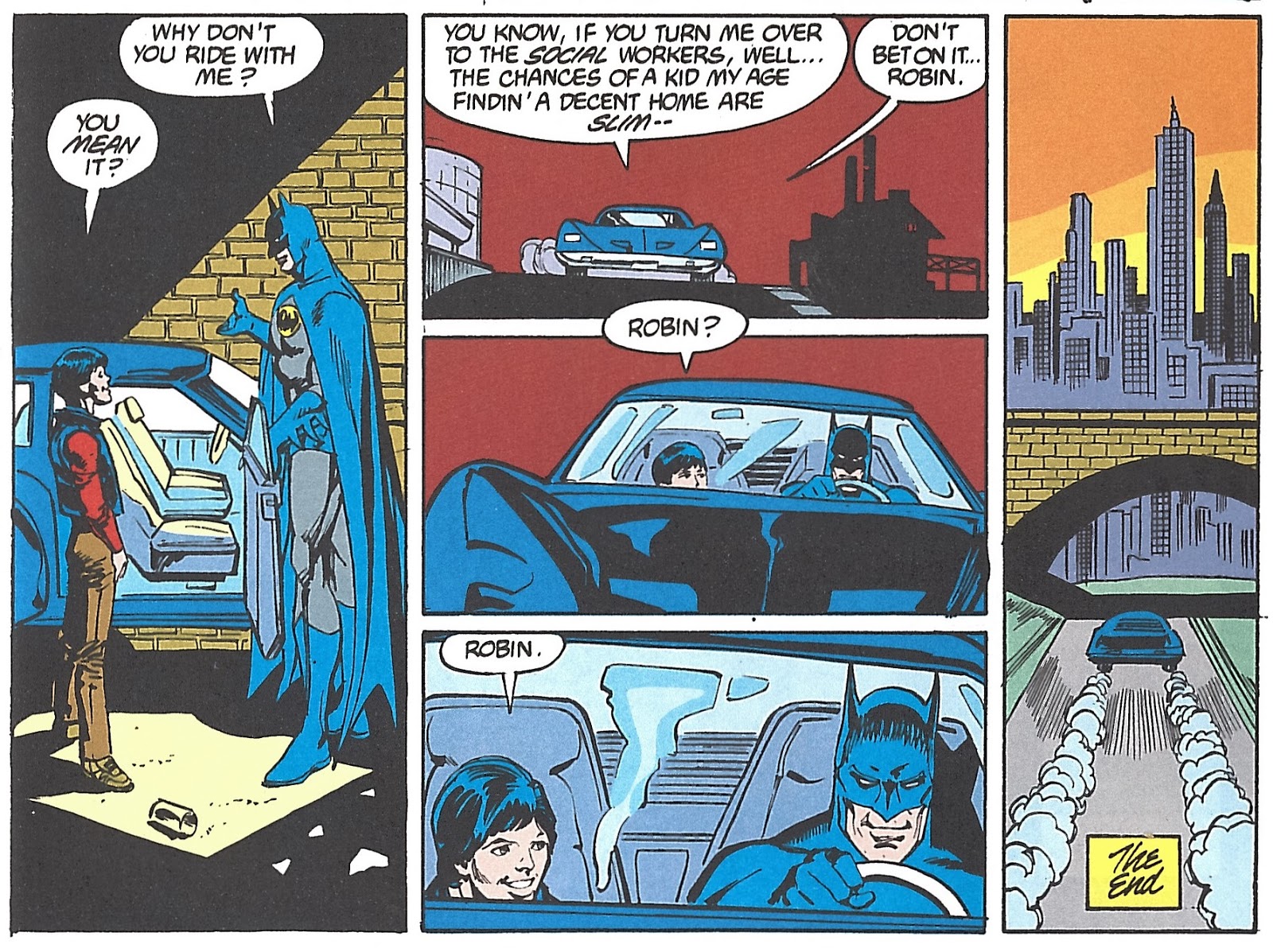 |
| "Dick Grayson? Who cares about Dick Grayson? Screw that guy." from Batman vol. 1 #409 (script by Max Allan Collins, art by Ross Andru & Dick Giordano) |
The next few stories chronicle the early days of Jason Todd as Robin, as they face Two-Face, who turns out to be responsible for Jason's father's death. It's a lot of weird, Silver Age-style hijinks, with Two-Face employing the "Dopple Gang" and robbing one of Gotham's two major league baseball stadiums during the second half of the second inning when there's two strikes, two balls, and two men on base! It's not Starlin's best work on the title. I assume the intro story about the false Batman slots in here, before the next couple tales, each more weird than the last: an evil mime and a samurai ghost.
That last tale is by Jo Duffy, and then Jim Starlin takes over as writer. His first story is a sort of grim, but consequence-free story of Batman hunting a serial killer. With only 22 pages to make us care about some woman and kill her off, the story isn't big enough to succeed. Then Batman discovers Commissioner Gordon is a Manhunter in a crossover with Millennium that totally does not stand on its own, and then Dick Grayson comes back in "White Gold and Truth"-- which is dated "ONE YEAR AGO." I have no idea where that's mean to place it relative to the other stories in the volume.
This story finally fills in what Dick Grayson has been up to. In a retcon I don't think later writers abided by, allegedly all of Dick's adventures with the Teen Titans occurred after he left Batman's company. Dick's retelling of their split is also a little more acrimonious than the one we saw in "Did Robin Die Tonight?" Bruce and Dick argue, but Dick and Jason team up to beat up some criminals while Bruce smiles from the rooftop, unseen. It feels more like a patch over Collins's sparse story than a story of its own.
Collins isn't all done; the last story in the book is "Love Bird," a cute tale illustrated by Norm Breyfogle about a paroled Penguin seeking love and trying to go straight.
A common denominator between many of these stories is the presence of Vicki Vale as Bruce's girlfriend who hates the Batman and also hates Bruce's idling about all the time. Her presence is inconsistent; Collins seems to keep forgetting about her. As a result, I never really had a good feel for what she and Bruce saw in each other, so she comes across as largely superfluous.
 |
| "Batman, if you just drive a couple more miles to the other Kroger's, their bananas are two cents cheaper!" from Batman vol. 1 #402 (script by Max Allan Collins, art by Jim Starlin) |
So: historically important tales, yes, but inconsistent in quality. But I got very intrigued from this era of Batman history, and I actually added a few more 1980s/Jason Todd stories to my list after reading it, wanting to flesh him and his era out before hitting A Death in the Family. These came out after Batman: Year One, but that story didn't change the other Batman tales overnight; these later stories feel like a weird jumble of the Silver Age aesthetic and the Frank Miller one (Commissioner Gordon looks more like a jolly grandpa than a hard-hitting cop/special forces vet), and I look forward to seeing how that changes over time.
Next Week: It's Year One again as Huntress makes her debut on the Gotham stage!
14 June 2016
Review: Doctor Who: The Ripple Effect by Malorie Blackman
 |
| Mass market paperback, 85 pages Published 2014 (originally 2013) Acquired December 2014 Read July 2015 |
Doctor Who: The Seventh Doctor: The Ripple Effect
by Malorie Blackman
The idea of the Doctor being forced to confront good Daleks has potential, but I don't think it's always realized to the extent that it could be. Dark Eyes explored it as part of its theme of "hope," for example, but sort of chickened out before the end, not quite tackling the idea that the one bit of hope the Doctor will never allow himself to have is that the Daleks could be good. The Ripple Effect offers some interesting moments, too, and some effective characterization of the seventh Doctor and Ace (one of my favorite TARDIS teams), but the necessity of returning to the status quo means the story gets too bogged down in "TIME WAS NEVER MEANT TO BE THIS WAY," which I think is hard to create compelling drama from.
Next Week: The eighth Doctor goes it alone against an alien Spore!
13 June 2016
Review: The Heart of Thomas by Moto Hagio
Also: take a look at Unreality SF to read my review of Big Finish's first UNIT audio, Extinction.
The Heart of Thomas by Moto Hagio
translation by Matt Thorn
The Heart of Thomas is the most recent English translation of a piece of shōjo manga by Moto Hagio, and reading it means I've finally read all of Hagio's work available in English. (For a brief period, anyway; there's a translation of Otherworld Barbara coming out this fall.) It's the first long-form work by her to be translated into English; previous volumes have collected her short fiction. It's also her first piece of realist fiction in English, with no fantasy or science fiction elements.
Heart of Thomas is about a boy at an all-boy German boarding school who commits suicide; from what I had read, I expected to be because of homophobia. Heart of Thomas is a very different book than that, though, and much more complicated. Thomas actually dies right in the opening chapter, and the book chronicles the effects his death has on the community, especially Juli, with whom Thomas wanted to be involved, and a boy named Erich who comes to the school just days after Thomas's death and looks a lot like him. Many of the boys at Schlotterbach are interested in other boys; there's no hint of homophobia, and the male-male romantic and sexual relationships are diverse in their types.
There are a lot of characters; in addition to Thomas, Erich, and Juli, there's Ante (a young manipulator who competed with Thomas for Juli's attentions), Oskar (a world-weary older boy who is Juli's only confidante), and many more. Hagio is impressive in the depth of her characterization: the 500 pages of this book are a slow unspooling of information about the characters, and situations that initially seem obviously are slowly revealed to be more complicated as time passes. Each and every character turns out to have a subjectivity that's not obvious when the book begins, but influences their actions and feelings throughout. In their ways, each boy here is damaged and hurt, and some of the sections where we find out what's going on are riveting and painful. It's over 500 pages long, but it never feels padded or dull; Hagio keeps things going at exactly the right pace.
If the book is summed up by anything, it's by this exchange between Juli and Erich:
There's no easy solutions here, because few of the characters are in love with ones who love them back; indeed, I think every love here is unrequited: but by the book's end, some of the characters have opened up enough to reciprocate and form real relationships, even if they're not necessarily romantic or sexual. It's a beautiful book, in both word and image, and Hagio even throws in a few jokes for good measure. I've really enjoyed everything I've read by her, and Heart of Thomas continues that trend. Here's hoping for more translations soon.
 |
| Comic hardcover, 516 pages Published 2012 (contents: 1974) Borrowed from the library Read May 2016 |
translation by Matt Thorn
The Heart of Thomas is the most recent English translation of a piece of shōjo manga by Moto Hagio, and reading it means I've finally read all of Hagio's work available in English. (For a brief period, anyway; there's a translation of Otherworld Barbara coming out this fall.) It's the first long-form work by her to be translated into English; previous volumes have collected her short fiction. It's also her first piece of realist fiction in English, with no fantasy or science fiction elements.
 |
| Hagio's layouts are typically dramatic and emotional. |
Heart of Thomas is about a boy at an all-boy German boarding school who commits suicide; from what I had read, I expected to be because of homophobia. Heart of Thomas is a very different book than that, though, and much more complicated. Thomas actually dies right in the opening chapter, and the book chronicles the effects his death has on the community, especially Juli, with whom Thomas wanted to be involved, and a boy named Erich who comes to the school just days after Thomas's death and looks a lot like him. Many of the boys at Schlotterbach are interested in other boys; there's no hint of homophobia, and the male-male romantic and sexual relationships are diverse in their types.
 |
| This is an unflipped manga, i.e., don't forget that it will make little sense unless you read it right-to-left. |
There are a lot of characters; in addition to Thomas, Erich, and Juli, there's Ante (a young manipulator who competed with Thomas for Juli's attentions), Oskar (a world-weary older boy who is Juli's only confidante), and many more. Hagio is impressive in the depth of her characterization: the 500 pages of this book are a slow unspooling of information about the characters, and situations that initially seem obviously are slowly revealed to be more complicated as time passes. Each and every character turns out to have a subjectivity that's not obvious when the book begins, but influences their actions and feelings throughout. In their ways, each boy here is damaged and hurt, and some of the sections where we find out what's going on are riveting and painful. It's over 500 pages long, but it never feels padded or dull; Hagio keeps things going at exactly the right pace.
If the book is summed up by anything, it's by this exchange between Juli and Erich:
 |
| Something that threw me about the coloring conventions used here at first is that even though Juli's hair is dark black, when there's a light shining on it, Hagio renders it completely white, like she does for blond characters. |
There's no easy solutions here, because few of the characters are in love with ones who love them back; indeed, I think every love here is unrequited: but by the book's end, some of the characters have opened up enough to reciprocate and form real relationships, even if they're not necessarily romantic or sexual. It's a beautiful book, in both word and image, and Hagio even throws in a few jokes for good measure. I've really enjoyed everything I've read by her, and Heart of Thomas continues that trend. Here's hoping for more translations soon.
 |
| I really liked the comedy background students, though they do put paid to McCloud's notion that the central characters are the ones that are more cartoony, in order to promote reader identification. |
10 June 2016
John Ashbery's "...by an Earthquake": A Visual Guide
I recently had the pleasure of listening to a friend read "...by an Earthquake," a poem by John Ashbery. I don't want to violate copyright, so I'll just excerpt four lines for you:
The exact nature of this tangle is probably beside the point, but I thought it would be fun to trace out, and I spent an hour or so working it out in yEd Graph Editor. Here are the fruits of my labors:
I should note that I did not include characters without names unless they had significant relationships to named characters, and that I simplified the nature of some relationships to stop the labels from being overly long.
It does reveal some interesting facts. First, is that there are really just two tangles of relationships. There are all the intersections of A, who is married to B-3, and later B, and is nephew of U, and so on. No character with an actual name connects to A's cluster except for Herschel, and no character with a letter name is not contained in it, except for A-4, about whom we know only that he is "missing food from his larder." (Was it stolen by A, though? We know he is a crook.) Some characters are mentioned in multiple contexts, which becomes suggestive: does the tragic adventure that A and A-2 go on, resulting in A-2's death, have anything to do with the infernal machine that A sent to his enemy, A-3, but ended up in the hands of A-2? If A caused the death of his friend, it seems even more tragic than at first glance.
The other significant cluster is in the top middle of the graph, and this one is made up of all named characters (except for a little girl who is mean to a rabbit and transforms into a grown woman). This one is much less centralized than the A cluster, and the relationships more tangled; there are lots of unreciprocated loves and such.
What struck me when doing this visualization was the number of characters in no relationship at all. When they're all arranged in whitespace like this, with no lines going in or out, it seems rather sad. It's an interesting way of looking at an interesting poem.
You can read the full poem here at the Paris Review web site. I highly recommend it; it is an oddly captivating poem, suggestive of the strange tangle of human relationships, but also much more. Parts of it chronicle mundane happenings, parts of it fantastic ones.A, a crook, seeks unlawful gain by selling A-8 an object, X, which A-8 already owns.A sees a stranger, A-5, stealthily remove papers, X, from the pocket of another stranger, A-8, who is asleep. A follows A-5.A sends an infernal machine, X, to his enemy, A-3, and it falls into the hands of A’s friend, A-2.Angela tells Philip of her husband’s enlarged prostate, and asks for money.
The exact nature of this tangle is probably beside the point, but I thought it would be fun to trace out, and I spent an hour or so working it out in yEd Graph Editor. Here are the fruits of my labors:
 |
| Unless you've got better eyes than I, click to enlarge. |
I should note that I did not include characters without names unless they had significant relationships to named characters, and that I simplified the nature of some relationships to stop the labels from being overly long.
It does reveal some interesting facts. First, is that there are really just two tangles of relationships. There are all the intersections of A, who is married to B-3, and later B, and is nephew of U, and so on. No character with an actual name connects to A's cluster except for Herschel, and no character with a letter name is not contained in it, except for A-4, about whom we know only that he is "missing food from his larder." (Was it stolen by A, though? We know he is a crook.) Some characters are mentioned in multiple contexts, which becomes suggestive: does the tragic adventure that A and A-2 go on, resulting in A-2's death, have anything to do with the infernal machine that A sent to his enemy, A-3, but ended up in the hands of A-2? If A caused the death of his friend, it seems even more tragic than at first glance.
The other significant cluster is in the top middle of the graph, and this one is made up of all named characters (except for a little girl who is mean to a rabbit and transforms into a grown woman). This one is much less centralized than the A cluster, and the relationships more tangled; there are lots of unreciprocated loves and such.
What struck me when doing this visualization was the number of characters in no relationship at all. When they're all arranged in whitespace like this, with no lines going in or out, it seems rather sad. It's an interesting way of looking at an interesting poem.
Subscribe to:
Posts (Atom)