28 September 2015

Review: The Complete Calvin and Hobbes, Book One: 1985-1987 by Bill Watterson

Comic trade paperback, 359 pages
Published 2012 (contents: 1985-87)

Acquired December 2014
Read August 2015
The Complete Calvin and Hobbes, Book One: 1985-1987
by Bill Watterson

Calvin and Hobbes is one of those things I don't ever remember not knowing. The strip began syndication only five months after I was born, and I remember both reading it in the newspaper-- my parents always said it was the only thing on the comics page worth reading-- and having a number of collections lying around the house. I don't think we had a comprehensive collection, though, so I was curious to see if reading the first volume of the complete strips-- a gift from those same parents-- would reveal any I didn't remember. There were some, but not a lot.

Anyway, this was a total delight. Surely some of that is nostalgia, but most of that is that these really do hold up: Bill Watterson is consistently funny. There are a lot of other good things going for these comics, but more than anything else, the frequency with which I laughed out loud-- once per week of strips at least-- is the most noteworthy. It's amazing to think that they're almost thirty years old now because no newspaper comic strip I've read since comes even close to matching the regular humor of Calvin and Hobbes.

Watterson treads a fine line with Calvin as a character, and it's impressive how he never descends into caricature. Calvin has an active imagination on one hand-- but on the other, he refuses to read in favor of the television. This is no overdone romantic idealization of childhood; in many ways, Calvin is really rather awful!

It's interesting to see the strip begin to take shape here: Calvin is a member of the Cub Scouts (which I think gets dropped later on), Calvin and Hobbes play actual sports, albeit creatively (there's no Calvinball yet), and the large, fanciful storylines I remember so well only really begin to emerge near the end of the book. Though the cardboard box makes some early appearances as a time machine, it's nowhere near as extended as what we'd see later; in fact, the biggest storyline here is (I believe) a miserable camping trip undertaken by Calvin and his family where it just rains nonstop-- this is one of the few occasions in the book where the Sunday strip is smoothly integrated into the storyline. (Nicely, the book places Sunday strips out of publication order occasionally to improve reading experience.)

It probably would surprise no one who knows me that on this reading I had a great appreciation for Calvin's long-suffering parents, especially his father, who reminds me of my own with all of his off-kilter explanations about how the world works and his claims that any form of suffering is justified because it builds character. I look forward to seeing the strip as it develops; even if I've read them all before, I know I've never read them all in the proper order, and it's a great journey to undertake again for the first time.

25 September 2015

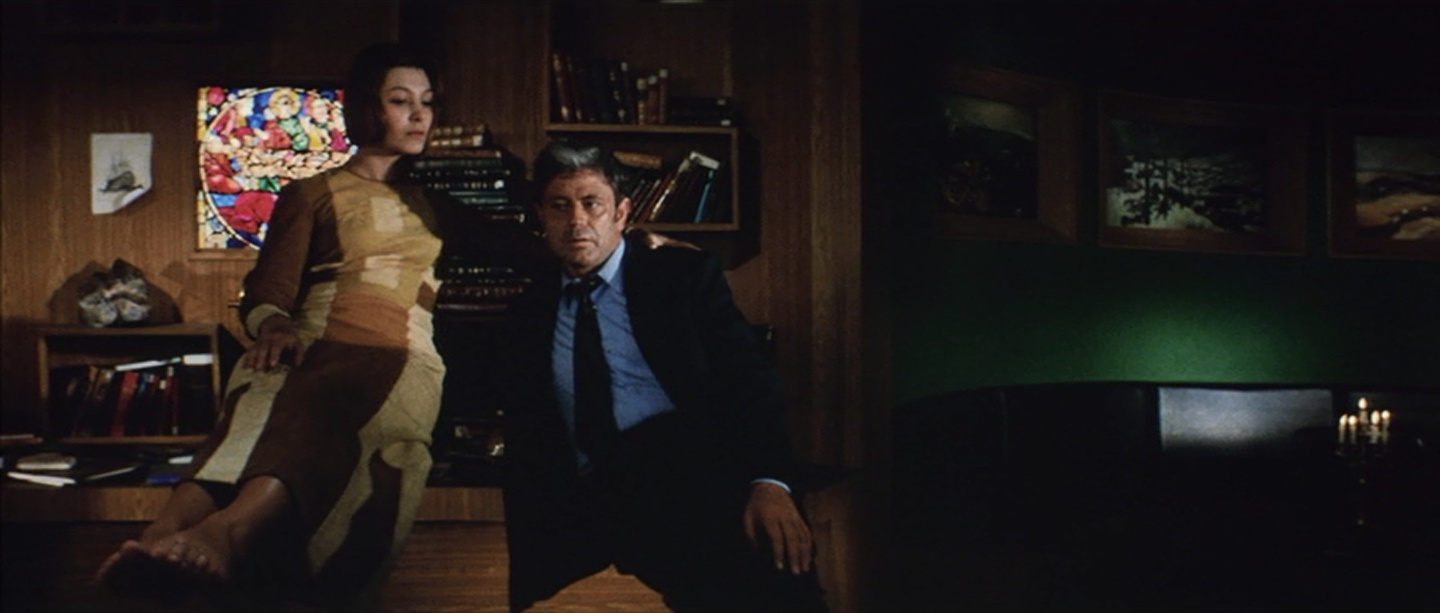
Film Review: Andrei Tarkovsky's Solaris

I was introduced to Stanislaw Lem in high school, and I have been a fan ever since. We read "The First Sally (A), or Trurl's Electronic Bard" in my European literature class, and I loved it. What nerdy high school kid wouldn't love a story with an algebraic love poem? Not long after, the Steven Soderbergh film version of Lem's Solaris was released, and I saw it in theaters. To this day, it remains one of my favorite films (top ten? I guess?): a moving, estranging portrait of loss, love, and memory, with a great score by Cliff Martinez. At this distant juncture, I'm not sure if I saw it before or after borrowing the novel from the library, but I did read it around the same time.


A conversation with a friend this summer made me realize I'd never seen the previous 1972 film version of Solaris by Russian filmmaker Andre Tarkovsky, so we made a point of watching it this fall. It's a difficult film to like, especially in the beginning, as we watch characters watch films of lectures where people watch films, and where characters we never see again spend significant chunks of time navigating traffic to no evident purpose. Donatas Banionis as Kris Kelvin seems to have one facial expression: I know he's depressed because his lover committed suicide some years ago, but geeze! Find another setting than "mopey."


Maybe halfway through, though, it all clicked, and it became terribly gripping, with some fabulous dialogue, macabre humor, and great imagery-- especially the zero-gravity sequence, and Hari's final resurrection. Soderbergh's version definitely takes some cues from Tarkovsky's, including the increased focus on the human relationships. But Soderbergh's is, in some sense, all about those relationships, the planet Solaris just being a backdrop. Tarkovsky's version foregrounds the planet some more. This dialogue is striking:
We have no interest in conquering any cosmos. We want to extend the Earth to the borders of the cosmos. We don't know what to do with other worlds. We don't need other worlds. We need a mirror. We struggle for contact, but we'll never find it. We're in the foolish human predicament of striving for a goal that he fears, that he has no need for. Man needs man.
Lem's book is in some ways about the foolishness of trying to find the human everywhere we look, of expecting everything we encounter to tell us something about the human condition. In some ways, this seems like a weird fit for the novel's own premise, given that it is about humans encountering a planet that is literally a mirror for their desires and experiences. Soderbergh's embraces that aspect. The end of his version has Kris Kelvin rejecting his mundane life on Earth to stay on Solaris so that he can recreate the life he once had with his dead lover, and hopefully make it work out properly this time.

Tarkovsky's, on the hand, maintains Lem's emphasis on the mysteries of the planet, even as it deepens the emotional story. At one point, Kris Kelvin is reprimanded:
Don't turn a scientific problem into a common love story.

A cynic might argue that this is exactly what Soderbergh did (I would say he turned it into an uncommon love story), but Tarkovsky keeps both. At one point, Kris seems to have totally given up on the problem of Solaris, losing himself in his personal problems, almost wallowing in the darkness of his own past.
What does it matter when you're worth more to me than any science could ever be?

But after Hari kills herself for the last time, Kris passes into a memory of his past, one where I think he rewrites what he did that day on Earth where Hari originally killed herself, meeting his mother and acquiring emotional closure. But unlike Soderbergh's Kris, who elects to return to his lover ("Rheya," in that version), Tarkovsky's Kris presses on.
Man was created by nature so he could learn her ways. In his endless search for the truth, man is condemned to knowledge.

His emotional demons satisfied, Kris can resume "his endless search for truth"; the love story ended, Kris can turn his attentions back to the scientific problem. Tarkovsky's Solaris is both a scientific problem and a love story, about both a man's emotional catharsis about his past and his confronting of the vast, forbidden frontier of the unknown. The end makes you think he's gone home at first; Soderbergh's pulls a similar trick. But while Soderbergh reveals that Kris actually stayed on the station to be with Rheya, Tarkovsky reveals that what seems to be Kris's father's house is actually a newly formed island on Solaris.

Though, even on Solaris, man finds a mirror.


Also, my new favorite burn:

24 September 2015

Review: Star Trek: Captain's Log by J. K. Woodward et al.

Comic trade paperback, n.pag.
Published 2011 (contents: 2010)

Acquired May 2012
Read May 2015
Star Trek: Captain's Log

Written by Stuart Moore, Scott and David Tipton, Marc Guggenheim, Keith R.A. DeCandido
Art by J. K. Woodward, Federica Manfredi, Andrew Currie
Colors by J. K. Woodward, Andrea Priorini, Moose Bauman
Color Assists by Chiara Cinabro
Lettering by Robbie Robbins, Neil Uyetake, Chris Mowry

This collection consist of four tales of Starfleet captains from the edges of the Star Trek universe: Christopher Pike of the original Enterprise from "The Cage" and "The Menagerie," Hikaru Sulu of the Excelsior from The Undiscovered Country, John Harriman of the Enterprise-B from Generations, and Edward Jellico of the Cairo from "Chain of Command." It's an okay set of okay stories, on the whole-- nothing great, nothing terrible, all pretty disposable.

The stories vary in quality and interest. The Pike tale, by Stuart Moore and J. K. Woodward, could be decent, but feels compelled to show up Pike's last mission on board that training vessel for the umpteenth time, and in a way that doesn't even really seem consistent with what "The Menagerie" establishes about it. Because it crams both that and an unseen "Cage"-era mission into 20 pages, there's not really time to do much of interest, though I appreciated seeing Yeoman Colt, long a favorite of mine from "The Cage" itself and the old Early Voyages comics. But thinking of Early Voyages just makes me regret that they didn't get Dan Abnett and Ian Edginton to do this one!

The Sulu story by the Tipton brothers and Federica Manfredi is decent, a showdown with the Tholians that lets old Hikaru show some backbone and gumption. Decent stuff, let down by Manfredi's inability to use the right starships in the artwork; the other Federation starship is Oberth class but suddenly becomes a Constitution in one panel, and one panel of the Excelsior streaking into warp is blatantly the original Enterprise, lifted from The Motion Picture.

The Harriman tale by Marc Guggenheim and Andrew Currie could be good, but it's let down by too much focus on a visiting Doctor McCoy and rehashing of old events, especially The Search for Spock and Generations. There are a lot of Harriman tales where he "proves" himself by overcoming someone's expectations; I'd rather Harriman tales just get on with him being awesome, as any captain of the Enterprise must be.

Finally, there's Keith R.A. DeCandido and J. K. Woodward's take on Jellico. Jellico defenders like to point out that he's just following protocol... while that might be true, good leaders don't act like assholes to their subordinates in the pursuit of protocol, either. I'm not convinced this is the redemptive take on Jellico it wants to be.

23 September 2015

Faster than a DC Bullet: Project Gotham, Part VIII: Batman: The Ring, the Arrow and the Bat

Comic trade paperback, 182 pages
Published 2003 (contents: 1998-2000)

Borrowed from the library
Read November 2014
Batman: The Ring, the Arrow and the Bat

Writer: Dennis O'Neil
Pencillers: Greg Land, Sergio Cariello
Inkers: Dick Giordano, Matt Ryan
Colorists: Greg Wright, Rick Taylor
Letterers: Clem Robins, Willie Schubert

Year One, August - Year Two, February
I wish I'd known about this book when I did my big readthrough of Green Arrow tales, because it's much more Green Arrow and Green Lantern's tale than it is Batman's. This collects two stories: the first, "Peacemakers," is about the first meeting between Green Arrow and Green Lantern, while the second, "The Arrow and the Bat," unites the two with Batman.

That said, it's not very good. I feel like the later you are in Denny O'Neil's career, the worse his writing is, and this book is no exception. It's jumpy, characters don't (re)act realistically, the conspiracies are too complicated to make sense, it's bloodier than a mainstream DC superhero story ought to be, and it doesn't even get basic points of continuity right. Oliver seems to have lost his fortune already, but he hasn't even joined the Justice League yet because there is no Justice League yet. And it was O'Neil who wrote the story where Oliver lost his fortune, set well into his tenure on the League! What's the point of writing a tale to tick off a continuity box if you get the continuity wrong? None, as far as I can tell, because this is a disappointing and uninteresting book.

Next Week: Batman enrolls in D.A.R.E. in Venom!

22 September 2015

Review: Doctor Who: Sky Jacks! by Andy Diggle & Eddie Robson, Andy Kuhn, et al.

Comic PDF eBook, 108 pages
Published 2013 (contents: 2012-13)
Acquired May 2014
Read November 2014
Doctor Who, Volume 3: Sky Jacks!

Written by Andy Diggle & Eddie Robson and Len Wein
Art by Andy Kuhn and Matthew Dow Smith
Colors by Charlie Kirchoff and Adrian Salmon
Lettering by Shawn Lee

For the first three chapters, this is classic Doctor Who: the Doctor and Clara (yay!) end up in an infinite sky, where they fall in with the crew of a British bomber from World War II. It's a very cool, sprawling world, and it's very fun-- thanks especially to the art of Andy Kuhn, who eschews dull tie-in realism for a more cartoony style to good effect. His Clara Oswald may not look like Jenna-Louise Coleman, but she does look like Clara. There are a lot of cool visuals and neat ideas here, plus dogfights, and what's more exciting than that?

It all crashes down in chapter four, though, when it's revealed who's behind it all-- tying back in to Andy Diggle's first story in The Hypothetical Gentleman. (The book credits Andy Diggle and Eddie Robson with writing; I'd guess Eddie Robson scripted it from a plot by Diggle, whose presence on the book has been inconsistent at best.) Unfortunately, it's a maniacally evil Matrix, having escaped the destruction of Gallifrey. There's potential here-- the Doctor vs. the dead memories of his race-- but it comes across as an excuse for continuity (there are tie-ins to The Deadly Assassin, The End of Time, and "The Day of the Doctor") and really it could be the Doctor fighting any evil robot spider. I really like Eddie Robson as a writer, but this final chapter does not play to his strengths.

Finally, there's a short tale by Len Wein and Matthew Dow Smith: "In-Fez-Station!" The Doctor, Amy, and Rory fight the Slitheen while wearing fezes at the Fez Music Festival in Fez, Morocco. It's fun.

Next Week: Tony Lee returns (and so does Clara) as the TARDIS visits the Old West in Dead Man's Hand!

21 September 2015

Review: Divas, Dames & Daredevils: Lost Heroines of Golden Age Comics by Mike Madrid

Comic trade paperback, 236 pages
Published 2013 (contents: 1940-48)
Acquired December 2013
Read June 2015
Divas, Dames & Daredevils: Lost Heroines of Golden Age Comics
compiled and annotated by Mike Madrid

I would never had guessed that the Golden Age of comics possessed such a wide range of female hero characters-- most of what's remained in the popular consciousness are fairly straightforward superheroes, like Wonder Woman, the Phantom Lady, or, uh, Firebrand*?

There are definitely superheroes here, but they are probably some of the less interesting heroines on offer. If you've ever read collections of any of the lesser Golden Age superheroes, like Sandman, you'll know what to expect: quick criminal plots wrapped up by personality-less characters. There are still some standouts, though, such as Mother Hubbard, an ugly witch who uses her powers to aid America in the war effort in a story by Bill Madden. Though her magic makes her so powerful there doesn't seem to be much that can stop her! I found most of the war comics similarly generic, though it was neat seeing all the different roles the women held, from super-spies to super-nurses.

There are also a number of tales here of fantasy and science fiction heroines: epic adventurers across time and space. For many of these, the individual tales here aren't so interesting as Mike Madrid's synopses of their publication history-- I want to know about the storied histories of Fantomah, Mystery Woman of the Jungle, who is at various points a goddess, a jungle queen, and an Egyptian ruler; Queen Camilla of the Lost Empire, who goes from being a warrior queen to a lost jungle girl; Gale Allen and the Girl Squadron, who fly through space battle pirates; and the Magician from Mars, exiled from her home planet by the evil Hood. They sound fascinating!

No, the real good stuff here comes in the tales of "everyday" women fighting the good fight against evil. Barbara Hall's "Introducing the Blonde Bomber" does exactly what the title implies, introducing Honey Blake, a newsreel camerawoman who is also a chemist, and uses her reporting and scientific powers to fight crime. Apparently she appeared regularly in a number of comics for about five years; I'd like to seek more of them out. There's also Jill Trent, Science Sleuth who battle crime with her friend/possible lesbian lover, here in the tale "The Freezer Ray!" by Ken Battefield and Frank Frazetta. I like these stories of women are captivating not (only) through their beauty, but through their intellectual superiority to every man around them!

Probably the best story in the book is by Bill Draut, who went on to have a successful career for DC in the Silver Age, especially in horror comics. The Calamity Jane tale "The Man Who Met Himself" has (like, apparently most Calamity Jane tales) an entertaining frame where Jane seeks out Draut to get her to illustrate her most recent adventure. Jane is very much a typical hardboiled detective... only she's a woman, and her condescending attitude to everyone she meets is terrific fun. This is another character I'd definitely seek out more adventures of... if I ever clear out my current backlog of digital comics to read! Since these stories are in the public domain now, most can be read for free online, and I suspect I would enjoy getting to explore this forgotten corner of comics history.

* Not an actual Golden Age heroine, apparently, much like the "original" Fury.

18 September 2015

Reading Roundup Year in Review, 2014/15

My reading year is over! I never got around to doing a big wrapup last year (September was during my Big Blog Drought), but I'm back with charts and data. First off, how does it stack up to years past?

Year Books Read
2003/04  151
2004/05  129
2005/06  141
2006/07  129
2007/08  152
2008/09  161
2009/10  157
2010/11  139
2011/12  184
2012/13 195
2013/14 148
2014/15 146
SUM 1832
MEAN 152.7

A little bit below average for me, but not by a lot. This is fair, as my teaching and writing responsibilities were definitely higher than they've been in the past.

Here's what I've been reading this year: (I broke out series/authors only if I read more than one book of that series/author)

SERIES/GENRE/AUTHOR # OF BOOKS BOOKS/ MONTH % OF ALL BOOKS
Doctor Who 26.5 2.2 18.2%
Star Wars 11 0.9 7.5%
Star Trek 6.5 0.5 4.5%
Media Tie-In Subtotal 44 3.7 30.1%


George Griffith 3 0.3 2.1%
A. Conan Doyle1 2 0.2 1.4%
Stanislaw Lem2 2 0.3 1.4%
Other SF&F 21 1.8 14.4%
General SF&F Subtotal 28 2.3 19.2%


Crisis Crossovers3 15.5 1.3 10.6%
Batman 14.3 1.2 9.8%
Legion of Super-Heroes 2.5
0.2 1.7%
Other DC Comics3 6.7 0.6 4.6%
Avatar: The Last Airbender 3 0.3 2.1%
Other Comics4 5 0.4 3.4%
Comics Subtotal 47 3.9 32.2%


James Bond by Ian Fleming 2 0.2 1.4%
Victorian Literature 2 0.2 1.4%
Other Literature 16 1.3 11.0%
General Literature Subtotal 20 1.7 13.7%


Other Nonfiction5 7 0.6 4.8%

1. This also includes the novel Dinosaur Summer, by Greg Bear, a sequel to a Doyle work (The Lost World).
2. This also includes Summa Technologiae, a nonfiction book by Lem.
3. These also include novels about these comics-originated characters/premises.

4. Comics based on a particular series (e.g., Doctor Who or Star Wars) are included with that series's count.
5. Nonfiction connected to a particular series (e.g., Star Trek or Avatar: The Last Airbender) is included in that series's count.


Tie-ins had a big upsurge for me this year, based on a couple things: my working through the Doctor Who Humble Bundle, and my reading of one novella per month from the 50th anniversary collection. I've also been rereading old Star Trek and Star Wars books a lot this year, something I don't often do. I read lots of Victorian literature this year, but most of it was proto-science fiction, so it gets lumped into the sci-fi category, making me look like a poor Victorianist! Most other categories stayed pretty flat, except for nonfiction, which dropped down to its usual levels when I'm not reading for exams.

As usual, I picked a book every month as the "Pick of the Month"; here's the full list in alphabetical order by author:
It's usually impossible to select a "Pick of the Year," but this year it is obviously Possession, if only because Dubliners was a reread. The full list of "Picks" going back six years is here.

And finally, the customary graph of reading share over time:
click to enlarge
I sure do read a lot of DC comics, huh?

You can compare this to previous years if you're interested: 2007/08, 2008/09, 2009/10, 2011/12, 2012/13. (I didn't do ones for 2010/11 and 2013/14.)

17 September 2015

Review: William Wells and Maconaquah, White Rose of the Miamis by Julia Gilman

Trade paperback, 317 pages
Published 1985

Acquired December 2012
Read May 2015
William Wells and Maconaquah, White Rose of the Miamis
by Julia Gilman

I'm on a project to read fiction set in my hometown of Cincinnati, tired by years of American fiction that seems to equate "New York" or "Massachusetts" with the entirety of the United States. First up is William Wells and Maconaquah, a fictionalized version of the lives of two white settlers who were taken by the Indians as children and raised among them. It's very uneven: Gilman has a very distanced narrative perspective, so it's impossible to get emotionally invested in this book, as one never really cares what happens to either character. At one point, William Wells essentially decides to sell his people out to the whites, but apparently he experiences no emotions over this, despite having an Indian wife and children-- later he commits bigamy with as little introspection. Meanwhile, Maconaquah drops out of the book for hundreds of pages at a time, so I'm not sure why she rates being in the title. The title characters barely even meet, to boot! Worsening all this is that Gilman is just not a very good writer, with lots of awkward dialogue exchanges especially, and lots of characterization told but not shown.

The book is good at delineating exactly how and why the Indians were screwed over by the white invaders, but I could have read a good history book if that's what I was after. In the end, very little of the book was set in Cincinnati, anyway. Its setting ranges from eastern Pennsylvania (the Wilkes-Barre area) to Kentucky to Fort Wayne, Indiana, with just a couple chapters set at Fort Washington, in what would later be called Cincinnati.

16 September 2015

Faster than a DC Bullet: Project Gotham, Part VII: Batman: Shaman

Comic hardcover, n.pag.
Published 1993 (contents: 1989-90)

Borrowed from the library
Read November 2014
Batman: Shaman

Writer: Dennis O'Neil
Penciller: Edward Hannigan
Inker: John Beatty
Letterer: John Costanza
Colorists: Richmond Lewis

Year One, December
Except for some flashbacks, we finally move out of the timespan of Miller's Batman: Year One, into new territory; Shaman covers some of Batman's first winter in Gotham, as artifacts from an Indian tribe where he trained to become the Batman reappear in Gotham. This is the first of a couple Dennis O'Neil "Year One" tales, and probably the best of them; O'Neil and Edward Hannigan are consummate comics storytellers, and know how to write a gripping tale. It's not an amazing tale-- there are definitely some odd leaps-- but it is a well-told one. I also liked the reinsertion of some details from Batman's Golden Age origin into Batman: Year One, and the joke at their expense. It's actually a kind of brazen poke at a giant in a way.

Next Week: Green Arrow meets Green Lantern for the first time in The Ring, the Arrow and the Bat! Oh, and I guess Batman is there, too.

15 September 2015

Review: Doctor Who: The Eye of Ashaya by Andy Diggle, Josh Adams, Joshua Hale Fialkov, Horacio Domingues, Ruben Gonzalez, et al.

Comic PDF eBook, 110 pages
Published 2013 (contents: 2012-13)
Acquired May 2014
Read November 2014
Doctor Who, Volume 2: The Eye of Ashaya

Written by Andy Diggle, Joshua Hale Fialkov, and Richard Dinnick
Pencils by Josh Adams and Horacio Domingues with Andres Ponce
Inks by Marc Deering, Josh Adams, and Ruben Gonzalez
Colors by Charlie Kirchoff and Adrian Salmon
Lettering by Shawn Lee and Tom B. Long

Lady Christina is one of Doctor Who's better "one-off companions," which maybe says more about Michelle Ryan's appearance and performance than anything else. The Eye of Ashaya reunites her with the Eleventh Doctor, along with an Amy and Rory who clearly hail from during Series 7A, when he was always picking them up and dropping them off-- this story actually begins with them in an airport! The way Christina is involved in a space heist is a bit contrived, and Andy Diggle's decent script is let down by Josh Adams plasticky, posed artwork, which fails to make any of the characters look remotely attractive.

The second tale here, "Space Oddity," pits the Doctor and a lone cosmonaut against the Vashta Nerada on an orbital station. It's not scary-- I don't think Richard Dinnick or the artists really exploit the way the comics medium can be used for horror-- but it is fun. The last story is "Time Fraud," which really undersells the potential return of the Time Lords, and features a weird tie-in to Torchwood: Children of Earth for some reason.

Next Week: Clara Oswald joins the IDW comics in Sky Jacks!