21 March 2017

Review: The Transformers: Robots in Disguise, Volume 3 by John Barber, et al.

Comic PDF eBook, n.pag.
Published 2013 (contents: 2012)
Acquired March 2015
Read February 2017
The Transformers: Robots in Disguise, Volume 3

Written by John Barber
Art by Livio Ramondelli, Brendan Cahill, Guido Guidi
Additional Inks by John Wycough
Colors by Joana Lafuente, Guido Guidi, Priscilla Tramontano
Letters by Shawn Lee, Chris Mowry


In comparison to More than Meets the Eye, any comic book is going to come up inferior, but even trying to step outside of that, I don't think Robots in Disguise lands as well as it ought to. It hovers somewhere between mediocre and good, with occasional flashes of brilliance. At least part of the problem is the feeling that there's some filler here, that not enough of the book is dealing with the problem of postwar Cybertron, which is ostensibly its whole reason for existing. The first story here is another adventure of Orion Pax, the second and third are set on Cybertron, but the second is about 50% flashbacks to the early days of Cybertron, long before Optimus Prime and Megatron.

The flashbacks are actually pretty entertaining; I love how John Barber and Gudio Guidi emulate the style of Marvel's early Transformers comics:
In the distant past, apparently Cybertronians spoke Exposition.
from The Transformers: Robots in Disguise Annual 2012 (art by Guido Guidi)
...but what do they have to do with anything, beyond providing some backstory? Amusing and interesting, but seemingly distracting.

That said, when these comics hit, they hit well. The moment where the Metrotitan reactivates and speaks to Starscream about his destiny genuinely gave me shivers:
NO, NOT YOU. YOU.
from The Transformers: Robots in Disguise Annual 2012 (art by Brendan Cahill)

And the last-page revelation has lots of promise, too. I also like the power struggle within the Decepticon ranks, as we start to realize that Shockwave is up to more than we thought. (And recent revelations about Shockwave in More than Meets the Eye have me more interested in him than I was before.)

On the other hand, isn't Starscream a little too nakedly mercenary for the supposed smooth political operator he's supposed to be? Like he's openly disdainful of Autobot lives when talking to Metalhawk, who is his greatest political ally. Or, if Prowl thinks the Decepticons are a threat and he's so ruthless, how come he waits until Starscream tells him something to wipe them out, since he's apparently capable of it all along? It's things like this that stop this comic from being as good as it should be. Like the previous volume of Robots in Disguise, I enjoyed this because it felt like set-up for something good, but I hope the something good turns up soon.

C'mon, Metalhawk, dude is trying on crowns and the election hasn't even been called yet. And c'mon, Starscream, maybe you should notice that he notices!
from The Transformers: Robots in Disguise vol. 1 #11 (art by Guido Guidi)
Next Week: Meanwhile, in space... it's time for Transformers tragedy in More than Meets the Eye!

20 March 2017

Review: Rumors of War and Infernal Machines by Charles E. Gannon

Vaguely related (in that apocalypses come up): my review of series five of Terry Nation's Survivors is available for your consumption.

Hardcover, 311 pages
Published 2005 (originally 2003)
Borrowed from the library
Read July 2016
Rumors of War and Infernal Machines: Technomilitary Agenda-setting in American and British Speculative Fiction
by Charles E. Gannon

When you read as many academic monographs as I do, it's easy to hate them for their long sentences, long paragraphs, and unclear thinking. (All things, I should point out, that my own academic writing is prone to as much as anyone's.) Often one yearns for a book that has interesting ideas and writing that is merely acceptable. So I was very pleased when Gannon's book turned out to more more than acceptable, but good-- Gannon constructs a compelling narrative chock-full of interesting details.

The focus of his study is on near-future military science fiction: stories about the "next" war where the technology deployed does not yet exist (or has not yet been used), but plausibly could exist. He's interested in how these stories exploit contemporary anxieties, but also in how they affect them: science fiction about future wars can have a real effect on politics and policy. So mostly the book consists of a series of illustrations of how a future-war narrative drew on contemporary concerns, and then how it affected them. The book has two primary parts: chapters 1 through 4 cover British narratives of invasion published during the late Victorian and Edwardian periods (1871 to 1914) and chapters 5 through 10 are about American stories drawing on the Cold War and after (1950 to the present).

Obviously the first half was of more interest to me personally than the second. Gannon covers a number of familiar texts, giving probably the most thorough account of the highly influential The Battle of Dorking (1871) that I've read, a mere pamphlet which changed the shape of British politics-- its author was even elected to Parliament! Probably the best part was the chapter covering the work of William Le Queux, who drove around Britain in his motorcar to figure out the perfect invasion route for his newspaper serial The Invasion of 1910 (1906), but was forced by his publisher to plot a less plausible one that intersected more major population centers where newspapers could be sold. The Invasion of 1910 drew on a contemporary spy scare, but magnified it all out of proportion.

There's other famous stuff here too: The Great War of 189— (1893) by Admiral Philip Colomb, and much H. G. Wells, especially his "The Land Ironclads" (1903). It was fascinating to learn that the inventor of the tank, Ernest Swinton, was friends and collaborators with a writer of future-war fiction who wrote about tanks, Captain R. E. Vickers, who wrote the story "The Trenches" (1907). Gannon traces their relationship in detail from scant archival evidence to show a compelling connection between science fiction and the deployment of actual science fiction weaponry. The one real weakness of the first half is how much he glosses over everyone who wrote about the airplane before H. G. Wells, like George Griffith.

The second half of the book ought to have been less interesting to me because it's not "my" time period, but I still found much to enjoy, such as a persuasive discussion of Nevil Shute's On the Beach (1957) and its film adaptation mere weeks before I ended up teaching the book. Gannon argues that nuclear war fiction is important because the atom bomb has a destructive power beyond our ability to grasp in numbers: "the discourse of nuclear literature had traditionally relied upon images because a personally meaningful quantitative assessment of the bomb’s annihilatory powers is impossible" (129). As in the earlier section, Gannon delivers compelling connections between fiction and reality: the Eisenhower administration tried to suppress the film because they thought it would make the American people lose their nerve in the Cold War, President Truman carried a copy of Tennyon's future-war poem "Locksley Hall" (1835) with him and cribbed one of his speeches from a 1907 future-war magazine serial! Once the book moved past the atomic bomb, though, it sort of lost my interest.

Overall, a good book covering an interesting topic in a compelling fashion, and well written. I liked his breaking down of genres into subtypes, each with different purposes-- it's a good example of how to do genre-based criticism. The only bugbear of academic writing Gannon falls victim to is overuse of hyphens and parentheses in titles. "An Imperfect Future Tense(d): Anticipations of Atomic Annihilation in Post-War American Science Fiction" makes me wince a little, but "Cultural Casualties as Collateral Damage: The Fragment-ing/-ation Effects of Future-War Fantasies vs. Fictions" is unforgivable.

17 March 2017

"My Childhood—Only an Abstraction to Me Now"

Recently, I came across and took a survey for a project on the effects of family composition.

One of the questions was, "What is your happiest childhood memory, relating to one or more of the adults in your household?" This isn't a question I can remember ever being asked before, certainly not in this format, and I was surprised how difficult it was to come up with an answer. Not because I had an unhappy childhood, but for two reasons. The first is that I had a pretty happy childhood as far as I am concerned (certainly I think so now, and maybe I even thought so at the time), and so the whole thing is sort of a blob of nice things happening. The second is related to the first: happiest is a pretty high bar, and it's hard to grab any particular childhood memory and say, "That's it, that's my happiest childhood memory relating to one or more adults in my household."

Definitely there was good stuff: I will always look back with fondness on my family's road trips to various national parks, and my father trained me to build sandcastles on the beach with the best of them, and of course Thanksgivings in my family are a thing of legend.

But what I ended up typing into the survey was going on car rides with my mother. I don't mean long, epic trips, I just mean driving from place to place. My mom was stay-at-home for the first fourteen or fifteen years of my childhood, so she drove all of us lots of places. There's one in particular that sticks with me: telling me, shortly before my twelfth birthday, that I actually was not my father's son, but that she had been impregnated by an alien (via ray beam), and since that alien came from a planet six light-years from Earth, he'd be returning for me on my twelfth birthday.

It's not just that one conversation, though: it stands in for a larger set of conversations with my mother, where she took me seriously. I am sure I must have asked a lot of questions and said a lot of strange things as a child, and in retrospect I had some pretty poor emotional intelligence at times, so I'm sure car rides with me at any point where I was capable of talking could be pretty vexing. But as far I can remember, my mother always engaged with me fully and thoughtfully.

"Fully and thoughtfully," as the space alien story shows, though, did not rule out whimsically. My family had a variety of talking dolls and animals and whatevers with various personalities-- everything talked, and this was mostly because of my mother. Imaginative play was taken as seriously as anything else we did.

The next question on the survey was, "What, if any, effect did event that have on your development or who you are today?" I find this hard to answer because the effect seems immeasurable. Taking my curiosity and my imagination seriously: well, look where I am now.

Thanks for all the car rides, mom.

16 March 2017

Review: Caesar's Column: A Story of the Twentieth Century by Ignatius Donnelly

Hardcover, 275 pages
Published 2003 (originally 1890)
Borrowed from the library
Read May 2013
Caesar's Column: A Story of the Twentieth Century
by Ignatius Donnelly

Nicholas Ruddick's introduction to my Wesleyan edition of Caesar's Column argues for its place in the lineage of science fiction: Donnelly was the first to use Jules Verne's motifs in American literature, and George Griffith borrowed from Caesar's Column when he wrote his own proto-sf. And indeed, there are a lot of things I recognize from later sf: a secret revolutionary Brotherhood, fleets of air-ships, a corrupt world that needs to be obliterated so it can be rebuilt, flagrant racism that is distasteful to the modern reader. Donnelly is a little more sophisticated than Griffith is, I think; his analysis of the fact that public schools made the "trampled" working classes intelligent enough to want to rebel made me think of a similar point H. G. Wells makes about colonialism in The War in the Air.

The end of the novel is more realistic that Griffith's, too, or maybe I just mean it's bleaker. Unlike all those apocalyptic novels where destruction leads to utopia, Donnelly sounds a pessimistic note near the end: "The rude and begrimed insurgents are raised by their terrible purposes to a certain dignity. They are the avengers of time--the God-sent--the righters of the world's wrongs--the punishers of the ineffably wicked. They do not mean to destroy the world; they will reform it--redeem it. They will make it a world where there shall be neither toil nor oppression. But, poor fellows! their arms are more potent for evil than their brains for good. They are omnipotent to destroy; they are powerless to create" (200). But the book is just as condemnatory of those who permitted/caused the conditions that the mob rose up against. The end of the novel is bleak all around.

15 March 2017

Faster than a DC Bullet: All-New All-Different DC, Part I: Manhunter: Street Justice

Comic trade paperback, n.pag.
Published 2005 (contents: 2004-05)
Borrowed from the library
Read November 2016
Manhunter: Street Justice

Writer: Marc Andreyko
Penciller: Jesus Saiz
Inker: Jimmy Palmiotti
Colorist: Steve Buccellato
Letterers: Phil Balsman, Jared K. Fletcher, Pat Brosseau

These days Marvel gets a lot of praise, and rightly so, for its "All-New All-Different" titles, series like Ms. Marvel and Thor and so on that update classic heroes with new diverse characters-- and also diverse storytelling and artistic styles. DC had a similar, if unnamed, initiative in the mid-2000s, where they revived old characters with new twists in ongoing series: a divorced female Manhunter, a Mexican-American Blue Beetle, a Chinese-American Atom, a lesbian Latina Question, and a lesbian Batwoman. Many of these series didn't last too long (there are only two The Question collections, for example), but I've long been curious about them, so I'm going to be reading them all intermixed in publication order. One of the things I like about the (pre-Flashpoint) DC universe is the sense of legacy and history, which is part of what makes me curious about these characters. They were, after all, the sixth Manhunter, the third Blue Beetle, the fourth Atom, the second Question, and the second Batwoman. Some of the books I'll be reading won't quite fit into the rubric of revivals of old characters with new, diverse premises, but were related books coming out around the same time with that interest in the history of the DCU, like Captain Atom: Armageddon, Doctor 13: Architecture & Mortality, and Booster Gold.

NO MAN ESCAPES THE LOS ANGELES GIRL!
from Manhunter vol. 3 #1

So the first up is Manhunter, in a series that began shortly before Identity Crisis. Kate Spencer is a divorced district attorney in Los Angeles, who becomes tired of the fact that that supervillains always break out of jail and kill again after she's put them away. So she decides to take the law into her own hands and track down escaped villains... and kill them. She steals superpowered equipment from the evidence locker and bullies a former henchman in witness protection into providing her with technical support. In the meantime, she has to balance her superheroics with being a mother.

14 March 2017

Review: The Transformers: More than Meets the Eye, Volume 3 by James Roberts, Alex Milne, et al.

Comic PDF eBook, n.pag.
Published 2013 (contents: 2012)
Acquired March 2015
Read February 2017
The Transformers: More than Meets the Eye, Volume 3

Written by James Roberts
Art by Jimbo Salgado, Emil Cabaltierra, and Alex Milne
Flashback Art by Guido Guidi
Additional Inks by Juan Castro and John Wycough
Colors by Juan Fernandez and Josh Burcham with Joana Lafuente
Letters by Chris Mowry and Shawn Lee


I knew from, like, page three of this volume that it was gonna be a good one. The book opens with Hot Rod and a number of the other Lost Light Autobots on some kind of vaguely defined mission:
Sometimes I worry this is me.
from The Transformers: More than Meets the Eye Annual 2012 (art by Jimbo Salgado & Emil Cabaltierra)

There's some running around, some banter (I laughed), and then you discover that the characters have been miniaturized and are running around inside the mouth of Ultra Magnus, Duly Appointed Enforcer of the Tyrest Accord, fighting off an infestation of nanobots. Ultra Magnus is so grim that the pistons he needs to smile haven't been used in centuries:

13 March 2017

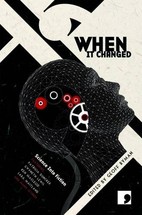
Review: When It Changed: Science into Fiction edited by Geoff Ryman

Trade paperback, 276 pages
Published 2009

Acquired August 2012
Read August 2016
When It Changed: Science into Fiction
edited by Geoff Ryman

Geoff Ryman edits an anthology that pairs science fiction writers with scientists: the sf writers provide stories based on real scientific concepts (sometimes loosely interpreted) and the scientists then provide a 2-3 page commentary on the story. Like any original anthology, it's a little uneven, and I found myself a bit disappointed that there weren't any particularly standout stories here. But still, there were some of note:

"Global Collider Generation: an Idyll" by Paul Cornell is a bit weird, a tale of a scientist trying to build a particle collider with the circumference of the Earth, and a mercenary trying to stop her, all in the midst of Cold War II. I don't know what to make of its assertion that direct conflict is needed for real progress. I'd hope not, but I suspect Paul Cornell actually hopes not too!

"Moss Witch" by Sara Maitland is kind of not a story, but more an examination of a hominid life-form with the traits of mosses. It made me wish I paid more attention to my botanist wife when she talks about plant reproduction, but when I wasn't lost in the details of plantdom, I enjoyed its conceit.

"You" by Geoff Ryman had a really neat idea, an idea so neat it seems like Ryman missed it. People in the future can lifeblog, go into the recorded lives of others. But you can go ever further than that: this story is about you lifeblogging someone who researched the life of someone by lifeblogging. Whoa! I'd've liked to have seen more of this, as this sort of layering was the best part of a tale of someone uncovering evidence there may have been life on Mars.

"In The Event Of" by Michael Arditti might cover some old ground as far as clone stories go, but I found it to be well-told and enjoyable regardless. What would it be like to be the clone of your parents' first child, who never lived up to her potential? Sibling-based imposter syndrome to the max!

"Zoology" by Simon Ings barely even used its scientific innovation, which I think is sort of implicitly acknowledged by Dr Matthew Cobb in "Exceptions," the story's afterword, but I mostly enjoyed it for its satire of the big and small issues of academia, from campus master plans to how rooms get renumbered in old buildings!

There weren't any bad stories here, either, but I wanted to love this book more than I did. I don't know if the premise of the book prevented the imagination from being as opened up as much as you might hope, or what, but these stories don't seem to quite live up to Ryman's hope in the introduction, that good science in fiction can create new and better ways of thinking. It's an overly ambitious goal, and perhaps the failure to realize that goal (he disparages the science and thus the imagination of the  Battlestar Galactica reboot, but I'd say that Battlestar is as good as most of what's here, if not better) is what prevented this book from really succeeding for me.

10 March 2017

Review: Nemesis: The Impostors by Ivan Brandon and Cliff Richards

When I read the various Final Crisis Aftermath titles a couple years ago, my favorite was Escape, which had the character of Tom "Nemesis" Tresser trying to escape Brother Eye and the Electric City, home of the new Checkmate Global Peace Agency. I said that it was the only one FCA story "that doesn't feel like the writer is trying to make something out of Grant Morrison's leftovers, that feels like its writer actually has his own story to tell" and though I found it confusing (it has conspiracies and duplicates and time travel), "just enough explanations were provided to make me feel like there was a logic to this, and to intrigue me to read on. There was a purpose to everything that happened, one that stems from the events of Final Crisis and has repercussions for the future."

Even though one of Grant Morrison's purposes in Final Crisis was setting up new concepts for other writers to play with them, and DC's purpose in the FCA tales was apparently to do that playing, none of them really took off. There were no more Human Flame stories after Run!, no Super Young Team stories after Dance, and almost no more Tattooed Man stories after Ink. Escape did, however, receive a follow-up, in the form of a four-issue Nemesis miniseries called The Impostors. Having escaped from the Electric City, Tom Tresser tries to take down the Council (apparently his recurring nemesis from his original 1980s appearances in The Brave and the Bold), but has to tackle with Batman and possibly the Joker in the process. It was never collected, so I couldn't get it from the library, but I liked Escape enough to buy the single issues off eBay.

As I quoted myself above, I enjoyed Escape and liked the future it implied. Only now, eighteen months after I wrote that, I have no idea what I was talking about. The Impostors did nothing to remind me what I was talking about back then. I was so confused reading this book, and not in a good way. Why exactly did Tom suddenly want to take down his old enemies? Why did he keep seeing Brother Eye and the Electric City? What did the stuff I did dimly remember from Escape actually have to do with anything? And what the heck was up with the ending?

Frustratingly, the story ends in such a way that indicates more is to come-- and that more needs to come, because The Impostors makes so little sense on its own. However, The Impostors was Tom Tresser's last appearance, and then the universe was rebooted. I bounced off this story completely, which is a shame because of how much I liked Escape. I would read more in the vain hope that something might make sense again, but I don't even have that option.

One thing I did like: Tom is pretty paranoid in this story, and justifiably so, and his paranoia is amped up because he doesn't believe the guy claiming to be Batman is actually Batman because his body language is wrong. This is because The Impostors takes place after Final Crisis-- so Bruce Wayne is unstuck in time, and Dick Grayson is the new Batman. It's a nice little touch.

Nemesis: The Impostors was originally published in four issues (May-Aug. 2010). The story was written by Ivan Brandon; illustrated by Cliff Richards; colored by Matthew Wilson; lettered by Steve Wands (#1), Sal Cipriano (#2-3), and Travis Lanham (#4); and edited by Ian Sattler (#1-4) and Rex Ogle (#2-4).

09 March 2017

Review: Oranges Are Not the Only Fruit by Jeanette Winterson

Trade paperback, 192 pages
Published 1997 (originally 1985)

Acquired January 2007
Previously read February 2007

Reread September 2014
Oranges Are Not the Only Fruit by Jeanette Winterson

Look, why oranges anyway? When one of my students asked that in class, we came up with a tremendous list of resonances and symbolisms that the oranges have in this novel-- the cover of my edition, at least, makes a sort of "forbidden fruit" interpretation obvious. One of the meanings of the oranges comes from fairy tale narratives embedded in the text of the novel, like the tale of Sir Perceval or the tale of Winnet. These are the stories that young Jeanette needed to hear but never did, the kind of stories that could have helped her operate in the world, but she never received; she only had one source of stories, her mother's (often warped) Bible tales. She had a steady diet of oranges, so to speak.

Oranges Are Not the Only Fruit is filled with embedded narratives like the fairy tales. This novel, as Mikhail Bakhtin would say all novels are, is heteroglossic, different-tongued. Bakhtin reminds us that you can't separate the form from the content; the fairy tales aren't a sideshow or a diversion, they're part of the meaning of the text as much as the plot is. Everything in a novel refracts the intentions of the author. So why the fairy tales? We should remember that, as Jeanette/Winterson tells us, stories are "a way of explaining the universe while leaving the universe unexplained" (93). Every story explains something and fails to explain something else; we all forget the aspects of the past that make us uncomfortable. So what can we do about this? As we're told (95), the world is a sandwich made up of other peoples stories, so you need to add your own mustard! Or, go even further, and make your own sandwiches.

Jeanette's mother never gets it. She only has one story. She reflects near the end of the novel, "After all… oranges are not the only fruit" (172), but this is in the context of her feeding a group of houseguests only pineapple! She's just substituted one universal story for another. Oranges Are Not the Only Fruit argues that the world is heteroglossic, that everyone needs a different story, and the worst thing that you can do is fail to recognize that. Jeanette grows up and loses the simplicity of her old world, the one where oranges were the only fruit, but she gains a new world with new stories-- and yet the old stories remain there too. She can go back and see her mother, and Jeanette is different but the same, and her mother is different but the same.

We're always finding new stories and discarding old ones when they don’t work. Jeanette’s mother’s stories work for her, but Jeanette needs a different set of stories, and yet the old stories remain inside her. Our sandwiches need mustard. We need oranges and pineapples and many other fruits. Oranges Are Not the Only Fruit is filled with different stories because we all need to be filled with different stories if we're going to survive.

08 March 2017

Faster than a DC Bullet: Prose Fiction #12: Spider-Man: The Venom Factor

Trade paperback, 348 pages
Published 1994

Borrowed from the library
Read December 2016
Spider-Man: The Venom Factor
by Diane Duane
illustrations by Ron Lim

Diane Duane is one of my favorite Star Trek novelists, which was my reason for including this book in my list of interesting prose novels based on comic book properties. It displays one of Duane's writing tics to a T: exhaustive research. We all know that Peter Parker is a photographer, but Duane makes us believe it, devoting time in the novel his purchasing of film and other equipment, his developing of film, and his going through the whole process of submitting photos to the Daily Planet and obtaining reimbursement for expenses. It's the kind of detail you probably wouldn't or shouldn't give in a superhero comic book, but deepens the realistic feeling of the world in a novel, which was part of my whole reason for this project. Peter's also a graduate student in physics during this time period, and Duane captures some of the nuances of that, too, though not as well. (I find it hard to believe anyone has the time to be a graduate student and a freelance news photographer and a superhero.)

Other than that, this is a decent if unimpressive novel. Duane captures the characters of Peter Parker/Spider-Man, Mary Jane, and Venom well, based on my limited experience of them all. (This is set during the period where Peter and Mary Jane were married, and apparently also Venom was kind of a good guy? He seems like he's going to be the book's villain, but it turns out to be misdirection.) It's the first part of a trilogy, so I guess the full story will be forthcoming.

Next Week: A new project begins-- my exploration of DC's "new heroes" in the Infinite Crisis era, beginning with Manhunter: Street Justice!