01 December 2007

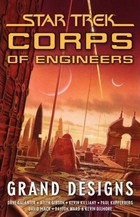
Archival Review: Star Trek: Corps of Engineers: Grand Designs by Dave Galanter, Allyn Gibson, Kevin Killiany, Paul Kupperberg, David Mack, and Dayton Ward & Kevin Dilmore

Trade paperback, 640 pages
Published 2007 (content: 2004)
Acquired August 2007
Read November 2007
Star Trek: Corps of Engineers: Grand Designs
by Dave Galanter, Allyn Gibson, Kevin Killiany, Paul Kupperberg, David Mack, and Dayton Ward & Kevin Dilmore

This collection only holds six S.C.E. stories (probably because Kevin Killiany writes so much), but that's all right-- includes three of my favorites.  Ring Around the Sky by Allyn Gibson is a beautiful look into new character Mor glasch Tev, Orphans by Kevin Killiany is a distinctively-written tale featuring Klingon engineers (who have disappointingly not yet returned), and Sargasso Sector by Paul Kupperberg is just plain fun.  And this time around, I enjoyed the other three stories more so than I remember previously, making this quite possibly the best stretch of S.C.E. stories in the series's existence-- the events of Wildfire certainly paid off in spades from a storytelling perspective, as its ramifications inform almost all of the tales in this volume.

Archival Review: Star Trek: Corps of Engineers: Aftermath by Christopher L. Bennett, Loren L. Coleman & Randall N. Bills, Robert Greenberger, Michael A. Martin & Andy Mangels, and Aaron Rosenberg

Trade paperback, 640 pages
Published 2006 (content: 2003-04)
Acquired November 2006
Read November 2007
Star Trek: Corps of Engineers: Aftermath
by Christopher L. Bennett, Loren L. Coleman & Randall N. Bills, Robert Greenberger, Michael A. Martin & Andy Mangels, and Aaron Rosenberg

This is the first of the rebranded, trade paperback collections of the S.C.E. series, collecting the first eight eBooks following the da Vinci's return to space after the Galvan VI disaster.  As always (am I possibly biased?), the series provided cracking adventures, intriguing dilemmas, and solid character work.  My favorite from this volume is The Demon by Loren L. Coleman and Randall N. Bills, the intense story of a journey deep into a black hole, almost to its event horizon.  What struck me most, reading these all at once for the first time, is the (welcome) increased focus on Soloman in this volume-- Ishtar Rising is all about him, of course, but Buying Time and Collective Hindsight also contain some very good moments for my favorite Bynar, who seems to fall by the wayside a little more often than one might like.

Archival Review: I, Robot: The Illustrated Screenplay by Harlan Ellison with Isaac Asimov

Trade paperback, 288 pages
Published 2004 (originally 1974)
Acquired March 2007
Read November 2007
I, Robot: The Illustrated Screenplay
by Harlan Ellison with Isaac Asimov

This isn't the script of the dreadful Will Smith film from a few years ago, but rather Ellison's 1970s straight adaptation of the Asimov "story-cycle", which never got produced because Ellison doesn't know when it pays to be polite to people.  It's an interesting thought experiment, though-- visually, it would have made a magnificent film, as the gorgeous illustrations show, though it's hard to imagine it satisfactorily being pulled off in the 1970s.  Nowadays, though... 

The adaptation of the chosen short stories is handled quite well-- inserting Calvin into "Robbie" is an obvious but excellent choice; I was surprised but happy to see "Runaround" included, as it's one of the best "Law problem" stories, and the addition of Calvin works; "Liar!" is adapted almost exactly, which makes sense, as it's probably the best Calvin story Asimov ever wrote; and "Lenny" might not actually be in the original book, but its method of inclusion here is inspired.  All in all, it makes for an excellent (and ultimately much more optimistic than Asimov's own) vision of the future of mankind.  The world is clearly not a Asimov one, though, but rather an Ellison one, and though that bothered me at times, it's the nature of adaptations.  If there's any substantial flaw, it's that the frame story is a little too long and involved; not everything that that happens in it is particularly relevant to the story Ellison is trying to tell.  But as for Calvin, Byerley, Powell, Donavan, and the rest, this is the cinematic treatment they deserved.

Archival Review: The New York Trilogy by Paul Auster

Trade paperback, 400 pages
Published 2006 (content: 1985-86)
Acquired January 2007
Read November 2007
The New York Trilogy
by Paul Auster

After a number of quick and easy reads, it was time for something more substantial-- and substantial is what this book has in spades. In a class I took last fall, we read the comic book adaptation of Paul Auster's City of Glass by Paul Karasik and David Mazzucchellil, and having thoroughly enjoyed it, I picked up a (extraordinarily handsome) omnibus edition of the original novel and the other two installments in the series.  There's something about Auster's prose that keeps you reading, even though you have no idea what's happening at times.  Well, that's not fair-- I always knew what was happening, but rarely why, as some pretty dang bizarre things happened.  But I suspect that's not the point.  What links these three pseudo-detective stories together far more than their setting is their ideas-- about identity and about language, primarily, but a lot else, too. (As a side note, I was astounded at how accurate an adaptation the comic book was, despite its length.  Very rarely did I come across anything in the novel that I didn't remember from the comic, and if anything, the excellent art in the comic only added to the effect of the story.)

Archival Review: [nemesis], Volume One: Chapters 1-4 by Greg Holkan

Comic trade paperback, 104 pages
Published 2006
Read November 2007
[nemesis], Volume One: Chapters 1-4
by Greg Holkan

[nemesis] is possibly my favorite webcomic and certainly the one with the best art, but it suffers in its weekly Internet format-- as this collection shows, it's really meant to be read in large, continuous chunks. It's about superheroes; the world it occurs in is basically a combination of ideas from the DC and Marvel universes. But this world's "Superman"-- Mister Zenith-- has been murdered. And in a world where only "numen" can serve as law enforcement officers, it's up to Rick Murphy, the only normal human on the police force, to solve the case. After all, who would want to murder Superman? Holkan's vaguely manga-ish art is excellent, and his writing extraordinary-- he deftly weaves together disparate stories about a number of different characters affected directly and indirectly by the death of Mister Zenith. I will continue to eagerly read this story (usually) every week online, and will certainly buy another collected edition when it comes.

Archival Review: Norby Through Time and Space by Janet and Isaac Asimov

Mass market paperback, 202 pages
Published 1988 (content: 1986-87)
Acquired March 2007
Read November 2007
Norby Through Time and Space
by Janet and Isaac Asimov

This YA series about Norby, the Mixed-Up Robot, was one of my favorite reads as a child, not to mention my introduction to Isaac Asimov (even if Janet actually did do all the writing). Occasionally, I come upon paperback versions in used bookstores that collect two of them together, and I snatch them up instantly. This one collects Norby and the Queen's Necklace (what I remembered as my favorite) and Norby Finds a Villain.

It's excellent YA literature, with a decent breadth of imagination on display in just these two stories. Jeff and Norby and a variety of other characters find themselves in the near future, pre-Revolutionary France, Roman times, prehistoric times, far-future utopias, far-future dystopias, hyperspace, aberrant future versions of Mars, and dangerous alternate realities just within the confines of these two short tales! Norby himself is as fun as ever, and the supporting cast doesn't disappoint. The Queen's Necklace isn't quite as good as I remember (not all of the temporal shenanigans actually work out in the end), but it's solid fun, as is Finds a Villain.

Archival Review: Highcastle: A Remembrance by Stanislaw Lem

Trade paperback, 160 pages
Published 1997 (originally 1966)
Read November 2007
Highcastle: A Remembrance
by Stanislaw Lem

Speaking of Stanislaw Lem, here's the man himself. Not with a sf tale, though, but rather a memoir of his childhood. Lem grew up in Poland during the 1920s and 30s, and he certainly was a precocious child, making this an entertaining read, as he destroys his toys for the sheer fun of it, wanders the parks of his home town, runs afoul of his father, and invents entire worlds for himself in the form of bureaucratic papers. I was disappointed to realize it covered very little from World War II (just a few rumblings and precursors), but as that was undoubtedly set his childhood apart from his adulthood, I can scarcely complain. A quick, enjoyable read, with a few nuggets of insight to boot.

Archival Review: Cosmicomics by Italo Calvino

Trade paperback, 168 pages
Published 1976 (originally 1965)
Acquired December 2006
Read November 2007
Cosmicomics
by Italo Calvino

I first read this in high school, having enjoyed Calvino's Mr. Palomar, and I found this book even more to my liking. Taking a class fall semester where we read If on a winter's night a traveler rekindled my desire to read more Calvino, and I picked up this as well as his Invisible Cities, which I haven't yet gotten around to.

Though I suspect no one would classify this book as science fiction, it reminds me of nothing so much as the robot fables of Stanislaw Lem, as depicted in The Cyberiad and Mortal Engines-- Calvino uses ostensibly scientific jumping-off points to tell stories that, despite usually being about strange creatures from the dawn of the universe, are actually about people and all their quirks and foibles writ large. My favorite in the collection remains "The Light-Years", which I once read aloud in Science Fiction Club, a highly amusing look at the lengths one man takes to preserve his reputation with observers in distant galaxies.

Archival Review: Star Trek: The Next Generation: Before Dishonor by Peter David

Mass market paperback, 352 pages
Published 2007
Acquired and read November 2007
Star Trek: The Next Generation: Before Dishonor
by Peter David

This is the last of this year's installments in the TNG relaunch, and I don't have much to say about it, beyond that it's basically the ultimate Peter David Star Trek book, with all the positives and minuses that that entails these days.

Archival Review: Children of the Lens by E. E. "Doc" Smith

Mass market paperback, 255 pages
Published 1987 (originally 1954)
Acquired March 2007
Read November 2007
Children of the Lens
by E. E. "Doc" Smith

Two-and-a-half years after I began, and here it is at last: the conclusion of E.E. "Doc" Smith's famous Lensman series. What can I say about this book? Not much. While I felt that Gray Lensman was an improvement on Galactic Patrol, and Second Stage Lensmen one on Gray Lensman, this book was not such an increase in quality, mostly thanks to a somewhat muddled storyline-- exactly what was going on that kicked the Patrol and especially the Second (and Third!) Stage Lensmen into high gear? I never quite knew. Still, it was rollicking good fun, with plenty of extravagant weapons, battles, and thrills, and what else does one need from the Doc? Like all books in the series, it ends bigger and better than the one before it (whole planets being flung about as weapons!), and I'm disappointed to finally reach the end.