10 October 2022

The Glorious Dead (From Stockbridge to Segonus: A Doctor Who Magazine Comics Marathon, Part 26)

The Glorious Dead: Collected Comic Strips from the Pages of Doctor Who Magazine
by Scott Gray, Martin Geraghty, Adrian Salmon, Roger Langridge, et al.

Collection published: 2006
Contents originally published: 1979-2001
Previously read: January 2008
Reread: July 2022

If you have a consistent writer, does the strip have a natural tendency toward story arcs? The backmatter here explains that after the Threshold arc, editor Gary Gillat promised fewer arcs... but in his very next multi-part story, scripter Scott Gray introduced the elements of a new story arc. Just can't be avoided, I guess? Like the stories in End Game, this arc draws on the strip's long history, but it feels less beholden to it, as instead of lots of returning strip elements, we just have one in the form of Kroton, and also unlike End Game, I don't have the feeling that the strip is trying to ape the storytelling style of the Mills & Wagner/Gibbons/Parkhouse era. Rather, I feel like it's forging its own identity a bit, trying to figure out what the shape of a late 1990s DWM story is on its own terms.

Throwback: The Soul of a Cyberman / Ship of Fools, from Doctor Who Weekly #5-7, 23-24 (Nov. 1979 & Mar. 1980)
story by Steve Moore, art by Steve Dillon
Just as the McCoy-era strips picked up a character from the Tom Baker–era back-ups and brought him into the main strip in the present, we have that here with Kroton the Cyberman with a Soul, and so the collection helpfully reprints his original appearances. Throwback is basically fine; I think what I struggle with is that even before Kroton breaks away, none of the Cybermen feel particularly Cyberman-y. I mean, I guess there's no reason Cybermen can't chat about things, as long as they do so logically, but they don't feel like the impassive, unstoppable telos of humanity here. But, you know, I would never say no to some Steve Dillon art, and Kroton's interventions on behalf of the human resistance are well done. Ship of Fools is a great spooky sf tale, but Kroton himself could pretty much be any random traveler in it. If someone picked it up because of issue #23's "A NEW CYBERMAN COMIC STRIP!" cover blurb, I imagine they were kind of disappointed.
from Doctor Who Magazine #272
Happy Deathday, from Doctor Who Magazine #272 (Dec. 1998)
story by Scott Gray, art & lettering by Roger Langridge
This is DWM's special contribution to the... ah, 35th anniversary? Is that a thing? It's a deliberately goofy multi-Doctor story, and I have to say, deliberately goofiness is probably better than deadly earnestness when it comes to these things, as the Doctors team up against the Beige Guardian, and there are references to Dimenions in Time, and it all turns out to be a videogame that Izzy is playing. There are some good jokes, and the art is fun.
from Doctor Who Magazine #274
The Fallen, from Doctor Who Magazine #273-76 (Jan.-Apr. 1999)
story by Scott Gray, pencils by Martin Geraghty, inks by Robin Smith, lettering by Elitta Fell and Peri Godbold
This is DWM's sequel to the TV movie: Grace, since its events, has been using DNA she recovered to try to create a human/Time Lord hybrid, that will fulfill her desire to hold back death. But the DNA didn't come from a Time Lord, because he was in the body of a Skarosian morphant, and so Grace and the MI6 scientist she's been working with have inadvertently created a horrendous monster. Meanwhile, the Master is back... even though no one knows it. What I realized while reading it is that it's really the only sequel to the TVM ever made! BBC Books kind of edged close to it a couple times (and I know authors wanted to use Grace in novels but couldn't), while Big Finish totally ignored it except for using McGann himself (up until they got Eric Roberts, anyway). But this is a full-fledged sequel, following on from its scenes and character beats, even. The Doctor makes big impacts on people's lives, and this has repercussions he's not always thinking about. There's a strong focus on the characters of the Doctor and Grace here, and Martin Geraghty does a great job with big action and character close-ups alike. Overall, a good one, and the beginning of a good direction, I think.
from Doctor Who Magazine #277
Unnatural Born Killers, from Doctor Who Magazine #277 (May 1999)
story & art by Adrian Salmon, lettering by Elitta Fell
If you say, "Adrian Salmon, draw a story about Kroton the Cyberman beating up Sontarans," of course he will draw the hell out of it. And it turns out he can write, too! It took a bit for me to adjust to the more irreverent, human Kroton of the 1990s, but it was the right call for sure.

from Doctor Who Magazine #281
The Road to Hell, from Doctor Who Magazine #278-82 (June-Sept. 1999)
story by Scott Gray, pencils from Martin Geraghty, inks by Robin Smith and Fareed Choudhury, lettering by Elitta Fell

I felt that this was the weakest story of the volume, though it got better as it went. At the beginning, I found it hard to track the different groups and characters, who were introduced thick and fast. But once the relationship between Izzy and Sato Katsura came into the foreground, I found the story worked a lot better. There are some great moments here, such as Izzy making the future of Japan manifest as her knowledge of manga, anime, and Power Rangers, but then the cliffhanger being the reveal of the atomic bombing of Japan. Some neat concepts here, and one thing I appreciate about Gray as a writer is his peppering of the dialogue with small moments of humor, especially between Izzy and the Doctor.
TV Action!, from Doctor Who Magazine #283 (Oct. 1999)
story by Alan Barnes, art & lettering by Roger Langridge
It's DWM's 20th anniversary! Alan Barnes's notes in the commentary give the whole thing an air of desperation, but I thought it was a blast... even though, as an American, most of the cultural references go over my head. They bring back one of DWM's first original villains, Beep the Meep, but have him and the TARDIS cross over into a different universe... ours. The Doctor and Izzy chase Beep through BBC Television Centre on the day DWM debuted, culminating in a scene where the real Tom Baker pretends to be the Doctor to cower Beep. Magnificent! The real Tom Baker quotations used in his dialogue are priceless.
from Doctor Who Magazine #286
The Company of Thieves, from Doctor Who Magazine #284-86 (Nov. 1999–Jan. 2000)
story by Scott Gray, pencils by Adrian Salmon, inks by Fareed Choudhury, lettering by Elitta Fall and Roger Langridge
This was good fun: the Doctor and Izzy arrive on a ship being hijacked by pirates, and when a Cyberman is found belowdecks, everyone misunderstands the situations... because it's Kroton, his path intersecting the TARDIS's at long last. Like I said above, the interplay between the Doctor and Izzy really works; I enjoyed her putting on her glasses and spouting Star Trek bafflegab to confuse a bunch of pirates about the status of their engines. This does a great job of escalating a complicated situation, and then exiting it. It's filled with delightful moments, such as a "high" Kroton, Izzy's idea to stop the bad guy, the TARDIS team flying through the void of space, and the two pirates who don't trust each other drifting apart in space on the final page. The Glorious Dead is great, of course, but this might be Scott Gray at his best, and Adrian Salmon's work is as delightful as always... or maybe even moreso.
from Doctor Who Magazine #291
The Glorious Dead, from Doctor Who Magazine #287-96 (Feb.-Oct. 2000)
story by Scott Gray, pencils by Martin Geraghty, additional pencils by Roger Langridge, inks by Robin Smith, lettering by Roger Langridge
The biggest DWM story ever! Ten whole months! It could be a grind, but Gray stops it from being so by switching things up every so often. The first three parts play out relatively normally, with the Doctor, Izzy, and Kroton trying to figure out what's up with this alien planet and the strange religion coming to it. But then the part three cliffhanger is marvelous: the Doctor hears the words "WAKE UP WAKE UP WAKE UP" and suddenly finds himself waking up... in bed with a Grace who called him "honey?" It's the kind of cliffhanger I can imagine Steven Moffat doing.

Part four then does something I can't remember any DWM story doing before (corrections welcome): jumping forward away from a cliffhanger, in this case about three weeks. The installment entirely focuses on what Izzy and Kroton on the occupied planet Paradost, told almost entirely via her narration (as a letter to Max). The jump forward again feels very Moffat (e.g., "Day of the Moon"); the choice to focalize the installment via the companion feels very Russell T Davies (e.g., "Doomsday"). And then in part five, we're doing something else entirely yet again! Here we have a masterpiece of surreal comics storytelling, as the Doctor tumbles from universe to universe, and thus from storytelling style to storytelling style. It starts out ordinary-ish, with the Doctor in a world where he did stay with Grace, but soon he's in a western, he's a cartoon tiger, he's in Peanuts getting advice from the Rani. I guess it's all a bit Steve Parkhouse—it reminds me of Once Upon a Time Lord—but it's so well done, and it's striking for coming in the middle of what has seemed like a pretty straight DWM space epic up until this point. Bits of it are drawn by Roger Langridge, which works well.

So with part six, things settle down... a bit. But we still get massive surreal landscapes of the omniverse, and the reveal that the alien planet the enemies come from is actually Earth, and the return of Sato, and Izzy shrunk and put in a test tube, and the reveal that the Master is behind it all! Again, it feels a bit RTD, akin to the reveal in Last of the Time Lords that the Toclafane are actually humans, and that the Master has been manipulating the entire series. It's all a bit mad, but in the best DWM way, and Gray and Geraghty's focus on the Doctor and Izzy and Kroton as people keeps it anchored. I do tune out a bit whenever we get one of those multi-page sequences of someone explaining the History Of All Time or whatever, but on the whole, this really works, and I like how it subverts the seeming prophecy about a Doctor/Master battle. Kroton gets a great end. Izzy's discussion of her parents and her relationship to them works well this time out. I think this does a good job of taking the kind of Parkhouse/Gibbons-y space epic and marrying it to the sensibilities of contemporary, character-focused storytelling—similar to what Big Finish was about to do in its own Paul McGann stories, and foreshadowing the approach the new series would take under Russell.
from Doctor Who Magazine #299
The Autonomy Bug, from Doctor Who Magazine #297-99 (Nov. 2000–Jan. 2001)
story by Scott Gray, art & lettering by Roger Langridge
I was going to say this was cute, but it's not; like the New Eighth Doctor Adventure The Cannibalists, it uses cuteness to disguise how horrifying it really is. The Doctor and Izzy come to an institution for deranged robots, and realize they are being pretty awfully mistreated. I didn't love it, but it's an effective serious story from Roger Langridge, and has a great moment of cartoon logic, and a nice conclusion. The stuff with the robots painting their faces is pretty good.
Other Notes:

  • Roger Langridge will go on to be a McGann-era mainstay of the strip as an artist, so much so that he illustrated the eighth Doctor installment of IDW's 50th anniversary series. But I, weirdly, know him from the fact that he illustrated special installments of the short-lived Shaenon K. Garrity webcomic Smithson (2004-8, I think? previously known as More Fun).
  • Unnatural Born Killers is one of only a few Doctor-free main strips... and actually the last one featured the Sontarans, too!
  • The Doctor is said to have defeated Beep twice before; the second time was in the story Star Beast II, published back in 1995, but this was collected with some twelfth Doctor strips, so I haven't read it yet. Big Finish would later add another Beep encounter, a direct follow-up to Star Beast II, inconsistent with this story. Which is, you know, as canon as anything. In IDW's era, they'd even do another story about the Doctor crossing over into our universe!
  • from Doctor Who Magazine #283
  • Barnes was inspired by a Star Trek short story he only vaguely remembers; it would be "Visit to a Weird Planet Revisited" by Ruth Berman from the anthology The New Voyages.
  • The only thing to dislike about Kroton being in the TARDIS crew is how little his time was! His departure story immediately follows his introduction. I demand missing adventures set between The Company of Thieves and The Glorious Dead. Another one to go on the the-tv-show-gets-cancelled-and-the-strip-becomes-a-nostalgia-fest list, I guess.
  • I kept comparing The Glorious Dead to something Russell would do, and it really is, in a number of ways... and then I learned from the commentary that Russell actually wrote DWM after part four!
  • Did the readers at the time know The Glorious Dead was going to be ten parts? Or did they just come to the end each month and read "TO BE CONTINUED..." every time instead of "TO BE CONCLUDED..." and wonder if it would ever end?

This post is the twenty-sixth in a series about the Doctor Who Magazine comic strip and Marvel UK. The next installment covers Oblivion. Previous installments are listed below:

  1. The Iron Legion
  2. Dragon's Claw 
  3. The Transformers Classics UK, Volume One
  4. The Tides of Time
  5. The Transformers Classics UK, Volume Two
  6. Voyager
  7. The Transformers Classics UK, Volume Three
  8. The World Shapers
  9. The Transformers Classics UK, Volume Four
  10. The Age of Chaos
  11. The Transformers Classics UK, Volume Five
  12. A Cold Day in Hell!
  13. Death's Head: Freelance Peacekeeping Agent (part 1)
  14. Nemesis of the Daleks
  15. Death's Head: Freelance Peacekeeping Agent (part 2)
  16. The Good Soldier
  17. The Incomplete Death's Head
  18. Evening's Empire
  19. The Daleks
  20. Emperor of the Daleks
  21. The Sleeze Brothers File
  22. The Age of Chaos
  23. Land of the Blind
  24. Ground Zero
  25. End Game

07 October 2022

Reading Kabumpo in Oz Aloud to My Son

Kabumpo in Oz by Ruth Plumly Thompson, illustrated by John R. Neill

I owned all of L. Frank Baum's Oz books growing up, and read them all many times. I only owned two Ruth Plumly Thompson ones, her last two canonical ones (which we will come to eventually, I suppose). Hers were not very commonly reprinted after their original Reilly & Lee editions. I did, however, read them all, or at least most of them: my mother helped middle-school me navigate the dial-up catalogue of the 1990s in order to request them all through interlibrary loan! That said, I have absolutely no memory of most of them; the titles don't even spark slight chords of memory in my mind. So, rereading them to my three-year-old son is more akin to reading them for the first time.

Originally published: 1922
Acquired and read aloud: June 2022

Kabumpo in Oz has a couple parallel plots. In one, the old Nome King (or "Gnome King," as Thompson spells it), Ruggedo, has regained his memory since the events of Magic of Oz and has carved out a "kingdom" for himself underneath the Emerald City... a kingdom with just two subjects, a rabbit named Wag (for whom Ruggedo steals shiny things from the city) and a wooden doll named Peg Amy (which Ruggedo stole from Trot). Ruggedo finds a boxed of "mixed magic" buried under the Emerald City, which he uses to bring Peg Amy to life, and then to enlarge Peg Amy, Wag, and... himself! Because he's standing under Ozma's palace when this happens, he ends up with the palace on his giant head and he freaks out and runs away to Ev. This interrupts a party Dorothy is having, meaning that her, along with Scraps, the Scarecrow, Tik-Tok, Trot, Betsy Bobbin, Sir Hokus, and Ozma, are all trapped in the palace on the head of the old Nome King.

Meanwhile, Prince Pompadore of Pumperdink, a tiny kingdom in the Gillikin Country, is having his tenth eighteenth birthday party (since people in Oz don't age) when the cake explodes. A magic scroll declares that if he doesn't marry a "proper fairy princess," Pumperdink will disappear. His father wants to marry him off to an old fairy crone who is the princess of a nearby magic forest, but Kabumpo the Elegant Elephant, a favorite in the court of Pumperdink, thinks that the only fairy princess in Oz good enough for Pompa is Ozma herself, and so Pompa and Kabumpo sneak out of Pumperdink in the middle of the night to go to the Emerald City and ask for Ozma's hand in marriage.

They have some adventures on the way, and by the time they get there, of course, Ozma's palace is gone, so they go on a quest with Wag and Peg Amy to retrieve the palace and defeat Ruggedo—an action they hope will prove that Pompa is worthy of Ozma's hand, even if by this point his fancy clothes are in tatters and his hair all got burnt off by a well-meaning living candle in the Illumi Nation.

I really liked this. Thompson's trademark puns come a bit thick and fast at times and often go over the head of my son (e.g., they meet living numbers, who don't have heads for figures, but do have figures for heads), but the characters work. Pompa is quiet and unassuming but has a nobility to him; Peg Amy is kind and can deflate the pomposity of anyone she meets; Wag is passionate and impetuous; Kabumpo is pretentious but ultimately well-meaning. The three non-human characters were all fun to read aloud.

Especially once all four are adventuring together, they make a great group. I liked the bickering between Kabumpo and Wag, and the way Peg Amy could calm Kabumpo down. In Royal Book, Thompson mostly stuck to Baum's characters as protagonists (with the exception of Sir Hokus), but here, she shows she can make her own characters that feel that they belong in Oz every bit, but also aren't the kind of characters Baum would write. Questing princes are a traditional fairy tale trope that Baum wasn't interested in for the Oz books. (Rinkitink aside, but I guess that wasn't meant to be an Oz book.)

The plotting might be a bit contrived. It takes days for Pompa and Kabump to get to the Emerald City, and then to Ev, so Thompson has to keep the Emerald City characters out of the action because otherwise they could easily solve their own problems. Basically, at the exact moment they begin making headway, the Sandman happens to trip over Ozma's palace and spill sleep sand everywhere, meaning everyone (bar the Scarecrow, Scraps, and Tik-Tok, of course) sleeps until Pompa shows up to save them. But, to be honest, I was entertained along the way, and I never minded.

What makes the book really work is the last few chapters. Ozma turning down Pompa's proposal is a moment both hilarious and touching; Kabumpo in particular is anguished. Doesn't she know how these kind of stories work? A princess can't turn down a prince who saves her! Is it Pompa's hair? The group consults the magic question box contained in the assortment of mixed magic, and it tells them that Pompa's "proper princess" is actually the Princess of Sun Top Mountain, a small kingdom in the Winkie Country.

The book has an emotional climax—something that I honestly don't think Baum ever even attempted in his Oz novels. As Pompa approaches Sun Top Mountain, he begins to mourn that he won't be able to go adventuring with his newfound friends anymore. Thompson has really succeeded in making their bond seem meaningful, so this is genuinely melancholic. The trip into Sun Top Mountain is kind of eerie, and as Pompa professes that he loves Peg Amy, he finds out that she (for somewhat complicated reasons) is the princess of Sun Top Mountain. It's a really well done moment of emotional catharsis.

For me, it elevates what was a good Oz novel into a great one, and my son had a pretty big reaction to the revelation of Peg Amy's true identity, too. He seemed to enjoy the novel on the whole; you can't do wrong by an elephant! He was already asking me if we would read about Kabumpo, Pompa, and company in future novels. (Thompson uses Kabumpo as co-protagonist in several of her novels, though I don't think Pompa and Peg Amy ever have a big role again. We'll see I guess!)

Books of Wonder may have done all the Baum novels as hardcover facsimiles, but they only did two of Thompson's, the only two with color plates that were in the public domain in the 1990s. (The other was Royal Book of Oz, which I owned as a Dover already, so I didn't upgrade.) It was published in 1998, and the copy I bought direct from the publisher is a first printing, indicating that these probably didn't sell very well; compare my copy of, say, the Books of Wonder Lost Princess, also originally published in 1998, where my new copy is an eleventh printing. Little wonder, I suppose, that even though many more Thompson Oz novels with color plates have come into the public domain the past few years, Books of Wonder hasn't done any more facsimiles. The demand just isn't there, alas.

So here, for now, is my complete collection of Books of Wonder facsimiles:

The inconsistent presence of spine numbers is a bit annoying. And why did Kabumpo use a different spine design than the Baums? It's not Books of Wonder's fault, though, that my supposed "like new" copy of Emerald City from Amazon Marketplace lacked a dust jacket.

It does seem a shame that now I'm missing just two Baums in this format. Maybe I will go back someday and upgrade my Dovers anyway.

Next up in sequence: The Cowardly Lion of Oz

06 October 2022

Reading Roundup Wrapup: September 2022

This post is a bit late because there was, well, a hurricane! More on that tomorrow. (EDIT: Well, next week.)

Pick of the month: The Wrinkle in Time Quartet by Madeleine L'Engle. Not every installment in here was a hit for me, but there was one great book, one very good book, one decent book, and one boring book. Overall, though, a great package that I really enjoyed getting to revisit.

All books read:

  1. The Flood: Collected Comic Strips from the Pages of Doctor Who Magazine by Scott Gray, Martin Geraghty, Mike Collins, John Ross, et al.
  2. Doctor Who: Trading Futures by Lance Parkin
  3. The Giant Horse of Oz by Ruth Plumly Thompson, illustrated by John R. Neill
  4. Dot and Tot of Merryland by L. Frank Baum, illustrated by Donald Abbott
  5. The Kairos Novels: The Wrinkle in Time Quartet: A Wrinkle in Time / A Wind in the Door / A Swiftly Tilting Planet / Many Waters by Madeleine L’Engle
  6. The Cruel Sea: Collected Comic Strips from the pages of Doctor Who Magazine by Robert Shearman, Mike Collins, Gareth Roberts, Steven Moffat, et al.

Okay, I know it looks bad, but hear me out! I count my reading list on a book basis: if a book contains several novels, it still counts as just one book. (On the other hand, if a novel is published across multiple volumes, it counts as multiple books.) So even though I logged just six books this month, I actually did a lot more reading than that because I've been reading a ton of Library of America compilations. From The Wrinkle in Time Quartet, I finished A Wind in the Door, A Swiftly Tilting Planet, and Many Waters; from The Polly O'Keefe Quartet, I finished Dragons in the Waters and A House Like a Lotus; and from American Science Fiction: Four Classic Novels 1960-1966, I finished The High Crusade and Way Station.

If you added all that back in, I'd be at a respectable twelve! Maybe I need a new system.

All books acquired:

  1. The Conjure-Man Dies: A Mystery Tale of Dark Harlem by Rudolph Fisher
  2. Jack Pumpkinhead of Oz by Ruth Plumly Thompson, illustrated by John R. Neill
  3. The Wishing Horse of Oz by Ruth Plumly Thompson, illustrated by John R. Neill
  4. The Collected Short Stories of L. Frank Baum edited by Katharine Rogers
  5. Sissajig and Other Surprises by Ruth Plumly Thompson
  6. Fantastic and Horrific Stories by Arthur Machen

Mostly Oz books for me and my son, including two collections of Oz-adjacent short stories.

All books remaining on "To be read" list: 688 (up 2)

05 October 2022

JSA, Book Four by Geoff Johns, David S. Goyer, Leonard Kirk, Keith Champagne, et al.

JSA by Geoff Johns, Book Four

Collection published: 2020
Contents published: 2002-03
Read: July 2022

Writers: Geoff Johns, David S. Goyer
Pencillers: Leonard Kirk, Peter Snejbjerg, Keith Giffen, Stephen Sadowski, Patrick Gleason
Inkers: Keith Champagne, Peter Snejbjerg, Al Milgrom, Andrew Pepoy, Christian Alamy
Colorist: John Kalisz
Letterer: Ken Lopez

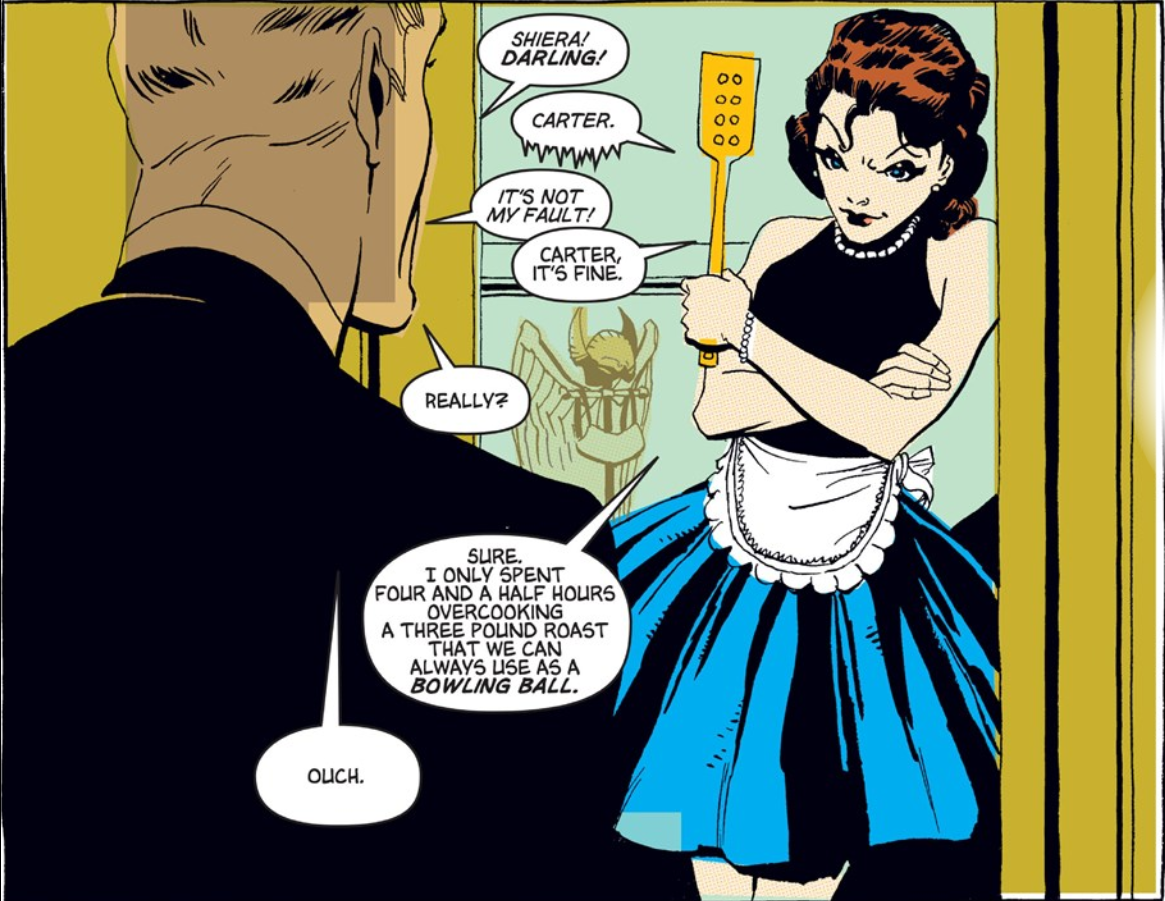
The fourth (and final) volume of JSA by Geoff Johns finally catches events up to what was collected back in book two; in that book, Captain Marvel and the Rick Tyler Hourman were members of the team, and we finally see them join here! If you're making a definitive series of collections, I feel like you could make a much better effort at getting the order right.

Collecting issues aside, the series finally hit its groove for me in this collection. I've struggled with it up until now, but I enjoyed most every storyline in this volume. It opens with "Stealing Thunder," where the Ultra-Humanite has put his brain into Johnny Thunder's body in order to access the power of the Thunderbolt. First there's a pretty decent character-focused prologue (which nicely wrongfoots you about what has happened to Johnny), and the story itself does a good job of focusing on the personalities of individual JSA members. It jumps ahead several months, to when the Earth is an Ultra-Humanite-controlled dystopia, and a small group of heroes remains free of his control. So we follow the members of this group, and it's all handled pretty well. We even get an issue that focuses on former Injustice Society member Icicle, a villain who's immune to the Ultra-Humanite's control and becomes an uneasy ally of the JSA. It's nice to see Rick Tyler (formerly of Infinity, Inc.) again, and the thing about him being able to spend one last hour with his dad, the original Hourman, is pretty neat.

I appreciate all the Infinc callbacks, of course... especially since I actually forgot about this one!
from JSA #34 (art by Leonard Kirk & Keith Champagne)

After this, we get some character-focused one-offs. A Father's Day story parallels Rick meeting with his father, and Jakeem Thunder trying to track down his. I enjoyed this one. Then there's a story about a villain lusting after Power Girl, and it's as bad as all Geoff Johns–penned Power Girl stories. But then there's a decent story about an old Dr. Mid-Nite villain getting his grandson to commit crimes, and the JSA working together to stop him.

Don't trust him!
from JSA #32 (art by Peter Snejbjerg)

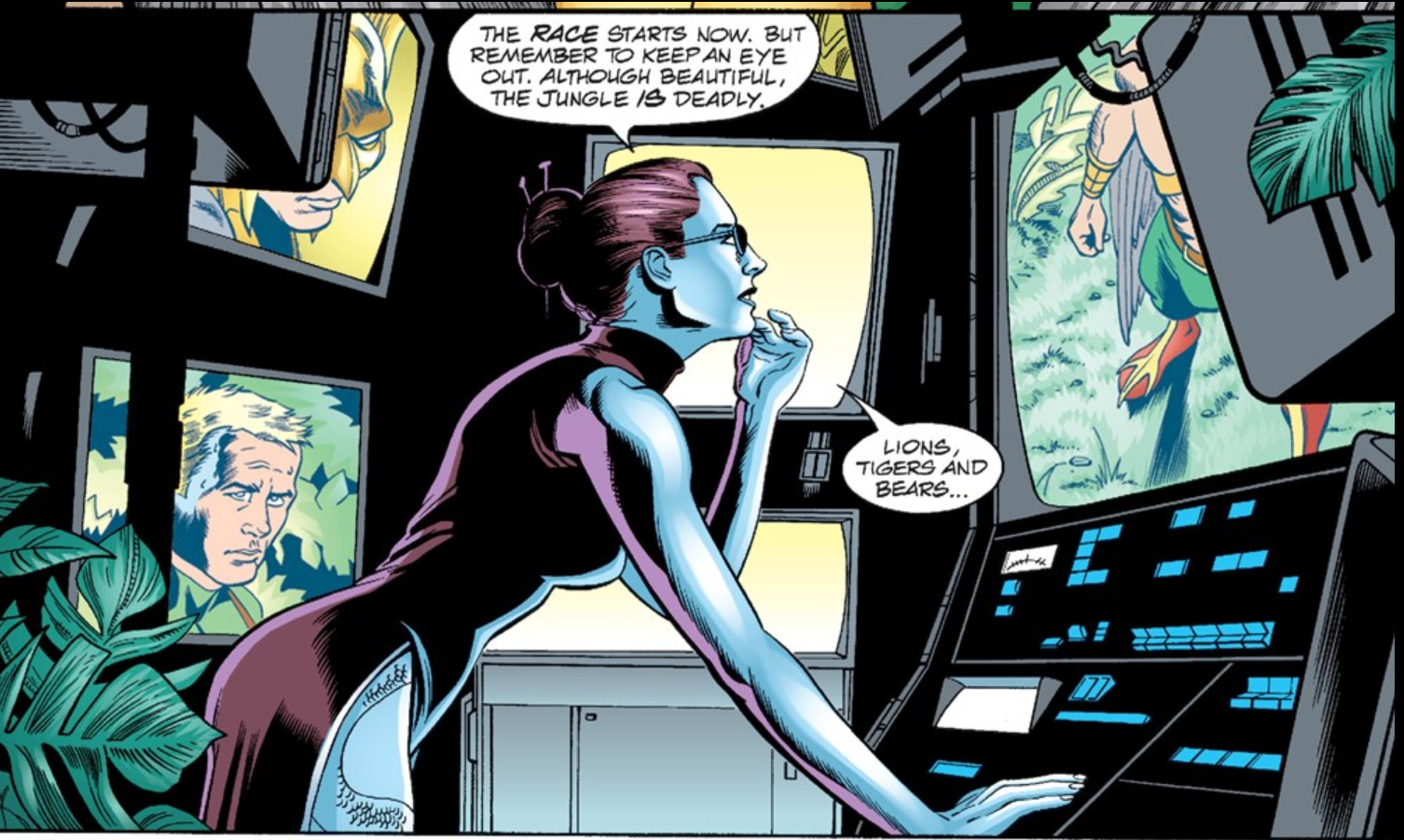
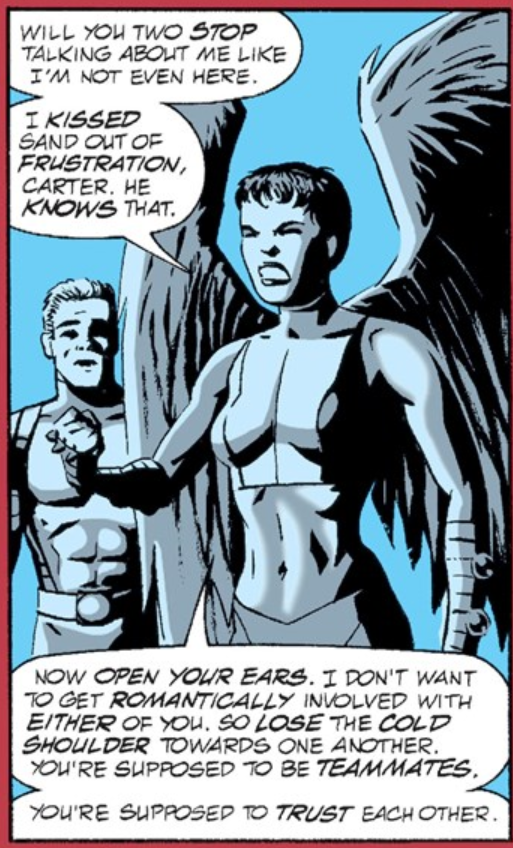
Finally, there's a multi-part story about time travel. Some characters go back to the 1940s and meet the original Mr. Terrific; this I really liked, especially the way Mr. Terrific immediately cottoned on to what was happening. Some other characters end up in Ancient Egypt with the original Hawkman and Black Adam, and this I found much less interesting. It does seem like the series is moving back in the direction of having Hawkgirl hook up with Hawkman, which I find profoundly dull and kind of creepy. The stuff about Black Adam's tortured past I don't really care for, because I know it goes pretty unpleasant places in stories like World War III.

Poor Johnny Thunder... or maybe not?
from JSA #36 (art by Leonard Kirk & Keith Champagne)

Also the Hector-Hall-looking-for-Lyta subplot continues to be dead dull. It's a succession of plot beats, not a story about characters.

Ouch.
from JSA #38 (art by Stephen Sadowski & Andrew Pepoy)

But overall, this is an effective team comic at this point. It helps that Leonard Kirk is an absolutely solid artist. Not "flashy," but good personality and good storytelling and good action, the exact kind of artist a nuts-and-bolts team title like this needs. I've liked him ever since his Captain Britain and MI13 days for Marvel. The real shame is that this series of collections ended with this volume; even though DC did collect all of JSA and Justice Society of America vol. 3 in a set of three JSA by Geoff Johns Omnibuses, their "re-cutting" of the run as a series of trade paperbacks ended here, only partway through the contents of what had been JSA by Geoff Johns Omnibus, Volume Two. So having read issues #1-45 of this series via Hoopla, I am going to need to track down #46-87 some other way! (Also it seems clearly criminal that this series was called JSA by Geoff Johns when in the end, David Goyer wrote as many of the collected issues as Johns did... if not more!)

This post is thirty-fifth in a series about the Justice Society and Earth-Two. The next installment covers JSA Presents Green Lantern. Previous installments are listed below:
  1. All Star Comics: Only Legends Live Forever (1976-79)
  2. The Huntress: Origins (1977-82)
  3. All-Star Squadron (1981-87)
  4. Infinity, Inc.: The Generations Saga, Volume One (1983-84)
  5. Infinity, Inc.: The Generations Saga, Volume Two (1984-85)
  6. Showcase Presents... Power Girl (1978)
  7. America vs. the Justice Society (1985)
  8. Jonni Thunder, a.k.a. Thunderbolt (1985)
  9. Crisis on Multiple Earths, Volume 7 (1983-85)
  10. Infinity, Inc. #11-53 (1985-88) [reading order]
  11. Last Days of the Justice Society of America (1986-88)
  12. All-Star Comics 80-Page Giant (1999)
  13. Steel, the Indestructible Man (1978)
  14. Superman vs. Wonder Woman: An Untold Epic of World War Two (1977)
  15. Secret Origins of the Golden Age (1986-89)
  16. The Young All-Stars (1987-89)
  17. Gladiator (1930) ["Man-God!" (1976)]
  18. The Crimson Avenger: The Dark Cross Conspiracy (1981-88)
  19. The Immortal Doctor Fate (1940-82)
  20. Justice Society of America: The Demise of Justice (1951-91)
  21. Armageddon: Inferno (1992)
  22. Justice Society of America vol. 2 (1992-93)
  23. The Adventures of Alan Scott--Green Lantern (1992-93)
  24. Damage (1994-96)
  25. The Justice Society Returns! (1999-2001)
  26. Chase (1998-2002)
  27. Stargirl by Geoff Johns (1999-2003)
  28. The Sandman Presents: The Furies (2002)
  29. JSA by Geoff Johns, Book One (1999-2000)
  30. Wonder Woman: The 18th Letter: A Love Story (2000)
  31. Two Thousand (2000)
  32. JSA by Geoff Johns, Book Two (1999-2003)
  33. Golden Age Secret Files & Origins (2001)
  34. JSA by Geoff Johns, Book Three (1999-2003)

03 October 2022

Lifespan by David Sinclair

Lifespan: Why We Age—and Why We Don’t Have To
by David A. Sinclair, with Matthew D. LaPlante

I've been reading sf stories about life extension for a class I will teach, but I've also been reading books recommended by one of my co-teachers about the actuality of it. This one is by a Harvard Medical School researcher into aging. Compared to some others that I have read, it has more of a real science feel. It's somewhat written in that breathless style of popular science journalism, but not as often. There's some real science in here, or at least so it seems from the perspective of this nonscientist.

Published: 2019
Read: June 2022

I also appreciated that Sinclair thinks through some of the social consequences of longer lifespan, and he has good answers where he can. Some areas, he freely admits, don't have good answers: the rich will gain access first, and longer lifespan will allow the rich to acquire even more, creating a feedback loop. (This is something I've seen in a number of the sf stories I've read.) On the other hand, I wasn't convinced by all his answers: he says we'll save money from not having to treat diseases that are symptoms of aging... but since he's not promising immortality, wouldn't those diseases catch up with us again at some point?

The book is clearly trying to be accessible but also not be fluff. I think it fails in threading the needle when it comes to explaining epigenetics, which is the key to Sinclair's theory of aging, but which I totally failed to understand the explanation of; it's a mixture of too-much technical detail and too-dumbed down analogies.

But on the whole, I found this to be one of the more convincing advocacies of anti-aging I've read. Should I start taking the supplements he recommends to extend my own lifespan...?

30 September 2022

The Expanse Reading Order

There are just nine novels in The Expanse, and they are numbered, so reading them in order is pretty easy.

However, there are also a number of novellas and short stories, available for individual purchase from ebook retailers like Amazon, and now collected in the book Memory's Legion. Some are prequels to the main series, showing what characters did before them; others are follow-ups to specific novels, showing more of characters and situations from the main series.

Possible Order #1: Release Date

The obvious, spoiler-free, way to read them is release order:

  1. Book One: Leviathan Wakes (June 2011)
  2. Short Story: The Butcher of Anderson Station (Oct. 2011)
  3. Book Two: Caliban's War (June 2012)
  4. Novella: Gods of Risk (Sept. 2012) 
  5. Short Story: "Drive" (Nov. 2012)
  6. Book Three: Abaddon's Gate (June 2013)
  7. Novella: The Churn (Apr. 2014)
  8. Book Four: Cibola Burn (June 2014)
  9. Book Five: Nemesis Games (June 2015)
  10. Novella: The Vital Abyss (Oct. 2015)
  11. Book Six: Babylon's Ashes (Dec. 2016)
  12. Novella: Strange Dogs (July 2017)
  13. Book Seven: Persepolis Rising (Dec. 2017)
  14. Book Eight: Tiamat's Wrath (Mar. 2019)
  15. Novella: Auberon (Nov. 2019)
  16. Book Nine: Leviathan Falls (Nov. 2021)
  17. Novella: The Sins of Our Fathers (Mar. 2022)

Possible Order #2: Chronological

I really don't think I would recommend this. It seems silly to me. The Expanse is definitely one of those series where the prequels are interesting because they tell you about characters you already like. Who would care about The Churn if you didn't already know Amos? And in some cases, it spoils: The Vital Abyss takes place over a span of time that ends around Cibola Burn, but builds on something revealed in Nemesis Games. But for completion's sake, here it is:
  1. Short Story: "Drive" [a long time before Book One]
  2. Novella: The Churn [some years before Book One]
  3. Short Story: The Butcher of Anderson Station [a few years before Book One]
  4. Book One: Leviathan Wakes
  5. Book Two: Caliban's War
  6. Novella: Gods of Risk [between Books Two and Three]
  7. Book Three: Abaddon's Gate
  8. Book Four: Cibola Burn
  9. Novella: The Vital Abyss [in parallel to Books One through Four]
  10. Book Five: Nemesis Games
  11. Book Six: Babylon's Ashes
  12. Novella: Strange Dogs [between Books Six and Seven]
  13. Book Seven: Persepolis Rising
  14. Novella: Auberon [between Books Seven and Eight]
  15. Book Eight: Tiamat's Wrath
  16. Book Nine: Leviathan Falls
  17. Novella: The Sins of Our Fathers [after Book Nine]

My Suggested Order

I actually came up with a different order to both. The thing off-putting about the release order is the somewhat erratic way the shorts were released—some books had two shorts between them, others none. I think having a small taster between each larger work is nice. So to maintain that, "Drive" gets pushed out of sequence a bit... but it can pretty much be read anywhere.

And I think in one case the prequel actually does benefit being read first: Auberon might have come out after Book Eight, but is more interesting read prior. So here is my "machete order" for The Expanse books, which tries to alternate between full-length novels and shorts, and also doesn't put anything where it will spoil something:

  1. Book One: Leviathan Wakes
  2. Short Story: The Butcher of Anderson Station [fills in background of a character introduced in Book One]
  3. Book Two: Caliban's War
  4. Novella: Gods of Risk [follows up on a Book Two character]
  5. Book Three: Abaddon's Gate
  6. Novella: The Churn [sets up some stuff that is used in Book Four]
  7. Book Four: Cibola Burn
  8. Short Story: "Drive" [could go anywhere]
  9. Book Five: Nemesis Games
  10. Novella: The Vital Abyss [fills in backstory for some stuff revealed in Book Five]
  11. Book Six: Babylon's Ashes
  12. Novella: Strange Dogs [takes place in this gap]
  13. Book Seven: Persepolis Rising
  14. Novella: Auberon [released after Book Eight but works well before it]
  15. Book Eight: Tiamat's Wrath
  16. Book Nine: Leviathan Falls
  17. Novella: The Sins of Our Fathers [follow-up to Book Nine]

It does kind of bother me that the alternating structure breaks down at the end! Maybe read The Expanse: Origins comic there, or maybe the answer is to work in "The Last Flight of the Cassandra" (a short story exclusive to the Expanse RPG sourcebook) somewhere.

My Expanse collection is a mish-mash. Mostly US trade paperbacks, but I have two UK trades and one US hardcover. Note that with the later US books, the author name and title switched prominence, but that didn't happen in the UK.

28 September 2022

Hearts of Oak by Eddie Robson

Hearts of Oak by Eddie Robson

I picked up this Tor.com novella (though I think it must be a novel by actual word count) because it was by Eddie Robson, one of my favorite Doctor Who writers, one of those whose senses of tone, character, and world are generally strong enough that I could imagine him succeeding at original science fiction, which is not a thing I believe of most tie-in writers.

Published: 2020
Acquired: December 2021
Read: June 2022

For its first half this is very strong. It has a weird setting: a city where everything is made of wood, ruled by a king with a talking cat, where the imperative is to just build build build. The parallel narratives follow the king and the chief architect, both of whom are beginning to suspect that their world doesn't entirely make sense. (What is... concrete?) The story is told with a dry, factual narrative voice that works well to highlight its absurdities.

About halfway through, though, the novel explains what's going on, and at that point, I was like, "This is just a Doctor Who story!" And indeed, when I flipped to the Acknowledgements page, I found Hearts of Oak was based on something Robson originally pitched to Alan Barnes, former script editor of Big Finish's Doctor Who range. At that point, the story becomes much less interesting; what's really happening is much less striking than what went before, and the disconnected style works against the narrative from then on, too, as to be interesting what comes next, we would need to be invested in the characters as people more.

That said, I like Robson in general and the first half of this novel in particular enough that I would give his original work another chance; I see that this is actually his second novel, so I'll have to seek out his first and see how it is.

26 September 2022

JSA, Book Three: The Power of Legacy! by Geoff Johns, David S. Goyer, Stephen Sadowski, Rags Morales, Peter Snejbjerg, et al.

JSA by Geoff Johns, Book Three

Collection published: 2019
Contents published: 1999-2003
Read: July 2022

Writers: Geoff Johns, David S. Goyer, Michael Chabon, Dan Curtis Johnson, James Robinson, J. H. Williams III, Brian Azzarello, Howard Chaykin, Darwyn Cooke, Jeph Loeb, Ron Marz
Pencillers: Stephen Sadowski, Rags Morales, Peter Snejbjerg, Sal Velluto, Buzz, Javier Saltares, Adam DeKraker, Barry Kitson, Michael Lark, Mike McKone, Dave Ross, Phil Winslade, Uriel Caton, Derec Aucoin, Rick Burchett, Tony Harris, Howard Chaykin, Darwyn Cooke, Eduardo Risso, Tim Sale, Chris Weston
Inkers: Bob Almond, Michael Bair, Peter Snejbjerg, Wade Von Grawbadger, Jim Royal, Ray Kryssing, Keith Champagne, Wayne Faucher, Barry Kitson, Michael Lark, Prentis Rollins, Phil Winslade, Anibal Rodriguez, Christian Alamy, Dave Meikis, Derec Aucoin, Rick Burchett, Howard Chaykin, Darwyn Cooke, Eduardo Risso, Tim Sale, Chris Weston
Colorists: John Kalisz, Tom McCraw, Carla Feeny, Mark Chiarello, Tony Harris
Letterers: Ken Lopez, Kurt Hathaway, Michael Lark, Patricia Prentice, Richard Starkings, Darwyn Cooke, Janice Chiang

I complained when reading book two of this series that it seemed like the stories were being collected out of order; book three (called The Power of Legacy! on the cover but subtitle-free on the title page) makes that particularly clear, with later issues collected here introducing things that had already happened in book two, like the transfer of the JSA chairship to Mr. Terrific. But anyway: let's take this part by part as it's presented.

Women, amirite?
from JSA All Stars vol. 1 #2 (script by Jeph Loeb, art by Tim Sale)

The book begins with JSA All Stars vol. 1, an eight-issue miniseries about the various "legacy" characters in the JSA, those who are successors to older heroes: Hawkgirl, Dr. Fate, Stargirl, Hourman, Dr. Mid-Nite, and Mr. Terrific. The middle six issues all follow the same format. First, there's a sixteen-page story about the modern hero written by Geoff Johns and David Goyer, usually delving into character points for them, like Hourman's addiction (this is the Rick Tyler version from Infinity, Inc.) or Stargirl's relationship with her biological father. Then, there's a six-page story about their Golden Age predecessor, written and drawn by high-profile guest artists, like Howard Chaykin, James Robinson and Tony Harris, or Darwyn Cooke. Overall, I enjoyed these; the present-day stories actually give us some solid character work, especially for characters who haven't really had much meaningful focus in the present-day stories, like Hourman, Dr. Mid-Nite, and Mr. Terrific. The flashback stories are good fun stuff: if you take a great writer and artist (or writer/artist) and tell them to do what they want in a six-page Golden Age adventure, they will deliver.

Learning that the new Dr. Mid-Nite also did a residency with the original makes me wonder even more what happened to Beth Chapel. Ah, well, gotta replace those black legacy characters with white ones.
from JSA All Stars vol. 1 #6 (story by David S. Goyer & Geoff Johns, script by Geoff Johns, art by Stephen Sadowski & Wade Von Grawbadger)

The only thing I didn't like was the frame, which I have a sneaking suspicion was added after the middle six issues were completed, because of it how it contorts to not be mentioned in them. A villain turns up, but disguises himself as the Spectre and tells the characters to take time off to think about their histories but also that they shouldn't think about the events of the frame. It's pretty pointless, to be honest, and the six issues would have stood up on their own just fine. But overall, JSA All Stars is my favorite thing I've read thus far in this title... though technically, it's not part of it!

I often find Dr. Fate thaumababble tedious, but I would have read the hell out of a Darwyn Cooke Fate ongoing.
from JSA All Stars vol. 1 #3 (script & art by Darwyn Cooke)

Then come three stories about a character named Nemesis, two from JSA Annual #1 and JSA Secret Files & Origins #2. She's raised by the Council (the same organization responsible for some of DC's various Manhunters), and I felt like a lot of time was spent on her for reasons that weren't clear to me. But maybe this will come in during book four more? The Ultra-Humanite seems to be part of the Council storyline, and he's in book four. (There are some other stories from that Secret Files issue, too; one I already read in the Chase collection, and the other is to foreshadow an upcoming storyline.)

I will never care about Sand, especially his self-doubt, but this was a neat moment.
from JSA Secret Files & Origins #2 (story by Geoff Johns & David S. Goyer, script by Geoff Johns, art by Javier Saltares & Ray Kryssing)

After this, we finally get back to the main JSA series. First we have one of those standalone stories where nothing in particular is going on and we check in on various character that team books like to do—and that I like them to do. After the icky stuff in book two where everyone was expecting teenage Hawkgirl to hook up with octagenarian Hawkman because it was her "destiny," this volume thankfully pushes back against that, with her telling everyone she's going to do what she wants to do. I hope the series sticks to this, and that it's not a set-up for her coming around and getting together with Hawkman anyway. We also have some interrogation of the idea that Black Adam can be part of the team; I liked that Captain Marvel turned up, though was Atom Smasher (then called Nuklon) this hot-headed back in Infinc? Thankfully Sand, the team's most boring nonentity of a character, finally steps down as team leader.

My favorite part of this is that like two panels later, Captain Marvel goes on to use the word "legit." Such grace!
from JSA #27 (script by Geoff Johns, art by Rags Morales & Michael Bair)

This book also introduces Alex, a new character who was a cousin to Yolanda Montez, the Wildcat of Infinity, Inc. He was inspired by her JSA enthusiasm, and now he manages the JSA museum in the JSA's HQ. Fun idea... but he never actually appeared in Infinc! Didn't Yolanda have a younger brother? Why not use him? 

This lady's power is to always pose like a man is watching her.
from JSA #28 (script by Geoff Johns, art by Stephen Sadowski and Christian Alamy & Dave Meikis)

Lastly, we have a storyline where villains kidnap a number of JSA members and force them to fight each other as part of a gambling operation. This I thought was pretty good, probably the best actual storyline thus far, with lots of good moments of characterization, something sorely lacking from the series up to this point. I've been complaining about Geoff Johns, but this is actually the first story not co-written with David Goyer, so maybe it's him who's the problem. My favorite issue here was one where Stargirl and Jakeem Thunder (modern-day inheritor of Johnny Thunder's Thunderbolt) are the only two heroes left in HQ during the events of the Joker: Last Laugh crossover and have to protect New York City from a Joker-venom infected Solomon Grundy. Just two principal characters gives the characterization and the action time to shine, aided by some excellent moody art from Peter Snejbjerg. There's also a decent story about the JSA working with Batman. So... after three 400-page books things are finally looking up?

Finally!
from JSA #31 (script by Geoff Johns, art by Peter Snejbjerg)

The last story in the collection is "History 101," which the back cover proudly declares has never before been reprinted... but in fact it was already reprinted in The Justice Society Returns! way back in 2003! There are also lots of profiles and such from various issues of Secret Files & Origins, which is nice to have if you like that kind of thing; I did enjoy the diagram of JSA HQ.

This post is thirty-fourth in a series about the Justice Society and Earth-Two. The next installment covers JSA by Geoff Johns, Book Four. Previous installments are listed below:
  1. All Star Comics: Only Legends Live Forever (1976-79)
  2. The Huntress: Origins (1977-82)
  3. All-Star Squadron (1981-87)
  4. Infinity, Inc.: The Generations Saga, Volume One (1983-84)
  5. Infinity, Inc.: The Generations Saga, Volume Two (1984-85)
  6. Showcase Presents... Power Girl (1978)
  7. America vs. the Justice Society (1985)
  8. Jonni Thunder, a.k.a. Thunderbolt (1985)
  9. Crisis on Multiple Earths, Volume 7 (1983-85)
  10. Infinity, Inc. #11-53 (1985-88) [reading order]
  11. Last Days of the Justice Society of America (1986-88)
  12. All-Star Comics 80-Page Giant (1999)
  13. Steel, the Indestructible Man (1978)
  14. Superman vs. Wonder Woman: An Untold Epic of World War Two (1977)
  15. Secret Origins of the Golden Age (1986-89)
  16. The Young All-Stars (1987-89)
  17. Gladiator (1930) ["Man-God!" (1976)]
  18. The Crimson Avenger: The Dark Cross Conspiracy (1981-88)
  19. The Immortal Doctor Fate (1940-82)
  20. Justice Society of America: The Demise of Justice (1951-91)
  21. Armageddon: Inferno (1992)
  22. Justice Society of America vol. 2 (1992-93)
  23. The Adventures of Alan Scott--Green Lantern (1992-93)
  24. Damage (1994-96)
  25. The Justice Society Returns! (1999-2001)
  26. Chase (1998-2002)
  27. Stargirl by Geoff Johns (1999-2003)
  28. The Sandman Presents: The Furies (2002)
  29. JSA by Geoff Johns, Book One (1999-2000)
  30. Wonder Woman: The 18th Letter: A Love Story (2000)
  31. Two Thousand (2000)
  32. JSA by Geoff Johns, Book Two (1999-2003)
  33. Golden Age Secret Files & Origins (2001)

23 September 2022

Reading L. Frank Baum's The Magical Monarch of Mo Aloud to My Son... and We Map the Oz Continent!

The Surprising Adventures of The Magical Monarch of Mo And His People
by L. Frank Baum, illustrated by Frank Ver Beck

L. Frank Baum wrote a number of different fantasies early in his career, before the runaway success of Oz (more down to the stage show) made it the one he came back to again and again. In what many cynically regard as an attempt to boost sales of those other books, he referenced many of them in The Road to Oz by having the rulers of the fairylands from them attend Ozma's birthday party. However, The Magical Monarch of Mo was not one of those.

Originally published: 1899
Acquired: ???
Read aloud: June 2022

This book was originally written under the title The King of Phunnyland and published as A New Wonderland in 1899, referencing Lewis Carroll. The book didn't sell too well to my knowledge, but after the success of The Wonderful Wizard of Oz, Baum and his publisher changed the title to The Magical Monarch of Mo and edited all occurrences of "Phunnyland" in the book to "Mo." Flip the "WW" of "Wonderful Wizard" upside down and you get the  "MM" of "Magical Monarch"! Phunnyland had actually been mentioned in The Life and Adventures of Santa Claus, bringing it into Baum's extended fantasy universe (when I read that one aloud to my son, I edited it to be "Mo"), but Baum linked it more directly to Oz later on. The Wise Donkey of Mo has a small appearance in Patchwork Girl, and Trot and Cap'n Bill visit Mo in Scarecrow of Oz.

It was this last reference that captured my son's imagination, as it established that in Mo, it rains lemonade and snows popcorn. Since then, he's asked us again and again about other weather phenomena in Mo. So, when we finished Royal Book so quickly that our copy of Kabumpo in Oz hadn't arrived yet, I suggested we read The Magical Monarch of Mo (rereleased with a comprehensive set of illustrations, complete with color plates, by Dover in 1968) while we waited for it, and he eagerly agreed. So if sales was why Baum did it, it worked on us. (Well, except that I've owned my copy since childhood.)

Magical Monarch isn't really a novel; it's more a set of fourteen short stories. Some are about the unnamed King of Mo; others are about his various children. They're usually comedic in tone, and use a kind of cartoon logic. The king loses his head to a Purple Dragon and tries various replacements; members of the royal family get trapped at the bottom of a lake of syrup; a prince gets smooshed flat by a giant's clotheswringer; a neighboring country attacks Mo with a mechanical giant; an evil wizard steals a princess's toe. Some are riffs on fairy tale structures (people going on dangerous journeys where things happen in groups of three), others are just short funny things. Many have ideas Baum would come back later in his career and integrate into Oz: people made up of parts of multiple people, mechanical men, immortality, odd objects growing on trees.

Some are better than others; some worked for my three-year-old son, and some went over his head. Mostly, I think, he delighted in the details about Mo: animal crackers growing on trees, cows that make ice cream, lakes of syrup, rivers of cream with strawberries. Some of the jokes are good for his age; others went over his head. (A fox with a sore throat cuts it out and hangs it in the sun to "cure" it, then puts it back. It's not like my son knows that meaning of the word "cure!") But he seemed to have a good time, and often repeated to his mother strange things he learned about the Land of Mo. He still occasionally asks me if ice cream comes out of cows in Oz, too.

Before we had even read it, he had illustrated the country based on its appearance in Scarecrow:

That's the Bumpy Man (the Mo character from Scarecrow) in his castle (the castle being my son's own invention).

While reading Magical Monarch, he asked where it was in relation to Oz, so I pulled up a picture of the International Wizard of Oz Club map of the Oz continent on my computer. (Mo doesn't appear on the continent map in the Tik-Tok endpapers.) This lead, of course, to a demand that we draw it ourselves, so I taped together four sheets of paper and this is what we came up with:

In some spots, he insisted I draw what was on the official map; in others, he came up with his own countries. So the countries of Aj, Bikker, Hedgehogboogi, Lotsoflands, Kook, and Makkafook are his. I named Aj (based on my theory that there must be an A and U country if there's an Ev, an Ix, and an Oz), but he named all the others, and drew many of them. He asked me where the yellow brick roads go, and I showed him where to draw the official ones in the Munchkin and Gillikin countries, but he thought the other quadrants of Oz deserved their own... though he never got around to doing the Winkie one (not that you would be able to see it if he had). He also drew one to connect Aj to Hedgehogboogi because the two countries are friends, and all the rivers are his work. He tried to get me to draw every island on the official map, but I put my foot down on that one!

It now hangs in a place of pride in our dining room, though he pointed out to me that it's too high up for him to touch it when he wants to ask me questions.

Next up in sequence: Kabumpo in Oz