21 April 2023

Reading The Purple Prince of Oz Aloud to My Son

The Purple Prince of Oz by Ruth Plumly Thompson, illustrated by John R. Neill

After some Oz books my son and I seemed to move through more slowly, this one we finished in just over a month. I attribute this to its clearer narrative focus—clearer in the sense it's more readily glommed onto by a four-year-old—and strong set of protagonists, especially Kabumpo.

Originally published: 1932
Acquired: February 2023
Read aloud: February–March 2023

This book is a sequel to Thompson's Kabumpo in Oz: at the end of that book, Prince Pompadore of Pumperdink married Princess Peg Amy of Sun Top Mountain. This one opens with them happily living in Pumperdink with their daughter, Princess Pajonia, and Pompa's parents, the king and queen of Pumperdink, when a young Gillikin mountain boy named Randy comes to court, and is adopted by Kabumpo, the Elegant Elephant of Oz, as his attendant. Most of the characters from Kabumpo, however, don't really factor into this, as in short order the entire Royal Family of Pumperdink is enchanted in a plot by Kettywig, the king's brother, and Faleero, the evil fairy princess of Follensby Forest. So Kabumpo and Randy set off on a quest to disenchant the Royal Family.

Kabumpo is Thompson's greatest addition to the pantheon of Oz characters, and this book shows why. The Elegant Elephant is loyal and intelligent, but also stubborn and conceited, which makes him always fun to read about, and always interesting. Like Baum's best characters, he has attributes that sometimes are the key to solving problems, and sometimes lead to problems. Randy is a bit of a generic Thompson protagonist, but he's fine enough. Together, the two of them do that typical Thompson thing of moving from weird place to weird place before they finally end up in Ev and meet Jinnicky the Red Jinn, who was a minor character in Jack Pumpkinhead, but here ends up joining them on their quest to stop Faleero. The Jinn doesn't take much seriously, which makes him a good contrast to the overly serious Kabumpo.

Like the best Oz books, we have an adventuring party of mixed personalities with a clear goal. So even though much of what the characters do along the way is pretty incidental, and there's not as much clever problem-solving as in, say, Jack Pumpkinhead, it's hard not to enjoy the ride. Both me and my son were carried through it pretty well, and had a good time. As it often is for Thompson, the ending is more down to coincidence than cleverness, but whatever.

About halfway through the book, we have an interlude in the Gillikin mountain kingdom of Regalia, where we learn their young prince is on a quest to prove himself worthy of being king. Which character could be this eponymous purple prince??? Hilariously, my son had no guesses at all in this novel with literally only one possible candidate, and by the time it was revealed, he had forgotten all about that interlude anyway. But Randy is actually Prince Randywell Handywell Brandenburg Bompadoo of Regalia, and becomes King of Regalia following his fulfillment of the quest; he'll turn up again (with more Kabumpo and Jinnicky, I think) in The Silver Princess in Oz.

As I have said before, I owned all the Baum books as a kid and a few Books of Wonder Thompsons; the rest of the Thompsons I got through interlibrary loan on 1990s dial-up thanks to my mother and the public library system of Cincinnati and Hamilton County. I don't know which ones I actually got and read, because nothing from any Thompson novel thus far has struck any kind of chord of familiarity.

But I do know I read Purple Prince, because this was the one Thompson Oz novel owned by the Cincinnati library system. This meant I couldn't ILL it... but the problem was that it was in the noncirculating collection at the downtown library, so I couldn't check it out either. (It would have been, after all, a valuable sixty-year-old book by that point.) My very indulgent family thus went on a trip to the downtown library, where I parked myself in a chair for a couple hours and read the whole book in one go! I am not sure how they entertained themselves. So I know for a fact that I read this one as a kid... but still I remembered nothing of it before cracking it open to read it to my son.

Next up in sequence: Ojo in Oz

19 April 2023

Catwoman: Her Sister's Keeper by Mindy Newell, J. J. Birch, and Michael Bair

Catwoman: Her Sister's Keeper

Collection published: 1992
Contents published: 1989
Acquired and read: March 2023

Writer: Mindy Newell
Penciller: J. J. Birch
Inker: Michael Bair
Letterer: Agustin Mas
Colorist: Adrienne Roy

My journey through the Justice Society and related comics will never come to an end, because I continually find other stuff to add to it. When I read JSA Classified, the story where Wildcat goes to Gotham and bumps into Catwoman indicated there was a history between these two characters... one I knew nothing about! So I did some research and that brought me to this collection, which contains the four-issue Catwoman vol. 1 miniseries from 1989.

This is basically "Catwoman: Year One" in all but name. It runs in parallel to Batman: Year One, showing how Selina Kyle decided to become Catwoman after being inspired by Batman, and how being Catwoman let her escape from her life as a prostitute and rescue both her fellow prostitute and ward, Holly Robinson, and her sister, who is now a nun named Sister Magdalene.

The Wildcat content is pretty small. Basically, Selina bumps into Flannery, a cop in the vice department who advises she protect herself from her abusive pimp and recommends a guy named Ted to her. Ted appears a bit in the first two issues, training Selina in how to fight and teaching her how to use her whip. Honestly, he comes across as a bit sleazy but ultimately well-intentioned. And then that's it; he doesn't appear in issues #3 or 4, though it's one of those issues where we finally learn his last name is "Grant" and thus that he's the JSA's Wildcat. In the then-current post-Crisis timeline, this would be many decades after the JSA had to retire from superheroics because of Congressional interference, and a couple years before their first encounter with the new JLA would bring them back into action. So I guess for those forty years, Ted Grant just worked in some sleazy gyms... which, you know, I buy. I will have to see if future stories featuring Ted and Selina make more explicit use of Ted's identity as Wildcat.

Ted Grant: always a charmer.
from Catwoman vol. 1 #1

Other than that, this is a solid story, albeit one very much of its time. That's not a criticism per se, but this is definitely right out of the gritty-but-without-being-gruesome Batman aesthetic birthed by Frank Miller and David Mazzucchelli in Year One and continued into other stories of the time like Shaman, Venom, and Night Cries; it's little surprise to see that it was edited by Denny O'Neil, because it was a vibe he was cultivating all over the place at the time. If you like that vibe, it's one of its more effective examples. Writer Mindy Newell effectively takes what could be kind of an awful twist on Selina from Year One (making her into a prostitute) and uses that to launch a character who feels like a meaningful person. I appreciated the fleshing out of her supporting cast with both Holly and Magdalene; giving Catwoman two people she's working on behalf of stops her from feeling like an out-and-out villain. (Holly Robinson will go on to have big role in Catwoman vol. 3, as I recall, but I'm not sure what becomes of Sister Magdalene in future stories.)

The story gets Selina from her fetish-y outfit from Batman: Year One into this more sedate grey one.
from Catwoman vol. 1 #3

J. J. Birch and Michael Bair are strong artists, capturing the Year One aesthetic without feeling derivative, and there's some great coloring from the ever-capable Adrienne Roy. I really like 1980s coloring, and this book's noir stylings are particularly suited for it.

I really liked the relationship between the sisters, two people broken by their upbringing trying to find a refuge in the world.
from Catwoman vol. 1 #4

My edition is from 1992; I would guess it was collected (in this case by Warner Books, not by DC itself) in order to have a Catwoman-related product in bookstores when Batman Returns came out. Since then, DC seems to have let it go out of print... which is weird, given DC's love of having "Year One" collections. Thirty years later, why haven't they rereleased this as Catwoman: Year One with a more legible cover? (Possibly throw in the uncollected Catwoman: Year 2 as well! But more on that next time.)

This post is forty-first in an ever-expanding series about the Justice Society and Earth-Two. The next installment is a supplement covering Catwoman: Year 2. Previous installments are listed below:

17 April 2023

The Wicked + The Divine, Vols. 7–9 by Kieron Gillen, Jamie McKelvie, et al.

The Wicked + The Divine, Vol. 7, Mothering Invention
The Wicked + The Divine, Vol. 8, Old Is the New New
The Wicked + The Divine, Vol. 9, "Okay"

Collection published: 2018
Contents published: 2018
Acquired: June 2020
Read: October 2022

Collection published: 2019
Contents published: 2016-18
Acquired: June 2020
Read: November 2022

Collection published: 2019
Contents published: 2018-19
Acquired and previously read: June 2020
Reread: November 2022

Writers: Kieron Gillen, Lizz Lunney, Chip Zdarsky, Chrissy Williams, Romesh Ranganathan, Hamish Steele, Kitty Curran & Larissa Zageris, Kate Leth
Artists: Jamie McKelvie, André Araújo, Ryan Kelly, Stephanie Hans, Aud Koch, Kris Anka & Jen Bartel, Rachel Stott, Chynna Clugston Flores, Emma Vieceli, Carla Speed McNeil, Erica Henderson, Lizz Lunney, Chip Zdarsky, Clayton Cowles, Julia Madrigal, Hamish Steele, Kitty Curran & Larissa Zageris, Margaux Saltel
Colourists: Matthew Wilson, Tamra Bonvillain, Erica Henderson, Dee Cunniffe
Letterer: Clayton Cowles
Flatters: Dee Cunniffe, Ludwig Olimba, Brandon Daniels, Fernando Argüello, Juan Castro, Becka Kinzie

I read the last three volumes of The Wicked + The Divine pretty much in a row. The first two were new to me; the final was a reread, since I read it on its own and was baffled when voting in the 2020 Hugo Awards. (The publisher very kindly provided all nine volumes at the time, but I did not have the time to actually read them all.)

The first, Mothering Invention, brings the series closer to its complicated endgame, explaining much of the series's backstory and incorporating a variety of plot twists. Quite frankly, Kieron Gillen and Jamie McKelvie are often too clever for their own good. One issues, for example, is entirely made of up six-panel pages, where each panel is ninety years after the previous, showing Ananke killing some member of the Pantheon, from 3862 B.C. to 2014 A. D. Is anyone really reading this issue panel by panel? Seems doubtful. In another, there are ten pages of all-black nine-panel grids, showing how a character is dead for all ninety years between Pantheons! Okay, I guess they are playing with the conventions of what comics can do... but shouldn't it also be interesting to actually read? As always, my ability to invest in the plot is dampened by the fact that I feel like I ought to care about the characters more than I actually do.

The second, Old Is the New New, collects a series of one-shots and side stories: stories about historical Pantheons, ones about the current Pantheon set before (or early in) the series, and noncanonical gags. There are lots of talented guest artists and writers here, but boy do I wish I cared about this series more.

When I originally read the last, "Okay", on its own, I wrote:

It's not this book's fault per se, but there was really no way I could enjoy reading the last six issues of a 45-issue comic book series on their own. I tried at first to work out who all the characters were from the chart in the front, but there were too many of them in too many guises and it wasn't really helping me enjoy it. Maybe someday I will have time to read them all, but not now!

Perhaps it is the book's fault, because now I've read the preceding 39 issues and I guess I understood it but I didn't care that I understood it. And now I hated the epilogue, which was unnecessarily indulgent even by the standards of these things.

I've complained about it in earlier reviews, but I can't help but feel there's a much more interesting version of The Wicked + The Divine out there somewhere, one that works with the actual premise of pop stars as deities that this one largely used as scene setting for uninteresting characters in an overly convoluted plot.

14 April 2023

Sick

I went to a conference the week before last, which was good, but means that I have been playing catch-up ever since, especially in terms of grading; this time of the semester is kind of unremitting in terms of assignments coming one right after another, which means I need to stay on top of them at all costs. This meant that after taking a red-eye home from California, there was no point I could really catch up on sleep, and so I've been running on fumes all week.

Then on Easter Saturday, my wife got sick—evidently some kind of stomach virus. With me exhausted, my wife sick, and the house a mess, we kind of shambled through Easter. I mean, the kids had a great time of course, but definitely more picturesque Easters have been had, even in this house.

Monday morning I woke up not feeling very good, but I attributed it to staying up yet another late night grading. But then, immediately after piling the kids into the car, I went into the bathroom and realized that I was a bit nauseous. I didn't think I would actually throw up...

...but boy I sure did.

I made it to the couch, called off my morning conferences and afternoon classes, and then staggered into bed. This was probably around 7:30am; I woke up around 2pm, ate some applesauce, and went back to sleep, waking up when the family got home a little earlier than normal around 4pm because the older one had thrown up at daycare. I was up for a couple hours, but by bedtime was back asleep, now on the couch, and then transferred into bed shortly thereafter. Then I slept until 7:30am when my wife left with the younger one for school.

So Tuesday I had to stay home with the older one; I was mostly feeling better by that point, except that my appetite still hadn't returned to normal. But that was about twenty hours of sleep in twenty-four hours. I am ultimately kind of thankful I got sick, I think, because it gave me the flexibility to sleep and finally catch up post-conference... but man I would not have guessed that I was that tired!

Anyway thankfully the semester is almost over.

12 April 2023

Joy to the Worlds by Maia Chance, Janine A. Southard, Raven Oak, and G. Clemans

Joy to the Worlds: Mysterious Speculative Fiction for the Holidays
by Maia Chance, Janine A. Southard, Raven Oak, and G. Clemans

I received this anthology of mystery-themed science fiction and fantasy set during the Christmas season from LibraryThing's EarlyReviewer program several years ago... just before I got overwhelmed with the number of ER books I had and thus shifted to being much more selective about my requests. But this  book finally surfaced to the top of my reading list over this holiday season, and so I finally read it, and now I am finally writing it up. Only seven years after it was published! How's that for "early"?

Published: 2015
Acquired: October 2015
Read: January 2023

The book has no credited editor, and consists of eight stories by four authors, each contributing two stories; the writers write introductions to each other's work. It's published by a small press and gives off a very small-press vibe in a bad way: none of these stories really read like they're ready for prime time. They almost all needed some tightening, or some rethinking of the basic premise.

The first one, "The Wild Hunt," has a neat idea of a modern wild hunt, but the very set-up makes no sense: we're told  they sniff out murders, but they fob their newest member off on a murder they see as unimportant... only they don't seem to have anything else to do? Or there's "Escape from Yorktown," set in a Victorian-themed reenactment on future Earth that just seems to go on and on before it gets to the point and is filled with clunky dialogue. "Bevel & Turn" had a neat premise, a Christmas whirligig that transports a character into their own family's history, but either I couldn't keep everything straight or (more likely) the story couldn't motivate me to want to. "Ol' St. Nick" was an overlong story where a murder victim was dressed as Santa Claus and otherwise had no meaningful Christmas connection.

The closest story to being good was "The Ringers" by Raven Oak, which was creepy and atmospheric, though if it was meant to be set in our world's real history, it didn't convince; felt more like stereotypes of the past than the actual past.

So overall, very much missable, and a good example of why I became more selective with my LTER requests. Mediocre books you get for free might not cost you money, but they do cost you time you could have spent reading and reviewing a better book.

10 April 2023

Daleks: The Ultimate Comic Strip Collection, Volume 1 (From Stockbridge to Segonus: A Doctor Who Magazine Comics Marathon, Part 41)

Daleks: The Ultimate Comic Strip Collection, Volume 1: Collected comic strips from the pages of Doctor Who Magazine
by Richard Alan, Steve Alan, Paul Cornell, Steve Dillon, Dave Gibbons, David Lloyd, Pat Mills, Steve Moore, Paul Neary, Lee Sullivan, John Wagner, et al.

Collection published: 2022
Contents originally published: 1979-89
Acquired: October 2022
Read: December 2022

As I am nearing the end of this project, I want to circle back and cover something I would have covered much earlier, had it existed at the time. This collects every Dalek story from DWM and adjacent publications from 1979 to 1993. Most of it was previously collected, but it does contain one story not collected elsewhere, so I read only that one.

If I was starting this readthrough now, I would read this volume between The Iron Legion and Dragon's Claw, though I would do just The Return of the Daleks, Absolm Daak... Dalek Killer, and Star Tigers, and save The Dogs of Doom, Nemesis of the Daleks, and Metamorphosis for their appearances in the proper DWM graphic novels.

The Return of the Daleks, from Doctor Who Weekly #1-4 (Oct.-Nov. 1979)
written by Steve Moore, art by Paul Neary & David Lloyd

This is a back-up strip focusing on the Daleks reinvading a planet where they were defeated centuries ago... coincidentally doing so right when someone is making a movie about the original invasion. It's fine; I found it hard to care about or even keep track of the protagonists. To be honest, I expected the movie stuff to be more significant, with fake Daleks versus real Daleks or something, but it's mostly there to explain why the characters have researched the history of the first invasion.
from Doctor Who Weekly #4
Stray Observations:
  • Other included stories and what collections to find them in: (see below for links to my reviews)
    • Abslom Daak... Dalek Killer!, Star Tigers, and Nemesis of the Daleks (in Nemesis of the Daleks)
    • The Dogs of Doom (in The Iron Legion)
    • Metamorphosis (in The Age of Chaos)
  • Did I buy this whole volume for just sixteen pages of new-to-me content? Well... kind of. One benefit it does have is that the original graphic novel appearances of Abslom Daak, Star Tigers, and The Dogs of Doom didn't have any commentary. Paul Scoones provides commentary for The Return of the Daleks and The Dogs of Doom, John Freeman for Abslom Daak and Star Tigers, so I did take the time to read that material, which was nice of them to include.
  • Found it a bit weird Richard Starkings and John Tomlinson are credited by their pseudonyms on the cover, when in the Nemesis of the Daleks collection their real names were given on the cover. People have heard of Richard Starkings, less so Richard Alan!

This post is the forty-first in a series about the Doctor Who Magazine comic strip and Marvel UK. The next installment covers The Phantom Piper. Previous installments are listed below:

  1. The Iron Legion
  2. Dragon's Claw 
  3. The Transformers Classics UK, Volume One
  4. The Tides of Time
  5. The Transformers Classics UK, Volume Two
  6. Voyager
  7. The Transformers Classics UK, Volume Three
  8. The World Shapers
  9. The Transformers Classics UK, Volume Four
  10. The Age of Chaos
  11. The Transformers Classics UK, Volume Five
  12. A Cold Day in Hell!
  13. Death's Head: Freelance Peacekeeping Agent (part 1)
  14. Nemesis of the Daleks
  15. Death's Head: Freelance Peacekeeping Agent (part 2)
  16. The Good Soldier
  17. The Incomplete Death's Head
  18. Evening's Empire
  19. The Daleks
  20. Emperor of the Daleks
  21. The Sleeze Brothers File
  22. The Age of Chaos
  23. Land of the Blind
  24. Ground Zero
  25. End Game
  26. The Glorious Dead
  27. Oblivion
  28. Transformers: Time Wars and Other Stories
  29. The Flood
  30. The Cruel Sea 
  31. The Betrothal of Sontar
  32. The Widow's Curse
  33. The Crimson Hand
  34. The Child of Time
  35. The Chains of Olympus
  36. Hunters of the Burning Stone
  37. The Blood of Azrael
  38. The Eye of Torment
  39. The Highgate Horror
  40. Doorway to Hell

07 April 2023

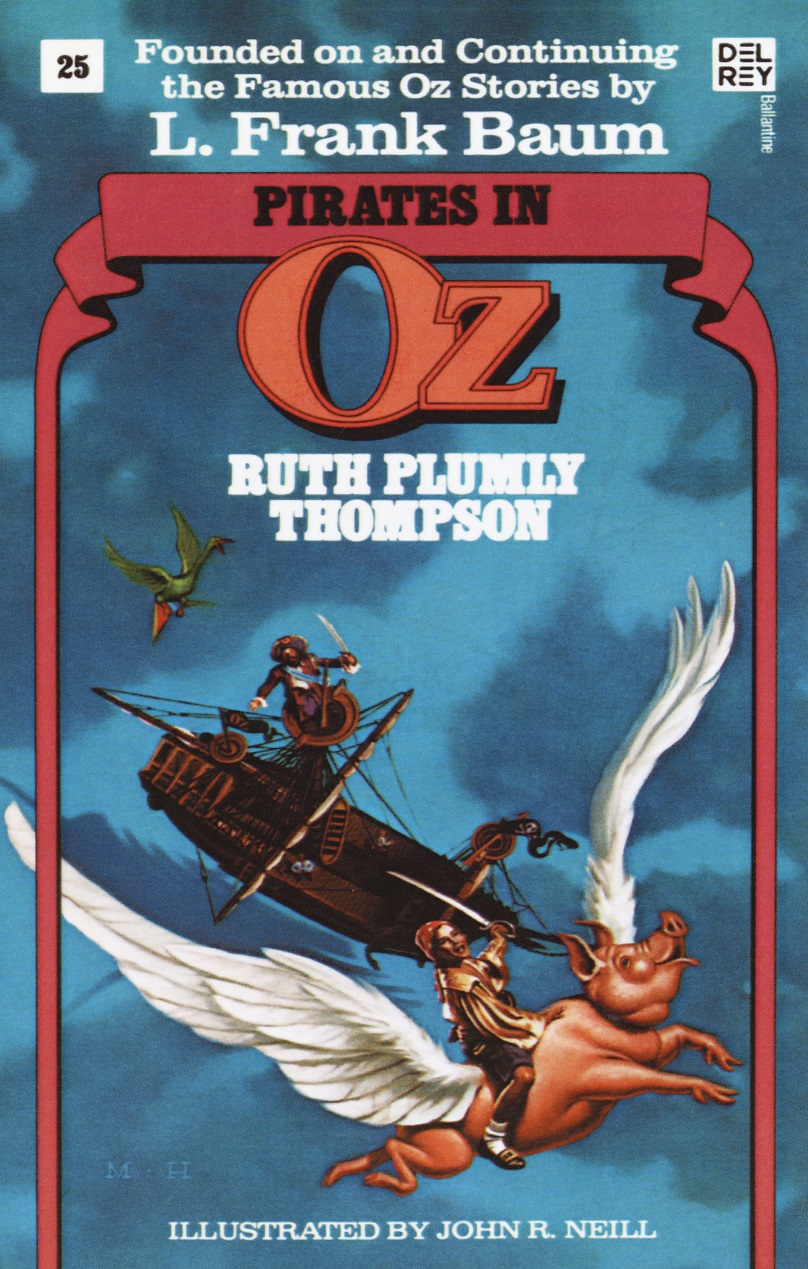
Reading Pirates in Oz Aloud to My Son

Pirates in Oz by Ruth Plumly Thompson, illustrated by John R. Neill

My son is definitely slowing down on the Oz books; we started this one in December after finishing The Yellow Knight of Oz, but we didn't wrap up until early February.

Originally published: 1931
Acquired: December 2022
Read aloud: December 2022–February 2023

We tended to read in fits and starts: we'd read a number of chapters in quick succession, then we'd have a long gap where he wasn't interested. This meant that by the time we got to the end, there was a lot he didn't remember about the beginning! But more on that soon.

Pirates in Oz follows two parallel plotlines. In one, Ruggedo, still bereft of the power of speech (following the events of Gnome King) ends up in the silent country of Menankypoo, which he soon becomes ruler of. But in short order, the country is attacked by pirates. With the aid of Clocker, the Wise Man of Menankypoo, he becomes ruler of the pirates, and of course decides to lead them to conquer Oz.

Meanwhile, on the Octagon Isle, all of King Ato's people desert him because they think he's not imperious enough—all he wants to do is listen to books read by his Read Bird, Roger. Soon a pirate ship arrives, but with only one pirate. Samuel Salt is the captain of the Crescent Moon, but his pirates deserted him because all he wanted to do was explore and collect specimens. (They're the pirates who wound up with Ruggedo; the Octagonese also end up joining Ruggedo's band.) Samuel Salt, Ato, and Roger set off on the Crescent Moon, joined by Peter, the American boy protagonist of Gnome King and Jack Pumpkinhead, spirited to Nonestica for the third time. That's quite a lot of strands!

So the Crescent Moon sets off in search of the deserters from both Salt and Ato, both men doing their best to practice being "rough, bluff, and ready" in order to win their people back over. In classic Oz fashion, this means they have a series of weird misadventures, and in classic Thompson fashion, they're mostly based on terrible puns, such as the Nobodies of Nowhere, who have no bodies, just limbs and heads. Or there's the bananny goat, which can generate an unlimited supply of bananas from its horns... one that threatens to sink the Crescent Moon! I've in the past discussed how I'm not a big fan of how manic a Thompson Oz novel can be, with no room to breath between episodes, but a sea voyage narrative precludes such energy. You have to take days between each island landing! I enjoyed the places they went, though I wish there had been a tad more problem-solving on the way (Thompson did a good job of that in Jack Pumpkinhead), as it often seems like they just go somewhere, leave it, go somewhere, leave it, without difficulty.

I enjoyed all this: the characters are fun, and they get to change and evolve and discover themselves. Samuel discovers he just can't be a mean pirate, no matter how hard he tries; there's one sequence where they do steal stuff from another ship, and Samuel slyly pays them back. On the other hand, King Ato discovers that he doesn't have to be indolent, he really does enjoy being ship's cook and being useful. Peter pretty much just stays Peter, once again returning to America to be with his grandfather and captain his baseball team. This is his last ever appearance in a canonical Oz novel. Peter's first appearance only came into the public domain this year, so he would have been difficult for even fan authors to use up until now.

Based on our looking at the covers, my son had known for a long time this book featured a flying pig named "Pigasus," and he was looking forward to that immensely. So much so that for the first two thirds of the book he was constantly asking me where Pigasus was! When Pigasus does finally turn up, he thankfully is good fun; his power is that everyone who rides him is obligated to speak in (terrible) rhymes, which of course plays to Thompson's strengths as a writer.

At the end, the Crescent Moon catches up to the pirates in Menankypoo... only by that point Ruggedo and his pirates have already made it to the Emerald City. So Peter takes off on Pigasus, while Samuel Salt uses a convenient magic flask to make the Crescent Moon fly. Ruggedo is invisible, so he's able to steal the Magic Belt before anyone notices, and Peter arrives just as he's about to transform everyone into various inanimate objects. Peter distracts Ruggedo long enough for Samuel to show up and finish him off. To be honest, it's a bit unbelievable both how easily Ruggedo overcomes Ozma, the Wizard, and company, and how easy he is overcome in turn, but hey, is anyone reading these books for the action climaxes? Probably not.

Due to our spread-out reading though, my son had pretty much forgotten that Ato was a king deserted by his people, and that Ruggedo's pirates used to be Samuel's before all that was paid off at the end of the novel! Still he seemed to have a good time with a lot of the fantastical elements, even if he didn't really get the joke of Samuel and Ato trying to be mean all the time and failing. He reported he enjoyed the novel, and I think this is true.

We've been at this so long, though, his memory of the previous ones is getting so vague. When Trot turned up, he asked me who she was! Though, shortly thereafter, he reminded me of a minor plot element from Kabumpo in Oz that I didn't remember, and he even gave which book it was from by name. By the time we get to the end of these books we'll need to go back to the beginning to start over... only, by the time we get to the end, I bet he'll be reading chapter books by himself!

Next up in sequence: The Purple Prince of Oz

05 April 2023

JSA: Ragnarok by Paul Kupperberg

JSA: Ragnarok
by Paul Kupperberg

Ragnarok is a prose novel originally intended for publication in early 2006, supposed to be the first part of a JSA trilogy from iBooks. However, the owner of iBooks died in a car crash and his company limped on for a bit before going into bankruptcy. The manuscript was due to go to the printers when everything came to a halt. Fourteen years later, the author, Paul Kupperberg (writer of many DC comics, but most relevant to this project, a couple issues of All-Star Squadron) was able to finally get the book released through indie publisher Crazy 8 Press. I bought the book when it was released, and decided that I would read it as part of my JSA marathon around the time it would have been released. Early 2006 would put it after JSA, during the run of JSA Classified, and before volume 3 of Justice Society of America, so I read it following JSA Classified.

Published: 2020
Acquired: December 2020
Read: February 2023

It is actually set during JSA, a bit before the events of Infinite Crisis (more on that later, though), and it features the JSA line-up of that time: Green Lantern, the Flash, Mr. Terrific, Power Girl, Jakeem Thunder, Sand, Wildcat, Stargirl, and so on. The book chronicles an encounter between the Justice Society and the Injustice Society, here led by the Wizard. The Injustice Society is trying to hunt down the Spear of Destiny and release a Norse god; the Spear of Destiny is of course the artifact Hitler used to keep American superheroes out of Nazi-occupied Europe according to All-Star Squadron, and there's an extended flashback in the middle of the book chronicling what happened to the Spear after the end of the war. It also ties into Last Days of the Justice Society of America, as part of the Wizard's plan is to send the JSA back into Ragnarok.

Kupperberg is primarily, I believe, a comics writer, and overall a solid one, the kind of comics writer who is not distinctive enough to be a favorite, but who typically turns in work that, well, works. I do have fond memories of his Starfleet Corps of Engineers novella Sargasso Sector, which would have been written around this same time, but I didn't find the book very gripping.

Superheroes in prose is a very tricky thing, and I've found that few have managed it well (basically just Elliot S. Maggin and Marv Wolfman, to be honest). Overall, basically, the book is fine. Many of the characters have little moments of development, but they are pretty generic and don't really feel like they arise out of the plot and themes of the novel, nor does it feel like much is ever at stake for them. The story is a bit slow considering how long it is, and the action doesn't jump off the page. This isn't to say it's terrible or anything; I found it a diverting way to spend a couple days. But it did feel to me like the promise of a JSA novel is a bit more than what we got here: these are characters with more depth and history than your average DC superhero, and I would have liked to have seen that explored in a more novelistic way, while what we have here feels more like a comic on the page, not really playing to the strengths of the medium.

I did enjoy, though perhaps it was a bit too long, a flashback to the JSA after V-E Day, drawing a lot on retcons established in All-Star Squadron and other post-Crisis stories. (For example, the Hippolyta Wonder Woman turns up, and her affair with Ted Grant is mentioned.) That period stuff is always a win for me. There's another flashback that didn't work for me, though, which is to the events of Last Days. Near the end of the novel, the Wizard tries to send the JSA back into Ragnarok, so we get a flashback showing us the original events of that story. Specifically, the flashback tries to emphasize why Alan Scott would really really not want to go into this. But a flashback only a couple chapters before the climax of your novel really disrupts the pacing, and the groundwork it lays would have been better laid earlier, in more detail. A good idea, but needed more to support it.

The book as a book is clearly small press, and could have used some better typesetting and proofreading: some em-dashes are left as two hyphens, for example, and sometimes the book shifts into the present tense for a single paragraph.

I do, of course, have some continuity issues. The book has to take place after JSA #50, because Power Girl knows that her Atlantean backstory is false, which is something she learns in that issue. It has to take place before JSA #59, because that's the issue where Captain Marvel leaves the team. However, from issue #50 to #64, Sand isn't present in the JSA because he's been turned into actual sand—so there's no actual time where the line-up present in this book all exists.

Kupperberg also does some retconning for the post-Crisis history of the JSA. The events of Last Days took place after the Crisis on the Infinite Earths; the story begins with the JSA at the funeral for the Earth-Two Huntress and Dick Grayson, who both died in the Crisis. But of course they couldn't exist at all post-Crisis, and so when Kupperberg retells those events, he makes it the funeral of the original Mr. Terrific, who died in the 1979 JLA/JSA team-up. At the funeral, Green Lantern thinks about how the JSA is stepping down and Infinity, Inc. is kind of supplanting it, so Kupperberg has moved the death of Mr. Terrific (Year Nine on my timeline) later or the founding of Infinity, Inc. earlier (Year Ten on my timeline). It's reinforced when in that flashback, Alan Scott thinks about his daughter Jade, but he didn't know she was his daughter until Infinity, Inc. Annual #1 (Year Eleven on my timeline). (And, weirdly, he doesn't think about his son Todd at all. I get why Todd isn't mentioned in the present-day stuff, as he's evil from the time of JSA #1 to #52, but why doesn't Alan think of him fondly in the flashbacks?) Most of this isn't an issue, but I just found it interesting.

This post is fortieth in an ever-expanding series about the Justice Society and Earth-Two. The next installment covers Catwoman: Her Sister's Keeper. Previous installments are listed below:

04 April 2023

Reading Roundup Wrapup: March 2023

Pick of the month: Temeraire: In the Service of the King by Naomi Novik. What an unfair month! In any other month, Lois McMaster Bujold's Shards of Honor would have cruised to victory, a well-observed, well-told tale of two enemies from different societies finding solace in each other and becoming lovers. But unfortunately for Bujold, this month I read an omnibus of the first three Temeraire novels, and I enjoyed it so so much; it was a book surely made for me. Every day at some point I told my wife, "This book is just so perfect." And it was somehow true of all three installments! I look forward to reading more of them posthaste!

All books read:

  1. Shards of Honor by Lois McMaster Bujold
  2. Mistress of Chaos: Collected comic strips from the pages of Doctor Who Magazine by Scott Gray, John Ross, Mike Collins, and David A Roach
  3. Legion of Super-Heroes: Before the Darkness, Volume One by Gerry Conway, Paul Kupperberg, E. Nelson Bridwell, J. M. DeMatteis, Jim Janes, Steve Ditko, Jim Sherman, Frank Chiaramonte, Dave Hunt, et al.
  4. Star Trek: Strange New Worlds: The High Country by John Jackson Miller
  5. Star Trek: Prometheus: The Root of All Rage by Bernd Perplies and Christian Humberg
  6. The Transformers Annual [1990] edited by Chris Francis
  7. Catwoman: Her Sister’s Keeper by Mindy Newell, J. J. Birch, and Michael Bair
  8. Transformers: Aspects of Evil! by Simon Furman, Andrew Wildman, Staz Johnson, et al.
  9. Doctor Who Magazine: Special Edition #59: The 2022 Yearbook edited by Marcus Hearn
  10. Transformers: Earthforce (part 1/part 2) by Simon Furman, Andrew Wildman, Staz Johnson, et al.
  11. Temeraire: In the Service of the King: His Majesty's Dragon / Throne of Jade / Black Powder War by Naomi Novik
  12. Transformers: Way of the Warrior (part 1/part 2/part 3) by Simon Furman, Simon Coleby, Staz Johnson, et al.
  13. Transformers: Fallen Star (part 1/part 2) by Simon Furman, Simon Coleby, Stuart Johnson, et al.
  14. Transformers: Perchance to Dream (part 1/part 2/part 3) by Simon Furman, Andrew Wildman, Lee Sullivan, et al.
  15. The Purple Prince of Oz by Ruth Plumly Thompson, illustrated by John R. Neill
  16. Dragonsong: Volume One of the Harper Hall Trilogy by Anne McCaffrey 

Overall, a very prolific month. Sure, the Transformers comics are bitty little digests... but Temeraire was three bulky novels in one! I don't have my stats on the computer I'm using right now, but it must be my best month in some time.

All books acquired:

  1. Temeraire: In the Service of the King: His Majesty's Dragon / Throne of Jade / Black Powder War by Naomi Novik
  2. The Transformers Annual [1990] edited by Chris Francis
  3. Catwoman: Her Sister’s Keeper by Mindy Newell, J. J. Birch, and Michael Bair
  4. Batman/Wildcat by Chuck Dixon, Beau Smith, Sergio Cariello, et al.

Currently reading:

  • Batman/Wildcat by Chuck Dixon, Beau Smith, Sergio Cariello, et al.
  • Dragonsinger: Volume Two of the Harper Hall Trilogy by Anne McCaffrey

 Next up in my rotations:

  1. Dragondrums: Volume Three of the Harper Hall Trilogy by Anne McCaffrey
  2. American Splendor: Our Movie Year by Harvey Pekar et al.
  3. Twenty-First Century Science Fiction edited by David G. Hartwell and Patrick Nielsen Hayden
  4. Star Trek: Deep Space Nine: The Missing by Una McCormack

Books remaining on "To be read" list: 675 (down 2)

Three months of sequential decrease!

03 April 2023

Legion of Super-Heroes: Before the Darkness, Volume One by Gerry Conway, Paul Kupperberg, E. Nelson Bridwell, J. M. DeMatteis, Jim Janes, Steve Ditko, Jim Sherman, Frank Chiaramonte, Dave Hunt, et al.

Legion of Super-Heroes: Before the Darkness, Volume One

Collection published: 2020
Contents originally published: 1979-81
Acquired: February 2021
Read: March 2023

Writers: Gerry Conway, Paul Kupperberg, E. Nelson Bridwell, J. M. DeMatteis
Artists: Jim Janes, Steve Ditko, Jim Sherman, Joe Staton, Ric Estrada, Frank Chiaramonte, Dave Hunt, John Calnan, Bob Wiacek

Before the Darkness is DC's most recent reprint series for Legion of Super-Heroes, the one that finally totally seals the gap before The Great Darkness Saga, thus giving us a complete collection of the Legion from 1958 to 1984! I feel like this era is often spoken of in pretty disparaging terms, the consensus being that when Levitz and Giffen took over, they saved the book. Even in this very volume, the introduction comes across as an apology for what you are about to read, explaining that Gerry Conway—who writes most of the stories collected here—did not really like the Legion. Conway's run actually began with issues collected in the previous collection, Superboy and the Legion, Volume Two, and I didn't like much of what I read there.

So... I was pleasantly surprised by this run! I don't think Conway is among the great Legion writers, but this volume shows him to be among the solid ones. He provides more character focus than I remember from some previous Legion volumes, particularly on lesser-used, often-forgotten characters like Timber Wolf and Light Lass. Timber Wolf had largely faded into the background since he joined the Legion, but Conway gives him lots to do; Light Lass I don't remember doing anything at all ever, but here she's a versatile, integral member of the team. He shows off the powers of some other Legionnaires to good effect; Princess Projectra, always one of my favorites, got a couple excellent moments across these stories. We get a nice return to what Bouncing Boy and Duo Damsel are up to, for example. Maybe Conway didn't love the Legion, but he clearly threw himself into its history and characters with a gusto that he probably could have got away with not having.

A bit of futurism where Gerry Conway totally whiffed it: the continued relevance of circuses. They didn't make it into the twenty-first century, much less the thirtieth.
from Legion of Super-Heroes vol. 2 #260 (script by Gerry Conway, art by Joe Staton & John Calnan)

Conway is also, I think, more of a science fiction fan than most comics writers: you can tell he was probably reading actual prose sf, not just reading other comics and watching bad films. He uses stuff like tachyons and explores how the President of Earth might be elected. Genuinely interesting worldbuilding, which is something that usually happens in Legion by accident... if at all. I particularly liked the climax of one story: the Legion, in space suits, grabs onto a spaceship when it enters hyperspace. Without a hull between hyperspace and them, their perceptions of its strange dimensions threaten to drive them mad, but Brainiac 5 has the bright idea that Projectra should cast an illusion of reality, so they all perceive themselves in a beautiful meadow. This includes the villain, who's there with them... and he, not understanding the illusion, runs away from them, thus letting go of the ship and losing himself in the depths of hyperspace.

Jim Sherman can balance the human and the cosmic alike.
from Legion of Super-Heroes vol. 2 #262 (script by Gerry Conway, art by Jim Sherman)

A lot of them are goofy, of course. Not sure what was up with the one about the guy who attacked the Legion with fake pirates! But every story by Conway has at least one solid moment of characterization, one clever twist. I particularly liked the saga of the "Dark Man."

How can you know enough about the Legion to know who Shadow Lass is, what planet she's from, and what powers people have there, but not know that all the Legionnaires can fly?
from Legion of Super-Heroes vol. 2 #267 (script by Paul Kupperberg, art by Steve Ditko & Dave Hunt)

Conway also writes out Tyroc but tries to smooth out his history in the process. When originally introduced, it seemed as though Tyroc came from an island where all humans of African descent were segregated to—and ignored. This story establishes something very different, that it's a Brigadoonesque place that only appears every two centuries, and that it was settled by escaped slaves from the 1800s. I guess this is better? Unfortunately, it writes Tyroc out, so he never gets a chance to make much of an impact as a character. 

In the future, no one will wear pants.
from Legion of Super-Heroes vol. 2 #265 (plot by Gerry Conway, script by J. M. DeMatteis, art by Jim Janes & Dave Hunt)

Outside of Conway's stuff, there's a pretty bad fill-in by J. M. DeMatteis, which spends more time on overcomplicated exposition of the villain's backstory than the actual story, and three issues of Secrets of the Legion of Super-Heroes. This miniseries, written by Paul Kupperberg from a plot by E. Nelson Bridwell, with art by Jim Janes and Frank Chiaramonte, was I believe the first official attempt to put this history of the Legion into some kind of detailed order. With the way I dance around Legion history out of sequence, it's hard for me to know for certain, but I think this story is the source of many retcons we now take for granted.

...and she went on to be the best member that wasn't Saturn Girl.
from Secrets of the Legion of Super-Heroes #2 (plot by E. Nelson Bridwell, script by Paul Kupperberg, art by Jim Janes & Frank Chiaramonte)

The plot is thin: R. J. Brande is dying and his assistant Marla Latham sneaks into Legion H.Q. to steal files on the Legionnaires because he thinks one might secretly be related to him and thus be able to provide a blood transfusion. Like, why not just ask? But it's an excuse to watch some history tapes and for the Legion to reexplain their own backstories, and I appreciated that more than the mediocre attempt at drama. It's also the story that reveals Brande is secretly a Durlan and the father of Chameleon Boy.

Not really clear to me why the villain changed Dreamy into this outfit to murder her, to be honest.
from Legion of Super-Heroes vol. 2 #268 (script by J. M. DeMatteis, art by Steve Ditko & Bob Wiacek)

The art in this volume is generally quite solid, too. One story by Jim Sherman, which is always nice, but most of it is by the new-to-me Jim Janes, who I would say is above-average for the era is terms of doing character work with the art. I see he continues on into the next volume, but apparently has not done much other comics work, alas. I feel like he could have blossomed into quite a talent given time. Steve Ditko does one issue, and unlike most Legion artists, he gives the Legionnaires spacesuits, not just bubble helmets. But the spacesuits are colored to look like their costumes, which means any Legionnaire with bare arms or legs (which is most of the women and many of the men) has a spacesuit that is mostly flesh-colored. (I guess this could be the colorist's fault. On the other hand, the colorist was clearly told during some issues to make the outfits more modest, as parts of characters like Shadow Lass and Princess Projectra that are usually colored like skin are made to be part of their outfits.)

I read a Legion of Super-Heroes collection every six months. Next up in sequence: Before the Darkness, Volume Two