30 January 2018

Return to Oz: The Wonderful Wizard of Oz by L. Frank Baum and W. W. Denslow

Hardcover, 267 pages
Published 1987 (originally
1900)
Acquired January 2011

Reread December 2016
The Wonderful Wizard of Oz by L. Frank Baum
pictures by W. W. Denslow

I've been an Oz fan as long as I can remember, but the copy of the first book I had as a kid was kind of rubbish. A 1958 edition from Scholastic, it had new illustrations by Paul Granger obviously designed to remind you of the MGM film versions of the characters-- and even leaving that aside, they weren't very good. So after reading about it (Michael O. Riley discusses it in Oz and Beyond) and hearing about (Anne Philips presented on it at a conference I attended), I knew I needed to pick up a facsimile of the original book, and thankfully I found this 1987 Books of Wonder edition a few years later.

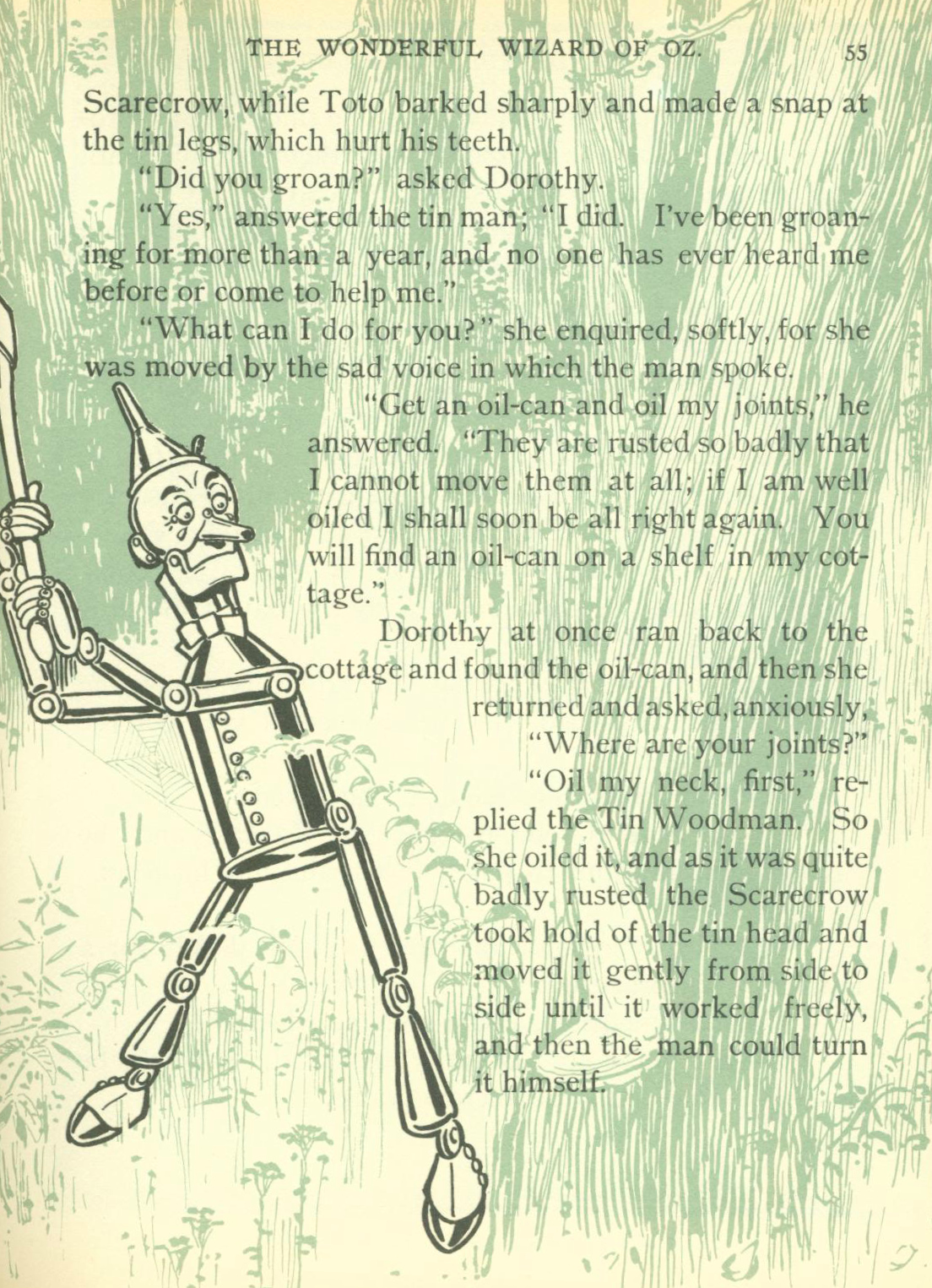
The original book is as much W. W. Denslow's as it is L. Frank Baum's I would argue (and indeed, Denslow and Baum split the copyright, whereas Baum was the sole owner of the later novels illustrated by John R. Neill). The original is an very visual experience. Far from just having pictures occasionally opposite or next to the text like my old Scholastic edition, in the original Denslow's pictures interact with the text. Take for example this illustration from when Dorothy and the Scarecrow find the Tin Woodman in the forest:
Baum & Denslow (1900), p. 55

As you can see, the Munchkin forest doesn't just surround the Tin Man, but it also surrounds the very words of the story itself-- the story is in the woods as much as the characters are. Like a lot of Oz books, the book features both a number of color plates and also black-and-white illustrations on the text pages, but uniquely, the black-and-white illustrations almost all have some kind of color accent. This color shifts throughout the story. You get the dark green above when the characters are in the Munchkin Country (I'm not sure why it's not in blue, though). This becomes light green in and near the environs of the Emerald City:
Baum & Denslow (1900), p. 116

Earlier in the book, in Kansas, a dismal brown was the accent color:
Baum & Denslow (1900), p. 5

And, appropriately, it keeps changing as the novel goes on: a sort of dark yellow as they travel into the Land of the Winkies, brown for the forests of south Oz, and orange-red in the Quadling Country (this color is also used during the poppy field incident). It's a cool touch, and one that as far as I know, the Oz books never made use of again. But this was a lavish edition, intended for gifting, and Denslow's star was arguably bigger than Baum's at the time.

The color plates are great, too. This one of the Cowardly Lion to dinner at a random house on the road is pretty nice, for example:
Baum & Denslow (1900), opp. p. 114

And the green wash Denslow covers the illustrations from the Emerald City chapters with nicely reproduces the effect of the green glasses everyone wears in the book:
Baum & Denslow (1900), opp. p. 196

Denslow's style works to keep Oz safe. As I've discussed before, Baum occasionally describes horrific violence: a lot of creatures fall victim to the Tin Man's axe, and a pair of Kalidahs-- themselves described as "monstrous" (79)-- are even "dashed to pieces" on rocks at the bottom of a chasm (81). Or there's the story the Tin Woodman tells of his own mutilation. But, Denslow never renders this violence directly. The plunging Kalidahs are almost comic:
Baum & Denslow (1900), opp. p. 80

And this is all the illustration we get of the Tin Man killing an army of forty wolves in a nighttime battle:
Baum & Denslow (1900), p. 142

I also like Denslow's cartoony, round-headed people. Almost everyone looks like a little kid in Oz, which seems appropriate. Glinda might be a young woman, but she's one of the only human beings in the book who is actually taller than Dorothy:
Baum & Denslow (1900), p. 253

The witches end up being the only characters with, well, stature, which seems appropriate for the way their capabilities tower across the plot of this novel. I know this draws on the way the Oz characters are described in the text of Wonderful Wizard, but I don't think Baum and Neill maintained these height distinctions in the later Oz novels, and I assume it was one of the inspirations behind casting people with dwarfism as the Munchkins in the MGM film. (Though, why are the Scarecrow and the Tin Man as tall as average human beings when they're both modeled on Munchkin men?)

Each chapter even gets both an illustration with its first word (as with the opening to Chapter XXIII immediately above) and a cool title page of its own, setting the atmosphere for the chapter ahead, like this one:
Baum & Denslow (1900), p. 85

In short, Baum's original text has always been great, but pair it with Denslow's illustrations, and you have a journey into the fantastic that no one will ever be able to surpass. This is the definitive version of The Wizard of Oz and all others pale in comparison.

Next Week: I resume an old reading project, The New Doctor Who Adventures, picking up with the Doctor vs. Hitler in Timewyrm: Exodus!

29 January 2018

Review: The Jack Kirby Omnibus, Starring Green Arrow

A couple Doctor Who: Short Trips reviews have been posted over at Unreality SF: Adric meets the fourth Doctor again in "The Ingenious Gentleman Adric of Alzarius" and Susan meets the eighth Doctor again in "All Hands on Deck."


Comic trade paperback, 304 pages
Published 2011 (contents: 1946-59)

Acquired December 2016
Read January 2017
The Jack Kirby Omnibus, Volume One: Starring Green Arrow

Written by Joe Simon, Jack Kirby, France E. Herron, Bill Finger, Dave Wood, Robert Bernstein
Pencilled by Jack Kirby
Inked by Jack Kirby, Joe Simon, George Roussos, Frank Giacoia

This volume collects everything Jack Kirby drew during his first two tenures freelancing for DC Comics (1941-49 and 1956-59) that doesn't fit into the other Jack Kirby omnibus volumes DC has released (e.g., The Sandman, The Newsboy Legion, The Boy Commandos); it's basically an assortment of random issues of Real Fact Comics, House of Secrets, House of Mystery, Tales of the Unexpected, My Greatest Adventure, and All-Star Western, plus Green Arrow features from Adventure Comics and World's Finest Comics.

This isn't Kirby at his best; most of the time he's writing to someone else's scripts, or at least someone else's demands. I mean he's still a great illustrator, and I love seeing his image of our supposed rocket-age future:
I just love the assured tone of this thing: "probably called 'rocketeers.'" Like, why? What leads you to think that will "probably" be the case, Jack and Joe? Also, where's my rocket tube to China?
from Real Fact Comics #1 (script & art by Joe Simon & Jack Kirby)

...but giving him a two-page feature in Real Fact Comics (don't worry, there are no real facts to be found) is a waste of his talents. The Sandman, from the same era, is a much better use of Kirby's abilities; there's little trace of his trademark dynamism here.

Kirby is good at drawing bizarre monsters, so the stories from 1950s "weird" titles are more suited to him, though they're still not great. There's an odd subset of these stories that present "rational" explanations for seemingly irrational events. But I'm actually found it more plausible that a criminal found a magic lantern during a jailbreak that the idea that an undercover cop planted it there and arranged to have the criminal's three wishes granted on command in a convoluted plot to discover the location of money the criminal had stolen. I guess "impossible" trumps "highly unlikely" in the probability stakes. This must have been a thing, though, because there are a lot of stories with these kinds of endings (I'm not really telepathic, the metal plate in my skull is just picking up your dictaphone from miles away; I'm not really immortal, I just wanted to obtain your money; I'm not really a yogi, I just wanted to sell my crystal ball to another fake yogi and so commissioned a women to pretend to be a Cleopatra waxwork and kiss you; and so on).

I feel like if Oliver Queen can get something like that to fly around in circles on command, there has to be a better application for it than trick arrows.
from Adventure Comics vol. 1 #251 (script & art by Jack Kirby)

This is actually the third time I've read the Green Arrow tales collected here, since DC previously reprinted them in both a thin volume of Kirby's Green Arrow work, and (in black and white) in Showcase Presents The Green Arrow. I have to say, they don't hold up to repeated rereading. Some I still didn't remember reading, though! And man, does Oliver Queen have a loose definition of "arrow" and an ability to make incredibly un-aerodyamic objects fly regardless.

"Straightened out." I think your manservant is having a little fun with you.
from Tales of the Unexpected vol. 1 #24 (writer unknown, art by Jack Kirby)

Still, there are times the King of Comics gets to strut his stuff: the cool visuals of "The Two-Dimensional Man" were probably my favorite thing in the whole book. Give Kirby something totally bizarre to draw, and he will always knock it out of the park.

26 January 2018

Adventures in Lunchtimes

I've always been a packer.

In my youth, we were allowed to pick one day per week where we could buy lunch from the school cafeteria. At the beginning of the month, the lunch schedule for that month would be distributed, and we would go through and mark down one "B" per week. Pizza was every Friday, so that was a good default if there was nothing else good. (I am pretty sure I was the only student who liked Mexican pizza.) The rest of the time I packed.

I assume this was for financial reasons. The main thing I remember is that my rotation of meals involved a lot of peanut butter: peanut butter and jelly sandwiches, peanut butter and banana sandwiches, peanut butter and marshmallow sandwiches. Plus a thermos full of milk. A man could get sick of peanut butter you know. (By the time my sister was in grade school, I am pretty sure she got to buy over 50% of the time. I assume this was for laziness reasons.)

In high school, I was informed I was responsible for my own lunches. This mean packing them myself, or buying them myself. Given that if I packed, the food came out of the pantry, and that if I bought, the money came out of my pocket, I was an even more dedicated packer than I had been in grade school. I think I could count the number of meals I purchased in four years in the high school cafeteria on one hand. (Well, maybe not that infrequently. But it sure didn't happen very much.)

I was a big aficionado of these things that came with a can of tuna fish, squeeze packets of mayo and relish, and crackers. You'd mix up the tuna, mayo, and relish to taste, and spread on the crackers. Sometimes I'd switch it up and eat chicken salad ones.

I have a dim memory that after eating these things every day for like a year, they began to taste repulsive to me, and I had to take a year off tuna. I'm not sure what I ate after that, though.

I was one of the only members of my high school crowd who packed, though; most everyone else bought lunch. I remain impressed with the Mollmann thriftiness to this day. I mean, I guess in college it was all dining hall all the way (I worked there after all), but upon entering the work force, it became a combination of sandwiches and reheated leftovers that would form the basis for 90% of my lunches.

At UConn, the consequences for forgetting to pack (or being too lazy to pack) were bad: the closest place to my office, you had to pay over $10 for a sandwich, soup, and pop, and sometimes they had the Dagwood, but not often enough. These days at UT, though, I'm right across from "Ultimate Dining," where for $8.50, faculty can get all the food they want! It's too tempting, I've banned myself from doing. Gotta keep packing.

#558: What do you eat during the school day?

25 January 2018

Voice and Genre in Young Adult Literature: Chime (2011)

Trade paperback, 361 pages
Published 2012 (originally 2011)
Acquired November 2016

Read March 2017
Chime by Franny Billingsley

In my young adult literature class I wanted to pair with The Hero and the Crown a contemporary YA fantasy novel, and ideally one with some kind of representation that would have been lacking in the 1980s: racial, sexual, whatever. A recommendation from my wife led me to Chime; she was very fascinated by its portrayal of intellectual disability. The protagonist, Briony Larkin, has a sister named Rose who could be called autistic, I suspect, were the novel not set in an alternate early twentieth century, and Briony herself suffers from depression.

Unfortunately, the book is a bit of a slog at 360+ pages, and all the interesting stuff seems to happen near the end. The book for a while implies that Rose's disability has a magical cause: Briony thinks she did it, and thus your tendency is to think that Briony's evil stepmother did it, but both of these things turn out to be untrue, and Rose just is disabled. Which is a nice undercutting of how disability often works in fantasy stories, but the whole thing is underdeveloped.

I taught the book alongside an essay by an old colleague of mine, Abbye Meyer, called "'But she's not retarded': Contemporary Adolescent Literature Humanizes Disability but Marginalizes Intellectual Disability." Meyer build on the work of disability theorists who argue that disability should be seen as a political category, and thus YA literature should treat it as it does other underrepresented minorities, with humanization and representation. Unfortunately, then, Meyer argues, YA often falls short, as depictions of intellectual disability typically fall into three categories: 1) those without intellectually disabled characters, where the physically disabled prove their worth via a lack of intellectual disability, 2) those where only secondary characters are intellectual disabled, usually show the protagonist can demonstrate virtue through behavior toward them, and 3) those where the narrator/protagonist is intellectually disabled... but then proves that they're not by the story's end.

Meyer also argues that YA fiction can compensate for these problems by doing a few things, including humanizing disability, arguing for disability as an identity category, celebrating difference, and arguing for accommodation. Chime definitely treats Rose as a side character, and frequently as a side character who frustrates Briony and prevents her from doing what she wants, which seems to dehumanize her. The switcheroo that reveals that Rose's disability isn't a curse is a nice one in emphasizing disability as an identity category, but pushes against the weight of a novel where Briony seems to think it is a curse. Not in the magical sense, but in the sense of a burden that weighs her down. Rose does get to show romantic interest (which might even be reciprocated), which is also nice. So really, I don't think Chime does what Meyer thinks it ought very much.

But all this is largely to the side in Chime, and my students found those first two hundred pages as much a slog as the magical swamp in which the book takes place. Nothing reveals a book's pacing problems like teaching it, because for the first two of our three classes on Chime, I felt like nothing had happened worth talking about in class. My students also reacted very poorly to Briony's boyfriend, who borderline assaults her near the end of the novel... and then they just reconcile! I didn't read the scene that way, but once they pointed it out to me, I couldn't not see it.

I do think it's a decent depiction of depression, and through that it does some nice meta stuff about the stories we tell ourselves, but again, all these concepts are really paid off in the last fifty pages or so, which make it hard to teach. Which is maybe unfair, but that's the context I read it again; if I ever teach a YA literature course again, Chime will not be on the syllabus.

23 January 2018

Return to Oz: Adventures in Oz by Eric Shanower

Comic trade paperback, 256 pages
Published 2006 (contents: 1986-93) 

Acquired August 2012
Read December 2016
Adventures in Oz
​
Writer and Illustrator: Eric Shanower
Calligrapher: Willie Schubert
Painting Assistant: Tom McCraw

Long before he was tapped to write comics adaptations of L. Frank Baum's Oz novels, Eric Shanower wrote and illustrated five original Oz comics, collected here in a single volume by IDW. Shanower's style as an illustrator I've always found very classic Oz, in that it's very John R. Neill: his Dorothy especially is a lot like Neill's. His stories here, too, are very classic Oz in style. There's not a lot of new characters or anything, rather, we have Dorothy going out on adventures in and near Oz, almost always with the Scarecrow at her side-- which of course was the very first Oz protagonist pairing. (But one not utilized much outside of Wonderful Wizard, I don't think.)

However, Shanower delves into the history of Oz in a way that is very un-Baum, as Baum was always pressing forwards, by and large. In these stories we see the tree that is the source of Oz's magic (an idea that doesn't feel very Ozzy to me, to be honest), a new character with a flashback-told link to the Wicked Witch of the West, a story about Zurline and the Forest of Burzee (from The Life and Adventures of Santa Claus), and stories that fill in two gaps in the Oz cartography of witches: the Wicked Witch of the South and the Good Witch of the East. I guess what I'm saying is that the book is definitely fannish, in terms of having continuity references to obscure texts, and plugging in gaps, sort of what you might imagine if Big Finish produced original Oz audio dramas or something.

They're also fannish, though, in capturing what makes Oz such an enjoyable place to visit. Each story might have these kind of continuity-driven aspects, but they also feature journeys to strange and interesting places that feel like ones Baum could have come up with. My favorite of the tales was probably "The Secret Island of Oz": Dorothy, the Scarecrow, the Cowardly Lion, and Eureka go on a trip to locate an obscure fish for the gardens of the Emerald City. It feels like the kind of adventure hook Baum himself could have used for a post-Emerald City Oz novel, where this simple quest ends up getting the characters embroiled in the problems of one of those weird magical enclaves within Oz. There are strange characters, both good and evil, and some creative problem-solving, and the characters get split up and reunited-- basically it feels like a prototypical Oz adventure in miniature, and that's why I liked it so much.

The other thing to like about this volume-- and where Shanower most departs from a straight Baum pastiche-- is in the deeper emotional content of these stories. It's hard for me to imagine a Baum story where the resolution hinges on a girl re-accepting the living toy she played with as a child but abandoned (as in "Secret Island"), or one where forbidden love leads to an invasion (as in "The Forgotten Forest of Oz"), or one where a domestic dispute plays out over and over again, stuck in time (as in "The Blue Witch of Oz"). This last one was probably the other highlight of the volume for me, a story about a broken family in need of healing, with lost children and spurned love. Shanower's stories are prototypical Oz in some ways, but uniquely his own in others, the ideal balance of adaptation in my mind.

My only complaint is that it wasn't until typing up this review that I learned the hardcover version has stories and content the trade paperback I read lacks. Now I'm going to have to buy it all over again!

Next Week: Back to the beginning, with The Wonderful Wizard of Oz!

22 January 2018

Review: Star Trek: The Next Generation: Metamorphosis by Jean Lorrah

A little spurt of audio drama review catch-up at Unreality SF: the most recent series of Survivors (number seven!); Though Scoundrels Are Discovered, the "pilot" for the new range Cicero; the adventures of Derek Jacobi's Master in Only the Good; and two Short Trips featuring the eighth Doctor, "Flashpoint" and "A Heart on Both Sides." More to come, probably.

Mass market paperback, 371 pages
Published 1990

Reread January 2017
Star Trek: The Next Generation: Metamorphosis
by Jean Lorrah

You might argue that this book is pointless: its central premise is that Data becomes a human being for real, which of course he never did on the show, nor even alluded to, so the whole thing has to be wiped from both history and memory. But Jean Lorrah is such a good author as to overcome this. I said in my review of Survivors that she excelled at capturing Data and Yar; extend that here to the whole Enterprise-D crew. Picard's speeches sound like ones Patrick Stewart would give on the show, Riker doesn't do much but Lorrah captures his openness to all experiences, and even Wesley comes across as smart, naïve, and eager in a way that's not annoying.

It's not just dialogue, either; when Data is transformed into a human, the two people who recognize him without any prodding are Doctor Pulaski and Geordi La Forge, which feels exactly right to me. Best of all is how she captures ways of thinking. When we're inside Data's head as an android, it rings true as the interiority of the character we see the exteriority of on screen. Even better is what she pulls off in the second half of the book: if Data was a human being, this is how he would think, trying to be an android but with only human mental capacities. I'd have loved to have seen Brent Spiner do any of this on screen, but the book gets by just fine without it because it gives us Data's actual thoughts in a way the television never could. The whole book might not have "happened," but if it Data were to become human, this is how it would be.

The only thing not to like is the kind of cursory way it wraps up: Data's motivations for undoing his humanity come out of nowhere, and after the middle of the book drives home that Data has value as a person, not just from his android powers, it's a little disappointing that the end kind of revolves around his android powers saving the day. Though I guess Lorrah undercuts that with the cute last line (which fortuitously foreshadows Data getting Spot in "Data's Day" on screen).

Anyway, this is an enjoyable book, one of the best Next Generation novels. Rereading Lorrah's two Next Generation novels has made me regret that she never contributed to Star Trek again after this.

19 January 2018

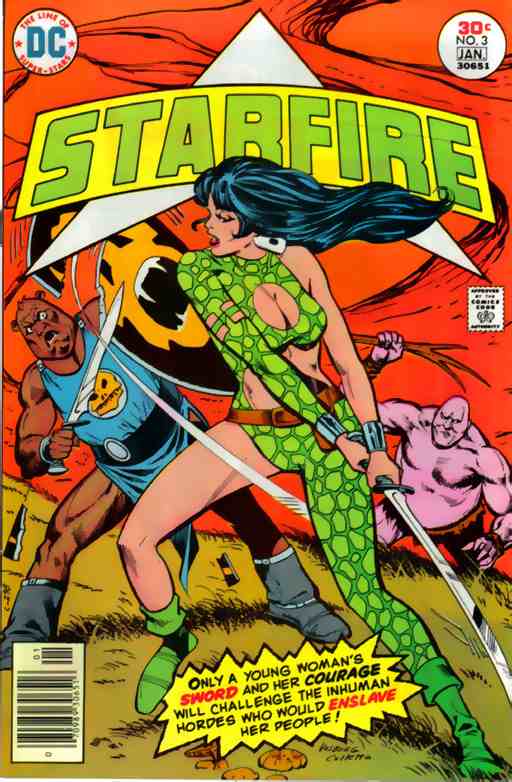
Review: Starfire by Mike Vosburg, Vince Colletta, Elliot S! Maggin, et al.

Four years before the Teen Titan Starfire debuted, and almost forty years before she got her own series, there was a very different DC series called Starfire. A take on the sword-and-sorcery comics then popular, it billed itself as "sword-and-science": it was set on another planet, and in a world not with magic, but one that had been conquered by aliens and partially regressed into barbarism after an era of great scientific achievement.

In this era, humans are the subjects of the Mygorg, a brutish alien race; the main character, Starfire, began her life as a human slave of the Mygorg, but when she's about to turn eighteen, she realizes she's going to become their sex slave! She runs away, and is rescued by a priest who helps train her in the ways of combat. They fall in love, he dies, and she vows to destroy the Mygorg forever. So she sets off with a band of adventurers seeking the people and resources to do exactly that.

Starfire was one of very few female-led DC superhero-adjacent titles in the 1970s (were the other just Wonder Woman, Lois Lane, and Supergirl?), but more importantly it was probably the first comic to feature an Asian protagonist.* Well, sort of-- since Starfire is set on an alien planet nothing to do with Earth, she can't be from China or Cambodia, but we are told, "her mother was white, and the father yellow," artist Mike Vosburg draws her with East Asian facial features, and the colorists depict her skin tone as slightly different from all the white characters (though she has blue eyes). Though I suspect it was done to make her a little more "exotic" and thus sexy, it was a surprising moment of diversity for the comics of the 1970s.

If you look at the credits at the bottom of this entry, you'll see that even though Starfire had a consistent penciller, the series accrued four writers and three editors in eight issues. The series is kind of jerked around and never really takes off as a result. David Michelinie creates the baseline in his original two issues: the first gives Starfire's backstory, climaxing in a surprisingly brutal scene where she beheads the Mygorg who killed her lover and would have taken her as a "bride." Then in #2, he establishes the formula: Starfire and her band (the only named member of which is Thrumdahg) come to a place, fight some Mygorg, and advance onwards. In this story, they acquire a map with the location of the fabled "Lightning Lords" on it, humans with advanced weapons that will help Starfire's band win their battles, thus setting up a quest behind the formula.

Michelinie stops it from being too straightforward, though; Starfire's eagerness for a fight in #2 disrupts a manor whose human lord has an uneasy truce with the Mygorg, for example, culminating in the accidental death of the manor lord's young son. So Starfire's quest will be tinged with a need for understanding complexity, and an undercurrent of tragedy.

The next three issues are the work of Elliot Maggin, who basically reproduces Michelinie's issue #2 formula. He keeps adding new members to Starfire's band, including the mute Thump and the poet Moonwatcher. Beginning with Thrumdahg back in #2, though, there's this consistent thing that the members of Starfire's band all think she really needs some loving, and so she's always fending off unwanted advances. Thump is the only exception to this. It's a weird, unpleasant choice, even in the context of a comic that began with its protagonist almost being forced into a life of sexual slavery. Like, why do I want to read about a band of would-be rapists? Still, Maggin's first two issues are solid adventure tales, each setting up its own interesting situation and then resolving it in the course of a single issue.

In issue #5, though, things begin to change, as Starfire meets the Lightning Lords at last in what's the first part of a three-part story by two different writers. The premise of the series begins to warp: while in the first five issues, it was sword-and-science, no sorcery needed, #6 introduces an out-and-out sorceress with magical powers!

The attempts to retool the series also become pretty brazen. In #6, while camping outside the lair of the Lightning Lords, who live in the middle of a mountainous wilderness, Starfire runs off in the middle of the night and comes back in a new costume. Which she allegedly picked up at a marketplace? Like why is there a human marketplace in the middle of nowhere selling sexy costumes for adventuresses?

This new costume lasts one whole issue, as in #7, Starfire is charging through a doorway and her costume gets caught on a nail and falls off, meaning she has to run around in a bra and short pants. I shit you not. Vosburg doesn't even draw the nail; in one panel, Starfire's shirt is ripping, and in the next she observes, "Looks like I lost my modesty to a rusty nail! Nothing ever comes free in this world!" Like, what does that even mean? And then she never mentions it again, apparently content to wear what is essentially a chainmail bikini. (I actually did like her original outfit, a sort of asymmetrical Seven of Nine-esque jumpsuit.)

Also, in #7, new new writer Steve Englehart must have also disliked the fact that the majority of Starfire's band were rapists, because he kills off all the supporting characters except for Thump and Moonwatcher in a teleporter accident! Like, a supercomputer tries to beam a group of them out of danger, but it doesn't know human biology, and they all die except Moonwatcher (the least rapey of the ones who weren't Thump; he seemed to want to charm Starfire into sleeping with him). Starfire also becomes a bystander in her own story in this storyline, as it turns out Thump is a genius computer programmer, and he makes a lot of decisions while Starfire just yells and fights a lot.

#8 introduces a new new direction, bringing back the order of priests Starfire's lover from #1 belonged to. The book promises there are more issues to come, but they never happened; I'm not sure why. The DC Implosion that killed Star Hunters was over a year away. Well, I mean I guess I know why, because this book's writer and premise were constantly shifting, and each change made it worse, not better. (Creator David Michelinie did slip Starfire into a one-panel cameo in Star Hunters #7 as another avatar of the same multiversal force as Star Hunters's lead character. But that was Star Hunters's last issue too!)

The one consistently good part of the book was the artwork of Mike Vosburg and Vince Colletta. They do great fantasy stuff, especially with Starfire herself: thick lines that really show off her beauty and her power. Too bad the writing couldn't consistently match what they were capable of.

Starfire vol. 1 was originally published in eight issues (Aug./Sept. 1976–Oct./Nov. 1977). The series was written by David Michelinie (#1-2), Elliot S! Maggin (#3-5), Steve Englehart (#6-7), and Tom DeFalco (#8); pencilled by Mike Vosburg; inked by Robert Smith (#1) and Vince Colletta (#2-8); colored by Liz Berube (#2); and edited by Joe Orlando (#1-4), Jack C. Harris (#5-7), and Denny O'Neil (#8).

* Karate Kid received an ongoing series in Mar./Apr. 1976, and he's half-Japanese, but that's a retcon, and I'm not sure when it was established.

18 January 2018

Review: The Beetle by Richard Marsh

Trade paperback, 354 pages
Published 2004 (originally 1897)
Acquired November 2012
Read January 2013
The Beetle by Richard Marsh

It's been five years since I read The Beetle (this review is a tad belated), and I feel like I need to reread it to assess it. But I also feel like that would be the case even if I had just read it. It is a strange book, a weird window into Victorian exoticism and eroticism. It is not surprising, however, that while it originally outsold its contemporary supernatural thriller Dracula, Dracula has persisted while The Beetle has not. Both are very Victorian, but The Beetle is perhaps particularly Victorian. The kind of racialized and sexualized Other that haunts this novel no longer haunts us, or at least not in this way. The book is almost impossible to describe, though; when I find myself wanting to recommend it to someone (and that takes a very particular kind of someone), all I can really do is just shove it into their hands because anything I can say would be inadequate.

16 January 2018

Return to Oz: The Royal Book of Oz by Ruth Plumly Thompson

Trade paperback, 312 pages
Published 2001 (originally 1921)

Acquired December 2009
Read December 2016
The Royal Book of Oz: In which the Scarecrow goes to search for his family tree and discovers that he is the Long Lost Emperor of the Silver Island, and how he was rescued and brought back to Oz by Dorothy and the Cowardly Lion
 by L. Frank Baum
enlarged and edited by Ruth Plumly Thompson
illustrated by John R. Neill

This is the first Oz book written by someone who wasn't L. Frank Baum (don't believe the cover and title page, they lie). It's not terrible, but it's not very good, either. The Scarecrow goes off to find his family tree and ends up in an underground kingdom of racist caricatures-- even leaving aside the racist caricatures, it's not very interesting. Like, one would hope for the Scarecrow to do some clever stuff and grapple with the ruling of a country (and maybe Thompson could even remember that the Scarecrow has previously been a ruler), but mostly he just whines a lot and the story goes in circles.

Meanwhile, Dorothy and the Cowardly Lion go looking for him and end up in some weird places and meet some weird characters: I liked Sir Hokus of Pokes, the Arthurian knight who wandered into Oz, in particular. As a sort of outcast, he's the kind of character who paradoxically fits right into the the Oz novels.

Next Week: Eric Shanower shows us some new corners of fairyland, as he takes us on some Adventures in Oz!

15 January 2018

Review: Star Trek: The Next Generation: Survivors by Jean Lorrah

Mass market paperback, 253 pages
Published 1989

Reread December 2016
Star Trek: The Next Generation #4: Survivors
by Jean Lorrah

You know, I've never seen "Legacy," the episode of The Next Generation where Tasha Yar's sister turns up, and we learn about the long-dead Tasha's backstory in more detail. Yet I have read Survivors, a TNG novel written during the first season (published during the second) that tells us about Tasha's childhood and early Starfleet career in great detail. In a bit of "head-canon," I suspect that even if I had seen "Legacy," I would still prefer this as the "true" backstory of Tasha Yar. Lorrah depicts the ideal Yar, the one TNG never actually gave us: a damaged woman from a damaged world, and thus someone who believes in the idealism of the Federation even more than those raised within it. The characterization of Tasha and also Data are really the book's strong points: I think Lorrah gets Data better than the show writers did at this point. (I really liked the touch that his rattling off of synonyms was a purposeful affectation.) You can see why Pocket commissioned Lorrah to write a Data-focused "giant novel" in Metamorphosis, because he just jumps off the page here, a perfect mixture of superintelligence and emotional inexperience. There's a lot else I could praise or say about this book, but suffice it to say that it's the best kind of tie-in fiction-- a story we couldn't have gotten on screen, but fitting in perfectly with the ones we did.