14 March 2017

Review: The Transformers: More than Meets the Eye, Volume 3 by James Roberts, Alex Milne, et al.

Comic PDF eBook, n.pag.
Published 2013 (contents: 2012)
Acquired March 2015
Read February 2017
The Transformers: More than Meets the Eye, Volume 3

Written by James Roberts
Art by Jimbo Salgado, Emil Cabaltierra, and Alex Milne
Flashback Art by Guido Guidi
Additional Inks by Juan Castro and John Wycough
Colors by Juan Fernandez and Josh Burcham with Joana Lafuente
Letters by Chris Mowry and Shawn Lee


I knew from, like, page three of this volume that it was gonna be a good one. The book opens with Hot Rod and a number of the other Lost Light Autobots on some kind of vaguely defined mission:
Sometimes I worry this is me.
from The Transformers: More than Meets the Eye Annual 2012 (art by Jimbo Salgado & Emil Cabaltierra)

There's some running around, some banter (I laughed), and then you discover that the characters have been miniaturized and are running around inside the mouth of Ultra Magnus, Duly Appointed Enforcer of the Tyrest Accord, fighting off an infestation of nanobots. Ultra Magnus is so grim that the pistons he needs to smile haven't been used in centuries:

13 March 2017

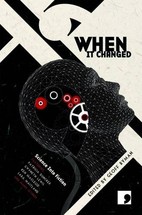
Review: When It Changed: Science into Fiction edited by Geoff Ryman

Trade paperback, 276 pages
Published 2009

Acquired August 2012
Read August 2016
When It Changed: Science into Fiction
edited by Geoff Ryman

Geoff Ryman edits an anthology that pairs science fiction writers with scientists: the sf writers provide stories based on real scientific concepts (sometimes loosely interpreted) and the scientists then provide a 2-3 page commentary on the story. Like any original anthology, it's a little uneven, and I found myself a bit disappointed that there weren't any particularly standout stories here. But still, there were some of note:

"Global Collider Generation: an Idyll" by Paul Cornell is a bit weird, a tale of a scientist trying to build a particle collider with the circumference of the Earth, and a mercenary trying to stop her, all in the midst of Cold War II. I don't know what to make of its assertion that direct conflict is needed for real progress. I'd hope not, but I suspect Paul Cornell actually hopes not too!

"Moss Witch" by Sara Maitland is kind of not a story, but more an examination of a hominid life-form with the traits of mosses. It made me wish I paid more attention to my botanist wife when she talks about plant reproduction, but when I wasn't lost in the details of plantdom, I enjoyed its conceit.

"You" by Geoff Ryman had a really neat idea, an idea so neat it seems like Ryman missed it. People in the future can lifeblog, go into the recorded lives of others. But you can go ever further than that: this story is about you lifeblogging someone who researched the life of someone by lifeblogging. Whoa! I'd've liked to have seen more of this, as this sort of layering was the best part of a tale of someone uncovering evidence there may have been life on Mars.

"In The Event Of" by Michael Arditti might cover some old ground as far as clone stories go, but I found it to be well-told and enjoyable regardless. What would it be like to be the clone of your parents' first child, who never lived up to her potential? Sibling-based imposter syndrome to the max!

"Zoology" by Simon Ings barely even used its scientific innovation, which I think is sort of implicitly acknowledged by Dr Matthew Cobb in "Exceptions," the story's afterword, but I mostly enjoyed it for its satire of the big and small issues of academia, from campus master plans to how rooms get renumbered in old buildings!

There weren't any bad stories here, either, but I wanted to love this book more than I did. I don't know if the premise of the book prevented the imagination from being as opened up as much as you might hope, or what, but these stories don't seem to quite live up to Ryman's hope in the introduction, that good science in fiction can create new and better ways of thinking. It's an overly ambitious goal, and perhaps the failure to realize that goal (he disparages the science and thus the imagination of the  Battlestar Galactica reboot, but I'd say that Battlestar is as good as most of what's here, if not better) is what prevented this book from really succeeding for me.

10 March 2017

Review: Nemesis: The Impostors by Ivan Brandon and Cliff Richards

When I read the various Final Crisis Aftermath titles a couple years ago, my favorite was Escape, which had the character of Tom "Nemesis" Tresser trying to escape Brother Eye and the Electric City, home of the new Checkmate Global Peace Agency. I said that it was the only one FCA story "that doesn't feel like the writer is trying to make something out of Grant Morrison's leftovers, that feels like its writer actually has his own story to tell" and though I found it confusing (it has conspiracies and duplicates and time travel), "just enough explanations were provided to make me feel like there was a logic to this, and to intrigue me to read on. There was a purpose to everything that happened, one that stems from the events of Final Crisis and has repercussions for the future."

Even though one of Grant Morrison's purposes in Final Crisis was setting up new concepts for other writers to play with them, and DC's purpose in the FCA tales was apparently to do that playing, none of them really took off. There were no more Human Flame stories after Run!, no Super Young Team stories after Dance, and almost no more Tattooed Man stories after Ink. Escape did, however, receive a follow-up, in the form of a four-issue Nemesis miniseries called The Impostors. Having escaped from the Electric City, Tom Tresser tries to take down the Council (apparently his recurring nemesis from his original 1980s appearances in The Brave and the Bold), but has to tackle with Batman and possibly the Joker in the process. It was never collected, so I couldn't get it from the library, but I liked Escape enough to buy the single issues off eBay.

As I quoted myself above, I enjoyed Escape and liked the future it implied. Only now, eighteen months after I wrote that, I have no idea what I was talking about. The Impostors did nothing to remind me what I was talking about back then. I was so confused reading this book, and not in a good way. Why exactly did Tom suddenly want to take down his old enemies? Why did he keep seeing Brother Eye and the Electric City? What did the stuff I did dimly remember from Escape actually have to do with anything? And what the heck was up with the ending?

Frustratingly, the story ends in such a way that indicates more is to come-- and that more needs to come, because The Impostors makes so little sense on its own. However, The Impostors was Tom Tresser's last appearance, and then the universe was rebooted. I bounced off this story completely, which is a shame because of how much I liked Escape. I would read more in the vain hope that something might make sense again, but I don't even have that option.

One thing I did like: Tom is pretty paranoid in this story, and justifiably so, and his paranoia is amped up because he doesn't believe the guy claiming to be Batman is actually Batman because his body language is wrong. This is because The Impostors takes place after Final Crisis-- so Bruce Wayne is unstuck in time, and Dick Grayson is the new Batman. It's a nice little touch.

Nemesis: The Impostors was originally published in four issues (May-Aug. 2010). The story was written by Ivan Brandon; illustrated by Cliff Richards; colored by Matthew Wilson; lettered by Steve Wands (#1), Sal Cipriano (#2-3), and Travis Lanham (#4); and edited by Ian Sattler (#1-4) and Rex Ogle (#2-4).

09 March 2017

Review: Oranges Are Not the Only Fruit by Jeanette Winterson

Trade paperback, 192 pages
Published 1997 (originally 1985)

Acquired January 2007
Previously read February 2007

Reread September 2014
Oranges Are Not the Only Fruit by Jeanette Winterson

Look, why oranges anyway? When one of my students asked that in class, we came up with a tremendous list of resonances and symbolisms that the oranges have in this novel-- the cover of my edition, at least, makes a sort of "forbidden fruit" interpretation obvious. One of the meanings of the oranges comes from fairy tale narratives embedded in the text of the novel, like the tale of Sir Perceval or the tale of Winnet. These are the stories that young Jeanette needed to hear but never did, the kind of stories that could have helped her operate in the world, but she never received; she only had one source of stories, her mother's (often warped) Bible tales. She had a steady diet of oranges, so to speak.

Oranges Are Not the Only Fruit is filled with embedded narratives like the fairy tales. This novel, as Mikhail Bakhtin would say all novels are, is heteroglossic, different-tongued. Bakhtin reminds us that you can't separate the form from the content; the fairy tales aren't a sideshow or a diversion, they're part of the meaning of the text as much as the plot is. Everything in a novel refracts the intentions of the author. So why the fairy tales? We should remember that, as Jeanette/Winterson tells us, stories are "a way of explaining the universe while leaving the universe unexplained" (93). Every story explains something and fails to explain something else; we all forget the aspects of the past that make us uncomfortable. So what can we do about this? As we're told (95), the world is a sandwich made up of other peoples stories, so you need to add your own mustard! Or, go even further, and make your own sandwiches.

Jeanette's mother never gets it. She only has one story. She reflects near the end of the novel, "After all… oranges are not the only fruit" (172), but this is in the context of her feeding a group of houseguests only pineapple! She's just substituted one universal story for another. Oranges Are Not the Only Fruit argues that the world is heteroglossic, that everyone needs a different story, and the worst thing that you can do is fail to recognize that. Jeanette grows up and loses the simplicity of her old world, the one where oranges were the only fruit, but she gains a new world with new stories-- and yet the old stories remain there too. She can go back and see her mother, and Jeanette is different but the same, and her mother is different but the same.

We're always finding new stories and discarding old ones when they don’t work. Jeanette’s mother’s stories work for her, but Jeanette needs a different set of stories, and yet the old stories remain inside her. Our sandwiches need mustard. We need oranges and pineapples and many other fruits. Oranges Are Not the Only Fruit is filled with different stories because we all need to be filled with different stories if we're going to survive.

08 March 2017

Faster than a DC Bullet: Prose Fiction #12: Spider-Man: The Venom Factor

Trade paperback, 348 pages
Published 1994

Borrowed from the library
Read December 2016
Spider-Man: The Venom Factor
by Diane Duane
illustrations by Ron Lim

Diane Duane is one of my favorite Star Trek novelists, which was my reason for including this book in my list of interesting prose novels based on comic book properties. It displays one of Duane's writing tics to a T: exhaustive research. We all know that Peter Parker is a photographer, but Duane makes us believe it, devoting time in the novel his purchasing of film and other equipment, his developing of film, and his going through the whole process of submitting photos to the Daily Planet and obtaining reimbursement for expenses. It's the kind of detail you probably wouldn't or shouldn't give in a superhero comic book, but deepens the realistic feeling of the world in a novel, which was part of my whole reason for this project. Peter's also a graduate student in physics during this time period, and Duane captures some of the nuances of that, too, though not as well. (I find it hard to believe anyone has the time to be a graduate student and a freelance news photographer and a superhero.)

Other than that, this is a decent if unimpressive novel. Duane captures the characters of Peter Parker/Spider-Man, Mary Jane, and Venom well, based on my limited experience of them all. (This is set during the period where Peter and Mary Jane were married, and apparently also Venom was kind of a good guy? He seems like he's going to be the book's villain, but it turns out to be misdirection.) It's the first part of a trilogy, so I guess the full story will be forthcoming.

Next Week: A new project begins-- my exploration of DC's "new heroes" in the Infinite Crisis era, beginning with Manhunter: Street Justice!

07 March 2017

Review: The Transformers: Robots in Disguise, Volume 2 by John Barber, et al.

Comic PDF eBook, 98 pages
Published 2012 (contents: 2012)
Acquired August 2014
Read February 2017
The Transformers: Robots in Disguise, Volume 2

Written by John Barber
Art by Livio Ramondelli, Brendan Cahill, and Andrew Griffith
Colors by Joana Lafeunte, Josh Perez, and Livio Ramondelli
Letters by Shawn Lee


Physically, all IDW trade paperbacks are thin. IDW as a company just doesn't like collecting more than four issues at once, and this is as true of The Transformers as it is for Star Trek, Doctor Who, or My Little Pony. And besides, I'm reading these Transformers volumes electronically. But despite that, this one collects four issues and still manages to feel thinner than most. Probably at least partially because the first issue collected here is not about the Autobots forging a new future on Cybertron, but Orion Pax nee Optimus Prime following up on clues from crazed Decepticon scientist Jhiaxus about Monstructor. Though I'm sure it'll play into events on Cybertron in the long run, it feels like filler: Orion is not a main character in this series, and I barely know who the other robots on this mission-- on either side-- even are. Livio Ramondelli's art doesn't help; his painterly style is attractive, but the storytelling is often difficult to follow.

Give him an amazing discovery in an ancient ice cavern, though, and he'll draw the hell out of it.
from The Transformers: Robots in Disguise vol. 1 #6 (art by Livio Ramondelli)

The remaining three issues here advance some of the plotlines of post-peace Cybertron: Wheeljack investigates a mysterious Decepticon recently arrived on Cybertron, while Ironhide and the Dinobots brave the wilderness of post-reformatting Cyberton and Bumblebee tries to balance his desire to be inclusive with his fear of giving Decepticons a bigger role in the global government. The stories are decent if not great, enlivened by the stuff Barber and his artistic collaborators do with voice and structure. One issue, for example, parallels happenings in Autobot HQ depicted in conventional comics formats with Wheeljack's explorations in a sixteen-panel grid filled with narration:
Forget the nine-panel grid, Alan Moore. John Barber is here!
from The Transformers: Robots in Disguise vol. 1 #7 (art by Brendan Cahill)

Also, the little touches make it sing, like the former Decepticon who produces terrible poetry at open mic night, or just how goddamned smug Starscream is all the time:
I also dig every little crack he makes about the elections.
from The Transformers: Robots in Disguise vol. 1 #7 (art by Brendan Cahill)

I've never really paid much attention to Bumblebee before, but I like him here-- a nice guy harried by every person, trying to live up to an impossible ideal in a difficult decision, always too hopeful that there will be an easy way out, and completely lacking confidence in himself. There's a lot simmering in this book, and it's an enjoyable simmer, but I look forward to seeing it boil over. Too often I feel like something interesting is about to happen, not actually happening.

Next Week: Meanwhile, in space... as always the Lost Light crew encounters something that's More than Meets the Eye!

06 March 2017

Review: Lynton Abbott's Children by Florence Fenwick Miller

Speaking of the late John Hurt, I have a review of his last hurrah as the Doctor up on Unreality SF.

PDF eBook, 249 pages
Published 1879
Read July 2016
 
PDF eBook, 238 pages
Published 1879
Read July 2016
 
PDF eBook, 268 pages
Published 1879
Read July 2016
Lynton Abbott's Children
     I am arguing neither for nor against heredity. I am stating facts only; their interpretation does not come within my province. But I have been compelled to think upon this subject of the strange differences between children of one family: happier would my life have been had transmission of qualities been indeed an exact law! And in the course of suffering and eventful years I have learnt to be infinitely pitiful, and to blame society and environment rather than the individual for most crimes and cruelties. (3: 57)
This three-volume Victorian novel was published anonymously, but Rosemary T. Van Arsdel's Florence Fenwick Miller: Victorian Feminist, Journalist and Educator indicates it was the work of Florence Fenwick Miller, who sought a medical degree at the University of Edinburgh but was turned away, though she eventually took a degree from the Ladies' Medical College and conducted a medical practice in London for a time. Van Arsdel says the book was well reviewed but cost her money, leaving her feeling depressed. She says little of what Fenwick Miller's motivation was beyond "her own amusement, as well as to try her hand at other subject matter" than the scientific writing she'd been selling in the periodical press (92). But it seems that Fenwick Miller must have intended more than that.

The protagonist and narrator is a girl who is the seventh of eight children-- all the others are boys, and her father was one of ten boys, and his father similarly so. Her father has picked out names and occupations for the ten sons he plans on having in advance, based on their uncles' names and occupations: number seven should be named Henry and can be either a doctor or a clergymen. He deals with the unexpected arrival of a daughter by naming her "Henrietta," calling her "Henry," and raising her to be a doctor anyhow. Henry is thus raised and educated like a boy until she turns ten and her aunt discovers this is going on and takes her away to be raised properly. Henry is a charming, fun narrator-- apparently some of the contemporary reviews compared the book to Jane Eyre, and I can see it.

Things take a dark turn, however, when in living with her brother Marshall at the home of her Uncle Marshall (the Marshalls of the Abbott family must become clergymen), she discovers that even at the tender age of ten, he has already discovered vivisection! Marshall wants to become a doctor, not a clergyman, and thus acts out medical experiments in secret, dissecting frogs and a stray dog alive, and soon turning his eyes upon Henry's dog: “his wrath was the white heat of burning metal. Only his eyes flamed far away, his skin kept that violet hue, and his teeth were tightly set” (1: 80-1).

This is no Victorian scientist novel, however. Time elapses and soon Henry is twenty and about to debut in society. Marshall has been set up with a vicarage close to the ancestral seat, and when she goes home for the first time in years, Henry discovers that he mentally abuses and tortures his wife. Much of the second volume covers Henry's attempts to help her sister-in-law and avoid Marshall, who tries to discredit her and besmirch her character in order to stop her from informing on him, along with side plots like one of Henry's brother falling in love with Henry's best friend, and a physically repulsive genius proposing marriage to Henry (she refuses, and is kind of a jerk about it). Marshall is a creepy villain, and Fenwick Miller draws a straight line from vivisection to spousal abuse-- a wife is just an even more powerless creature to toy with.

Things get more desperate in the third volume, as Henry convinces her father to arbitrate between her and Marshall, only Marshall proves too clever for her. I rather liked Lynton Abbott, Sr., a man set in his ways but of fundamental morality. Then the murders start happening, and the novel becomes a bit melodramatic; the ending is probably its most unsatisfactory part.

There's a lot of ruminating on the diseased mind, and what makes Marshall so awful as he is: nature or nurture? At one point it's suggested that if Marshall had been allowed to be a doctor as he liked, then everything would have turned out okay for him, but given how creepy he already was as a child, it's hard for me to buy this. The book's feminist leanings don't just come through in the discussion of abusive marriages; it also argues that women should be allowed to do what they like, and not held back out of nonsensical ideas of purity or womanliness. Unfortunately, the world isn't ready for that, and the very ending of the book sends Henry to Paris, the only place she can study and practice medicine. Her and one of her brothers do serve together in the Crimea, which sounds badass. Where's Lynton Abbott's Children at War? I'd read it!

03 March 2017

Recasting Doctor Who

John Hurt died last month.

Of course, Doctor Who fans being what they are, they immediately started wondering about recasting. John Hurt played an incarnation of the Time Lord otherwise known as the Doctor who fought in the Time War in the Doctor Who 50th anniversary special, "The Day of the Doctor" (2013) and in 2015, he surprisingly reprised the role for a series of audio dramas for Big Finish Productions, racking up an additional twelve episodes across four box sets.

Recasting the Doctor has never made a whole lot of sense to me. Or rather, the Doctor is already recast all the time. In 1966, a desperate production team invented television's most amazing method of recasting. They didn't replace William Hartnell with a guy doing a William Hartnell impression, they replaced him with a guy who was almost playing a totally different character... except he wasn't. And thus the mechanism that would allow Doctor Who to last 53 years (and counting) was born.

So at this point, the actors who played the first three television Doctors are dead. Some fans have been after recasts for a long time at this point. Probably since 1999, when Big Finish began producing original audio stories featuring the fifth, sixth, and seventh Doctors, opening up the possibility for new adventures for other "classic" Doctors. Big Finish finally bowed to the pressure in 2014, with Peter Purves and William Russell sort of playing the first Doctor, Frazer Hines sort of playing the second, and Tim Treloar playing the third.

I never wanted this.

Some people object to recasts on moral grounds. "It's disrespectful!" they cry. Others point out it happens all the time in other media franchises-- no one thinks Sean Connery has been disrespected when Daniel Craig turns up, or William Shatner by Chris Pine.

I object on the basis of two interrelated reasons: 1) Doctor Who already has a built-in method of recasting, called regeneration, and 2) I'm not convinced that incarnations of the Doctors are actually distinct characters. Now, obviously, there are some differences in characterization and background. The third Doctor is a snob, the fifth Doctor likes cricket and gets overwhelmed easily, the seventh Doctor is a master manipulator, the tenth Doctor mopes about Rose, but I'm sympathetic to Terrance Dicks's claim that the differences between Doctors are really about the actors.*

For me "the fourth Doctor" has little meaning outside of "the Doctor as played by Tom Baker."† And when you put it that way, it seems silly. Would you hire someone to play "the Doctor as played by Tom Baker"? Probably not outside of a comedy sketch. Yes, James Bond gets recast all the time, but Daniel Craig wasn't asked to play Sean Connery playing James Bond, he just plays James Bond. Why hire an actor and then just ask them to do a Jon Pertwee imitation, rather than a bona fide performance? And if you hire an actor and just ask them to play the Doctor, they're not playing "the second Doctor" or "the sixth Doctor," they're just playing their own version of the Doctor.

The Doctor on television has never been recast outside of the context of regeneration, with two exceptions. The first is Richard Hurndall, who played William Hartnell playing the Doctor in The Five Doctors (1983), since Hartnell was dead. Now, I enjoy The Five Doctors a lot, but Hurndall is one of its worst parts. I don't think he does a good job capturing Hartnell's performance at all, and watching him "reunite" with his granddaughter Susan is hollow. And honestly, what's the point: The Five Doctors is fundamentally nostalgic (here's Patrick Troughton! the Brigadier! a Yeti! Jon Pertwee! Sarah Jane Smith! K-9! Cybermen! stock footage of Tom Baker and Lalla Ward!)... but I have no nostalgia for Richard Hurndall. Why is this guy I don't care anything about wasting time and space in my precious 20th anniversary celebration? I'm not "offended" by it, but I do think it's a poor creative choice. The other exception is that John Guilor recorded one line as "the first Doctor" for "The Day of the Doctor," which was played over stock footage of William Hartnell. This didn't bother me because I'm not expected to take it seriously as a performance, it's just a neat little cameo.

Now, I'm willing to believe other people perceive the character of the Doctor differently than me, and if they want to listen to Frazer Hines playing Patrick Troughton playing the Doctor, they're welcome to do so, but I think this is all especially silly in the context of John Hurt as the "War Doctor." Like, a lot of accomplished actors and Colin Baker have played the Doctor over the years, but John Hurt is surely the most accomplished of them all. He was nominated for two Oscars, which is two more than anyone else who played the Doctor (I think; probably someone is going to turn up and tell me that Sylvester McCoy was nominated for an Oscar for The Hobbit), and David Lynch called him "simply the greatest actor in the world" (thanks Wikipedia). The idea that you could replace this man with a guy doing his best John Hurt imitation, and I would think, "Sure, that's what I want" just seems fundamentally absurd. Like, either you thought having a great actor in the role was meaningful or you did not.

I get it. John Hurt was great. That's why you want more of him. In fact, all the Doctors are great. But the very things that make each actor great make them inimitable. Recasting is a pointless chasing after an illusion, an invocation of false nostalgia. There is no War Doctor, except when he is played by John Hurt.

* I think Steven Moffat has said this too-- that he basically wrote the same for the ninth, tenth, and eleventh Doctors. Indeed, when he tries to write the Doctor distinctively different, it misfires. I feel like he tried to write the twelfth Doctor as distinctly different at first, what with all the "AM I A GOOD MAN?" stuff, and it weakened the character somewhat. 

† I say "little meaning" because obviously the fourth Doctor is different from the eleventh Doctor in prose even though Tom Baker has never come anywhere near Festival of Death.

02 March 2017

Review: Red Planets edited by Mark Bould and China Miéville

Hardcover, 293 pages
Published 2009
Borrowed from the library
Read May 2013
Red Planets: Marxism and Science Fiction
edited by Mark Bould and China Miéville

This is one of those books that's not as good as the title makes you think it will be. I guess I wanted more Marxism? I feel like the book was more a discussion of class and utopia in science fiction, without the Marxist lens being as prominent as the (delightful) title implies. I also wanted more on revolution. Like any critical anthology, it's a bit of a mixture, and every now and again a little nugget would shine through, like Carl Freedman's observation in "Marxism, Cinema and Some Dialectics of SF & Film Noir" that some sf is deflationary (life is not what you expected) and some is inflationary (it's more than expected), but Marxism is both, in that it destroys illusions but also promises a better humankind. I feel like there's a better book on this topic to be written-- the futurist orientations of Marxism and science fiction seem similar-- but I know I'm not familiar enough with Marx to be the one to write it. Though maybe if I was, I'd've gotten more out of this book as it was written.

01 March 2017

Reading Roundup Wrapup: February 2017

Pick of the Month: More than Meets the Eye, Volume 3 by James Roberts, Alex Milne, et al. Tough one this month, so much so that I had to use Preference Revealer to help me make up my mind. Ended up with what I would say is a pretty tight top three: More than Meets the Eye, Holes, and Blue Beetle: Road Trip, all excellent books. Dr No and Time Trips were also quite solid. Any one of the five could have won in a different month. But I guess I had to give the edge to the only book I read this month where a life-or-death situation is resolved by the Duly Appointed Enforcer of the Tyrest Accord cracking a smile. I should also point out that there was kind of a tight race for the bottom. Three books that could have lost in a different month: The Sea Fairies, Timewyrm: Apocalypse, and The Rise of Endymion. Though Rise is the clear, far and above, loser.

All books read:
1. The Rise of Endymion by Dan Simmons
2. Dr No by Ian Fleming
3. Manhunter: Unleashed by Marc Andreyko
4. The Transformers: Robots in Disguise, Volume 2 by John Barber
5. The New Doctor Who Adventures: Timewyrm: Apocalypse by Nigel Robinson
6. Blue Beetle: Road Trip by John Rogers & Keith Giffen
7. The Hero and the Crown by Robin McKinley
8. Doctor Who: Time Trips by A. L. Kennedy, Jenny T. Colgan, Nick Harkaway, Trudi Caravan, Jake Arnott, Cecelia Ahern, Joanne Harris, and Stella Duffy
9. Doctor 13: Architecture & Mortality by Brian Azzarello
10. Holes by Louis Sachar
11. The Sea Fairies by L. Frank Baum
12. The Transformers: More than Meets the Eye, Volume 3 by James Roberts
13. Feed by M. T. Anderson
14. Bringing Down Gaddafi: On the Ground with the Libyan Rebels by Andrei Netto
15. Black Widow: Deadly Origin by Paul Cornell
16. Elsewhere by Gabrielle Zevin
17. The Transformers: Robots in Disguise, Volume 3 by John Barber

All books acquired:
1. Doctor Who: The Emperor Dalek's New Clothes by Justin Richards
2. Doctor Who: Snow White and the Seven Keys to Doomsday by Justin Richards
3. Doctor Who: Little Rose Riding Hood by Justin Richards
4. Doctor Who: Cinderella and the Magic Box by Justin Richards
5. Doctor Who: The Gingerbread Trap by Justin Richards
6. Doctor Who: Helana and the Beast by Justin Richards
7. Doctor Who: Andiba and the Four Slitheen by Justin Richards
8. Doctor Who: Sirgwain and the Green King by Justin Richards
9. Doctor Who: The Garden of Statues by Justin Richards
10. Doctor Who: Frozen Beauty by Justin Richards
11. Doctor Who: Three Little Sontarans by Justin Richards
12. Doctor Who: The Three Brothers Gruff by Justin Richards
13. Doctor Who: The Grief Collector by Justin Richards
14. Doctor Who: The Scruffy Piper by Justin Richards
15. Doctor Who: The Twins in the Wood by Justin Richards
16. Doctor Who: Jak and the Wormhole by Justin Richards
17. The Sea Fairies by L. Frank Baum
18. Star Trek: Mirror Universe: Rise Like Lions by David Mack
19. Time Capsule by Lalla Ward with Paul W.T. Ballard
20. Sky Island: Being the Further Exciting Adventures of Trot and Cap'n Bill after Their Visit to the Sea Fairies by L. Frank Baum

Books remaining on "To be read" list: 653 (no change)
Books remaining on "To review" list: 52 (down 1)