16 March 2022

James Bond 007 in Quantum of Solace by Ian Fleming

Quantum of Solace: The Complete James Bond Short Stories by Ian Fleming

Whoever holds the Bond novel rights typically republishes the appropriate Fleming novel when a film adaptation comes out—if one is available. When Quantum of Solace came out, the complication was that "Quantum of Solace" was a short story, not a novel, and that it was already part of the collection For Your Eyes Only. In 2008, Penguin solved this issue by taking both Bond collections, For Your Eyes Only and Octopussy & The Living Daylights, and combining them to make Quantum of Solace: The Complete James Bond Short Stories. I dutifully picked it up even though I had already read all the contents because it featured a new cover by Richey Fahey matching the design of his gorgeous covers for the previous fourteen books... although because Quantum of Solace was only published by Penguin US, and my copies of the previous fourteen were the Penguin UK editions, its height is slightly taller than the other ones, and so it doesn't really match at all. Oh well.

Collection published: 2008
Contents originally published: 1960-65
Acquired: May 2021
Read: June 2021

I don't have much to say about this that I didn't about the constituent parts. Fleming was a good short story writer, perhaps a better short story writer than he was a novelist. I read in detail the stories I remembered liking ("From a View to a Kill," "For Your Eyes Only," "Quantum of Solace," "Octopussy," "The Living Daylights"), and liked them again this time around. I didn't waste my own time and only skimmed the ones I remembered not being very into ("Risico," "The Property of a Lady," "007 in New York"). There was one I remembered liking last time but couldn't get into this time ("The Hildebrand Rarity"); I guess because it's kind of complicated and I wasn't in the mood for complicated.

I will dutifully watch the film adaptation (though I am behind; as of this writing I still haven't even watched The Man with the Golden Gun) even though I know it has nothing to do with this book! I wonder what film fans who picked up this edition in 2008 thought. I wonder if it will be mined for more titles. Possibly: I can't imagine "Risico" or "007 in New York" being used, but "The Property of a Lady" seems Bondian enough, though it would have to have a new plot, as that story's essentials were already used on screen in Octopussy.

I read a James Bond book every four months. Next up in sequence: nothing!

Book Rankings (Final):

  1. Casino Royale
  2. On Her Majesty's Secret Service
  3. Dr No
  4. Thunderball
  5. Moonraker
  6. For Your Eyes Only
  7. From Russia with Love
  8. The Spy Who Loved Me
  9. Quantum of Solace
  10. Octopussy & The Living Daylights
  11. The Man with the Golden Gun
  12. You Only Live Twice
  13. Live and Let Die
  14. Goldfinger
  15. Diamonds are Forever

14 March 2022

How to Talk So Little Kids Will Listen by Joana Faber & Julie King

How to Talk So Little Kids Will Listen: A Survival Guide to Life with Children Ages 2-7
 by Joana Faber & Julie King

Our eldest son (two years and eleven months old as of the time I am writing this, some months before it will be posted) has been having some issues with causing physical harm-- biting other kids at daycare, along with kicking and scratching and sometimes throwing. He also does it to us, and to his little brother. I picked this book up from the library because it seems to be well regarded and I think broadly fits with our parenting philosophy.

Published: 2017
Read: May 2021

It's a well written book. There's a general overview of their approach in the first part, which alternates their principles with examples of them in action from either the authors' own experience or from parents in workshops they ran. The book is engagingly written and never dry. The second part then focuses on specific areas, so you can just read the ones that are relevant to your own experience.

The general principle of the book is that you work with kids by acknowledging their feelings. So if your kid is angry that they can't have a cookie, don't minimize that or try to explain why they can't, just agree with them. "Ugh, that's so frustrating!" You also express your feelings strongly, but in ways that are directed at the deed, not the doer: "I don't like to see little kids getting pushed!" not "Don't push your brother!" They also have this idea of problem solving, where you work with the kid to figure out a solution at a point where they are calm, so you can head off the behavior in the future.

Like all advice books, the proof is in the pudding. Does following the advice accomplish what it is supposed to? I am writing this about a month in, and my answer thus far is "I am not sure." Acknowledging feelings on its own doesn't seem to work much on Son One. I'll say, "You're feeling very frustrated right now!" and he'll reply, "Don't say that!" Part of this might be on me: I don't think I am good at matching emotion with my voice, and my voice often carries a "but" in its tone even if I don't say one aloud. So I am working on it. One way they suggest of acknowledging is giving the child what they want in fantasy. I don't think Son One quite gets this yet, so when we go, "What if you got to eat all the cookies?" he thinks it is going to happen! But one tool they suggest for fantasy is drawing, and this has been effective: you draw cookies on a piece of paper with him, and that often defuses things.

They are anti-time-out. I am not sure their alternatives are working on him... but it didn't seem to me that time-outs were working either, so I guess we are no worse off.

One thing that feels like a contradiction to me is that they talk about 1) acknowledging feelings, and 2) being consistent with that by expressing your own desires in terms of feelings. So if you say, "I get angry when I see little kids get hurt," your kid knows what that means because of how you've talked to them about them being angry. The problem I see here is that your kid never gets what they want when they are angry... but ideally you the parent do. Why should their frustrations go unfulfilled but not yours?

Some of it is tricky to put into practice, and will take time. Eliminating "you" from your vocabulary is quite hard, especially in the heat of the moment. My inclination is to say, "You don't sit on the cat!" not "I don't like to see cats get sit on!" So the jury is still out on the effectiveness of this book. Part of it will depend on me and my wife (can we actually do what is suggests consistently), and part of it will depend on the kid (will he actually respond to it). Right now he is out of daycare for the summer, but I really hope we aren't dealing with biting in the fall when he goes back.

11 March 2022

Star Trek Adventures Starter Campaign and Missions: My Experience as a GM

I lasted posted about DMing Star Trek Adventures some ten months ago, promising a further post once my players had got through my opening story arc... that has finally happened! It was a five-episode arc, so yes, it takes us about two months to do a single episode. I want here to reflect on the game in general so far, explain my campaign, and review the individual episodes we've played.

Our Campaign: Beyond the Rim of the Starlight

"Beyond the rim of the starlight" is the opening line to the lyrics of the theme song to the original Star Trek. I've always like the phrase, and have occasionally thought about the "Rim of the Starlight" as an in-universe thing: some kind of bright barrier in space. I once came up with a premise for an original series–era audio drama about some kind of small ship patrolling Federation colonies "beyond the Rim of the Starlight," where the Rim only permitted passage periodically so the ship was on its own. I revived this concept for my STA campaign, with some tweaks. Some were my own idea, some derived from the way I worked the published missions together.

Our campaign is set in 2371, the year after The Next Generation ends but before Generations; after the Dominion has been discovered on Deep Space Nine but before the Dominion War has begun. This lets us play with most things in the TNG/DS9 toolbox without worrying about the continuity of the big political changes DS9 introduced. The "Rim of the Starlight" is a barrier in space, beyond which lies a largely uncharted mass of the galaxy... but occasional holes do open up, meaning there have been sporadic visits by the Federation or other familiar species, which would let me make use of the published missions.

There are five published missions that claim to be designed to introduce players to the system:

  • "The Rescue at Xerxes IV" (included in the Core Rulebook)
  • "Signals" (part of the "Quickstart" free download)
  • "A Star Beyond the Stars" (a three-part campaign, part of the "Starter Set" pack)

I decided to incorporate all three into my opening campaign, designed to introduce the players to the game, and the characters to the area beyond the Rim of the Starlight. There's a narrative break between parts one and two of "A Star Beyond the Stars," so I put "The Rescue at Xerxes IV" there, and then I stuck "Signals" at the end. This also worked well in terms of introducing the mechanics... mostly.

I wanted my characters to be "lower decks" ones, a group of ensigns just graduated from the Academy. I guess I was influenced by watching Lower Decks, but also I was coming from a traditional D&D idea of RPG progression: start at the bottom and work your way up. This, I would come to realize, is not how STA conceptualizes things. It would be easier to go all lower decks if I was writing my own missions from scratch, but so far I have stuck with published ones, and some require some pretty big tweaks to explain why a group of ensigns is at the focus! (I assure my players that between missions, the ships gets into all kinds of exciting scrapes in which they play absolutely no significant role.)

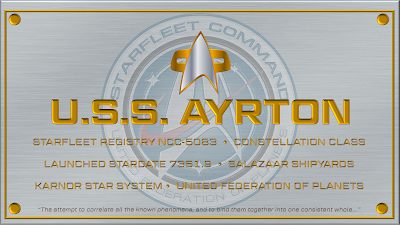
The tricky thing has also been creating a senior staff for their ship, the USS Ayrton. I mean, they all exist with names and stats, but I've struggled to work them in without overshadowing the player characters, which means the senior staff barely appear, and my players never really remember anything about them.

(The Ayrton is an old Constellation-class starship that has served on many venerable exploration campaigns. My players have complained that whenever the ship rolls to assist, it fails, so it must not be a very good ship.)

Our players have fluctuated. So far they have included:

  • my wife Hayley as Liana Carver, human science officer (all episodes)
  • Cari and Andy as Jor Lena, Bajoran security officer, and Gurg bim Vurg, Tellarite doctor (all episodes)
  • Jeremy and Daniela as Samel, Vulcan engineer, and Ioza Morganth, Betazoid pilot (episodes 1-3)
  • Claire as Mooria Loonin, Trill command officer (episodes 3-4, but intends to return in future)

(Two new players have joined us beginning with episode 6, as well.)

I will say the Star Trek format makes characters appearing and disappearing much easier to justify than D&D. ("Uh, this guy stayed in the tavern this week.") Especially with my lower decks focus, I just have to say that the captain didn't assign someone to beam down this episode!

Episode 1: "A World Beyond the Starlight, Part I: The Alcubierre"

(based on "A Star Beyond the Stars, Part I: The Alcubierre" by Marco RafalĂ )

As published, this mission is about the player characters going aboard a derelict Federation starship, the USS Alcubierre, that was testing an experimental engine, which would allow it to go faster than warp five without causing subspace pollution (tying into the TNG episode "Force of Nature"). They discover that the ship was attacked by Romulans, but end up discovering on top of that that the Romulans are being controlled by the parasites from the TNG episode "Conspiracy."

I retooled this to fit my campaign: the Alcubierre was testing out a device to cross through the Rim of the Starlight at will. When it crossed through, the device malfunctioned, stranding it, but also it was attacked by Romulans. In a last-ditch effort, it was able to cross back; the Romulan warbird was cut off, but the ship had still been boarded. I wasn't interested in working with the "Conspiracy" parasites, though, and replaced them with a fungus, loosely based on the so-called "zombie-ant fungus."

I had the player characters shuttle over to the Alcubierre with an NPC first officer character in command of the mission. This meant that I could provide some guidance as they figured out the system, but my plan was also for the commander to get knocked out at some point, so that one of the players would have to be put in command.

Overall, this mission went pretty well. The players spent their time learning the system, but soon figured it out. They quickly proved themselves adept at coming up with interesting solutions. In this mission, they find there's just one survivor on the Alcubierre, Ensign Jim LaSalle, an engineer who helps them do the cold restart of the ship's engines, which allows the players' ship to beam people over and win the day. The players are supposed to fight their way into Engineering and then fix the engines.

My players had the idea that instead of coming with them, LaSalle should stay behind and cause a distraction, drawing some Romulans away from Engineering. I let them do this, but I think I should have handled things slightly differently: if I was making the combat tasks easier by reducing the number of Romulans, I should have made the technical tasks harder. (Instead of having LaSalle there to talk them through things, they had to depend on his notes.) I still think this would have played to their strengths; at the time, there was just one character who was worth anything in combat. But overall it went well!

They did some creative stuff, too, in terms of capturing a Romulan. On the other hand, we struggled a bit with combat, and it wasn't until partway through episode 2 that I realized there was a very basic rule about how to use STA's custom "command dice" when rolling for damage that I had totally overlooked because it's printed in a different part of the CR than all the other information about combat! It's a good system, but it's not always well explained.

Episode 2: "A World Beyond the Starlight, Part II: The Rescue at Xerxes IV"

(based on "The Rescue at Xerxes IV," author unknown)

So I had episode 1 end with a tug arriving to tow the derelict Alcubierre back to Deep Space 8, and the player characters being assigned to go with it to do debriefing on the fungal threat. Episode 2 opened, then, with them flying on a runabout back to their own ship, the Ayrton, allowing me to integrate the starter mission from the Core Rulebook. In the mission as written, the characters discover that all life-forms on Xerxes IV are devolving, including a Federation science team which they have to evacuate. The scientists don't want to leave, though, because they're researching a medicine, and if they don't get samples now, the plants they need will devolve too.

I tied this into my ongoing plot by having it be an antifungal that they were researching—and by giving a piece of paper to Gurg's player that indicated this antifungal was, according to a medical briefing he'd seen on DS8, exactly what was needed to remove fungus from someone's brain without harming their brain. Pretty big coincidence? Well, they also learned that a mysterious signal had been intercepted by the Xerxes outpost computers several months ago... the outpost hadn't been able to decode it, but a couple days later, they'd received orders from the Federation Ministry for Science telling them to research antifungals. Only, later the characters would learn the Ministry had never sent any such orders...

Other than this, I didn't change much. The mission works really well as an introduction to the STA mechanics overall: it begins with some basic tasks, then some simple combat, then teaches you Extended Tasks. My players again surprised me: at the beginning, they get attacked by devolved scientists ("Neanderthals" according to the mission; my players made fun of the science here), and they managed to capture one and brought him along with them! Which was not a thing I had anticipated. This proved especially challenging when the players had to cross a ravine, and they had to get this tied-up Neanderthal to walk across a log! There were some good shenanigans there.

The climax of the episode is both clever and somewhat confusing for a first-time GM. Basically, the characters have to split up and undertake three different things simultaneously, all within a time limit: they need to find parts to repair their damaged runabout, they need to cure the devolution, and they need to gather plant samples to use in the fungicide, but an ion storm is bearing down on the planet that will make taking off impossible. My players debated what to do a bit. Ioza, who was in charge of the mission, didn't think gathering materials for the fungicide was worth the time. On the other hand, Gurg knew how valuable the fungicide could be... but the briefing he'd learned that from was classified, and I'd added a Mission Directive of "Maintain operational security and protect classified information."

Carver, our science officer, was game to find the samples, and Ioza was willing to go with her if she insisted; it seemed logical that Gurg would cure the devolution, and Jor the security officer wanted to help him. But Gurg kept insisting he didn't need help—his way of trying to make Jor go work on the more important task without revealing what he knew! But one of Jor's Values is "Tight with Gurg," and I ended up giving her a point of Determination if she refused to listen to Gurg in order to help Gurg.

According to the mission as written, the characters should have 15 intervals to do all of this. In STA, a Task by default takes 2 intervals, though players can spend Momentum to reduce that to 1, and if they roll a Complication, it increases to 3. The mission seems to indicate that you should rotate between the characters, with each Task taking 2 intervals, but 1) doing all three of those things would be totally impossible, you would just run out of time, and 2) it also doesn't make much sense from a narrative standpoint. The characters are working simultaneously: why should Carver scanning for samples in one location give Samel less time to look for engine parts in a different location? It also says to spend some Threat to add Neanderthals to some scenes, and that combat should take 1 interval... but also to just integrate the Neanderthals into the turn order. So the whole combat is 1 interval? How can you do that and maintain the turn order?

I ended up treating each location as its own separate Timed Challenge, and just trying to move back and forth between them in a way that made sense: if 2 intervals passed in one location, but 4 in another, then I went back to the one where 2 had passed to "catch it up," so to speak. And I had player combat Tasks take 1 interval by default. This all worked out very well, actually; pretty much every group finished in the nick of time, and there was some good rolling and rerolling. But it was more confusing than I feel like something aimed at first-time GMs and players ought to be! I posted in one of the STA facebook groups to ask if I was interpreting things correctly, but the advice I got didn't really clarify. I've never seen anyone else complain about this mission being confusing, though, so maybe it's just me!

Anyway, that aside, it was overall a fun one, and it was by the end of this mission that I felt that STA as a system had really clicked for me and my players, with them effectively using Momentum, Determination, Talents, and Focuses to their advantage, and me figuring out what to do with Threat.

It took two-and-a-half sessions to play this one; one of my players complained after the first session that she didn't really know what was happening narratively in the first Extended Task. She understood the mechanics, but what was actually taking place? This was good feedback, and I made many of the Tasks in the later scenes more detailed as a result. As written, the mission just says the characters are collecting samples, for example, but I would say things like, "you're looking for a tree of genus Ditasa," which I think helped the immersion.

I had the episode end with the Xerxes science outpost broadcasting a mysterious signal through the Rim of the Starlight, opening up a hole in it. (All this stuff with the signals was me working in foreshadowing of what would be the arc's last episode, "Signals.")

Episode 3: "A World Beyond the Starlight, Part III: We Are Not Ourselves"

(based on "A Star Beyond the Stars, Part II: We Are Not Ourselves" by Marco RafalĂ )

Episode 3 thus opened with the main characters back on the Ayrton, joined by a new crew transfer, Loonin, and the ship assigned to cross through the Rim of the Starlight to find the Romulan warbird and the alien fungus. I set it up with a series of chained Tasks as the ship crossed through the Rim: Carver was in the science lab on scanning duty, Samel was on the bridge on Engineering duty, Gurg was in sickbay, and the other three characters were on a damage control team together.

  • Carver in the science lab does a Reason + Science Difficulty 2 Task to determine where the Rim is going to fluctuate. She sends this information to Samel on the bridge...
  • Samel on the bridge does a Reason + Engineering D2 Task to figure out where to send the damage control team...
  • Loonin does a Command + Presence D2 Task to get the damage control team moving quickly and efficiently...
  • Ioza does an Insight + Engineering D2 Task to fix the system while...
  • Jor does a Fitness + Security D2 Task to rescue a crewman trapped by the damage and get him to sickay...
  • Gurg does a Reason + Medicine D2 Task to stabilize him.

Each player could spend Momentum off the back of a successful Task to reduce the difficulty of the next one, e.g., if Samel did a very good job identifying where the damage would happen, that would make Loonin's job easier. My players seemed to like it, it gave their "lower decks" characters something to do, and they ended up with a nice big pool of Momentum at the beginning of the episode.

This episode has two discrete parts as written: first the players investigate a derelict Klingon space station infected by the parasites (fungus in my version) and then they go to a base where the parasites are performing genetic experiments. As written, the parasites are trying to create superior hosts for themselves, but keep triggering devolution by mistake. I had to change this a bit: we had just done devolution in the last mission! I also wanted the fungus to be up to something more interesting (more on that when I get to episode 4). So I had the fungus experimenting to make itself more intelligent; they were inducing mutations in the Klingons to increase their cranial capacity, and then harvesting those neurons and injecting them into fungal samples. Despite this, my players made a connection to the devolution they had seen on Xerxes IV. Two totally unrelated phenomena in two weeks making people devolve: that's just life in Starfleet, I guess.

Investigating the Klingon station was kind of tricky. Mostly it's a series of Tasks where you look at a thing, then learn something. The players were a bit unlucky with some bad rolls, and also it was hard to use Threat in a way that made things more fun, I found. Also this is where I learned that making transporting into a Task with a Difficulty beyond 0 can backfire when the plot requires that the characters beam over! Because they did poorly on that Task, they had to use a shuttle... and then they did poorly on that one! So, if something needs to happen, and you don't want to explore negative repercussions, your best bet as a GM is to just make it D0 and let your players earn some momentum.

The second part of the mission was better, though; I did have an NPC member of the senior staff beam down with them, but here is where I learned that that is hard to play an NPC right when the NPC is in command but you also want to maintain player agency, and the NPC mostly faded into the background, her personality not emerging as I'd hoped.

Again, my players surprised me. (Always a good thing.) Advancing on a place where they knew there were some fungus-controlled Romulans and Klingons, they wanted to draw them out in smaller numbers. They had the idea of Loonin—who had a Focus in Animal Handling—making the call of an animal they had been hearing (alien apes the fungus was experimenting on). I liked this... but also thought that it was pretty unlikely Loonin could skillfully mimic something she'd only heard a couple times! So I set it to Difficulty 5. They grumbled a bit, but used their ingenuity to come up with a new plan: they recorded the animal noise on a tricorder, then "bluetoothed" a comm badge to the tricorder, placed the comm badge ahead of them while they hid, and then used the tricorder to make the comm badge play back the noise, drawing out a Romulan, who they took down quite effectively.

They then ended up capturing one of the fungus-controlled Romulans, pointing out it was the only one left. I made this appeal a D4 Task, but they pulled it off in style.

Something I hadn't anticipated when changing the parasites into fungus is that when a fungus-controlled person dies, they release a cloud of spores, which made my players paranoid they were going to be taken over. Eventually, we figured out that they could just set their phasers to "vaporize"! (The fungus absorbs stun blasts, so you have to set your phaser to kill to combat it effectively at all.)

Episode 4: "A World Beyond the Starlight, Part IV: The Pierced Veil"

(based on "A Star Beyond the Stars, Part III: The Pierced Veil" by Marco RafalĂ )

This episode begins right where the previous one ends on a cliffhanger. As written, the "Conspiracy" parasites are out for revenge, and they have found an Iconian gateway that they can use to travel anywhere in the galaxy once they reactivate it. What I changed this to was that the fungus had found an ancient device that could establish reliable travel though the Rim of the Starlight, allowing it to run rampant in an unsuspecting galaxy. So the players need to find the planet where the device is and stop the fungus.

This mission I made a lot of changes to, the most thus far. Some because of my ongoing plot, some because of player availability, and some because I think the mission as written is actually quite bad.

So the first key one is that the player ship, once it tracks down the ancient device, is supposed to get into a battle with a Romulan warbird, introducing your players to ship combat. But from reading the rules, it seemed to me that ship combat really depends on having the engineer and helm officer as player characters... and ours had quit during episode 3, leaving me with a science officer, a doctor, a security officer, and a junior command officer. So I came up with a different idea: while the NPC senior staff was fighting a pitched battle, Carver would be working in a sensor suite, and the other three would be on a damage control team together. But then Hayley had to put the baby down for a nap when the relevant scene actually happened, so it ended up just focusing on the trio.

This turned out to be pretty fun. I reused a corridor map from the starter set (originally representing part of the Alcubierre), and told them there was a device they had to repair, a plasma fire they had to put out, and a trapped engineer they had to rescue. There was some good tension and drama, especially when Gurg disobeyed Loonin's orders: he had a chance to fix the device, but instead helped someone in medical danger. And then Gurg was put in charge of the away mission!

The mission as written presents a pretty pointless "moral dilemma": the "Conspiracy" parasites say that if the player characters let them go, they'll just go infect the Romulans instead. The players can let them do that, or arrest them. Like, what? Really? Would any Starfleet officer be remotely tempted by this?

So I switched things up a lot. The fungus wasn't innately sentient: it only becomes sentient when inhabiting a sentient host. This was the reason for the experiments from the last episode; the fungus was trying to make itself independently sentient. The players ended up in a situation where they could create a fungicide gas or shut down the cross-through device, and what I wanted to happen was this:

  1. they would trying to shut down the cross-through device, but something (ultimately revealed to be one of those signals again) would stop them
  2. they would thus have to create the gas
  3. they would then be captured and learn that if they gassed the Romulans, they would wipe out the only remaining sentient fungus
  4. then the signal would cut the power to the base they were all in, removing the threat of the cross-through device, and also ensuring that the gas (on its own power supply) would be released
  5. then the players would have to help save a fungus aliens in true Star Trek fashion, despite the apparently genocidal agenda of whoever was behind the signals

But my players were too damned principled to even make the gas as a last resort! I guess this is what happens when you try to railroad.

So things went a bit differently. An NPC they had met (LaSalle from episode 1, out for revenge against the fungus for killing all his crewmates) was outraged at their principles, and he cut off the air to the base they were in. So now the issue was they would all asphyxiate. Here I got to use Threat effectively: Loonin scored a good hit on LaSalle, which ought to have stunned him, but I spent 2 Threat to Avoid an Injury, giving LaSalle enough time to destroy the air system. It's situations like this that make Threat really shine: instead of having Loonin fail due to GM fiat, she failed because I had the Threat in my pool to spend, which feels less arbitrary and more satisfying, I think.

The characters were able to convince the fungus-controlled Romulans to help them fix the air control system and surrender to the Federation, where Federation scientists would work to find a way to extract the fungus while maintaining its sentience. Diplomacy in action!

So overall, it ended up being an exciting and tense mission, but I feel like that's partially in spite of how it was written.

I will say that overall, "A Star Beyond the Stars" is kind of meh as a starter set. Every episode basically requires combat, but on the other hand across three episodes, there's just one Extended Task! It doesn't really work as written to introduce the players to the full breadth of what the STA system can and should do. And like I said, the supposed moral dilemma is bad, and as written the players don't really play a role in the climax; things fail, but not because of them.

(One other nitpick: there's a bit where the scenario suggests that the situation should be paranoid because the characters won't know if any of the crew has been taken over by the parasites... but also checking to see if someone has been taken over is a Difficulty 1 Task, so how could you not figure it out? I made it harder to figure out if someone had been taken over—you had to try to knock them unconscious and see if the fungus prevented that from happening—but also didn't do anything to make them think any of their crewmates had been taken over. That said, Jor began to be paranoid that she had been infected by fungal spores and didn't know it!)

I was ultimately pretty happy with how I tweaked it... but I also feel like I ought not have had to do so much tweaking!

Episode 5: "A World Beyond the Starlight: Epilogue—Signals"

(based on "Signals" by Ian Lemke)

"Signals" is, like I said, a mission that comes with the free Quickstart. I placed it last because of my "signals" story arc: the players are trying to track down the mysterious signals that influenced events in episodes 2 and 4. But as I came to write it up in detail, I realized that it was a bit of an anticlimax after the events of "The Pierced Veil," more about setting up what is to come than anything else, hence why I ultimately designated it "Epilogue" rather than "Part V." I had a belated idea of making it go between "We Are Not Ourselves" and "The Pierced Veil"; the players could come across Seku VI as they searched for clues about where to find the fungus. But by that point, I'd written up episode 4 already and didn't feel like rewriting.

Also once I dug into it, I realized that "Signals" is super-basic. It opens with the away team already having beamed down to Seku VI, looking for both a lost runabout and some mysterious signals; they fight some Romulans who run away, find two dead members of the runabout crew, find the crashed Romulan ship, meet some settlers who let them see an alien artifact, the artifact self-destructs, and then they leave. It felt more like "and then another thing happens..." than a coherent story. This is kind of intentional, as it's designed to be simple: it's supposed to be someone's first mission, not their fifth!

But I learned that it was a cut down version of a mission from the "Living Campaign," which was a thing where Modiphius would post free missions on the web across the course of a year so that groups could play along at home. That version of "Signals" is more complex: there's some scenes before crew beams down, there's more dangers on the planet, there's a whole space-based subplot about the ship searching for the missing runabout in a nebula. I didn't want the ship subplot, but I added the other stuff back in.

I also had the idea that the settlers wouldn't want the crew to see the artifact; I made them into refugees who saw the artifact as the only thing of value they possessed. So the players would have the dilemma of maybe betraying a trust if they wanted to see it. I then realized this would be more effective if they met the settlers earlier, so I moved the settlement encounter up, and had one of the settlers accompany the players to the crashed Romulan ship.

It still played quicker than any other mission (a single three-hour session got us up to halfway through the last scene!), but it worked even better than I hoped. The players did a great job befriending nervous young Drev Katel, and our Bajoran security officer particularly bonded with them, telling them how hard things had been on Bajor, and what a difference the Federation had made in her life. Drev offered to get the Starfleet characters into the mines to see the artifact, provided they turned it off so outsiders would stop coming to their settlement.

The players, however, had rotten luck and failed the Task to bluff their way into the mines. They then tried to tell the guards why they were really there, but the guards were unimpressed, and an impulsive decision by the security officer to disarm one of them ended with the guard unconscious, forcing a conflict, while a horrified Drev watched the supposedly friendly Starfleet officers knock out their comrades. At that point, the players were committed, and went to investigate the artifact. Then they rolled very well and deactivated its self-destruct, and the security officer stunned the group of four Romulans who pursued them into the mines with one shot.

I had 5 Threat left, so I brought in two more Romulans, and spent one extra to give one of them a good roll, and they managed to stun the security officer. The science and medical officers, Carver and Gurg, are not good at fighting, and came up with a plan: convince the Romulans to let them turn the artifact back on under the guise of sharing data, but in actuality reactivate the self-destruct and run away. Unfortunately, some bad rolls meant they failed to convince the Romulans, who compromised at letting the Starfleet officers run away with their lives.

The episode ends with them going back to the ship, knowing the settlers are going to hash it out with the Romulans over a disabled artifact they learned little from. Talk about a downer! I ended up feeling kind of bad for the players, especially my wife, who had been in command. I feel like player failure has to happen sometimes, but it's not fun when it does.

Star Trek Adventures Overall

In the main, I really like the game. The 2d20 system is very easy to pick up. There are some fiddly bits, especially around combat, but the fundamental idea of always rolling two dice, always aiming to get below a target number, and always needing a certain number of successes, is pretty simple I think. It's also very adaptable: as GM it's easy for me to determine what the players need to do to succeed at something even if it's an idea that would never have occurred to me. The collaborative nature of it is fun; the Star Trek focus on diplomacy and science as solutions is great and has lead to some inventive stuff by my players. They are very prone to going, "no, let's not shoot these guys who are shooting at us, let's ask what they want!"

I'm in a STA GMs facebook group, and occasionally there are questions like, "How do you make travel times work?" Then people will say, "We fudge them," and the asker will say, "Don't your players notice/object?" Well, mine never would! But even so, I would say this is approaching STA wrong. One time, someone in the fb group asked why junior officer player characters with no experience were basically as good as senior officer players with 30 years of experience. I wrote:

The thing you have to keep in mind with STA is it's not a "life in a 'real' Starfleet" simulator, it is a "main characters on a Star Trek tv show" simulator. If a main character on a show is a junior officer, they're generally no less competent[,] because they're still the star.

It got a like from the game's designer, so I'll take that as a win. But it's what I really like about the system, and what makes it fun. It fudges the bits the show itself would fudge, allowing it to emphasize the things the show itself would emphasize: creative problem solving in difficult situations, and working together as a team. Things like Momentum, Threat, Values, and Focuses all work together really well to make that happen.

I have a twelve-episode "first season" very loosely plotted; we started the first episode of it, "Biological Clock," at our last session. If the first five episodes are any indication, it will take us two years to get through that season! I don't know if my players will be up for it for that long, but I will. I have to contain myself, actually, because I keep thinking of ideas faster than we can play them!

(Clearly the solution is to start a second campaign!)

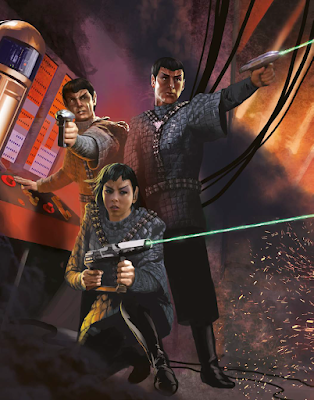
The dedication plaque I made by tweaking a template provided by someone in one of the STA facebook groups; I can't figure out who! The other images are from the game books themselves (episode 1 art from the Starter Set, episode 2 from the Core Rulebook, and episode 3-5 from the Quickstart).

09 March 2022

The Terminal Experiment by Robert J. Sawyer

The Terminal Experiment by Robert J. Sawyer

This was wretched. I read it because it's about mind-uploading, and I am co-teaching a class on that... but I will not be teaching this book. Let me take the time to explain.

Originally published: 1994-95
Acquired: July 2021
Read: August 2021

The book has two concurrent ideas in play. One is that the main character, a designer of medical devices, is preoccupied with the idea that there's no definitive way of knowing when someone transitions between being alive and being dead. He invents an extremely discriminating device to map the brain, and using it on someone at the moment they die, detects what he dubs "the soulwave" leaving their body. This rocks the world: suddenly we know when people are alive and dead, we know what kind of life counts as alive and dead, and so on.  But once the device is invented and made public, this idea basically vanishes from the plot of the novel, and just becomes a background element; between chapters, we read news updates of how this is affecting society. But it never affects the story, it never even really affects our main character, who could have just easily been an inventor of a new type of soda pop, and the plot would have proceeded in exactly the same way. This seems to me to be one of the worst sorts of science fiction; it's a complete lack of imagination. Isaac Asimov says in Asimov on Science Fiction that in sociology-dominant sf, the author should come up with a society affected by a "what if—" and then "[t]he actual plot of the story, the suspense, the conflict, ought to arise—if this were a first-class story—out of the particular needs and frustrations of people in such a society" (p. 172). None of that is true here; Sawyer squanders his central idea. Interesting extrapolation in the background, but none in the foreground.

The other idea is that the main character sells his mind-scanning technology to an AI research firm. He asks if they can upload his consciousness into a computer... and they just do! Apparently all you have to do is scan the brain in order to have a working simulation of the brain. This seems like a huge leap to me. Like, being able to map where neurons are does not equate to being able to simulate how someone thinks! On top of this, the book acts like this is no big deal, and that no one will be interested in it! Even though the soulwave thing doesn't affect the plot at all, it does change the world. But the characters totally brush off the idea that anyone would even want to upload a brain. This surely has theological and philosophical repercussions even bigger than those of the soulwave. Where there was once one person, there are now four (they make three copies of the main character's brain). They call a press conference to announce the soulwave... but treat this advancement as if its old news. Again, it's a complete failure of imagination when it comes to worldbuilding. At one point they even go, "Oh, who would be interested in such technology anyway?" Like, everyone would!

The brain uploading stuff also reads as hugely improbable. Even though the technology was just invented, the AI researcher can just hit a couple buttons to rewrite the main character's personality. Of the three uploaded scans, one is edited to simulate how he would be if he was immortal, the other is edited to simulate how he would be without a physical self. And then all three selves can move themselves around because the original knows how directories work... I don't think that follows. Also, why don't they copy themselves if they are files? Somehow there's only one copy of each of the three versions. That a brain uploaded to a computer instantly becomes a super-hacker seems like something from a cheesy 1970s sci-fi film, not a supposedly serious 1990s near-future sf novel, but it's how the entire plot resolves; they stop the copy that goes evil by uploading the copy of a police officer's brain into the Internet to get him!

On top of all this, the prose reads like it was written by a tedious pedant. Utterly lifeless. This won the Nebula!?

(Not Sawyer's fault, but the way the book is dated by being written in the 1990s but set in 2011 is often hilarious. There's a bit that essentially goes, "He's taken over the entire Internet... AOL and CompuServe!" Well... maybe it is Sawyer's fault; his version of the future seems exactly like his present except that they have e-readers.)

07 March 2022

The Hidden Girl and Other Stories by Ken Liu

The Hidden Girl and Other Stories by Ken Liu

I continue to work my way through stories about life extension and mind uploading for the class I will eventually teach on the topic. That journey brought me to this collection by Ken Liu (his second; I own his first but have never gotten around to reading it), which contains a sequence of stories about the Singularity. Three of them form a tight sequence about a single character; the others don't share characters, but do seem to be set in the same future history. In this world, imaging the brain destroys it, so you can only be uploaded if you die physically, and quantum considerations mean the programs cannot be duplicated. Though there is a period of initial chaos, by the far future, humanity all exists "in the cloud," essentially, with new, purely digital people being born. The relevant stories are:

Collection published: 2020
Contents originally published: 2011-20
Read: July 2021

  • "The Gods Will Not Be Chained" (2014) – a girl named Maddie discovers her father has been uploaded
  • "Staying Behind" (2011) – a father clings onto physical life when the majority of humanity has been uploaded
  • "The Gods Will Not Be Slain" (2014) – Maddie tries to stay alive with the help of her father as the world goes to hell
  • "Altogether Elsewhere, Vast Herds of Reindeer" (2011) – a purely digital human tries to come to terms with her mother's decision to die (her mother is an uploaded human, one of only a few left)
  • "The Gods Have Not Died in Vain" (2015) – Maddie discovers she has a cloud-born sister
  • "Seven Birthdays" (2016) – a mother and daughter's relationship across an increasingly long life-span; between the daughter's 49th and 343rd birthdays, the upload takes place

These stories are okay. I think they raise some interesting ideas, but I often felt that Liu didn't have much interesting to say about them, and even though Liu is a software engineer, I felt they overrelied on hoary clichés of mind-uploading stories: anyone in the Maddie stories who is uploaded instantly becomes a super-AI capable of hacking and battling on the digital plane, for example. There's a constant reiteration in some stories that the digital world is less "real" feeling than ours, which seems to me a pretty uninteresting idea for sf to explore. What if a technology some people think is good is actually bad!? I wanted to see more of interest done with it.

That said, I think several of them are worth teaching; definitely the first Maddie story and "Staying Behind"; possibly the second and third Maddie stories. These are ones that raise interesting philosophical and ethical questions that would be worth pursuing in a college course, even if Liu's own answers aren't always the most interesting or plausible.

I did take the time to read all the stories collected here, since Liu is someone I've been meaning to read more of. I found it hit or miss. I found Liu at his best when exploring ideas of race or cultural identity: "Ghost Days," contrasting the way that 2310s space colonists, 1980s Connecticut Chinese immigrants, and 1900s Hong Kong residents dealing with the British all play down or play up their cultural identities was pretty neat. "Maxwell's Demon," the story of a "no-no girl" who ends up spying for the Americans in Japan and developing a weapon out of ghosts was sad but good.

I also enjoyed some of his near future stuff when it wasn't about uploading. "Thoughts and Prayers" is a neat story about the weaponization of algorithms. I had previously read "Byzantime Empathy," about an attempt to put empathy on the blockchain, and I liked it a lot this time around, too. On the other hand, "Real Artists," about making the perfect movie by monitoring how the brain responds to it, reminded me too much of one of those Golden Age stories that was more an idea than an actual story.

Outside of his short fiction, Liu primarily writes fantasy novels; interestingly, I found almost all of the fantasy stories here deadly dull. I just could not buy into them for whatever reason. Mostly they are clustered at the end of the book, which didn't help.

By the end of this book, I was very down on it. I think the issue is that Liu is a very one-track writer, at least as represented by this book. There is no sf idea that cannot be hitched to a heartfelt tale of a father and daughter, or less commonly, a mother and daughter. This is the approach of "Thoughts and Prayers," the three "Gods" stories, "Staying Behind," "Altogether Elsewhere, Vast Herds of Reindeer," "Memories of My Mother," "The Hidden Girl," "Seven Birthdays," and "The Message," over half of the collection's nineteen pieces. Done a little, this can give weight to a story. Repeated so much, the theme quickly becomes saccharine; I really hated it by the time I got to "The Message." Also, daughters every time? (Only "Ghost Days" uses a son.) It quickly felt like less a theme Liu wanted to explore and more a crutch he was using to give emotional weight to banal ideas.

This might be unfair—I think I would have liked many of these a bit more on their own—but this is how Liu put his book together, and that's how I read them. In a strong collection, a writer brings out their themes in such a way that it makes you appreciate their writing more, but I finished this book somewhat less enthused for the eventual moment that I finally read The Paper Menagerie and Other Stories.

04 March 2022

Reading Little Wizard Stories of Oz Aloud to My Son

 Little Wizard Stories of Oz by L. Frank Baum, illustrated by John R. Neill

I was, of course, not just content to read my son the original fourteen Oz novels by Baum. Why not the whole Famous Forty? Heck, why not all the "quasi-canonical" stories too?? Why not all the "Borderlands" novels???

Contents originally published: 1913
Acquired: July 2013
Previously read: December 2016
Read aloud: December 2021

My ambitions began with Little Wizard Stories of Oz, which collects six Oz short stories that came out as individual booklets in 1913 in, if I recall correctly, the run-up to the publication of The Patchwork Girl of Oz, which resumed the series after Baum's attempt at ending it, but had just turned out to be a two-year hiatus. Each pairs off two Oz characters: the Cowardly Lion and the Hungry Tiger, Dorothy and Toto, Tik-Tok and the Nome King, Ozma and the Wizard, Jack Pumpkinhead and the Saw-Horse, the Scarecrow and the Tin Woodman. I actually didn't know about this until I was an adult, and only read it for the first time a few years ago.

With six short stories, it reads aloud very quickly, especially when my son insisted on two chapters back-to-back; we got through it in just a couple days. I don't think it will ever be anyone's favorite Oz book. but I particularly enjoyed reading the Lion/Tiger story: the Hungry Tiger decides that he finally will eat a baby, but then ends up helping the baby find its mother. My son didn't like the idea that the Tiger would eat a baby, though. He also didn't like Tik-Tok getting broken, but I do really enjoy my supercilious voice for Kaliko, the Nome King's steward.

There are some good hijinks in the Jack Pumpkinhead one, too, and the Scarecrow and Tin Woodman one as well. I am not sure my son got a ton out of it, though... but then there's not a ton to get! Nice John R. Neill pictures in this one.

02 March 2022

Bernice Summerfield: Adorable Illusion by Gary Russell

Bernice Summerfield: Adorable Illusion
by Gary Russell

I'm catching up on my Bernice Summerfield audio dramas, and I paused to read this novel. I listened to it between discs four and five of the Missing Persons box set based on what I read on-line; it's always tricky to place things before you experience them! Having read it, I would now advise listening to it during the Road Trip box set, between discs two and three. (See my Bernice Summerfield timeline for full details.)

Published: 2014
Acquired: November 2017
Read: April 2021

Bernice Summerfield may seem like an audio character now, but of course she was born in prose novels-- and, unfortunately, this is the last one. (All subsequent Bernice Summerfield books have been anthologies.) Doubly unfortunately because 1) this is a medium where she can thrive, and 2) this last appearance of Benny in her original medium is wretched. Like a lot of Gary Russell novels, it feels like he had 100 pages of ideas, and so this is padded out with long, unfunny diversions, and ostensibly humorous exposition. Nothing about the characters here will grab you, and much of the plot makes little sense. (Benny is given the identity of a murderer, on a ship with the parents of the murder victims, and apparently none of these people know what the murderer looks like!) Some subplots work to set up the climax of the New Frontiers box set... an episode that was actually quite bad. The character of Avril Fenman appears here, but shortly before reading this I listened to the audiobook of Fenman's original appearances in The Squire's Crystal and The Glass Prison and this isn't her, it's just a different character with the same name.

Its sole saving grace is that we do get our first (and, I think, only) check in on the Collection cast, the characters who made up the series's ensemble for ten years, but haven't appeared since Escaping the Future, released four years prior. I liked getting to see what happened to Adrian, Bev, and Joseph, though what we see here does make it pretty improbable that Benny never ran into them again.

01 March 2022

Reading Roundup Wrapup: February 2022

Pick of the month: The Justice Society Returns! by David Goyer, James Robinson, et al. I didn't finish many books this month, but still, this was fun. Good solid superhero comics, the kind of thing I read the genre for. Neat uses of history, good character moments, not bound down by continuity.

All books read:

  1. Doctor Who: Time Lord Victorious: Defender of the Daleks by Jody Houser, Roberta Ingranata, et al.
  2. Star Warriors of the Modern Raj: Materiality, Mythology and Technology of Indian Science Fiction by Sami Ahmad Khan
  3. The Justice Society Returns! by David Goyer, James Robinson, et al.

Ouch. I am still reading Little Dorrit. I have under 200 pages to go, but I have been moving so slowly. This is ridiculous!

All books acquired:

  1. Star Trek: Titan: Sight Unseen by James Swallow
  2. The Justice Society Returns! by David Goyer, James Robinson, et al.
  3. Chase by J. H. Williams III, Dan Curtis Johnson, et al.
  4. Legion of Super-Heroes: Before the Darkness, Volume Two by Gerry Conway, Roy Thomas, Paul Levitz, Steve Ditko, Frank Chiaramonte, Bruce Patterson, Carmine Infantino, et al.
  5. Pandora's Star by Peter F. Hamilton
  6. Judas Unchained by Peter F. Hamilton
  7. American Science Fiction: Four Classic Novels 1960-1966: The High Crusade / Way Station / Flowers for Algernon / ...And Call Me Conrad [This Immortal] edited by Gary K. Wolfe
  8. American Science Fiction: Four Classic Novels 1968-1969: Past Master / Picnic on Paradise / Nova / Emphyrio edited by Gary K. Wolfe

And then I got so many! The two Peter F. Hamilton books I found on a bench in the building I work in, with post-in notes in them reading, "Free Sci-Fi Books! 4/5 stars".

Books remaining on "To be read" list: 685 (up 5)

28 February 2022

Legion: Secret Origin by Paul Levitz, Chris Batista, and Marc Deering

Legion: Secret Origin

Collection published: 2012
Contents originally published: 2011-12
Acquired: May 2019
Read: October 2021

Writer: Paul Levitz
Penciller: Chris Batista
Inker: Marc Deering
Colorist: Wes Hartman
Letterer: Dezi Sienty

I haven't read much of the so-called "deboot" era of Legion of Super-Heroes, when the continuity was reset to be as it was in the 1980s because nothing screams "teenagers of the future" like "making it like it was thirty years ago." Whenever I do read something from this era, I am kinda baffled. Never bad... but always pointless.

This, I think, is supposed to recap the Legion's origin for new readers but also fill in some background for old readers. Unfortunately, none of it is interesting. The origin we've seen a million times by now, and Levitz tries to make it interesting by putting it in the background while putting the machinations of the United Planets' secret police and the Time Trapper in the foreground. It doesn't work. The origin is such a background element that one doesn't really get a sense of why anyone would care about the Legion; it has nice roles for Phantom Girl and (less so) Brainiac Five, but the rest of the characters feel like they are barely there.

What is put into the foreground is even less interesting; I never cared about any of the new(?) characters, and there's less a plot and more bits of a plot arbitrarily strung together with some foreshadowing. It's deadly dull stuff, and the story never takes off.

The idea of this kind of way of doing a Legion origin is okay—the Bierbaums, Giffen, and Al Gordon did a great one during the "Five Years Later" era by focusing on Marla Latham—but the execution makes it clear that these were "secrets" no one needed to know about.

The best part of the book is the damning-with-faint-praise back cover blurb someone at DC picked for the back cover:

It explicitly says it doesn't give good background to the characters, but they slapped it on the cover anyway! Note that in the actual review, the first sentence is "I'm not 100% convinced 'Legion: Secret Origin' would be the perfect introduction to the 'Legion of Super-Heroes' in general." so it's a pretty unethical use of ellipses as well. But given the quality of the book, this is probably the best blurb they could find. It's not even so bad it's good, it's the kind of thing you'll forget about a few days after reading it.

I read a Legion of Super-Heroes collection every six months. Next up in sequence: Superboy and the Legion of Super-Heroes: The Early Years

23 February 2022

The Adventures of Alan Scott--Green Lantern by Roger Stern, Ron Marz, Dusty Abell, Jim Balent, Andrew Pepoy, et al.

While reading Justice Society of America vol. 2, I learned from the lettercol that at the same time, Alan Scott had his own feature in the short-lived Green Lantern Corps Quarterly series. I don't necessarily track down every solo appearance of every JSA member, but these seemed to have some focus on Alan's family life, which meant appearances by Jade and Obsidian of Infinity, Inc., plus Alan's marriage to the original Harlquin, also an Infinc concept. So I went ahead and tracked it down. (I skipped the final issue, #8; it featured Lobo, so it goes for $20 at least these days. No thanks.)

GLC Quarterly was an ongoing anthology comic about various members of the Green Lantern Corps; each issue had 54 story pages. Typically, there was a short frame story, an eighteen-page lead story about a new Green Lantern character, a twelve-page Alan Scott story, a twelve-page G'nort story, and a short story either about a preexisting character ("Whatever Happened to...?") or a previously unknown Earth Green Lantern ("The History of Sector 2814"). Issue #7 switches things up somewhat, and features two Alan Scott tales. (In issue #8, the Alan Scott story is actually a flashback tale, so I feel justified in excluding it.)

from Green Lantern Corps Quarterly #3
(script by Roger Stern, art by Dusty Abell & Mark McKenna)
The first four stories are written by Roger Stern, and mostly feature art by Dusty Abell and Steve Mitchell. Roger Stern is one of those comics writers who I wouldn't call "great" but you can depend upon to turn in a satisfactory story, in my experience, and that's exactly what he does here. Across his four tales, we get an origin recap, a family reunion, a visit to the grave of Dinah Drake Lance (the original Black Canary), a battle with Solomon Grundy, and a visit to Doiby Dickle's adoptive home planet.

This is solid stuff. I always like seeing a superhero's family, and though twelve pages don't leave a ton of room for it, we get a good sense of the affection Alan has for his found family. The best story was, to my surprise, the Doiby Dickles one, which treats this goofy character with enough affection that I found myself charmed: Alan and Molly visit his new planet, and discover that he's remade it into a tribute to the place and time he's left behind. Dusty Abell is an artist I don't have much experience with—I do remember a solid turn on the "Five Years Later" Legion of Super-Heroes—but he proves himself well-suited to the classic heroism of a Golden Age character. All in all, enjoyable stuff. I was pleased also to see the whole JSA paying tribute to Dinah, who died while they were in limbo; it's a nice touch that keeps these characters feeling real.

from Green Lantern Corps Quarterly #7 (script by Ron Marz,
art by Mark Tenney & Wade Von Grawbadger)
With issue #4, though, Jim Balent and Andrew Pepoy take over the art, and with issue #5, Ron Marz takes over the writing. The result is an immediate, jarring change in style and tone: overwrought, angsty, verging on the 1990s "xtreme" aesthetic stuff. There's a new Harlequin taunting Alan; later, Alan is de-aged, and in issue #7, we learn this is because of the power of the Starheart, the ejected magic core of the Power Batter on Oa that gave Alan his powers. Alan becomes the new "Sentinel," abandoning his Green Lantern identity. It was all rather rushed and under-explained, even though issue #7 gives us two Alan Scott stories, and makes his story the frame narrative.

This is all because, I think, of the impending Emerald Twilight storyline, the end goal of which was to make Kyle Rayner the only Green Lantern in the universe; if Alan was to go on, he needed a new superhero identity. I am not a fan, but I guess I'm glad he wasn't killed off. However, this material doesn't feel rooted in the life and history of Alan Scott like Stern's; it's much more generic action-adventure with a dose of darkness that feels gratuitous.

I thought the Harlequin here was the same new one who bedevilled Infinity, Inc. back in the day, Marcie Cooper, but the DC wiki tells me that she's a new character who only appeared in two more issues a few years later (Underworld Unleashed #1 and Green Lantern vol. 3 #71), and who we never really learn anything about. It seems to me it would make more sense for her to be Marcie, based on what she knows about Alan's personal life.

This could make a nice little trade if anyone was ever so motivated, but I doubt anyone ever will be. Still, the first four issues are worth picking up if you are into the JSA legacy elements, and I assume the last three will be important for understanding future Alan Scott stories if nothing else.

(It's not my focus here, but I did read all the stories in this title. Some were quite good! There's a charming Mark Waid/Ty Templeton collaboration in issue #2, I really liked the story of the woman who turned down the Guardians in issue #4, Elliot S! Maggin has a neat one-off about an alien GL in issue #5, and so help me, I even liked the G'nort feature at times.)

The Adventures of Alan Scott--Green Lantern were originally published in issues #1-7 of Green Lantern Corps Quarterly (Summer 1992–Winter 1993). The stories were written by Roger Stern (#1-4) and Ron Marz (#5-7); pencilled by Dusty Abell (#1-3), Jim Balent (#4-6), Darryl Banks (#7), and Mark Tenney (#7); inked by Steve Mitchell (#1-2), Mark McKenna (#3), Andrew Pepoy (#4-6), Terry Austin (#7), and Wade Von Grawbadger (#7); lettered by Bob Lappan (#1-3), Bob Pinaha (#4-5, 7), and Albert DeGuzman (#6); colored by Anthony Tollin (#1), Matt Webb (#2-5, 7), and Stuart Chaifetz (#6); and edited by Kevin Dooley (#1-7) and Eddie Berganza (#6-7).
 
This post is twenty-third in a series about the Justice Society and Earth-Two. The next installment covers Damage. Previous installments are listed below:
  1. All Star Comics: Only Legends Live Forever (1976-79)
  2. The Huntress: Origins (1977-82)
  3. All-Star Squadron (1981-87)
  4. Infinity, Inc.: The Generations Saga, Volume One (1983-84)
  5. Infinity, Inc.: The Generations Saga, Volume Two (1984-85)
  6. Showcase Presents... Power Girl (1978)
  7. America vs. the Justice Society (1985)
  8. Jonni Thunder, a.k.a. Thunderbolt (1985)
  9. Crisis on Multiple Earths, Volume 7 (1983-85)
  10. Infinity, Inc. #11-53 (1985-88) [reading order]
  11. Last Days of the Justice Society of America (1986-88)
  12. All-Star Comics 80-Page Giant (1999)
  13. Steel, the Indestructible Man (1978)
  14. Superman vs. Wonder Woman: An Untold Epic of World War Two (1977)
  15. Secret Origins of the Golden Age (1986-89)
  16. The Young All-Stars (1987-89)
  17. Gladiator (1930) ["Man-God!" (1976)]
  18. The Crimson Avenger: The Dark Cross Conspiracy (1981-88)
  19. The Immortal Doctor Fate (1940-82)
  20. Justice Society of America: The Demise of Justice (1951-91)
  21. Armageddon: Inferno (1992)
  22. Justice Society of America vol. 2 (1992-93)