18 March 2019

Review: The Vision by Tom King, Gabriel Hernandez Walta, et al.

Comic hardcover, n.pag.
Published 2018 (contents: 2016-17)

Acquired January 2018
Read March 2018
The Vision

Writer: Tom King
Artists: Gabriel Hernandez Walta & Michael Walsh
Color Artist: Jordie Bellaire 
Letterer: Clayton Cowles

I read the first half of Tom King and Gabriel Hernandez Walta's run on The Vision when it was a finalist for the Hugo Award for Best Graphic Story, and I loved it (it got my first place vote in that category... even though it came in sixth), so I knew that once a hard copy collection of the whole run was out, I would pick it up.

The Vision is a well-done comic, a meditation on both family and man's inhumanity to man told in the form of superpowered robots moving to the suburbs. Its power rests in its stark simplicity-- much like the power of its central character. Both narration and art are very matter-of-fact about violence; horrific things being related in unemotional terms. It's a solid piece of comics, really well put together, showing the power of the genre of superhero comics when you pluck at the strangeness of its edges.

15 March 2019

The Making of a Black Man: Green Lantern: Mosaic

Mosaic, the four-part Green Lantern storyline by Gerard Jones, M. D. Bright, and Romeo Tanghal (vol. 3 #14-17), was followed by Green Lantern: Mosaic, an ongoing series about Green Lantern John Stewart trying to integrate the various cities plucked out of space and deposited on Oa to form "the mosaic world." Gerard Jones continued on as writer; the series's main penciller was Cully Hamner, who I know from his work over a decade later on the new Jaime Reyes Blue Beetle book. The series lasted eighteen issues, cancelled as part of a general deck-clearing in preparation for the massive reshuffling of Green Lantern that happened with Emerald Twilight.

In an early lettercol (in issue #5), Gerard Jones says he was unhappy with how the original Mosaic story went (he agrees with a writer who calls it "deadly dull") and wanted to do something different with the premise when it became an ongoing. I don't think you'd need to read the lettercol to know that, because the transition between Green Lantern #17 and Mosaic #1 is obvious and sharp. I think it's best summed up by the aliens. The aliens inhabiting the mosaic in the original miniseries are Star Trek aliens. In the ongoing, they're Farscape aliens. Everything gets weird and dark and twisted and far less human.

Which really sums up the whole approach, because it's not just the mosaic that's changed: John Stewart is weird and dark and twisted and far less human now, too. John Stewart is a man pushed beyond endurance, trying to reconcile the dozens of conflicting peoples of the mosaic, but as the story goes to great pains to point out, that's life as a man of color. His very identity is a mosaic, one that is assembled in a rickety way but must withstand the pressure of American racism. In one sense, John is going crazy because of this sci-fi scenario he's been plunged into, but in another, the story surfaces the problems John Stewart has had all along.

It reminds me of a Vertigo series in style, but it could never be a Vertigo series because of its more "mainstream" content. In fact, I wonder if it lucked out in being born in 1992, that era where DC was publishing the comics that would become Vertigo comics when the imprint was formed in 1993. You wouldn't put this alongside The Sandman, Hellblazer, and Animal Man, it has too many ties to other superhero comics, but it's pretty much like no contemporary DC comic I've read, either. Post-Vertigo, it would have no clear place in DC's line-up, but before March 1993 divides the DC world in Vertigo and not-Vertigo, it's just one of a number of boundary-pushing comics DC published in the early 1990s. Surely, as I often say, one of the publisher's most fertile periods.

One Vertigoesque attribute is it doesn't really feel like a setup for an ongoing set of stories, more like one big story in many chapters. Jones's run was curtailed, and that shows, but I'm doubtful it's the kind of series that could run one hundred or even fifty-plus issues and still remain fresh.

That said, what's here is excellent. The opening issue is fantastic, a strange tour of the mosaic that lets you into John Stewart's mind at the same time: "This is my world... '...and welcome to it.' James Thurber." The second issue is bizarre and dark, the notorious death of Ch'p, the squirrel Green Lantern, but what made it more noteworthy to me is the way Jones and Hamner make Ch'p into something alien himself, not just a comedy alien Green Lantern.

Issue #4 is one of the series's occasional forays into life in the mosaic: the inhabitants of the American town have largely given up hope, and express their despair by watching reruns of classic television ad nauseam, not to mention days-long binge-drinking sex orgies. The issue is told from the perspective of their children who see the mosaic as an opportunity; the don't want to wallow in tv nostalgia, but to push forward into the new, no matter how dangerous. The series didn't often do this kind of thing, but it was usually worthwhile when done. Who would have thought that Green Lantern: Mosaic, of all series, could support a special Christmas issue!? Yet #9 was super-weird and super-fascinating.

The best issue is probably #5, "The Child-Man and the Great White Hero." Hal Jordan comes to confront John over how he's been handling the mosaic, and we get a great, dark insight into John and the way he thinks about Hal Jordan, about how he envies Hal's casual heroism, his whiteness. As John says to Hal, "You fight to prove your rightness, you score your total victories, and you stride out as you entered. I never score a total victory!" The book even gives Hal some casual (or perhaps more than casual) racism: he doesn't like that his old romantic interest Rose is now with John... but he can't quite vocalize why.

There is the occasional misstep; seeing John step outside the mosaic in #6 and into a more clichéd Green Lantern narrative wasn't particularly interesting. The one with the music aliens (#7) wasn't as good as it ought to have been.

The last few issues push John in an interesting direction, as we (spoiler) find out that it wasn't the mad old Guardian who brought all these cities to Oa, but John itself. Yet this idea feels squandered as one of many introduced as the series wraps up; it would have been nice for the series to have the room to actually explore it. The implications of this don't really get the time they deserve. In the final issue, John becomes a Guardian of the Universe himself, or maybe something else: "What's man in me. What's American in me. And what's black in me... I'll nurture every day... as I become a new kind of being."

Yet this would never be explored; John Stewart next appeared in Darkstars, no longer a Guardian or even a Green Lantern, recruited as the head of NEMO (the organization that supports the Darkstars), with no sign of the baggage or characterization introduced here.  

Mosaic is, like so many comic book premises, a great idea cut short by the constraints of the medium. Or, perhaps we might say, cobbled together from disparate parts in crazy ad hockery to make something worth viewing from a distance, even if each individual piece might not shine on its own. That is to say, of course, a mosaic.

12 March 2019

Star Trek: The Destiny Era: Typhon Pact: Rough Beasts of Empre

Mass market paperback, 387 pages
Published 2011

Acquired September 2012
Read November 2017
Star Trek: Typhon Pact: Rough Beasts of Empire
by David R. George III

2381-82
This is essentially two entirely separate novels crowbarred together, so I'm going to review each in turn, and then discuss they way they are brought together.

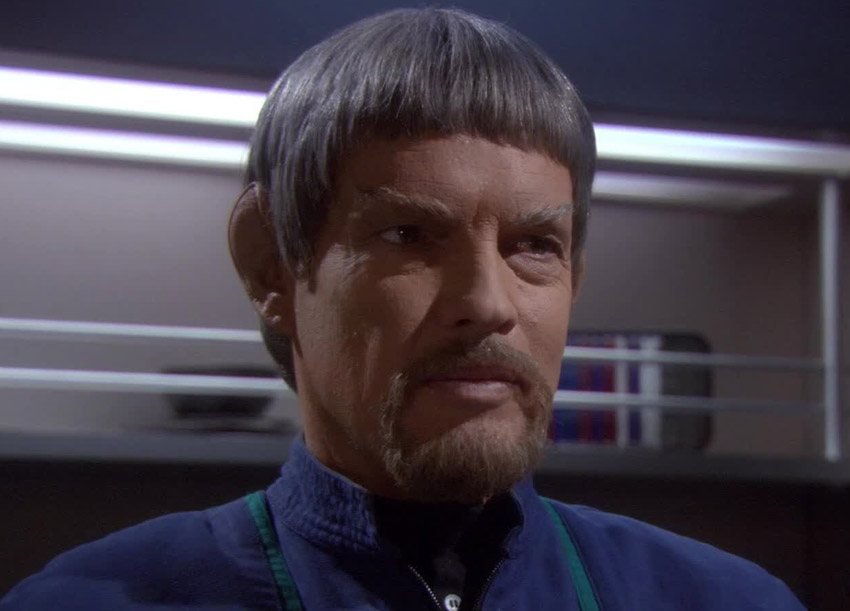
The first is what's promised by the series title: Rough Beasts of Empire is (chronologically) the first of eight books about the Typhon Pact, the Warsaw Pactesque Federation adversary introduced in A Singular Destiny. Basically, it's a set of alien species often opposed to the Federation banding together. With six members and eight books, there's more or less one alien race explored per book. Rough Beasts of Empire covers the Romulans, who in some previous book (Articles of the Federation, I think? it's been a while) split into two different polities, each led by a female character from Nemesis: Praetor Tal'Aura's Romulan Star Empire (which has joined the Typhon Pact) and Empress Donatra's breakaway Imperial Romulan State (which is friendly to the Federation).

The main focus of the novel is that Romulus is an empire divided, which basically no one wants: Tal'Aura and Donatra both desire to rule over a united Romulus. Many of the Star Empire's allies, particularly the Tzenkethi, would prefer to be dealing with a united nation as well. And then there's Ambassador Spock, still doing his Vulcan-Romulan reunification thing underground (literally and figuratively), who realizes that a united Romulan people makes reuniting with the Vulcans easier. So in classic Romulan tradition, we have plots and counterplots, as Tal'Aura, the Tal Shiar, Spock, Donatra, the Tzenkethi, and various Romulan families each pursue their own interests clandestinely.

It's entertaining enough. I didn't love it, but it's well done. It's hard to care about any of the Romulan characters, so really it's just Spock carrying you through the whole book. David R. George III has a pretty good grasp on Spock for the most part, as a principled man. Spock is attacked by a Reman assassin early in the book, and has the plan to turn him into the authorities, even though Spock is wanted by those same authorities, and that seemed very in character to me. There was a spot where he was overly naïve (I didn't buy that he would not foresee how his movement being legitimated could lead to long-term harm), but on the whole I enjoyed his story.

I do wish Donatra had appeared in the narrative earlier: she doesn't really become significant until near the end, and she shines then, as a principled woman trying to save her people from autocrats. On the other hand, she's distressingly passive for a head of state, especially one who's declared herself an empress! I would have liked to have seen her fighting more actively.

The Romulan plot kind of fizzles out, though. You figure out what's going on, the characters do too, and then it all plays out inevitably. There's no suspense as events draw to a close: some characters get what they want, and Spock watches it all happen. I did like how complicated it was, though. Almost no one here is an obvious black hat, and arguably the Romulan people are better off once the book is over even though the "villains" technically won!

There's a whole second book in here, though, that follows Benjamin Sisko. Now, Sisko ascended into the Bajoran wormhole at the end of Deep Space Nine to live with the Prophets, but he came back in the tenth-anniversary special Unity. Personally, I feel that after Unity, Sisko should have been quietly shunted off-stage somewhere to never play a major role in a Star Trek story again. How can you keep writing him into action-adventure stories in a way that doesn't undermine the celestial experience he would have had?

According to this novel, though, Sisko reactivated his Starfleet commission during the Borg invasion in Destiny to command the USS New York. I can kind of buy this, but everything that follows just seems wrong. Sisko is convinced that his is a life of sorrow (following on from the Prophets' warning to him in "Penumbra"): since he's returned from the wormhole, his daughter has been kidnapped, his neighbors have died, Elias Vaughn has been rendered brain-dead, and then a few chapters into this novel, his father Joseph passes away. I can just about buy that Sisko would be hurting from all this, though it's somewhat unconvincing for the novel to depend on past events only briefly described for its emotional heft. (Like, why the heck should I care about his dead neighbors?)

But what I really don't buy is what Sisko does in reaction to all this. He shuts down, leaving his siblings to manage his father's funeral while he aimless wanders the streets of New Orleans, ignoring Jake. Then he permanently reactives his commission (accepting command of the USS Robinson)... without telling Kasidy! I can only assume that when Sisko returned from the wormhole, it was another man who looked exactly like him, because this bears no relationship to the man whose adventures I saw on screen for seven years. Sisko was a builder and a doer, never a runner. Even when he suffered the greatest tragedy of his life, he did his job: through all of "Emissary" he does his best to set up Deep Space 9 to run successfully even though he has no intention of staying in command of it.

It also flies in the face of everything we've seen about Sisko as a family man. He would never ignore Jake like this; he would certainly never ignore Kasidy and his daughter like this. This is a man who lost it all and managed to put it back together. He is not so emotionally immature as to do what he does here, and the recent tragedies in his life don't make it plausible. The death of Jennifer is the defining tragedy of Sisko's life, and not even the death of his father comes close. This is the man who once said, "Running may help for a little while, but sooner or later the pain catches up with you, and the only way to get rid of it is to stand your ground and face it."

It also is just so pedestrian. Sisko should be enlightened and shit, not doubting that his experiences with the Prophets ever happened. I get that George probably wanted the prophecy from "Penumbra" to have some weight, but this was not the way to do it. I found this entire plotline frustrating to read about in the extreme.

Unrelated to all this, there's this sort of weird non-subplot about the Tzenkethi in the Sisko half of the novel. The Robinson ends us patrolling a sector of space where they sight some Tzenkethi vessels. This leads to a series of flashbacks to when Sisko fought against the Tzenkethi under the command of Leyton on the Okinawa (as mentioned in "The Adversary"). Why? Who knows because Sisko doesn't even interact with the Tzenkethi in the present day of the story; he just monitors sensor contacts from the bridge of the Robinson. It's really strange and pointless and has nothing to do with anything. It feels to me like when the initial set of Typhon Pact novels was reduced from six to four,* George was asked to jam them into his book because they weren't going to get a focus novel otherwise.

I read most of Rough Beasts on a flight; my wife sat next to me noted that the cover indicated a team-up between Sisko and Spock. "So far," I said, "their storylines have had nothing to do with each other." I think I was two-thirds of the way through at that point; the rest of the novel didn't remedy it. As close as the two plotlines come is when Spock gets a secret message to the Federation president asking for information to be passed onto Donatra, Sisko and the Robinson are assigned to do it. Why? I don't know. The president's staff tells her that Spock is the diplomatic service's expert on Romulans so that without him available, they should ask Starfleet. The head of Starfleet ends up recommending Sisko, because 1) according to a deleted scene he worked at the Federation embassy on Romulus, and 2) he met Senator Vreenak. Really!? There's no one in the whole Federation Diplomatic Corps who knows more about Romulans than that? Seems unlikely.

It's a contrived attempt to jam together what really are two completely separate stories. Take out the trip to see Donatra and the flashbacks to the Tzenkethi conflicts, and Sisko's story has nothing at all to do with the Typhon Pact in general, or the Spock/Romulus tale in particular. I also didn't really see any thematic resonance, though George tries to bring up a commonality of home at the very end. Based on the acknowledgements, it seems like George realized that with former Deep Space Nine editor Marco Palmieri gone from Simon & Schuster, the DS9 story wasn't going to advance unless he slipped it into unrelated novels.

Unfortunately, it doesn't serve it to advance it in such a weird way.

Continuity Notes:
  • There are a few small references to Diane Duane's Rihannsu novels: "High Rihan" is said to be the name of the Romulan language, some Romulan characters reference the Elements that Duane's Romulans swore by. It's subtle enough that it works: I didn't really like how Martin and Mangels' Enterprise novels gave all their Romulan characters Rihannsu-style names nothing like the screen Romulan names.
  • Amanda is said to have passed onto her son Spock a love of physical books. When the book came out, on-screen canon said she liked Alice's Adventures in Wonderland but said nothing about a love of physical books (often shown to be odd in the 23rd century)... but by the time I read it, Discovery revealed that Amanda gave Michael Burnham a physical copy of Alice's Adventures in Wonderland.
  • There's a joke about how Romulans have a lot of ancient sayings about serpents. A previous George novel, Serpents Among the Ruins, takes its title from a Romulan saying.
Other Notes:
  • Kira has become a vedek!? I know future novels will fill in more of the backstory in the four-year gap between this novel and the previous chronological DS9 novel, The Soul Key, but I find it hard to believe that George could ever make me believe in such a transformation, which is as bad a misunderstanding of Kira's character as this book is of Sisko's.
  • It also seems pretty shitty to (essentially) kill off Vaughn.
  • So who's in command of the station, then? If we're told, I missed it. But Kira's gone, and Vaughn's gone, and Ezri's gone. Even Bowers is gone. I guess that leaves Nog or Shar?
  • Sisko emotionally isolates himself from the crew of the Robinson and gets called out on it; George repeated this subplot almost precisely with Sulu's transfer in Allegiance in Exile.
  • The book's title is taken from the notes accompanying a Romulan painting. Based on the full poem (the novel's epigraph), the painter was really into William Blake.
* I'll talk more about the overall shape of the Typhon Pact series in a future review.

11 March 2019

Review: David Copperfield by Charles Dickens

Trade paperback, 974 pages
Published 2004 (originally 1849-50)
Acquired August 2018
Read October 2018
David Copperfield by Charles Dickens

My annual project to read more Charles Dickens continues with David Copperfield, Dickens's fourth most popular novel (according to LibraryThing, anyway). I know many people consider it one of Dickens's best-- my Penguin Classics edition's introduction by Jeremy Tambling makes the case that it unites the "early" Dickens with the "late" Dickens-- but for me, I think it's solidly middle-tier. It's no Great Expectations or Our Mutual Friend, but neither is it as dull as Hard Times or A Tale of Two Cities.

The first quarter or so of the novel, however, surely ranks among Dickens's best writing. Young David has a horrible life, and Dickens executes it with his trademark combination of melancholy, comedy, and well-observed character. The story of David's actual birth is hilarious (I subjected a lot of people to it after reading it), but the story of David's life with his stepfather and step-aunt is depressing and hard to take, especially what ends up happening to his mother. The stuff about David at school is funny; David's attempt to leave London and find his aunt is depressing and funny all at once. His relationship with Peggotty is touching.

The effect is all aided by some nice narrative choices by Dickens. We (and I kind of blame the modernists for this) like to stereotype Victorian fiction as being very staid. But there are some bits of David Copperfield we might call "experimental," except I think Dickens was less concerned with experimenting and more concerned with just telling the story the best way possible. Though most of the story is told in the first-person past tense, every now and again the narrator (an older David; the full title is The Personal History and Experience of David Copperfield the Younger) shifts into the present tense as he re-enacts a particularly vivid memory. It's a neat technique and usually very effective, isolating key moments and heightening their emotional repercussions-- because you can tell how important they still are to the narrator all those years later, so much so they he thinks of them as still happening.

After David reunites with his aunt, though, I found the energy of the novel dissipated. The last three-quarters just don't have the same drive as the first quarter. Not that it's ever bad: nothing here ever sinks as low as the tedium of the middle of A Tale of Two Cities or Hard Times, and there are lots of good jokes still (I liked when David tries to get out of his apprenticeship at the law firm). But for big chunks, the stakes are vague, and I have to admit I never really cared about Uriah Heep. But every now and then you still get that flash of Dickensian brilliance, and the ending is excellent, so there you go. I might have liked it more if I'd read it more quickly, but it came along at a very busy time in my life!

08 March 2019

Review: Green Lantern: Mosaic by Gerard Jones, M. D. Bright, and Romeo Tanghal

Green Lantern: Mosaic is one of those cult classic comics runs-- I don't think it was successful in its time, and it's never been collected, but people who have read it speak highly of it, and I was sufficiently intrigued to break my rule of only picking up those space-based DC comics that do not feature Green Lantern. But before Green Lantern: Mosaic, the ongoing series, there was Mosaic, the four-part Green Lantern story. (That's not confusing at all.)

There was obviously even some set-up before this, but it works on its own well-enough; in fact, despite having been originally published in 1991, it reads like something optimized for the trade paperback era. The background is pretty easy to work out: one Guardian of the Universe, the so-called "Old Timer" (the same one who traveled America with Hal Jordan and Oliver Queen) went mad and died, but not before using his power to bring one settlement each from a number of planets to Oa, clustering them together into a sort of a "mosaic" world. While Hal Jordan cruises the universe re-establishing the Green Lantern Corps (I'm not sure why it needs re-establishment to be honest, it seems like the Corps is always being un- and re-founded), John Stewart has been assigned to watch over the settlements on Oa.

Gerard Jones seems to me to be a perennially underrated writer. I know his career is over now, but it seems to me that in the early 1990s he was putting out quality stuff on a regular basis but he never made it big like some of his contemporaries did. In addition to a redefining run on Green Lantern and various spin-offs, he also wrote or co-wrote much of Justice League Europe (issues #14-50), and he was responsible for the only Elongated Man series ever published, Europe '92. The more I read of him, the more I see what a versatile writer he was. Mosaic is not just the story of people having to learn to co-exist on an alien planet (and failing), it's a deep dive into the traumas and history of John Stewart.

The main plot of Mosaic is the conflict between the various way of thinking on the mosaic world, some of which are quite alien; the whole thing kicks off when an alien race with an irrepressible desire to expand at all costs kills a couple innocent humans. Armed conflict between the two species quickly escalates, despite the best efforts of both John Stewart and a woman named Rose Hardin. John can't come up with any solutions other than brute force: giant walls between settlements that his ring needs his force of will to maintain. But things keep getting worse. There's some pointed commentary on race, especially as humans start finding allies among the aliens-- allies in a desire to tear down the walls so that the fighting can resume.

But the real story of the book is the mind of John Stewart. Jones's script brings together a number of incidents from John's past to give us a broken man: his history as an architect, his perennial outsider status, the death of Katma Tui in Action Comics Weekly, the destruction of Xanshi in Cosmic Odyssey. Jones does a great job of uniting these disparate threads into a picture of a desperate man, suffering from tragedy (he even deftly justifies John's poor judgement in Cosmic Odyssey as a consequence of him overcompensating for the powerlessness he felt after Katma Tui died), who his whole life has tried to build structures that turned out to be more like strictures-- and now he has to try his hand at sculptures for the first time if he's going to save the planet and save himself.

I mostly knew Jones for comedy with a tinge of character in JLE and Elongated Man, and for more straightforward cosmic adventures in the other bits of his Green Lantern I'd read. Oh, and for whatever the heck Batman: Fortunate Son was meant to be. But here he shows himself to be capable of complicated psychological tragedy. I look forward to seeing where the mosaic world and John Stewart go when Jones and I return to it in the Green Lantern: Mosaic ongoing series that began eight months after this storyline came to an end.

Perhaps unjustly, I haven't said much about it here, but I enjoyed the artwork of M. D. Bright and Romeo Tanghal here. Bright was one of the, ahem, bright spots of the otherwise dismal run of Green Lantern in Action Comics Weekly, especially his out-there space adventure stuff in the story in Green Lantern Special #2 that tied up the whole storyline. He's just as good here, handling Jones's human drama and far-out space plots with equal skill. The kind of artist I wish I saw more of. As for Romeo Tanghal, the man was basically ubiquitous as an inker at DC from the early 1980s to the late 1990s, and he's never disappointed me. It's just a shame neither man really returns for the Mosaic ongoing, but hopefully its actual artists will be quality ones as well.

Mosaic originally appeared in issues #14-17 of Green Lantern vol. 3 (July-Oct. 1991). The story was written by Gerard Jones, pencilled by M. D. Bright, inked by Romeo Tanghal, colored by Anthony Tollin (#14-16) and Matt Hollingsworth (#17), lettered by Albert DeGuzman, and edited by Andy Helfer.

07 March 2019

The Scientist in Victorian Literature: Dean Winnstay, Naturalist (Alton Locke, 1850)

Trade paperback, 452 pages
Published 1983 (originally 1850)

Acquired January 2019
 R
ead February 2019
Alton Locke, Tailor and Poet: An Autobiography
by Charles Kingsley
'Mak a style for yoursel, laddie; ye're na mair Scots hind than ye are Lincolnshire laird: sae gang yer ain gate and leave them to gang theirs; and just mak a gran', brode, simple, Saxon style for yoursel.' (99)
Was Charles Kingsley a two-hit wonder? The more I read the more I wonder. The Water-Babies was good, and I appreciated Two Years Ago, but none of the other novels I've read by him have done much for me. Or anything really. There's fertile ground in Alton Locke, a first-person narrative of a cockney tailor's ascent to poetry and political revolution, but like Hypatia, so much of it is boring tedium where nothing happens.

He does meet a man of science, though, the Dean of a Cambridge college, who both wants to teach Locke science and to experiment on him scientifically. I like that he says, "the man of science finds every worm and beetle a microcosm in its way" (167)-- never was the project of the scientist in the scientist novel so clearly expressed; the man of science is a microcosm for science, and the novel is a microcosm of the universe. But though it might apply to scientist novels, Alton Locke is not one, and thus have little to recommend itself to me, and honestly, it has little going for it for others, too.

(I do like Kingsley's political stirrings, especially the Chartist Scot quoted above, but there's just so much other stuff that's just not interesting.)

06 March 2019

Review: Star Wars: Dark Times: A Spark Remains by Randy Stradley and Douglas Wheatley

Comic trade paperback, 118 pages
Published 2014 (contents: 2013)
Acquired October 2014

Read February 2019
Star Wars: Dark Times, Volume Seven: A Spark Remains

Script: Randy Stradley
Art: Douglas Wheatley
Colors: Dan Jackson
Lettering: Michael Heisler

This volume draws some of the threads of Dark Times together as the series comes to an end. Finally reunited with the Uhumele, Dass Jennir plots an ambush for the mysterious Darth Vader. There's even a callback to the original story in Clone Wars, Volume 9 from which Dark Times sprang.

It's fine. I liked the resolution to what was going on with the Verpine Jedi, and Wheatley's art is good, even though it's not as good as it was. Darth Vader and the Empire aren't quite the inevitable force they ought to be, but I think my biggest issue is less with something Dark Times did and more with something it didn't.

The earlier volumes, I think, were pointing at something unique, asking what it means to be a Jedi in dark times? The answer A Spark Remains gives us is that it's not all that different. Which is a good message, one supposes, but maybe too pat. I also think Bomo Greenbark and the Uhumele crew ultimately ended up squandered; after volume 3, they didn't contribute very much to the main thrust of the series any more. Greenbark was originally an ordinary guy crushed by war and spat out, and I liked that. But here's, he's just another guy on the ship. I wish his character had ended up being as important to the series as Jennir's, which is what the earlier volumes had implied would be the case.

All in all, I enjoyed Dark Times. It's no Knights of the Old Republic or Legacy, but it is a valuable reminder of the kind of interesting smaller-scale side stories about "ordinary" people in the Star Wars universe that Dark Horse was good at.

05 March 2019

Star Trek: The Destiny Era Prelude: Mirror Universe: Rise Like Lions

Mass market paperback, 400 pages
Published 2011

Acquired February 2017
Read October 2017
Star Trek: Mirror Universe: Rise Like Lions
by David Mack

2377-81
"Mirror, Mirror" is good fun, but I never really warmed to the Mirror Universe episodes of Deep Space Nine. "Crossover" is decent and I will admit to enjoying the inanity of "The Emperor's New Cloak," but outside of that, they tend to range from dull to inexplicable (i.e., "Resurrection"). Deep Space Nine shifted too far from the core premise of the Mirror Universe, I think, which is pretty simple: Our Heroes Are Evil. "Crossover" got this but it overcomplicated things to get there, with an elaborate backstory about the fallen Terran Empire and the Klingon/Cardassian Alliance, blah blah blah. Who cares? I just want to see women with bare midriffs, Vulcans with beards, and liberal use of the agony booth. Diane Duane got this when she wrote Dark Mirror: it's deliciously, delightfully dark. But the set-up of the DS9 MU episodes positions most of Our Heroes as good guys for some reason? And makes the Klingons and Cardassians-- the "bad guys" of our universe-- the bad guys there too! Like, why? And then the whole century of Actual History kind of misses the point. I don't need a convincing explanation, I need Evil Federation.

The Deep Space Nine Mirror Universe thus falls into an uncanny valley: not ridiculous enough to enjoy, but too ridiculous to take seriously. On screen, it kind of muddles through thanks to the fact that the actors are clearly enjoying playing these broad versions of themselves, but lacking a Mirror Universe where Our Heroes Are Evil, what we mostly seem to actually get is Our Heroes Are Dumb Thugs.

All of this is to say that I have been tepid on prose takes on the DS9 MU, and initially planned to not read Rise Like Lions at all even though I liked David Mack's previous Mirror Universe novel, The Sorrows of Empire, okay, but then I found out it tied into the Destiny Era novels somehow, and so here I am. This novel picks up from, well, everything: all the 24th-century stories in the three S&S Mirror Universe anthologies are brought together, along with the masterplan introduced in Sorrows of Empire. So we have mirror O'Brien, mirror Keiko, mirror Dukat, mirror Damar, mirror Worf, mirror Picard, mirror Troi, mirror Klag, mirror Kes, mirror Neelix (because you demanded it!), mirror Calhoun, mirror Jellico, and so many more, surely a cast of thousands if there ever was one.

The problem is that I just don't care about any of them. Minus the liveliness of an actor's performance, most of them are just selfish people doing dumb things. The ones who are supposed to have ruled galactic empires do not convince, coming across as squabbling, short-sighted idiots. The book has so many characters that none of them have any kind of dramatic arc; the book ping-pongs between all these different people, giving each a chapter every now and again, but like the other Star Trek historical epics I've read recently, it often seems like the focus is misplaced. Like, Damar commits genocide against the Vulcans and this is relayed to us in introspective narration about past events! Meanwhile I'm reading about yet another argument between Klingons.

Once you get the lay of the book, it all unfolds pretty predictably: the Klingons and the Cardassians squabble among themselves, and the new Memory Omega-backed Terran Resistance picks up the pieces. (Memory Omega's super-tech removes a lot of suspense.) I found there weren't really any surprises, and there wasn't really any reason to care about these people. How awful people learn to run a democratic society is a potentially interesting question, but all that happens off-stage too.

Somehow, I guess, this will end up factoring into the Prime Universe, but I can't say I'm excited to find out how.

Continuity Notes:
  • The end hints at more Mirror Universe stories to come involving the Dominion, but this was the last volume of what had evolved into a five-book series.
  • There's some stuff that picks up from the end of the last two Deep Space Nine relaunch novels, Fearful Symmetry and The Soul Key. It turns out I really don't remember what happened in them.
Other Notes:
  • I know it's not Mack's fault, but why doesn't mirror Tuvok have a beard? This is just further proof of how much Deep Space Nine misjudged the Mirror Universe. Even the producers of Enterprise got that one right.
  • I'm sure he's shown up in other tie-ins before, but it was a little surprising to me when the mirror Dukat showed up. The show never did him. I wonder why? Marc Alaimo as Dukat as an Actual Good Guy would have been delicious (though I have my doubts that the show would have gone that way).
  • There's a chapter called "Peaceable Kingdom"; as soon as I saw that I recognized it as the title of a Dayton Ward novel and thought, "Well it must be a song by Rush then." I was right.

04 March 2019

Review: The Norton Book of Science Fiction edited by Ursula K. Le Guin and Brian Attebery

Trade paperback, 869 pages
Published 1993 (contents: 1960-90)

Acquired November 2008
Read September 2018
The Norton Book of Science Fiction: North American Science Fiction, 1960-1990
edited by Ursula K. Le Guin and Brian Attebery
Karen Joy Fowler, consultant

This is an odd book; one can tell that as soon as you look at the table of contents. There are not many familiar names or familiar stories here. I think this would be okay if it were marketed as Science Fiction Stories Liked by Le Guin and Attebery, however, it's supposedly The Norton Book of Science Fiction, an overview of an entire genre. The back cover trumpets it as suitable for use in schools, but I think you'd be better off with, say, The Science Fiction Hall of Fame, Volume One if you want a chunky anthology that gives an overview of the genre. I don't think an overview has to be historically comprehensive, it just has to cover the range of subforms the genre can take, so the subtitle of "North American Science Fiction, 1960-1990" isn't necessarily limiting even if it is arbitrary. But this feels to me like a limited slice of what science fiction can do.

I guess it shouldn't surprise anyone that Le Guin's taste in sf is literary. That's perfectly fine by me, as I like literary sf, and Le Guin is my joint favorite sf writer. What does surprise me from the author of the Hainish cycle is that it's very Earthbound. Very few stories here take place in space. I think that's what makes it feel limited: sf's ability to imagine other worlds and future times is very underrepresented here. There are times this book feels very insular. It's hard to imagine handing this to a literary sf neophyte and having them come away wowed at the possibilities the genre offers.

Random thoughts on random stories:
  • "The Handler" by Damon Knight (1960): This felt very old-school to me, a short story constructed around a sort of Twilight Zone-y concept of a man who operates a human suit. But it's more than just a twist, it tells us something about ourselves in that best sfnal way, so I ended up liking it a lot despite the fact there's not a whole lot to it. (Kind of an odd choice to begin the collection, though, but I guess that's chronological order for you.)
  • "High Weir" by Samuel R. Delany (1968): I really enjoyed this, a tale of explorers on Mars where an encounter with an ancient, dead civilizations ends up unsettling the minds of one of the explorers. I am always meaning to read some Delany.
  • "Day Million" by Frederick Pohl (1969): This is one of the few stories (I think just four?) in the book that I'd read before (in this case, in Ascent of Wonder, a collection it definitely did not belong in). I enjoyed it there and enjoyed it here, a very weird story of romance.
  • "The Women Men Don't See" by James Tiptree, Jr. (1973): Justly a classic. My second time reading it, and I still quite enjoyed it. Cleverly written from the perspective of a male protagonist where you have to read against what he says to sympathize with the female characters.
  • "Schrödinger's Plague" by Greg Bear (1982): A sort of goofy sf thought experiment about a disease that may or may not exist, but clever enough and well told enough (it's a found documents story) to get away with it.
  • "Snow" by John Crowley (1985): A man accesses the life experiences of his dead wife, which had been recorded completely. There's a lot of stories here about people flitting into the lives of the dead, I think, actually, but this is one of the better ones. They didn't exactly love each other, which makes it more poignant.
  • "The Brains of Rats" by Michael Blumlein (1986): This was a dark, disturbing story, of a self-hating male feminist scientist. I wouldn't say I loved it, but I did think it was executed with great skill.
  • "We See Things Differently" by Bruce Sterling (1989): In a future where America is no longer a dominant world power, a Muslim Egyptian journalist interviews a popular rock star. This did absolutely nothing for me, and I'm not sure what the point was, even with the twist at the end.
  • "Half-Life" by Paul Preuss (1989): This is perhaps a typical weak story in some ways, one I wanted to like but couldn't never quite unlock. Something something Marie Curie, but I'd be damned if I could tell you what, and I think how the story is told gets in the way of whatever effect the writer was trying to achieve.
  • "And the Angels Sing" by Kate Wilhelm (1990): Perhaps unfairly, you could say this was like a lot of stories in the volume: something fantastic enters into the lives of humdrum people. That said, I did quite enjoy it, as Wilhelm draws character sharply and has a knack for the uncanny and the weird. A reporter who pushes everyone away suddenly finds an alien and has to figure out what to do, along with a photographer who doesn't like him very much.
There were plenty others I liked, too: "When I Was Miss Dow" by Sonya Dorman Hess, "Stable Strategies for Middle Management" by Eileen Gunn, "(Learning About) Machine Sex" by Candas Jane Dorsey, "Tauf Alef" by Phyllis Gotlieb, "Invaders" by John Kessel, and "Schwarzschild Radius" by Connie Willis. This all gives a disproportionately positive impression, though, because there are a lot of stories I just didn't even mention here, because I just couldn't latch onto them, not even enough to tell you what I don't like about them. Skipping back through the book to pick out the ones I listed above, I found there were so many I just didn't remember. There are some sixty-seven stories in the book, so even thirty standouts wouldn't be a very good rate. (The book took me seven months to read; I read a story over lunch at work one to five times most weeks.)

So, it's definitely got some interesting stuff going on, and there are stories I would revisit, but on the whole, there are definitely better entries into the genre of Honking Big SF Anthologies than this one.

01 March 2019

Reading Roundup Wrapup: February 2019

Pick of the month: The Goblin Emperor by Katherine Addison. Not without its flaws, but a really thoughtful, interesting political fantasy novel nonetheless. Like The Traitor Baru Cormorant and its ilk, attendant to the machinations and psychology of power; unlike them, fundamentally optimistic.

All books read:
1. Lord Hornblower by C. S. Forester
2. Star Wars: Dark Times, Volume Seven: A Spark Remains by Randy Stradley
3. Alton Locke, Tailor and Poet: An Autobiography by Charles Kingsley
4. The Rose and the Key by J. Sheridan Le Fanu
5. The Goblin Emperor by Katherine Addison
6. Mr. Midshipman Hornblower by C. S. Forester
7. Legion of Super-Heroes Archives, Volume 10 by Cary Bates with E. Nelson Bridwell
8. The Egoist by George Meredith
9. The New Doctor Who Adventures: Toy Soldiers by Paul Leonard

All books acquired:
1. Hypatia: The Life and Legend of an Ancient Philosopher by Edward J. Watts
2. Companion Piece: Woman Celebrate the Humans, Aliens and Tin Dogs of Doctor Who edited by L. M. Myles and Liz Barr
3. Ahistory: An Unauthorized History of the Doctor Who Universe: 4th Edition, Volume 3 by Lars Pearson and Lance Parkin
4. Mister Miracle by Tom King

Books remaining on "To be read" list: 654 (down 2)
Books remaining on "To review" list: 25 (up 4)