30 October 2019

Joe Casey's Adventures of Superman #606: Return to Krypton II

Return to Krypton II: "Rising Son" / "Culture Shock" / "Blood and Heresy" / "Dream's End"


The Adventures of Superman vol. 1 #606 (Sept. 2002)
Superman: Return to Krypton (2004), reprinting Action Comics vol. 1 #793, Superman vol. 2 #184, Superman: The Man of Steel #128 (Sept. 2002) 

Writers: Geoff Johns, Joe Casey, Mark Schultz, and Joe Kelly
Pencils: Pascual Ferry, Duncan Rouleau, and Karl Kerschl
Inks: Cam Smith, Marlo Alquiza, and Karl Kerschl

Colors: Tanya & Rich Horie, Rob Ro & Alex Bleyaert, and Moose Baumann
Letters: Ken Lopez
Assistant Editor: Tom Palmer jr.
Editor: Eddie Berganza 


I had mixed feelings about the original Return to Krypton; my feelings about its sequel are more straightforwardly negative. It seems to me that both of these storylines threw away a potentially emotionally powerful premise in favor of a combination of empty action sequences and unnecessarily complicated continuity "fixes."

from The Adventures of Superman vol. 1 #606
(script by Joe Casey, art by Duncan Rouleau & Marlo Alquiza)
In this story, the Jor-El of the Phantom Zone duplicate of Krypton manages to travel from the Zone into the real world, seeking Superman's help in pushing back against a tide of fundamentalist Kryptonian zealots who don't like Jor-El's new enlightened age. Honestly, for a supposed utopia, Krypton seems like a giant shithole, perpetually on the verge of complete social collapse at the drop of a hat. They ally themselves with General Zod's lackies against the zealots, trying to save Jor-El's wife and baby Kal-El before it's too late. It just all seems like pointless action sequences.

Then in the end, we finally get an explanation for this Krypton. I thought when reading the original Return to Krypton that all this was intended to retcon away John Byrne's Man of Steel vision of a sterile Krypton; that story claimed Jor-El presented a lie of a sterile Krypton to Kal-El so that he wouldn't feel so sad about his dead homeworld. This story rewrites that, so that we learn that after the Imperiex War (I think), Brainiac 13 time-travelled to pre-destruction Krypton (which really was the sterile world John Bryne showed us) and tried to kill Jor-El to stop Superman from being born. He failed, but made off with Jor-El's diaries and the Eradicator Matrix (I guess this is related to one-time Superman villain "the Eradicator," a.k.a. the Cyborg Superman, but I don't know enough to know), which he used in concert to make a fake Krypton as a trap for Superman. Only since Jor-El was a weirdo, his diaries recorded not the actuality of Krypton, but his dreamed, ideal Krypton. So this Krypton is a real place, a planet in the Phantom Zone, but it is not the real Krypton. Phew.

from Action Comics vol. 1 #793
(script by Joe Kelly, art by Pascual Ferry & Cam Smith)
It's not an explanation that convinces. Why would Jor-El dream up a Krypton where the government is a fascist dictatorship that suppresses dissent with lethal force, and where psychotic fundamentalists lurk in every corner? Like, dream up an actual utopia, dude!

And why did Return II even need to retcon the retcon? This was published in Sept. 2002; exactly one year later, Superman: Birthright would begin publication, removing Byrne inventions like the birthing matrix from continuity just as the first Return seemed like it was going to. By the time Return II came out, editor Eddie Berganza had to have known those changes were coming, so I just don't even get why this story-- which retcons the retcon of a retcon-- even exists.

And if you subtract the continuity jiggery-pokery, there's nothing here worth discussing. None of the five Super title crossovers published during Joe Casey's run on Adventures were exactly great, but Return to Krypton II is definitely the worst of them.

I did like that Krypto was in it, I guess, but Superman is not always a good dog-owner.

ACCESS AN INDEX OF ALL POSTS IN THIS SERIES HERE

29 October 2019

Review: Star Trek Comics Classics: Convergence and Generations by Michael Jan Friedman, et al.

Comic trade paperback, n.pag.
Published 2007 (contents: 1994-95)
Acquired December 2008
Read June 2019
Star Trek: Convergence

Scripts by Michael Jan Friedman & Howard Weinstein
Pencilled by Gordon Purcell, Ken Save, and Steve Erwin
Inked by Jerome Moore & Terry Pallot, Sam de la Rosa, and Charles Barnett
Lettered by Willie Schubert, Chris Eliopoulos, and Bob Pinaha
Colored by Rick Taylor and Dave Grafe

This volume from Titan collects three different DC Comics stories where there's interaction-- convergence, if you will-- between the original and Next Generation crews. One of those stories is the adaptation of Star Trek Generations, so I read it after finished Star Trek: Movie Classics Omnibus from IDW, which contains the first six movies. (The only Star Trek film adaptation to never be collected is Marvel's Star Trek: First Contact, though there weren't adaptations of Insurrection, Nemesis, or Beyond.)

from Star Trek Generations (script by Michael Jan Friedman, art by Gordon Purcell and Jerome Moore & Terry Pallot)

The Generations adaptation is competent but uninspired; mostly it's nice to see some deleted scenes that didn't make it into the film, like retired Captain Kirk going orbital skydiving, or Soran's torture of Geordi La Forge. On the other hand, some of the film's little bits of business become so shrunk down you wonder why Michael Jan Friedman even bothered to keep them; I don't see how anyone could follow the "Mr. Tricorder" bit. Gordon Purcell is a great artist, so I was pleased to see him doing his thing here. I was also amused that he faithfully renders how the Enterprise-D crew are constantly changing uniforms, even down to how Riker rolls up his sleeves to disguise the fact that Jonathan Frakes was given Avery Brooks's uniform from Deep Space Nine, and Frakes has longer arms. Surely a comics adaptation is a place to smooth out visual production exigencies and just make everything look as nice as possible!

from Star Trek: The Next Generation Annual #6 (script by Michael Jan Friedman, art by Ken Save & Sam de la Rosa)

The storyline "Convergence" is reprinted here, but since I'd just read that in IDW's The Gary Seven Collection, I did not reread it. It looks like the quality of reproduction is higher here, though.

from Star Trek: The Next Generation Special #2 (script by Michael Jan Friedman, art by Steve Erwin & Charles Barnett)

Finally, there's a short little story about how Captain Morgan Bateson is struggling to adapt to twenty-fourth-century life (following the events of "Cause and Effect") and Scotty comes along to help him out (following the events of "Relics"). Which is a little weird now that I think about it, because Bateson actually jumped forward in time first! I referenced this story in my first published piece of Star Trek fiction but don't tell anyone, I'd never actually read it before now.

Next Week: One last Star Trek film adaptation... First Contact!

28 October 2019

Review: The Gap of Time by Jeanette Winterson

Trade paperback, 289 pages
Published 2016 (originally 2015)

Acquired December 2018
Read July 2019
The Gap of Time: The Winter's Tale retold by Jeanette Winterson

Given Jeanette Winterson is one of my top five literary novelists, I don't read her near enough-- there are still so many of her books I've yet to read! But this one reaffirmed my belief in how good she is. You don't have to know the Shakespeare play it's based on but it helps (I either read or saw it in an undergraduate class, so over ten years ago, and the included synopsis was enough to jog my memory). Like the play, it's a novel of two halves: the events that lead up to Perdita being abandoned by her parents, and then the reunion. The first part is horrifying and engrossing, as you see one man's self-destruction play out, ensnaring everyone around him too. The fact that you read the synopsis doesn't spoil things; it only makes you even more tense, because you know what's coming and fear for it. (Poor Milo...) It's a great portrait of a certain kind of self-destructive masculinity. As always, Winterson's way with character and with language is superb. So many great people populating this book; I had a soft spot for the gardener, Tony.

The second half is more gentle. I guess, as she points out, the whole thing is an Othello that keeps going so it's not a tragedy but a comedy. It's funny and charming, but it does feel a bit of a letdown after the suspense of the first half. I still loved it, though. It's a story of redemption and forgiveness and opening yourself up when you'd been closed off.

The updating works well: Sicilia becomes a financial firm; New Bohemia is a rainy Louisiana city. If a BabyPod isn't real, I was convinced of its reality, and it makes some of the weird plotting of the original seem more natural (which is often, I think, the sign of a good adaptation). I was surprised that one of the referential touchstones was Superman: The Movie; it doesn't seem highbrow enough for Winterson, but I loved it, of course.

The book ends with a nice self-referential bit about Winterson's own love for Winter's Tale. I like how she draws out the themes of the original play. Like I said, it's been a long time since I read it, but it's a great interpretation.

I don't think this will be anyone's favorite Winterson novel (mine's still Oranges Are Not the Only Fruit, but like I said, I haven't read enough of them), but it reminds me why she's my favorite.

23 October 2019

Joe Casey's Adventures of Superman #601-05: Cult of Persuasion / Mirror, Mirror

Cult of Persuasion / "Baby Talk" / "Mirror, Mirror" / "Syndication"


The Adventures of Superman vol. 1 #601-05 (Apr.-Aug. 2002)

Writer: Joe Casey
Guest Pencillers: Pete Woods, Carlos Meglia, Sanford Greene, and Paco Herrera

Inkers: José Marzan, Jr., Carlos Meglia, Walden Wong, and Carlos Cuevas
Letterer: Bill Oakley
Colors: Rob Ro & Alex Bleyaert
Assistant Editor: Tom Palmer, Jr.
Super Editor: Eddie Berganza 


Before we get to the next Super titles crossover, Return to Krypton II, we have two multi-issue Adventures of Superman storylines from Joe Casey: Cult of Persuasion (#601-02) and Mirror, Mirror (#603-05). Cult of Persuasion picks up from a prologue in #598, as a laid-off power plant worker has taken up the mantle of the Persuader, one of the long-time members of the Fatal Five, enemies of the Legion of Super-Heroes. Parker, the new Persuader, has some superpowers thanks to a mysterious benefactor who wasn't really adequately explained, and uses to raise an army and go after Superman and the Daily Planet.

from The Adventures of Superman vol. 1 #601
(art by Pete Woods & José Marzan, Jr.)
The first part is mostly set-up: Superman is in action for only a tiny bit of it, a short sequence where he saves a space shuttle from a collision with a satellite. Instead, we have a lot of Clark Kent, as he investigates Parker's escape from prison, complete with a return appearance by the impressionable clerk Lois wooed secrets out of back during Prelude to War! (#593). It's nice and likeable stuff, actually; I like seeing Clark doing some investigation and journalism. The second part, on the other hand, is one big action sequence, but again, I liked it. I mean, I wouldn't put it in my top ten or twenty Superman stories, certainly, but Casey has nicely settled into the title at this point (#600 was his one-year anniversary), and knows how to write an engaging action sequence. There's a lot of emphasis on Superman's thinking during the fight, as he strategizes against a surprisingly powerful opponent, and that keeps it interesting, as opposed to what some of the other Super title writers do, and just have him punching villains again and again.

from The Adventures of Superman vol. 1 #602
(art by Pete Woods & Jose Marzan, Jr.)
There's also a subplot about Clark and Lois. Back in #600 we saw that she had been traveling the world with her mother to get space from him, but Superman could still keep tabs on her from anywhere; in part one she calls and leaves a message asking for space. Part two has an epilogue set two weeks after the main story, by time which she has returned, but they're still not certain how things will go between them. I liked it when Lois laid out what she wanted: "Our life together-- it's got that fairy tale thing going for it. Sometimes I'd get caught up in it. One thing mom taught me... [...] real life isn't a fairy tale. And I don't want to live that way anymore. I want a real life. And that means dealing with the bad as well as the good." Only I'm not entirely certain what that means on a practical basis, and I suspect I might never know, as most of the Lois/Clark developments seem to happen in the other Super titles, and Casey's writing just reflects the status quo changes that some other writer(s) is making.

Pete Woods fills in on just these two issues as penciller. He seems to be imitating the departed Mike Wieringo to an extent, because it's not quite his familiar style from later comics of his I've read, but he has always been a good, solid artist, with clear storytelling and good emotional expression. It would have been nice to see him step in regularly, but I'm happy with Derec Aucoin (who will take over soon with #608).

(Incidentally, Clark tells Lois that the Daily Planet "office got trashed once or twice while you were gone...", fortuitously lining up with the events of The Big Noise.)

from The Adventures of Superman vol. 1 #604 (art by Carlos Meglia,
Sanford Greene & Walden Wong, and Paco Herrera & Carlos Cuevas)
However, I was less into Mirror, Mirror. It's a sequel to Grant Morrison and Frank Quitely's JLA: Earth 2, which I've never read. A super-baby materializes in Metropolis, and Superman has to contain its unintentional destructive power. Soon Ultraman, Superwoman, and Owlman (the antimatter universe's Superman, Wonder Woman, and Batman) all turn up to argue over it. The story goes round and round in circles as the characters argue and fight, fight and argue, and never really had a hook that got me interested. Carlos Meglia's art was often unclear (when he was actually drawing it; there were a lot of extra artists), and in the end, there was a surprising amount of technobabble. A surprising dud from Casey at this point.

ACCESS AN INDEX OF ALL POSTS IN THIS SERIES HERE

22 October 2019

Review: Star Trek: The Gary Seven Collection by Howard Weinstein, Rod Whigham, Ken Save, Sam de la Rosa, et al.

Comic trade paperback, n.pag.
Published 2009 (contents: 1993-95)
Acquired February 2009
Read May 2019
Star Trek Archives, Volume 3: The Gary Seven Collection

Written by Howard Weinstein & Michael Jan Friedman
Pencils by Rod Whigham & Ken Save
Inks by Romeo Tanghal, Arne Starr, Carlos Garzon & Sam de la Rosa
Letters by Bob Pinaha
Colors by Tom McCraw, Rick Taylor & Chris Eliopoulos

As always, I have a beef with IDW's entire collecting strategy. Once again, the Star Trek Archives decided to focus their energy on what had been reprinted before, when so many Star Trek comics have never been reprinted at all. The first story arc here had been reprinted in DC's Revisitations, which you can track down for about $10 on the secondary market; the second story was reprinted just two years earlier by Titan in their Star Trek Comics Classics line! Like, why bother?

from Star Trek vol. 2 #50 (script by Howard Weinstein, art by Rod Whigham and Arne Starr & Carlos Garzon)

And as always, the books themselves are shoddy. The title of this according to the title page is "The Gary Seven Collection"; all of the other Star Trek Archives have titles that begin "Best of...", and this one's cover thus calls it "Best of The Gary Seven Collection," I think because someone forgot to take "Best of" off. Ouch. The credits opposite the copyright page contain multiple errors, giving inkers credits on issues they did not work on, Howard Weinstein an unwarranted plot credit, and misnumbering an issue. And the indicia gets the issues wrong, claiming the included comics are reprinted from Star Trek: The Peacekeeper #49-50, Star Trek: Convergence #6, and Star Trek: The Next Generation: Convergence #6, when in fact they are reprinted from Star Trek vol. 2 #49-50, Star Trek Annual vol. 2 #6, and Star Trek: The Next Generation Annual #6.

from Star Trek vol. 2 #50 (script by Howard Weinstein, art by Rod Whigham and Arne Starr & Carlos Garzon)

But what of the actual stories? I have a fondness for Gary Seven; I think he's the kind of fun whimsy that can exist at the fringes of the Star Trek universe. John Byrne did a good job capturing this in his Assignment: Earth miniseries a few years back, with adventures plugged into the colorful highlights of the 1960s and 1970s.

from Star Trek vol. 2 #50 (script by Howard Weinstein, art by Rod Whigham and Arne Starr & Carlos Garzon)

These stories, though, don't really lean into that aspect of the character. The first story collected here, "The Peacekeeper," is a decent technological thriller about a superweapon, but a bigger part of the focus is the "Aegis" Gary works for, and few of his fellow agents who have gone rogue and are trying to strike back against their masters. I enjoyed the story, but wanted more Gary and more color.

from Star Trek Annual vol. 2 #6 (plot by Howard Weinstein & Michael Jan Friedman, script by Howard Weinstein, art by Ken Save & Sam de la Rosa)

The second, "Convergence," is utterly tedious. It has a great premise: someone is kidnapping people who are important to Federation/Romulan history from out of time: a Romulan general, Spock, Captain Harriman of the Enterprise-B, Data,* and Chancellor Gowron. This changes the timeline, and the crews of the Enterprise-A and Enterprise-D end up working at the same time to fix it, unknown to each other.

from Star Trek Annual vol. 2 #6 (plot by Howard Weinstein & Michael Jan Friedman, script by Howard Weinstein, art by Ken Save & Sam de la Rosa)

But nothing happens, even though both issues are double-length. The Romulan, Harriman, Spock, and Data just talk and talk and talk, even though such a collaboration could be awesome. The two Enterprise crews just wander around a foggy planet. History has changed in the Next Generation era thanks to the removal of Spock and Harriman from history, but even though we see Ambassador Sybok, he promptly vanishes from the story before anything can be done with him. I'm sure this story had some limitations, but the novel Federation came out around the same time and managed to make the two Enterprise crews not meeting into an epic event regardless. This is a damp squib, and again, barely makes use of what makes Gary Seven a fun character.

(And the whole collection has no Roberta Lincoln at all! At least Isis turns up.)

from Star Trek: The Next Generation Annual #6 (script by Michael Jan Friedman, art by Ken Save & Sam de la Rosa)

I read these where they take place, between the comics adaptations of Final Frontier and Undiscovered Country. What I hadn't realized before reading is that they were written later. Admiral Cartwright shows up in "The Peacekeeper," with a slightly sinister agenda, and Harriman's appearance in "Convergence" was a total surprise. Two bits of nice retro-foreshadowing that justified my whole project. I also liked that Saavik was brought back as the Enterprise-A's helm officer following the departure of Sulu for his own command on Excelsior.

Next Week: We find out what happened after Star Trek VI, in... Convergence!

* Of course, these comics were written fifteen years before, but you could take this as foreshadowing Nemesis if you wanted.

21 October 2019

Review: The Expanse: The Churn by James S.A. Corey

Kindle eBook, 58 pages
Published 2014

Acquired and read August 2019
The Churn: An Expanse Novella
by James S.A. Corey

The Expanse original e-books typically flesh out a character from the main series; in this case, it's Amos Barton, the Rocinante's bruiser mechanic. In terms of his personality, I don't think this really tells you anything you wouldn't know just from reading the main books, or watching the show. And backstory that doesn't reveal personality seems to me to be of dubious purpose. Like, he used to do a different thing than he now does, but so what? What's most interesting about this book is that it fleshes out Earth's society, where most citizens are on a universal basic income, by showing us life in Baltimore. There are a lot of aspects we haven't had the room to see in the main series, and that was neat.

18 October 2019

oooOOO


Little Buddy has started patterns of recognition, and these have started leading to desire. I mean, I guess he has had them all along, but this is becoming clearer and clearer to me with time. I talked last time about his love for ducks; recently, Hayley taught him to wave his arm like a trunk and go bargua like an elephant. In practice, he just kind of waves his arm and goes oooOOO, but it's always recognizable. If you try to get him to do this, it's not super consistent, but it you mention the word "elephant" while he's in the room, he does it; if he happens to see an elephant, he does it. (He happens to see a lot of elephants, because his baby shower/nursery theme is "African savannah.") One of his changing pad covers has an elephant on it, so you'll be placing him on it for a diaper change, and he suddenly goes oooOOO; once I had him with me while I was moving his laundry from washer to dryer and he saw the cover in the washer and went oooOOO. Like with the ducks, he's able to extrapolate the pattern beyond what we focus on. His old rolly chair has a word-less Winnie-the-Pooh book about a heffalump attached to it; one day he grabbed it and went oooOOO.

I used to wonder if he would recognize a real elephant (as I wondered with ducks), but one day we were in the dining room and he suddenly went oooOOO. We realized that Hayley had left a DVD of a Nova episodes that she'd shown her class on the table-- and it had a photo of elephants on the cover.

But sometimes recognition leads to desire. One day I picked him up from daycare and then we were running errands on our way home; because Hayley had hand, foot, and mouth disease things were kind of in disarray on the home front, and she suggested we pick up a pizza for dinner on our way home. Little Buddy walked in with me, I paid for the pizza, and we were on our way out when he noticed the high chair. He was immediately super interested in it. I was like, Cool, he recognizes high chairs as the place he's supposed to be at a restaraunt. I was a little surprised, because I don't feel like we eat out with him that often, but I guess it's often enough. But then when I tried to get him to follow along with me, he got mad and started to cry, and then sat down on the floor next to the high chair, wailing. He knows he's supposed to get in high chairs-- and he gets mad if he doesn't! I was not expecting that.

Or the other day I brought him home from day care so Hayley could work late. He fell asleep in the car to the soothing sounds of All Things Considered, but when he woke up, he began crying as soon as I carried him into the house. He rejected all my attempts at soothing, so I put him down to see if that would help. He immediately went into our bedroom and began looking on the bed. This is apparently where he expects to find his mother if she's not in the living room! But she wasn't there, so he began walking in circles around the house, always stopping in the bedroom. I am pretty sure he wanted milk, but (as usual) he refused my offer of whole milk in a cup. Only puffs could get him to calm down.

He doesn't deal well with things not going the way he expects them to go. I guess this is a usual toddler thing... but it's certainly also a usual Steven Mollmann thing, so I am not very surprised!

16 October 2019

Joe Casey's Adventures of Superman #597-600: President Luthor and Other Celebrations

"Rubber Crutch" / "Cult of Persuasion (prologue)" / "Borba za Zhivuchest" / "A Lex" / "The Dailies 2002"


The Adventures of Superman vol. 1 #597-600 (Dec. 2001Mar. 2002)

Writer: Joe Casey
Pencillers: Derec Aucoin, Mike Wieringo, and Mauricet 

Inkers: Derec Aucoin and Jose Marzan, Jr.
Colors: Rob Ro & Alex Bleyaert and Tanya & Rich Horie
Letterer: Bill Oakley
Comic Strips: Jeph Loeb & Tim Sale, Mark Schultz & Dave Gibbons, and Joe Kelly & Carlos Meglia
Assistant Editor: Tom Palmer, Jr.
Editor: Eddie Berganza 


In early 2002, the Super titles changed their approach. Though there would still be stories that spanned all four series, they would be less frequent. (I think there are just three more during Joe Casey's time on Adventures of Superman.) Issues #596-605 therefore make up our first stretch of any length of issues just by Joe Casey (though #597 is a tie-in to a Batman event, Joker: Last Laugh), allowing his own writerly voice to begin to emerge; today I'll be dealing with the first half of that run.

from The Adventures of Superman vol. 1 #599
(art by Derec Aucoin)
In the better issues, Casey seems interested in probing the limits of Superman's power. Not in terms of finding bigger physical threats, but in terms of figuring out what he can't do or what he doesn't want to do. The two best issues are therefore "Borba za Zhivuchest" (#599) and "A Lex" (#600). The former opens with a sinking Russian nuclear submarine; Superman flies in and saves it so fast that no one even sees him. Some time later, he follows up with the captain of the submarine, Gussev, a man whose job might be sailor, but whose identity is farmer. Thanks to a bit of heroism he pulled during the disaster, Gussev is now dying. Of course, Clark Kent empathizes with a man who thinks that a farm is the best place on Earth.

I think it's probably not very surprising how things play out, but it is touching. Superman admits to Gussev that he is from a farm in Kansas: "it's the place where I have always found peace... it is where my family lives... that land is my heart as well..." The captain talks about being a farmer shaped his worldview: "We work the land... it becomes a part of us. And so... we see the Earth as a whole... we don't see borders..." Superman can't save this man's life, but he is able to do a couple things for him as he dies. I like it when Superman stories emphasize that being Superman isn't just about fighting bad guys, but about helping little guys in all sorts of ways. My preferred Superman is the one who can take a day out to keep a man company as he passes away.

from The Adventures of Superman vol. 1 #600
(art by Mike Wieringo & Jose Marzan, Jr.)
I also really enjoyed "A Lex." President Luthor goes missing, and Vice President Pete Ross asks Superman for help. Superman, of course, doesn't want Luthor to be president... but Pete says that Luthor really cares about America. Superman knows that the right thing for the country is to bring him back. Or does he? Casey rotates between Superman searching for Luthor, Clark visiting Lois to discuss his doubts, and a mysterious new criminal leading the downtrodden of Metropolis in an uprising against corporatism.

from The Adventures of Superman vol. 1 #600
(art by Mike Wieringo & Jose Marzan, Jr.)
I like that it shows Superman as someone who struggles with doing the right thing... not in that Superman wouldn't do the right thing, but in that it's not always clear what the right thing is. I also like how the story ends; the new criminal is Luthor, of course, wearing a toupee and without his memory. Superman saves him, partially thanks to Talia al Ghul, who's running LexCorp while Luthor is president; she gives Luthor his daughter, shocking him back to normal. (Lena is an infant here, but last time I saw her, in Our Worlds at War, she was a Brainiac-enhanced adult; I guess this is one of those things you just gotta roll with in comics.) At the end of the story, we find out that Luthor liked being a sewer-dwelling supervillain: "I almost had it... I was free...! Wealth... political power... nothing can match the intoxication of... that freedom... Why couldn't you just leave me alone...?!" We're just about a year away from Public Enemies, where Luthor ditches the presidency to wreak havoc in a battllesuit. I didn't like that turn in that storyline when I read it back in the day, but we're clearly setting it up here.

There's also some references to the Ricard Donner Superman films; this kind of thing can be overdone, but here it was a nice touch, reminding you of what another kind of Luthor could be at a time where Luthor had been a "respectable businessman" for almost two decades of publication.

from The Adventures of Superman vol. 1 #597
(art by Derec Aucoin)
On the other hand, Casey is weaker when he attempts straight action stories. In "Rubber Crutch" (#597), Luthor is infected by Joker venom and goes mad (remember when beginning your re-election campaign only one year into your term was a sign of madness?); Superman has to stop him from destroying the Earth with nuclear launch codes. There's some okay political jokes, but it's all pretty perfunctory otherwise.

Issue #598 is the prologue to Cult of Persuasion, a storyline that will appear in #601-02. I found it confusing and undramatic. Apparently removing the futuristic Brainiac 13 technology from Metropolis increases the use of automation? Seems counter-intuitive. It's not really clear to me why a group of disgruntled workers decide to pattern themselves after a member of the Legion of Super-Heroes's Fatal Five, even if footage of Superman fighting with them is replayed on television. Hopefully the full storyline is better.

from The Adventures of Superman vol. 1 #600
(art by J. G. Jones)
In addition to all of this, Adventures #600 has some backmatter in honor of its milestone status. (Note that the title being celebrated here was actually just called Superman from issues #1 to #423; in January 1987, it was retitled The Adventures of Superman so that DC could have a new Superman #1 but not lose the numbering of the original title.) There's a page of three "comic strips," the conceit being we're reading a single daily installment of three different newspaper comics: The Daily Planet, Super-Commander KentIn the 7th Millennium!, and The Most Bizarro Case of All. They're cute glimpses of what could be-- I want to read an actual story where Harley Quinn goes undercover at the Planet and Jimmy Olsen falls for her-- and worth it for the art. Work by Dave Gibbons and Tim Sale is always appreciated!

Finally, #600 contains a set of pin-ups covering key moments in Superman's life. Pin-ups often feel like padding to me, and this is a below-average set, alas, but there are still some nice ones. J. H. Williams & Mick Gray's and John Cassaday's were the two best.

Issues #598 and 600, by the way, mark the last work of regular penciller Mike Wieringo on the title. I don't think I ever said much about his work in this reviews, but I liked it. He was at his best when Casey was writing Superman as heroic and/or uplifting. On the other hand, I don't think he was always suited for Casey's take on the darker sides of the character. Just within this stretch, for example, I thought he was a good fit for #600, but I would have put him on #599 as well, instead of Derec Aucoin, whose sensibilities seem better suited elsewhere.

ACCESS AN INDEX OF ALL POSTS IN THIS SERIES HERE

15 October 2019

Review: Star Trek: New Frontiers (a.k.a. The Mirror Universe Saga) by Mike W. Barr, Tom Sutton, and Ricardo Villagran

Comic trade paperback, 190 pages
Published 2009 (contents: 1984-85)
Acquired September 2009
Read May 2019
Star Trek Archives, Volume 6: Best of Alternate Universes

Written by Mike W. Barr
Art by Tom Sutton & Ricardo Villagran
Lettering by John Costanza, Janice Chiang, & Carrie Spiegle
Colors by Julianna Ferriter

Let's start with the complaints about IDW.

There is a vast body of uncollected Star Trek comics out there. IDW's Star Trek Omnibus line was a decent effort to get some of it into print. While two of its five volumes were already-collected IDW material, the other three reprinted material that had largely not been collected before: the original Marvel ongoing, Early Voyages, and the film adaptations.

from Star Trek vol. 1 #10

The Star Trek Archives line, on the other hand, was ferociously misguided. Very little of DC's ten-year run of well-regarded Star Trek comics have been collected, and yet the majority of the issues reprinted in volume 1 of the Archives, published 2008, had just been reprinted by Titan in its Star Trek Comics Classics line in 2006! Why not try to reprint something never before reprinted? Volume 6 of the Archives reprints issues #9-16 of DC's Star Trek vol. 1, a storyline called New Frontiers, already reprinted by DC itself under the title of The Mirror Universe Saga; you can still get that collection for $11 including shipping on the secondary market, while IDW charged $25 for its new collection! Why? (I still bought it, though, so I guess that's why.)

from Star Trek vol. 1 #10

Plus the paratext is, as always, bad. The indicia claims the collected issues are #9-16 of a series called Star Trek: New Frontiers, and I don't get why the title is "Best of Alternate Universes." Is it really a "best of" if it only has one story in it? And why "alternate universes" when the story is from one specific alternate universe, the so-called "mirror universe"? If "The Mirror Universe Saga" was out of the question, then surely "Best of the Mirror Universe" would have been better?

from Star Trek vol. 1 #11

All that aside (and I'll have more complaints about the Star Trek Archives next week), I read this between the adaptations of Star Trek III and IV in the Movie Classics Omnibus. I remember reading this in high school and finding it just okay, but rereading it in context reveals what a good job scripter Mike Barr did. In Back Issue! no. 5, he says the difference between his work here and his work on the Marvel Star Trek series is the Marvels were written like tv episodes, but the DCs were written like comics.

from Star Trek vol. 1 #11

However, this reads like a film to me. If instead of The Voyage Home, the third Harve Bennett-produced film had been a trip to the mirror universe, it would have been exactly like this. Barr totally nails the scope of those films, the humor, the moments of characterization, the sense of fun. Big, titanic things happen here-- this isn't the small-scale adventures of Marvel's Star Trek. It draws together threads from the two films before it; I like that Amanda, Spock's mom, gets an appearance (there was no room for her in Star Trek III). I like that Tom Sutton draws Saavik as Kirstie Alley even though she'd been recast as Robin Curtis by this point. The idea that Spock's post-resurrection mental confusion would be cured by melding with mirror Spock is completely delightful. The use of David is neat (though it could be more emotionally impactful). I like the idea that after destroying his ship, Kirk kind of gets to step foot on its ghost. I like that Kirk gets a worthy adversary-- himself!-- and I love that mirror Kirk outplays our Kirk by using the same trick our Kirk used on the Klingons in Star Trek III.

from Star Trek vol. 1 #12

It starts to flag near the end (the final showdown seems one too many), and I'm not sure Kirk needs two order-following martinets as antagonists, nor that his defiance of orders really makes sense, but this is unabashed greatness in comics form. Has the Excelsior even been this impressive? I love The Voyage Home, but there are moments where I wish this had been made instead. Or maybe as Star Trek V? With some small tweaks, I could see it.

Next Week: We find out what happened between Star Treks V and VI, in volume 3 of the Star Trek Archives... The Gary Seven Collection!

14 October 2019

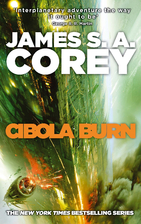
Review: The Expanse: Cibola Burn by James S.A. Corey

Trade paperback, 581 pages
Published 2015 (originally 2014)

Acquired and read June 2019
Cibola Burn: Book Four of The Expanse
by James S.A. Corey

This is the dullest Expanse novel by a long shot. Holden and company being sent to mediate between squabbling colonists is just not interesting; people bicker and blame each other again and again and again. It could have been an interesting allegory for real-world colonization issues, I suppose, but the lack of complexity for the principal characters in the dispute mean the dispute itself lacks complexity. The lack of the Roci characters in the early chapters also disappointed. I did like the surprise return of Miller's partner from Book One (how will the show handle this, given it killed him off during Season One?), but the other two new POV characters were pretty flat; Corey did a much better job coming up with new characters in Books Two and Three. Things pick up as they go, especially once Naomi and the rest of the Roci crew play a bigger role, but the overall plot never really excited me. Hopefully Book Five is stronger, because I'm seeing this through to the end.