07 June 2022

Hugos 2022: Monstress: The Vow by Marjorie Liu and Sana Takeda

Monstress, Volume Six: The Vow

Collection published: 2021
Contents published: 2020-21
Acquired: April 2022
Read: May 2022

Writer: Marjorie Liu
Artist: Sana Takeda
Lettering & Design: Rus Wooton

Another year of voting in the Hugo Awards, another volume of Monstress. This collects two issues of the Talk-Stories miniseries and #31-35 of the regular series. The two Talk-Stories issues are pretty good, nice little snapshots of two of our protagonists before the war; I especially liked the one about Kippa the fox arcanic, of course. But then we're back to the regular series, and unlike volumes four and five which kind of worked, this one is again an aimless blob of confusing politics, overcomplicated mythology, and too many characters. When this series is over, maybe I'll reread the whole thing in one go and like it more then, but for now, I really need to give up on it.

06 June 2022

Doctor Who: A Tale of Two Time Lords by Jody Houser and Roberta Ingranata

Doctor Who: A Tale of Two Time Lords: A Little Help from My Friends

Collection published: 2020
Contents published: 2020
Read: January 2022

Writer: Jody Houser
Artist: Roberta Ingranata
Colorists: Erica Eren Angiolini
Color Assistant: Sari Chankhamma
Letterers: Richard Starkings & Sarah Hedrick 

This collection has the thirteenth Doctor and the fam landing in London in the 1960s—during exactly the time the tenth Doctor and Martha were stranded there, as glimpsed in episode "Blink." The later Doctor tries to figure out if she needs to do something to help the earlier Doctor, and it turns out that not only are there Weeping Angels afoot (I am not sure why, though), the Nestene Consciousness is also up to something, and everyone ends up joining forces.

It's fun enough. Houser has a good grasp of the fam in dialogue and action, and one can imagine Jodie Whittaker being suitably awkward when she's trying to keep a low profile with Martha. The actual plot, as it always is in these thirteenth Doctor comics, is a bit basic, with what feels like a lot of wandering around and an easy resolution that feels a bit stretched out at four issues. I'd like to see this series play with story lengths more as Titan's earlier Doctor Who series did, but alas, they seem to be locked in at four issues.

(Note that this is, according to its copyright page, the first volume of "A Tale of Two Time Lords." There never was a volume 2, but one presumes that Alternating Current would have been so if not for the COVID-related changes to Titan's publishing schedule. But that does leave us with the slightly irksome phenomenon of a volume 1 with no volume 2!)

I read an issue of Titan's Doctor Who comic every day (except when I have hard-copy comics to read). Next up in sequence: Alternating Current

03 June 2022

Whatever Happened to the Good Witch of the North?

As I read the Oz books with my son, I of course am thinking about the continuity issues, of which there are many. (Terrance Dicks, script editor of Doctor Who from 1969 to 1974, once said continuity was whatever he "could remember about [his] predecessors' shows"; I think for L. Frank Baum, continuity was just what he could remember of his own.) One issue that has stuck out to me on this readthrough is the Good Witch of the North.

as illustrated by W. W. Denslow
Back in book one, The Wonderful Wizard of Oz, the Good Witch of the North is actually the very first person Dorothy talks to in Oz. It's her who explains to Dorothy the basic set-up of the Land of Oz:

"There were only four witches in all the Land of Oz, and two of them, those who live in the North and the South, are good witches. I know this is true, for I am one of them myself, and cannot be mistaken. Those who dwelt in the East and the West were, indeed, wicked witches; but now that you have killed one of them, there is but one Wicked Witch in all the Land of Oz—the one who lives in the West."

She explains she's not as powerful as the Wicked Witch of the East was, but she does seem to be pretty powerful. Later, the Wizard tells us that when he first arrived in Oz, that the set-up the Good Witch of the North described was already in place:

"There were four of them [witches] in this country, and they ruled the people who live in the North and South and East and West. Fortunately, the Witches of the North and South were good, and I knew they would do me no harm; but the Witches of the East and West were terribly wicked, and had they not thought I was more powerful than they themselves, they would surely have destroyed me."

We don't see her again after that early chapter, though; it's Glinda, the Good Witch of the South, who ultimately provides Dorothy with the information she needs to go home. (Baum, by the way, never gave her a name in the books. She was called "Locasta" in his 1902 stage adaptation of Wonderful Wizard, but unlike other character names from the musical, such as "Nick Chopper" for the Tin Woodman, hers was never imported back into the novels.)

She doesn't appear in the next three books, but two of them provide information about her. Book two, Marvelous Land, actually opens in the North quadrant of the Land of Oz, and provides it with a name for the first time, but the Good Witch of the North gets just a single mention:

Mombi was not exactly a Witch, because the Good Witch who ruled that part of the Land of Oz had forbidden any other Witch to exist in her dominions.

We learn more about the relationship between her and Mombi in Dorothy and the Wizard, book four. Ozma reveals that at one point, the Land of Oz was actually divided between four wicked witches, but by the time the Wizard had arrived, things had changed:

"[A] good Witch had conquered Mombi in the North and Glinda the Good had conquered the evil Witch in the South."

So now we know that Mombi actually used to rule the Gillikin Country, and that the Good Witch of the North did some kind of battle with her to take it over.

Then, in book five, The Road to Oz, she puts in her only other appearance in Baum's original fourteen novels, when she attends Ozma's birthday party. She's mentioned as being in the birthday procession, and then later, she does some magic at the birthday banquet:

The Good Witch of the North amused the people by transforming ten stones into ten birds, the ten birds into ten lambs, and the ten lambs into ten little girls, who gave a pretty dance and were then transformed into ten stones again, just as they were in the beginning.

On the other hand, this book introduces a wrinkle into our understanding of the political geography of Oz, because also in the same procession are the rulers of the four countries of Oz:

Then came the Rulers of the four Kingdoms of Oz; the Emperor of the Winkies, the Monarch of the Munchkins, the King of the Quadlings and the Sovereign of the Gillikins, each wearing a long chain of emeralds around his neck to show that he was a vassal of the Ruler of the Emerald City.

So there is some kind of (male) Sovereign of the Gillikins, who is distinct from the Good Witch of the North. And, for that matter, a male King of the Quadlings distinct from Glinda the Good. A similar passage in Ozma of Oz mentions "the King of the Munchkins, the King of the Winkies, the King of the Quadlings and the King of the Gillikins." The Munchkin king even appears, but like here, he went unnamed and undescribed. The Emperor of the Winkies is the Tin Woodman, but none of these three other rulers will ever be mentioned again. In fact, later on, Patchwork Girl indicates that there is no ruler of the Munchkins: "Unc Nunkie... might have been King of the Munchkins, had not his people united with all the other countries of Oz in acknowledging Ozma as their sole ruler..."

And then the Good Witch of the North never appears in any other Baum novel. So what happened to her?

Now, I know she reappears in at least one Ruth Plumly Thompson novel, but I want to focus here on what Baum was implying about her. As for what Baum intended, I would guess that at best, he decided to ignore her as part of the streamlining and alterations in Oz history that happen across the post–Emerald City Oz novels, and at worst, he just forgot about her!

She never appears again, not even in circumstances where you might expect her to. For example, in Lost Princess, an evil magician kidnaps Ozma and steals the magic of both Glinda and the Wizard of Oz. No one ever brings up the Good Witch of the North. On top of that, Patchwork Girl is the first book to mention that Ozma has largely banned the practice of magic in her country, and the only exemptions carved out are for Glinda and the Wizard, and this is reiterated many times across Baum's final eight Oz novels.

There's one other piece of indirect evidence. Several of the later Oz novels are set in the Gillikin Country, I assume because the early ones had mapped out most of the rest of the Land of Oz. Specifically, Tin Woodman of Oz, Magic of Oz, and Glinda of Oz all have significant amounts of action set in the Gillikin Country. Again, the Good Witch of the North is never mentioned, but on top of that, the Gillikin Country is often depicted as uncontrolled wilderness. For example, Woot in Tin Woodman, who is a native of the country, says, "in this northland country are many people whom it is not pleasant to meet." The narrator later says, the Gillikin Country is "where strange peoples dwelt in places that were quite unknown to the other inhabitants of Oz." In fact, at the end of the book, Ozma dispatches the Tin Soldier into the Gillikin Country to help bring it under control! It is similarly depicted as a largely wild, lawless place in the next two books as well.

So, if we ignore what post-Baum authors tell us, I would infer that actually, the Good Witch of the North is no longer active. She certainly doesn't practice magic any more, and might not even be capable of it, otherwise wouldn't the characters have gone to her for help in Lost Princess, Tin Woodman, or Magic?

It seems probable that she doesn't rule the Gillikin Country any more, either, as the country doesn't seem to have any kind of ruler in the later books. So presuming she didn't, say, die (as people in Oz generally don't), I would guess that she retired, turning the Gillikin Country over to the direct rule of Ozma, and in doing so she gave up her magic powers, or perhaps she left the Land of Oz altogether.

Eventually, my son and I will get to Thompson's The Giant Horse of Oz, which gives a backstory and a name ("Tattypoo"!) to her, and I'll be curious to see what that is. But Thompson aside, I think there's an interesting story to be told, probably set in the gap between Emerald City and Patchwork Girl, about Ozma consolidating her power over the Land of Oz, where the Good Witch of the North steps down and leaves. (Presumably, at the same time, whoever had been operating as King of the Munchkins since the death of the Wicked Witch of the East also abdicates.)

You can make a story out of this discontinuity, as you can so many in Baum's Oz novels, but it is somewhat surprising that a character who starts out so powerful and important fades away so much. The very first witch Dorothy ever met becomes a forgotten nonentity.

02 June 2022

Reading Roundup Wrapup: May 2022

Pick of the month: Iron Widow by Xiran Jay Zhao. Overall, a month of quality reads—most of them were, after all, Hugo finalists. This was technically a Lodestar finalist, but a strong YA novel all the same: angry feminism expressed via mecha in an alternate China. Strange Adventures was also quite good, and I almost went with it.

All books read:

  1. Across the Green Grass Fields by Seanan McGuire
  2. Doctor Who: Missy: The Master Plan by Jody Houser and Roberta Ingranata
  3. The Lost Princess of Oz by L. Frank Baum, illustrated by John R. Neill
  4. Doctor Who: Empire of the Wolf by Jody Houser and Roberta Ingranata
  5. Iron Widow by Xiran Jay Zhao
  6. Victories Greater than Death by Charlie Jane Anders
  7. Die, Volume 4: Bleed by Kieron Gillen and Stephanie Hans
  8. The Wicked + The Divine, Vol. 1, The Faust Act by Kieron Gillen and Jamie McKelvie
  9. Debarkle (the complete edition): 1880 to 2020 by Camestros Felapton
  10. The Tin Woodman of Oz: A Faithful Story of the Astonishing Adventure Undertaken by the Tin Woodman, assisted by Woot the Wanderer, the Scarecrow of Oz, and Polychrome, the Rainbow's Daughter by L. Frank Baum, illustrated by John R. Neill
  11. Monstress, Volume Six: The Vow by Marjorie Liu and Sana Takeda
  12. Fireheart Tiger by Aliette de Bodard
  13. Doctor Who: The City of the Dead by Lloyd Rose
  14. Strange Adventures by Tom King, Mitch Gerads, and Evan “Doc” Shaner
  15. End Game: Collected Comic Strips from the Pages of Doctor Who Magazine by Martin Geraghty, Alan Barnes, Scott Gray, Adrian Salmon, et al.
  16. The Magic of Oz: A Faithful Record of the Remarkable Adventures of Dorothy and Trot and the Wizard of Oz, together with the Cowardly Lion, the Hungry Tiger and Cap'n Bill, in their successful search for a Magical and Beautiful Birthday Present for Princess Ozma of Oz by L. Frank Baum, illustrated by John R. Neill
  17. The Wicked + The Divine, Vol. 2, Fandemonium by Kieron Gillen and Jamie McKelvie

Like I said, the majority were Hugo finalists, but I still squeezed in some other stuff: breakfast-time comics (#2, 4, 8, 17), Oz novels with my son (#3, 10, 16), and even some books from my reading list (#13, 15).

All books acquired:

  1. Star Trek: Deep Space Nine: The Long Mirage by David R. George III
  2. Shadow & Claw: the first half of The Book of the New Sun: The Shadow of the Torturer and The Claw of the Conciliator by Gene Wolfe
  3. Sword & Citadel: the second half of The Book of the New Sun: The Sword of the Lictor and The Citadel of the Autarch by Gene Wolfe
  4. Of Dice and Men: The Story of Dungeons & Dragons and the People Who Play It by David M. Ewalt
  5. The Last Graduate: Lesson Two of The Scholomance by Naomi Novik
  6. James Bond 007: Licence To Kill: The Official Comic Book Adaptation by Mike Grell et al.
  7. Glinda of Oz: In which are related the Exciting Experiences of Princess Ozma of Oz, and Dorothy, in their hazardous journey to the home of the Flatheads, and to the Magic Isle of the Skeezers, and how they were rescued from dire peril by the sorcery of Glinda the Good by L. Frank Baum, illustrated by John R. Neill

Books remaining on "To be read" list: 689 (up 4)

01 June 2022

"Another tricky little gun giving solace to the one / That will never see the sunshine": Quantum of Solace

This is it! My last James Bond film in my novel-order marathon. "Quantum of Solace" was a short story collected in For Your Eyes Only, but when this movie came out, all the James Bond short stories were repackaged into a single volume called Quantum of Solace as a tie-in, so I watched it after reading it. It's all kind of pointless, of course, in that the film has literally nothing to do with the short story except for the title. The short story is an interesting but weird little thing where Bond only appears in the frame, as he is told a story about a degenerating marriage where once the couple's marriage no longer contains even the smallest possible amount (i.e., a quantum) of solace, they turn on each other. Bond is in it mostly to serve as a contrast: "Suddenly the violent dramatics of his own life seemed very hollow." 

In the film, "Quantum" is revealed as the name of the evil organization that was responsible for the events of Casino Royale, but also the film is about Bond chasing "solace" for the death of Vesper in that film. It isn't spelled out, but one presumes he manages to find the smallest possible amount of it.

As I think I said back when I reviewed Spectre, I've seen all the Daniel Craig films in the theater. Thus, I have two contexts to think about each of them: how they fit into the other Daniel Craig films, and how they fit into the Bond films more broadly. I wasn't a big fan of Spectre as a Craig film when it originally came out, for example, but as a Bond film, I found it good fun on rewatching. I feel like the opposite happened here. I know this is a minority view, but I remember really enjoying Quantum of Solace when I saw it in the theater; on rewatching, I found it interesting how it played with Bond tropes but also it feels less like a Bond film and more like a generic action film of the Bourne era.


Okay, as a Craig film first. The movie opens literally an hour after the events of Casino Royale; the guy Bond went to confront at the end of Casino Royale, Mr. White, is stuffed into Bond's trunk when this film begins. Bond spends the film trying to get to grips with the plans of Quantum, who were behind Casino Royale, and spends the film trying to come to terms with the death of Vesper. This all worked for me when Casino Royale was indeed my previous Bond film, and I had seen it just a couple years prior, but in this sequence, Casino Royale was over seven years ago, nineteen Bond films back! I think some of it still lands okay, but it does feel like the movie is trading off your memory of the first one for your emotional investment here. Thank God for composer Daniel Arnold's occasional invocation of his beautiful "Vesper" theme. The one part that really didn't work for me was the return appearance of Mathis; Mathis has no real reason to go with Bond, so he clearly only does it because he's a familiar character who can die to prove the situation is serious, as in this new continuity, Bond doesn't really have any old friends.

On the other hand, it's pretty interesting how this one plays with tropes and expectations of Bond films, which is something I hadn't clocked watching it in its original context. Bond is pretty charmless for the first half, and also not particularly clever; as M points out repeatedly, he keeps killing his leads. There's a bit where he hijacks a boat driven by Olga Kurylenko's agent Camille so that he save her life. In a Roger Moore or Sean Connery film, she would get mad at him, but then they would flirt, he would save her life, and then they would sleep together. (This is basically what does happen in a very similar scene in Licence to Kill.) Here, she gets winged during the gun battle and falls unconscious, and he just ditches her! (We actually thought she was dead at first, but we may not have been watching too closely, as we were also folding laundry; she pops up again thirty minutes later, evidently fine.) This is "not your father's Bond," made very plain in a pretty clever way.

(The Goldfingeresque death of Agent Fields comes across as pretty gratuitous, though, and not really in character.)

On the other hand, I struggled with the action. Casino Royale had some big extravagant action sequences in its first sixty minutes, before the casino plot actually kicks in, but then the main body of the film is much more restrained than the old Bond films. But I felt like Quantum of Solace, having removed the over-the-top goofy action of a Roger Moore film and also lacking the intensity of Casino Royale, didn't know what to replace it with, so there were a lot of just pretty generic action sequences that could come from any 2000s action flick. There's no humor and no intensity. It did improve for me with the final sequence—the villain lair is visually striking—but even that lacked the climactic oomph it needed.


In trying to figure out what a non–Cold War, non-SPECTRE villain might want, Quantum of Solace comes up with a pretty clever answer. Mr. Greene, this film's Quantum representative, is supposedly an environmentalist, but secretly he's after oil... but that's another cover, and he's really after capturing water and then selling it back to impoverished countries at high premiums. This is clever... but it's also a bit too complicated, or at the very least, under-explained. It also means that the stakes don't really escalate. I mean, giving thirsty people their water back is noble, but it's not saving the West from Communism, you know? I do think the next film overreacted in its course correction, but it's little wonder that Quantum isn't even mentioned in Skyfall.

I feel like the filmmakers really missed a trick. Any movie where Bond discovers the villains have built a dam for nefarious purposes really ought to end with the dam exploding! That would have given us a great climax.

Craig himself does a good job with what he can, of course, but though we know he can be charming, there's little evidence of it here, even when he charms Gemma Arteron's Agent Fields and sleeps with her. She's the only woman he sleeps with; his relationship with Camille is very different, and probably the strongest part of the film, as he genuinely wants her to be a better person than he is... but he also wants her to get that same "quantum of solace" he's after.

So all in all, it's okay stuff. Probably the worst Daniel Craig film, but Craig had an above-average run. Better than Moonraker—there's your pull quote.  

Other Notes:

  • In this part of my review, I often comment on all the recurring character actors, but at this point in the Daniel Craig chronology, there's no Moneypenny yet and no Q! Judi Dench does a good job with generic material as M; I did really like the moment where she lets him get on with the job because she knows that if Bond's seemingly gone rogue, he has a good reason for it. Rory Kinnear puts in his first appearance as M's chief of staff, Bill Tanner, and ohmigosh, he looks like such a baby. (Actually, so does Daniel Craig. Somehow this movie came out thirteen years ago!)
  • It's not exactly a competition to be "best Felix," but Jeffrey Deaver wins it by a country mile.
  • The bit where Bond goes to the opera isn't much of an action sequence per se, but it does have good modern vibe to it, and is visually interesting.
  • The theme song is not the worst one, but it is much less memorable than this delightful fake one I have always loved:
    "The Suantum of Qolace. Is that how it goes?"
  • Of course, this isn't the end of my film Bond-a-thon. Even if the books have come to an end, I will go through all the movies not based on books in release order. That means next up is the second Timothy Dalton film, License to Kill; then all the Pierce Brosnan ones; and then finally a couple other Daniel Craig ones, Skyfall and No Time to Die. (If you've seen No Time to Die, you know that I could have slotted it in as a second You Only Live Twice adaptation, but it didn't exist back when I read that book in early 2020.) So only seven to go!
 Film Rankings (So Far):
  1. Casino Royale
  2. Dr. No
  3. From Russia with Love
  4. For Your Eyes Only 
  5. On Her Majesty's Secret Service
  6. Thunderball 
  7. The Living Daylights
  8. Spectre
  9. You Only Live Twice
  10. Goldfinger
  11. Quantum of Solace
  12. The Spy Who Loved Me
  13. Moonraker
  14. The Man with the Golden Gun
  15. Octopussy
  16. Never Say Never Again
  17. A View to a Kill
  18. Live and Let Die 
  19. Diamonds Are Forever

31 May 2022

Hugos 2022: Strange Adventures by Tom King, Mitch Gerads, and Evan "Doc" Shaner

And so it begins! As has been the case since 2017, I am voting in the Hugo Awards this year. Most finalists, I read either via the voter's packet or the library, and those I just write up as part of my final ballot posts. But I usually buy all the Best Novel finalists, plus any other finalists of sufficient interest, and those I'll be writing up on Tuesdays over the next few months, starting with...

Strange Adventures

Collection published: 2021
Contents published: 2020-21
Acquired: April 2022
Read: May 2022

Writer: Tom King
Artists: Mitch Gerads & Evan "Doc" Shaner
Letterer: Clayton Cowles

Tom King definitely has a "thing." I've previously read his work in The Omega Men (2015-16), The Vision (2016-17), and Mister Miracle (2017-19), and in my review of the last one, I wrote, "This feels to me like it finishes a thematic trilogy.... Like those stories, it's about reconciling superpowered violence with living an everyday life." Well, the stories may be thematically connected, but his work on Strange Adventures shows that he's not done with those ideas yet. Through the story of Adam Strange, he refracts them in a different way, and I would describe what's as stake here as masculinity, violence, and empire—all through the medium of superhero adventure comics, of course.

Adam Strange is the "Man of the Two Worlds," a human from Earth who fights to defend the planet Rann. Strange Adventures follows him in two parallel stories: in the past, he fights alongside his wife Alanna to defend Rann from the deadly Pykkt invasion. In the present, the two now reside on Earth, where Adam has become a hero and celebrity for defeating the Pykkts... but their daughter is dead, and the promise of a Pykkt invasion of Earth looms. We see what Adam and Alanna did in sequences illustrated by Evan "Doc" Shaner in the past while the Stranges defend themselves against accusations of impropriety in the present, especially a Justice League investigation run by Mister Terrific.

Beware the Pykkts!
from Strange Adventures vol. 5 #1 (art by Evan "Doc" Shaner)

Fundamentally, what King and his collaborators have done here is to take a Space Age gee-whiz comics concept and darken it. In the original series, Adam travels to Rann via zeta beam, fights alien monsters with science knowledge, kisses Alanna, and goes home, ad infinitum. I do feel like I could nitpick how King did this to death if I wanted to. Is this series doing anything that DC's last dark Adam Strange reinvention didn't? Well, actually, yes. Richard Bruning's series was interested in the histories of both Adam and Rann: what would make a person want to abandon his planet like this? why would a technologically advanced alien civilization need a guy from Earth to save them all the time? King doesn't really care about this; Adam's Space Age adventures are mostly there to contrast the horribleness and moral compromise of the Pykkt invasion. Along those lines, then, I actually wanted more deconstruction of the relationship between Adam and Rann: it kind of reads like the kind of thing we might now call a "white savior" narrative, and though there are hints of it, that's not really the story King is telling either, and I guess I can't begrudge him for that.

There is this interesting parallel between Earth and Rann, in that we want the throwback as much as they do: we want the "white savior" to come in and save us, despite—or, well, because of—the cost.
from Strange Adventures vol. 5 #9 (art by Mitch Gerads)

As you read the book, it becomes clear that the present-day story is Alanna's, not really Adam's. And, after all, the book is Strange Adventures, not Adam Strange: it doesn't specify which Strange in the title. The relationship between Adam and Alanna is the crux of the whole book, and it's fascinating and terrifying. Adam, as the book flags up on occasion, especially through Adam's media appearances on contemporary Earth, is a man. He's the kind of guy who does what needs to be done to save his people, and then romances a woman. This is shown to be Alanna's own doing in many ways: she shaped Adam into being the kind of man she wanted, and through extension, Rann needed. This worked for him for decades!

She may look nicer...
from Strange Adventures vol. 5 #5 (art by Mitch Gerads)

What Strange Adventures does is take that concept of masculinity and put it through the wringer. What if "what needs to be done" is more complicated than decisively implementing a science idea you've had? As the war against the Pykkts goes on, Adam must do more and more, pushed by Alanna on every step. Soon we see the dark side of that masculinity—and in the book's ultimate revelation, so does Alanna. Adam was pushed into a situation where his masculinity became untenable; in order to save the day in the way he was supposed to yet again, he had to betray the precepts he supposedly stood for. You can see both how Alanna pushed him into it... and how in becoming the person Alanna wanted him to be, he ultimately snapped, revealing the weaknesses at the heart of masculine identity. Alanna, in the end, recognizes this but doesn't let herself see it. In a sense, this story is about revealing that Adam Strange is a villain, but Adam is only a villain to the extent that masculinity has forced him to be one, and Alanna is the embodiment of the enforcement of masculinity. She makes him live up to an ideal that is ultimately impossible to live up to.

...but she is the truly dangerous Strange.
from Strange Adventures vol. 5 #7 (art by Mitch Gerads)

My biggest complaint would be the use of grawlixes, actually. You can show a guy's head explode, and show multiple sex scenes, but you can't use the work "fuck"? It threw me out of the moment almost every time.

Like clearly this panel would be better if it just said "Just fucking try to be a man."
from Strange Adventures vol. 5 #10 (art by Mitch Gerads)

So, yeah, there's a lot going on here, and I really enjoyed reading it. I think it might be my favorite of the Tom King comics I've read, though maybe that would also be The Omega Men. As a writer, King is replete with small touches that make things come alive. There are good jokes, some nice media and political commentary, a neat take on Mister Terrific, good characterization for all the different superhero cameos (Superman, Batman, and even Booster Gold), and interesting epigraphs. The art is perfect. I liked Mitch Gerads on Mister Miracle, but he absolutely kills it on the present-day sequences here, especially anything involving Alanna. Evan "Doc" Shaner has been a favorite of mine since I read his Convergence: Shazam miniseries, and his clear, heroic art is beautiful on its own terms and beautiful as a contrast to the horrific events it depicts. I assume Gerads and Shaner did their own coloring because there's no credited colorist, and the colors are great, too, really adding to the mood and tone and surrealism of the piece as appropriate.

Arming herself to do battle.
from Strange Adventures vol. 5 #10 (art by Mitch Gerads)

If King stops doing his dark deconstructions of male superheroes here, it will be a worthy conclusion. But if he keeps going, I will be along for the ride. And when will Evan Shaner get something other than Future Quest to really shine on!? 

But I will take whatever Doc Shaner I can get.
from Strange Adventures vol. 5 #2 (art by Evan "Doc" Shaner)

Side note: over the past few years, primarily beginning with 2009's Strange Adventures vol. 3, DC has associated Adam Strange with the title Strange Adventures. It's a natural association if you go by the name, but historically, Adam Strange's adventures mostly appeared in Mystery in Space. It occurred to me near the end of the volume that "Mystery in Space" would actually be a plausible collection for this story, too... and then like a page later, Alanna used it in text!

30 May 2022

Doctor Who: Time Out of Mind by Jody Houser, Roberta Ingranata, et al.

 Doctor Who: The Thirteenth Doctor: Time Out of Mind

Collection published: 2020
Contents published: 2019
Read: January 2022

Writer: Jody Houser
Artists: Roberta Ingranata, Giorgia Sposito, Valeria Favoccia
Colorists: Erica Eren Angiolini, Tracey Bailey
Color Assistant: Sari Chankhamma
Letterers: Richard Starkings & John Roshell, Sarah Jacobs & Sarah Hedrick
 
Like a lot of Jody Houser/Roberta Ingranata Thirteenth Doctor comics, this has a fun idea at its heart but reading it is a bit of a plod. The Doctor and the fam investigating a Krampus takeover of Santa's workshop ought to be a delight... but the whole thing is for some reason bogged down in the conceit that they already did this but had their memories erased, so they spend most of the comic not really doing anything except figuring out what they might have done last time. I appreciate that the comics decided to give us a Christmas special in an era where the tv programme has abandoned it, but it lacks Christmas sparkle, and doesn't really say anything about Christmas, either; it's just trappings on a pretty ordinary story.

I read an issue of Titan's Doctor Who comic every day (except when I have hard-copy comics to read). Next up in sequence: A Tale of Two Time Lords: A Little Help from My Friends

27 May 2022

The Pool Is Open

When Hayley and I were house-hunting here in Florida, she was adamant we needed a pool. What would be the benefit of living in Florida if you didn't have a pool?

I've struggled a little bit with pool maintenance this year. Basically it's that I fall out of my routine on shocking the pool, either because I forget to add the stuff, or I forget to go to the pool store to get more of it. This has meant battling a couple infestations of yellow algae. This meant that at the point where the weather became optimal for swimming, you wouldn't want to swim in it. (I did get it under control briefly, but when we got in, Hayley grumbled it was too cold, and then the algae bounced back.)

But since the semester ended two weeks ago, I've been able to get things back on track, with regular administering of shock, the addition of some "Stop Yellow," regular vacuuming of the pool, and regular cleaning of the filter. It seemed all good last weekend, but then the weather prohibited us from swimming!

This Tuesday, though, I jumped in after mowing the lawn, and it was 85℉ and glorious. Exactly what I needed after pushing around a lawnmower in 90℉+ heat.

And so Wednesday, before dinner, we finally got in as a family for the first time this summer. The bottom is clean, the water is clear, the kids were having a blast.

One of the real benefits of summer is that we can dip in whenever we like; a quick morning swim before lunch has been one of the features of our summers. If we ever move away from here, this is one thing about Florida I will definitely miss.

The pool is open!

25 May 2022

Land of the Blind (From Stockbridge to Segonus: A Doctor Who Magazine Comics Marathon, Part 23)

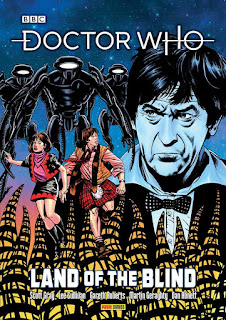
Land of the Blind: Collected Comic Strips from the pages of Doctor Who Magazine
by Warwick Scott Gray, Lee Sullivan, Gareth Roberts, Martin Geraghty, Dan Abnett, et al.

Collection published: 2018
Contents originally published: 1993-95
Acquired: December 2018
Read: January 2022

I think at the time, this surely must have been an abrupt transition. From the dangerous and moody seventh Doctor in #211, straight into the fourth Doctor and Romana gadding about in #212. Ace and Bernice are gone without a word; the strip of course has had to write out TV companions before (i.e., Peri) but usually at least says something about it. We get nothing like that this time. For me, though, it reads a little less abruptly because of where I included The Age of Chaos, which caps off the VNA era with The Last Word and eases us into the "past Doctor" stuff with Under Pressure and The Age of Chaos itself; plus, in publication order, Bringer of Darkness opens this volume, which is sort of a second Doctor story in a seventh Doctor style, giving another transitional point.

Unfortunately, the backmatter doesn't include anything from Gary Russell, who was strip editor at the time, and thus the one responsible for the sudden, unprecedented change in the DWM comics format. No longer is the strip one ongoing story; it's now a nostalgia tour. Thankfully, Gareth Roberts does explain a bit in his notes on The Lunar Strangers: there was no longer a television programme to follow, and so the mag became a celebration of Doctor Who's history, driven in part by the VHS range, which randomly dipped into the show's history, "So he was going to follow a similarly randomised pattern in DWM." I'm not sure this would have been my choice, but it has a good logic behind it.

First, it makes sense to uncouple from the NAs: why should one range of tie-ins be beholden to another, when the other clearly doesn't care about this one? Had the strip kept following the books, Ace would have had to disappear again around the time of #223, and then two new companions would have appeared out of nowhere in #227. But if you're going to uncouple, it makes sense to do so in a strong, distinctive way: continuing to do seventh Doctor adventures, just without Benny and "Spacefleet" Ace I think would have raised questions as to why the strip wasn't consistent with the NAs (a range the mag promoted every month with the preludes!) if it was featuring the same characters. Going into the show's past gives a clear reason for the strip to be unconnected to the novels, even if I don't like the loss of the strip's ongoing nature.

from Doctor Who Magazine Summer Special 1993
Bringer of Darkness, from Doctor Who Magazine Summer Special 1993
written by Warwick Gray, art by Martin Geraghty
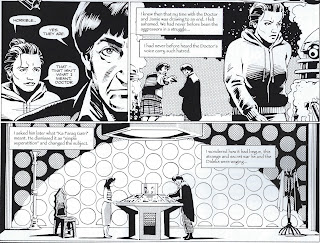
This is a neat little story, very effectively done. We begin our "past Doctor" adventures with the second Doctor, Jamie, and Victoria, and the story follows on from The Evil of the Daleks in having the Doctor investigate if he really did kill off all the Daleks or if he needs to finish the job, and in examining Victoria's emotional reactions to the Daleks, who killed her father; Victoria narrates the story in retrospect from some time shortly after she leaves the TARDIS. Add the dark, moody art of Martin Geraghty, and it all works rather well: a story with some darkness, but also some emotional depth, and it does a neat job of foreshadowing the NAs in a plausible, interesting way. (This came out during Emperor of the Daleks!, so arguably at the height of DWM's VNA era.)
from Doctor Who Magazine #212
Victims, from Doctor Who Magazine #212-14 (May-July 1994)
story by Dan Abnett, art by Colin Andrew, letters by Enid Orc
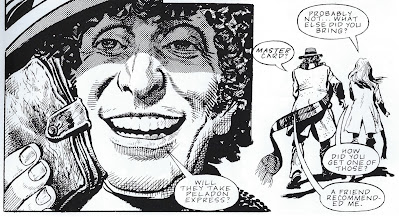
The fourth Doctor and second Romana investigate murders on a world known for its high fashion. The best part of this is the repartee between the Doctor and Romana; Abnett captures season 17 perfectly in that regard. No, strike that; the best part is the joke about the Doctor trying on Colin Baker's coat, which made me laugh out loud. The story is a bit darker than a real season 17 story, which works; what works less well is that it's kind of a mystery... but it has exactly one suspect, who turns out to have done it. I felt like it fizzled out by the end despite a strong start. Colin Andrew does a reasonable Tom Baker, but his Lalla Ward likeness is very inconsistent; if you're going to go for this retro/nostalgia approach, though, I think you need artists who are good at likenesses.
from Doctor Who Magazine #215
The Lunar Strangers, from Doctor Who Magazine #215-17 (Aug.-Sept. 1994)
script by Gareth Roberts, art by Martin Geraghty, letters by Elitta Fell
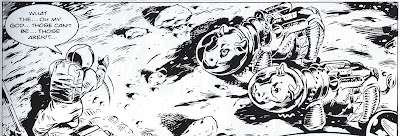
The very first page of this one is genius, stuff only the DWM comic could do: cows in spacesuits on the moon. Nothing else here quite lives up to that. The evil space cows' evil plan didn't strike me as wholly plausible, even by the standards of reading about the plans of evil space cows, and I didn't buy the human base administrator's actions either; it turns out she's been pretending, but 1) a good fake-out needs to be plausible, and 2) if she was suspicious, she could have just locked up the evil space cows and every subsequent problem would have been avoided! Gareth Roberts does capture the voices of the fifth Doctor, Tegan, and Turlough well, though, and Martin Geraghty draws a good evil space cow, even if I struggled to distinguish the two.
from Doctor Who Magazine #218
Food for Thought, from Doctor Who Magazine #218-20 (Oct.-Dec. 1994)
script by Nick Briggs, art by Colin Andrew, letters by Elitta Fell and Warwick Gray
In his notes, Nicholas Briggs says this wasn't his first comic strip, but it was his last. We can be thankful for this, I guess, because it feels like a first attempt, full of awkward, confusing transitions and unclear action, though perhaps a good artist could have saved the script somewhat. At least Briggs correctly notes that the characterization for Polly is downright awful.
Change of Mind, from Doctor Who Magazine #221-23 (Jan.-Mar. 1995)
story by Kate Orman, art by Barrie Mitchell, letters by Warwick Gray and Elitta Fell
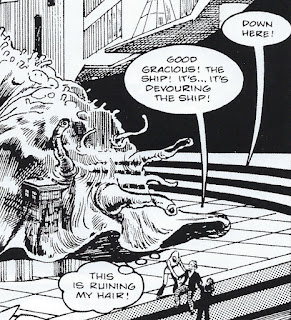
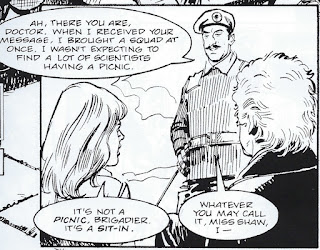
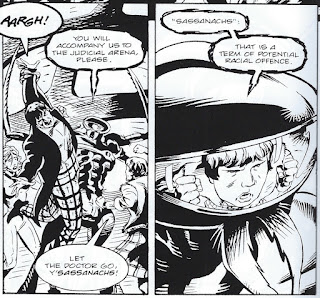
This third Doctor and Liz Shaw story is, I believe, Kate Orman's only comics work, though I gather one of the characters here recurs from her novels. She has a good handle on Liz; the throughline of the Doctor trying to figure out why Liz left (this is set some time later) works very well. It has some good set pieces, such as where the Doctor and Liz use a sit-in to distract the villain, and the climax. Unfortunately, there are two mysterious men in long coats, and as Orman herself points out, some sequences are hard to follow the action of.
from Doctor Who Magazine #223
This leads me on to a different point: there are three different writers in this volume who were new to comics (essentially, as far as I can tell) in Roberts, Briggs, and Orman; contrast this against Dan Abnett, by this point highly experienced, and Warwick Scott Gray, gradually amassing a body of quality DWM work. For most of its run, the strip has been written by experienced comics writers from outside the Doctor Who world, but that's been slowly changing since the late 1980s. We've seen fan writers with little comics experience come aboard before, of course (e.g., Paul Cornell, Marc Platt), but this is the first volume where I've read a couple strips and thought to myself that the writers were clearly inexperienced comics writers. Orman mentions making mistakes of the medium: but addressing this kind of mistake the exact thing an editor ought to have been on top of! My inference would be that, say, John Freeman and Richard Starkings knew how to nurture a new comics writer in a way that Gary Russell does not. Which, if you've read any of Gary Russell's comics work, is entirely to be expected.
from Doctor Who Magazine #225
Land of the Blind, from Doctor Who Magazine #224-26 (Apr.-June 1995)
story by W. Scott Gray, art by Lee Sullivan, letters by Elitta Fell
Thankfully, the volume closes out as strongly as it opens, with another well put together second Doctor story (this time with Jamie and Zoe) from Scott Gray, now paired with Lee Sullivan. This is a clever, inventive story about a city cut off from the outside universe, with some neat turns, good villains, and one really good joke. You could have stuck this in the Dave Gibbons era and no one would have batted an eye: not crazy ambitious, but the exact kind of thing the strip ought to be doing. I breezed through it in the best of ways.
Stray Observations:
  • Surely the story should have been called Fashion Victims. It's so obvious it boggles my mind that it's not.
  • After a pretty substantial run on the writing roster, Dan Abnett finally exits the Doctor Who Magazine comic strip. It's not his final Doctor Who work; he also wrote a couple Big Finish audio dramas and the Christmas novel The Silent Stars Go by. He has also been a pretty prolific writer in American comics. My favorite comics work by him is the excellent Legion Lost, but he's also the kind of writer who will reliably churn out tie-in issues to crappy "events," so I've actually read quite a lot by him, with things like Flashpoint and Convergence. Oh, and he also invented something called "Guardians of the Galaxy"!
  • Enid Orc has got to be a pseudonym, yes? But for who...
  • I always like to imagine what my hypothetical knows-Doctor Who-only-from-the-comics reader is thinking. In this volume, it's "Who the heck are Romana, Tegan, and Turlough? Where are Sharon and Gus?"
  • It is not clear to me what comics Nicholas Briggs has written other than Food for Thought; not Doctor Who ones at any rate. You may have heard of him, though, for going on to voice the Daleks on tv, and for writing a couple Big Finish audio dramas. (I have 79 releases written or co-written by him, according to iTunes!)
  • A hard-bitten space freighter captain going, "I ain't waitin' up here to get what's due! I don't care what the hell's goin' on down there! We're goin' in now, or we'll frazz the atmosphere!" (about which another character thinks "...hell's going on down there...") is surely one of the most Nick Briggs pieces of dialogue to ever Nick Briggs. I'm sure he put his heart and soul into it.
  • How do they decide who gets cover credit on these collections, anyway? Poor Colin Andrew contributes to more strips than anyone else in this volume (he draws six of them) but is shut out by Scott Gray (writes four), Lee Sullivan (draws three), Gareth Roberts (draws three), Martin Geraghty (draws four), and Dan Abnett (writes three). Well, I'm sure it's about who is famous, either to comicdom at large, or to Who fans, but it does seem unfair.

This post is the twenty-third in a series about the Doctor Who Magazine comic strip and Marvel UK. The next installment covers Ground Zero. Previous installments are listed below:

  1. The Iron Legion
  2. Dragon's Claw 
  3. The Transformers Classics UK, Volume One
  4. The Tides of Time
  5. The Transformers Classics UK, Volume Two
  6. Voyager
  7. The Transformers Classics UK, Volume Three
  8. The World Shapers
  9. The Transformers Classics UK, Volume Four
  10. The Age of Chaos
  11. The Transformers Classics UK, Volume Five
  12. A Cold Day in Hell!
  13. Death's Head: Freelance Peacekeeping Agent (part 1)
  14. Nemesis of the Daleks
  15. Death's Head: Freelance Peacekeeping Agent (part 2)
  16. The Good Soldier
  17. The Incomplete Death's Head
  18. Evening's Empire
  19. The Daleks
  20. Emperor of the Daleks
  21. The Sleeze Brothers File
  22. The Age of Chaos

23 May 2022

Doctor Who: Old Friends by Jody Houser, Roberta Ingranata, and Rachael Stott

 Doctor Who: The Thirteenth Doctor: Old Friends

Collection published: 2019
Contents published: 2019
Read: January 2022

Writer: Jody Houser
Artists: Roberta Ingranata, Rachael Stott
Colorists: Erica Eren Angiolini, Tracy Bailey
Color Assistants: Viviana Spinelli, Aaron Daly & Sari Chankhamma
Letterers: Richard Starkings & Sarah Jacobs, John Roshell & Jimmy Betancourt

There's a good idea at the heart of this volume: the Doctor runs into the Corsair, an old Time Lord friend she learned died back in "The Doctor's Wife." How do you handle a situation like this? Unfortunately, I felt that that aspect of the story was barely present; I only really got what the story was going for in its last issue. If the Doctor had talked about this with her companions, it could have been highlighted more, but much like on screen, Houser's version of the fam are interchangeable recipients of exposition. There's just nothing very characterful here. What do they all make of meeting another Time Lord at last, so different from the one they know so well? Who knows. Probably this is how Chris Chibnall would handle it on screen, as in, just as dully. Not terrible, but it's a disappointment for our first real glimpse of the Corsair.

I read an issue of Titan's Doctor Who comic every day (except when I have hard-copy comics to read). Next up in sequence: The Thirteenth Doctor: Time Out of Mind