20 April 2022

Doctor Who: The Many Lives of Doctor Who by Richard Dinnick et al.

 Doctor Who: The Thirteenth Doctor: The Many Lives of Doctor Who

Published: 2018
Acquired: March 2020
Read: November 2021

Writer: Richard Dinnick
Letterers: Sarah Jacobs and John Roshell
Artists: Mariano Laclaustra, Giorgia Sposito, Brian Williamson, Arianna Florean, Claudia Ianniciello, Iolanda Zanfardino, Neil Edwards, Pasquale Qualano, Rachael Stott
Inker: Fer Centurion
Colorists: Carlos Cabrera, Adele Matera, Dijjo Lima, Enrica Eren Angiolini

This story (which is a volume 0 to Titan's Thirteenth Doctor series) takes place while the twelfth Doctor is regenerating into the thirteenth. As this happens, they think about various aspects of their life, leading to a series of mini-stories about all the previous Doctors. I will be honest, I pretty much hated it, mostly thanks to the narration of the Doctor. The twelfth Doctor's speech at the end of "Twice Upon a Time" was ponderous enough; it didn't need this added to it. "Earth. You have a fondness for it. Especially London," they'll think to themself, and then we get a third Doctor adventure. No shit! "Remember Gallifrey. Your home planet?" As the book goes on, they seem to get increasingly strained. "You're not ill all that often. And human medicine isn't really your thing." Is this really stuff intrinsic to the Doctor that they need to be reminded of?

The mini-adventures are fine, but pretty insubstantial, and kind of over-stuffed with continuity callbacks. I get that Titan was trying to capitalize on the thirteenth Doctor hype, and needed some stuff to draw attention to its new offerings, but both this and The Road to the Thirteenth Doctor seemed pretty pointless. The best way to introduce a new Doctor is just to introduce a new Doctor! They don't need all this palaver.

I read an issue of Titan's Doctor Who comic every day (except when I have hard-copy comics to read). Next up in sequence: The Thirteenth Doctor: A New Beginning

18 April 2022

Doctor Who: The Year of Intelligent Tigers by Kate Orman

Doctor Who: The Year of Intelligent Tigers
by Kate Orman
story by Jonathan Blum & Kate Orman

Following on a few books from EarthWorld, this is another adventure for the amnesiac eighth Doctor with Fitz and Anji. Like Jacqueline Rayner, Kate Orman is a deft hand when it comes to characterization, especially Anji; I also really liked Orman's eighth Doctor, who you can imagine as being played by Paul McGann, but who also does the kind of things that are unique to this prose version of the Doctor, a man obsessed but who also doesn't know his own past. I liked him on the music-obsessed space colony, trying to figure out a piece of music he could remember; the visual of the Doctor literally curling up with tigers and adopting cat body language is something one can't imagine the tv show actually being willing to do, but fits beautifully.

Published: 2001
Acquired: November 2009
Read: November 2021

The story is a good one, with a human space colony discovering that native "tiger" life-forms they'd thought benign and nonsentient are actually intelligent and possess their own agenda; the Doctor and his friends must work to minimize loss of life and bring two sides together. Some good jokes, some beautiful prose, well written throughout. In general, I've picked and chosen from the post-Burning Eighth Doctor Adventures, but every one I have read shows off Doctor Who prose fiction at its best.

I read an Eighth Doctor Adventure every three months. Next up in sequence: The City of the Dead

15 April 2022

It's a Citation. But Probably Not the One You Were Expecting.

Every now and again when bored (usually when I should be grading) I search my own name on Google, Google Scholar, and Google Books to see what comes up. Are people talking about me? More specifically, are people citing me and I don't know about it? Google Scholar indexes some of this, but it doesn't catch everything, especially if your name is spelled wrong. If you have a more common name, this is probably a waste of your time, but I am one of exactly two Steven Mollmanns who has ever existed, so there aren't really any false positives, except for "Steve Mollman," who probably wonders why people ask him about his Star Trek books from time to time.

The most recent time I did this, I was surprised to find that I had been cited in a work of science fiction scholarship... surprised because the work of mine that was cited was not a work of sf criticism, but one of my Star Trek novels! Google Books' snippet view didn't yield much insight, so I requested the book from ILL.

Gary Westfahl's book is called The Rise and Fall of American Science Fiction, from the 1920s to the 1960s, but its last chapter is actually about the present day. Westfahl's point is that those who invented the genre of sf, and those scholars who study it, see it as a genre of endless possibilities, but that the sf that actually gets sold and read the most is formulaic: "science fiction today has finally become what Gernsback, Campbell, and others vigorously resisted, a genuine form of popular fiction, as an overwhelming majority of its works now rigidly follow some standard conventions" (243).

He decides to document this by going into a Barnes & Noble in January 2012 and cataloguing every single sf book on the shelf in the "New" area. There are 75 books in total... and one of them was my and Michael Schuster's own Star Trek novel, A Choice of Catastrophes. What dismays him is that 75% of the books are in series; what interests him is that the majority of authors are ones that are "unknown to scholars" (243). (He seems to take "in a series" as shorthand for "formulaic," which seems a bit unfair to, say, N. K. Jemisin.)

He does not mention A Choice of Catastrophes specifically; it only appears in an end note giving the complete list of books he saw (266-7n18). He does, however, say this:

However, optimists might continue, one cannot dismiss all series fiction as derivative junk until one has read it, for talented writers may find ways to stimulatingly stretch generic boundaries even within such confines.... It does seem more probably, though, that all of these novels are no better or worse than others of their kind, despite the best efforts of their writers. (As evidence, I note that I once began reading a Star Trek: Deep Space Nine novel, Warchild [1994], written by the iconoclastic fantasy writer Esther M. Friesner, hoping to find a fresh and original approach to the franchise; however, I abandoned the book when I found that the book utterly lacked Friesner's trademark humor and was just as dull as all of the other Star Trek novels I had read.) (244)

Ouch! I, actually, really like Warchild and think it's one of the better "numbered" DS9 novels, but the things that appeal to me about the book are, I think, pretty unlikely to appeal to him, which is how well it captures the characters and world of the series, but with the added depth you can get from prose. Is it "fresh and original," does it "stretch generic boundaries"? Kind of, but in the somewhat limited way of Star Trek novels at their best.

That said, I do kind of agree with this:

Writers in earlier generations shared certain ideas about science fiction..., that they endeavored to apply when writing.... [M]ost contemporary writers grew up without any exposure to the genre's traditions, having learned their trade almost exclusively from watching Star Trek and Star Wars, and they never even attempt to write anything exceeding those expectations.... (245)

He phrases it pretty uncharitably, but whenever Hugo season comes around, I do end up feeling like there's a subset of contemporary sf writers (especially those writing Tor.com novellas) who learned everything they know about writing from watching Joss Whedon television shows. Which, okay, fine, whatever... but prose sf can do something else and something different, and I am sympathetic to Westfahl's desire for more of that. Maybe someday I will read the whole book. (Who am I kidding? It's due back to the library May 1, and probably at that point I will forget all about it.)

As my friend Cari pointed out, though, a citation is a citation. Though Google Scholar doesn't seem to have scraped it, of course, and I have no idea how to inform it that Steve Mollmann the Star Trek writer is also Steven Mollmann the sf critic in any case!

13 April 2022

"His eye may be on you or me, who will he bang? We shall see": The Man with the Golden Gun

The Man with the Golden Gun was Roger Moore's second film as Bond, but in our weird, book-based sequence, it's his last, not to mention the second-last film to use a book as its basis... at least hypothetically, anyway. This is one of those Bond films that uses very little from its literary antecedent: the idea that there's an assassin out there with a golden gun is basically all the comes over. Which makes sense, because the book is pretty small-stakes, even for a Bond novel. Bond just shuts down a money laundering operation on Jamaica.

The film makes Francisco Scaramanga into an international assassin, and shifts the action to Lebanon, Hong Kong, and China, as Scaramanga works with an evil Chinese corporation to exploit the energy crisis by monopolizing the ability to use solar power.

It doesn't hang together entirely. At the beginning, it seems as though we're watching a personal conflict between Bond and Scaramanga; Scaramanga has seemingly dared Bond to come and get him, and M pulls Bond off the the energy crisis because he doesn't want the increased liability of someone coming after Bond when he's on his missions. So Bond goes after Scaramanga on his own, without authorization. This is the kind of move a lot of later Bond films would make, but I think this is its first use. Roger Moore doesn't really pull it off here; he doesn't seem like he's off the books, pursuing his own agenda, he's just Roger Moore-ing it up like usual. He does have the range to do it because he does it in For Your Eyes Only, but maybe he didn't know how to stretch the character yet on what was only his second outing.

Then, halfway through the film, we learn Scaramanga does have a connection to the whole energy crisis thing, but because we only heard about the energy crisis thing in one tossed-off line over an hour ago, it's like, "wait, what?" and suddenly we're watching a different movie and having to absorb a lot of exposition. It's not a very effective transition.

I think this film's problem is that it's frequently dull; the serious stuff isn't serious enough to care about, the goofy stuff (often the strength of the Moore films) isn't goofy enough to be truly enjoyable. The climax especially is not very interesting. The duel between Bond and Scaramanga isn't very intense, and the threat of the giant solar beam and the energy complex being in danger of exploding is blatantly tacked on.

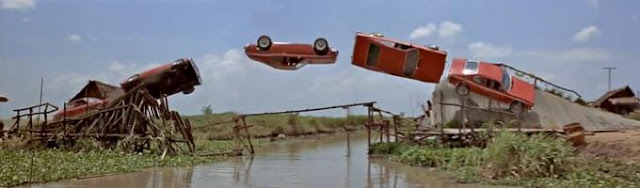
Still, when it leans into the ridiculousness it gets it right. The best part of the film is probably the chase sequence where Bond contrivedly bumps into the yokel sheriff from Live and Let Die, who accompanies him on an extended chase sequence that culminates in Bond's car doing a corkscrew jump across a river and Scaramanga converting his car into an airplane in a secret hangar. Why is the sheriff guy in the movie? I don't know but I came to love it.


Really, its biggest fault is the waste of its villain and its title character. Scaramanga is played by Christopher Lee, and Christopher Lee ought to play a delectable Bond villain... but why cast someone with such an amazing voice and then have him barely speak? Scaramanga is a silent thug for most of the film, and when he finally does get some good dialogue sequences, it's too little, too late.

Other Notes:

  • This film introduces an MI6 agent named Mary Goodnight. (This is the name of Bond's secretary in the books, but she's never appeared before in the films, what she does usually being merged into Moneypenny.) The film never seems to be able to decide if she's a competent agent or, you know, a woman. She gets trapped in a car trunk trying to bug it; she accidentally triggers the self-destruct of the solar energy facility; she almost kills Bond by bumping a switch with her butt. The Roger Moore films would do somewhat better with women agents in The Spy Who Loved Me and (especially) For Your Eyes Only.
  • Other genius moments:
    • Bond tries to get a golden bullet turned into a piece of jewelry out of a woman's navel with his teeth, and inadvertently swallows it, meaning the scene ends with him rushing off to the pharmacy. Can't believe they never got Daniel Craig to do something like that!
    • Bond is about to sleep with Mary Goodnight when Scaramanga's girlfriend turns up, and Bond needs to sleep with her to get information. So first Goodnight has to pretend to be pillows under the sheets, and then Goodnight must hide in a cupboard for hours while Bond and the woman have sex!
    • MI6 turns the wreck of the Queen Elizabeth liner in Hong Kong harbor into a base, so a bunch of scenes take place on an askew ship.
    • For reasons that aren't clear, Bond is at one point dropped into a martial arts school by the villains. What does work is a sequence where two schoolgirls beat up all the martial artists while Bond mostly just stands there.
  • There is a lot of delightful technical nonsense about the solar energy facility that we got a big kick out of.
  • Apparently Lee was suggested by Ian Fleming as a candidate to play the villain in Dr. No. How good would that have been!
 Film Rankings (So Far):
  1. Casino Royale
  2. Dr. No
  3. From Russia with Love
  4. For Your Eyes Only 
  5. On Her Majesty's Secret Service
  6. Thunderball 
  7. The Living Daylights
  8. Spectre
  9. You Only Live Twice
  10. Goldfinger
  11. The Spy Who Loved Me
  12. Moonraker
  13. The Man with the Golden Gun
  14. Octopussy
  15. Never Say Never Again
  16. A View to a Kill
  17. Live and Let Die 
  18. Diamonds Are Forever

11 April 2022

Doctor Who: The Road to the Thirteenth Doctor by James Peaty, Iolanda Zanfardino, Pasquale Qualano, Brian Williamson, et al.

 Doctor Who: The Road to the Thirteenth Doctor

Collection published: 2019
Contents originally published: 2018
Acquired: March 2020
Read: November 2021

Writers: James Peaty, Jody Houser
Artists: Iolanda Zanfardino, Pasquale Qualano, Brian Williamson, Rachael Stott
Colorists: Dijjo Lima, Enrica Eren Angiolini
Letterers: Richard Starkings and Jimmy Betancourt

This volume seems pretty pointless. Do new incarnations of the Doctor need "roads" to them? What does that even mean? How can you set up a new incarnation of the Doctor? What it turns out to mean here is three standalone stories about the three previous incarnations of the Doctor, the three who had ongoings from Titan for the previous three years. So we get a tenth Doctor, Gabby, and Cindy adventure; an eleventh Doctor and Alice adventure; and a twelfth Doctor and Bill adventure. Each is fine, but I found the reveals in the tenth Doctor one not very convincing (the monsters look cool but that's it) and the story in the eleventh Doctor one confusing. I don't even remember the twelfth Doctor one. Some Titan writers have done impressive single-issue adventures (mostly the writers on the Eleventh Doctor series), but these are not of them.

Each story is followed by a short back-up featuring the same Doctor, but by the creative team of the upcoming Thirteenth Doctor book and set during an episode of the tv show. In each case, the Doctor sees a hand coming through a time portal, and then does nothing about it, continuing about his business. Having already read the first volume of The Thirteenth Doctor as of this writing, it's pretty pointless set-up, and I don't entirely buy that the Doctor would just ignore each of these time portals and go about his business. Sure, we know it has nothing to do with the events of "The Girl in the Fireplace" or "The Power of Three" or whatever, but how does he? But I do like some Rachael Stott art.

I read an issue of Titan's Doctor Who comic every day (except when I have hard-copy comics to read). Next up in sequence: The Thirteenth Doctor: The Many Lives of Doctor Who

08 April 2022

Reading L. Frank Baum's The Sea Fairies Aloud to My Son

 The Sea Fairies by L. Frank Baum, illustrated by John R. Neill

After he ended the Oz books (unsuccessfully) with The Emerald City of Oz, Baum tried to begin a new series of children's fantasies, about Trot and Cap'n Bill, a young girl and a retired sailor who go on adventures. These only lasted two books before Baum gave up, gave in, and gave his public what they wanted by returning to Oz in Patchwork Girl. Later, though, he would bring Trot and Cap'n Bill to Oz in The Scarecrow of Oz, making Trot an Oz princess like Dorothy and Betsy Bobbin.

Originally published: 1911
Acquired and previously read: February 2017
Read aloud: January 2022

What confused me as a child was that the author's note at the beginning of Scarecrow indicated Trot and Cap'n Bill were being brought to Oz by popular demand... but how did any of Baum's readers know who these characters were if they hadn't yet appeared in a book? It wasn't until much later that I learned about The Sea Fairies and Sky Island (I think maybe when I was in high school), and even later than that when I finally got around to reading them (I was in graduate school).

So I wondered if I could construct my son's Oz journey in a way that would avoid my youthful confusion, and create the kind of demand for Trot and Cap'n Bill going to Oz that Baum's contemporary readers experienced. In strict publication order, these would be read between Emerald City and Patchwork Girl, but I wasn't about to delay getting to my favorite Oz book, so I decided to work them in slightly later: after finishing Patchwork Girl, I gave him the choice of Tik-Tok of Oz or The Sea Fairies, and he picked The Sea Fairies, even with my explanation that it was not an Oz book per se, but one that took place near Oz. (The fact that we had already read The Life and Adventures of Santa Claus gave some precedent for this.)

Unfortunately, I think this book is not up to much. It's one of those Baum books where no one has a goal; Trot and Cap'n Bill are sort of kidnapped by mermaids and made into mermaids, then they spend a hundred pages just being taken on a tour of what's underwater. Halfway through, a plot finally turns up, but it's one in which they play very little role, as most of their problems are solved by other characters. That said, I do like Cap'n Bill (a gruff sailor voice is exactly the kind I like to make), and this time I had an appreciation of Baum's worldbuilding. He wasn't always great at coherent extrapolation, but the explanation he offers for how mermaids work is one he explores all the implications of. Mermaids are surrounded by thin pockets of air which let them breathe, and keep their clothes from getting wet; this also lets them do things like cook. Trot and Cap'n Bill meet other humans underwater, who were kidnapped by an evil sea creature and given gills, and these ones have to wear wet clothes all the time and don't get to eat good food.

I don't know how much my son liked this one, but he seems to like Trot and Cap'n Bill themselves because he was game for returning to them with Sky Island.

06 April 2022

The Expanse by Corinna Bechko and Alejandro Aragon

As part of my holding pattern waiting for Book Nine of The Expanse to come out, I picked up this comic miniseries, which ties into the tv show, taking place between seasons 4 and 5 (and thus between books four and five, though there are some pretty big divergences from the books' canon; I haven't got this far in the show). There wasn't a digital collection at my library, but they did have the four individual issues on Hoopla. Weirdly, it seems to have no title beyond "The Expanse," which isn't confusing at all.

Most of the main cast put in only cameo appearances; the focus here is on Chrisjen Avasarala on the moon and Bobbie Draper on Mars working two different ends of a conspiracy. Some of what happens here sets up what, in the books at least, are the events of Nemesis Games, with Bobbie finding that someone is draining away Martian resources and personnel. The big difference is that here, Avasarala has somehow lost political power and ended up in an administrative position on the Moon (something with no parallel in the books), so she's being very mopey. I have to say, I found the idea of a mopey Avasarala unconvincing; I don't doubt that she could experience depression, but I do doubt that this is the form it would take.

from The Expanse #3
It's a pretty simple, quick-reading thriller on the whole, though some elements I struggled to understand. (Why does Avasarala get in that airlock? How could the bad guys have anticipated that plan at all?) Neat, I guess, as another peak into a familiar world, but it felt pretty inconsequential; Avasarala and Bobbie don't really learn anything, and we don't really learn anything about them. Alejandro Aragon's art looks nice, but I sometimes didn't realize that the character we were looking at was Bobbie until a couple panels had gone by. It was always clear who Avasarala was meant to be, but the likeness was occasionally pretty wonky. So, I would say, "get it free on Hoopla" is pretty much the exact quality level this was at. Thankfully, as I write this in December 2021, Leviathan Falls just showed up and I have already begun to read it.

The Expanse was originally published in four issues (Dec. 2020–Mar. 2021). The story was written by Corinna Bechko, illustrated by Alejandro Aragon, colored by Francesco Sagala, lettered by Ed Dukeshire, and edited by Jonathan Manning.

I read an Expanse story every eighty-ish days. Next up in sequence: Leviathan Falls

05 April 2022

Reading Roundup Wrapup: March 2022

Pick of the month: The Warrior's Apprentice by Lois McMaster Bujold. My friend Christiana has been after me to read the Vorkosigan books for ages; my sister joined the chorus some time ago as well. Finally I have taken the plunge... and I enjoyed the first volume a lot as they both knew I would. More anon.

All books read:

  1. Little Dorrit by Charles Dickens
  2. Chase by J. H. Williams III, Dan Curtis Johnson, et al.
  3. Sky Island: Being the Further Exciting Adventures of Trot and Cap’n Bill after Their Visit to the Sea Fairies by L. Frank Baum, illustrated by John R. Neill
  4. The Transformers: Best of UK: Time Wars by Simon Furman et al.
  5. The Warrior’s Apprentice by Lois McMaster Bujold
  6. Stargirl by Geoff Johns by Geoff Johns, Lee Moder, Scott Kolins, Dan Davis, et al.
  7. The Scarecrow of Oz by L. Frank Baum, illustrated by John R. Neill
  8. The Sandman Presents: The Furies by Mike Carey and John Bolton 

Not my best month... but certainly not my worst, either, almost three times as many books as February! Spring Break helped, of course, as did my conference flight. I read two Philip K. Dick novels, too, but as they're in an omnibus volume, they don't get counted on their own.

All books acquired:

  1. The Scarecrow of Oz by L. Frank Baum, illustrated by John R. Neill
  2. Legion of Super-Heroes: The Millennium Massacre by Paul Levitz, Mike Grell, Vince Colletta, et al.

That's it! 

Books remaining on "To be read" list: 686 (up 1)

04 April 2022

Doctor Who: Operation Volcano by Andrew Cartmel, Christopher Jones, Ben Aaronovitch, et al.

  Doctor Who: The Seventh Doctor: Operation Volcano

Collection published: 2019
Contents originally published: 2018
Acquired: March 2020
Read: November 2021

Writers: Andrew Cartmel, Richard Dinnick, John Freeman, Paul Cornell
Artists: Christopher Jones, Jessica Martin, John Stokes
Colorists: Marco Lesko, Charlie Kirchoff
Executive Producer: Ben Aaronovitch
Letterers: Richard Starkings and Jimmy Betancourt

This is Titan's first and last The Seventh Doctor volume (they have by this point stopped optimistically putting "Vol 1" on every title page), collecting a three-issue miniseries. The miniseries is written by Andrew Cartmel and illustrated by Christopher Jones (who illustrated Titan's Third Doctor series); Ben Aaronovitch is credited as "executive producer" but there's no indication of what this might actually mean even though he gets first billing on the cover! Anyway, I went into this not quite sure what it would be like. On the one hand, I suffered through Cartmel's attempt to recapture this era in his execrable Big Finish Lost Stories; on the other hand, I recently read Cartmel's early 1990s DWM comics for the first time, and found them really interesting and striking.

This is somewhere in between. Cartmel's not interesting in pushing the boundaries of Doctor Who or comics like he was thirty years ago, but this does a much better job of pastiching his own era than the Lost Stories did. It's a fun, if somewhat underdeveloped and simple story, about the Doctor, Ace, and the Intrusion Counter-Measures Group (of Remembrance of the Daleks fame) dealing with a crashed alien spaceship in the Australian outback. It has a sense of scale tv wouldn't have attempted in the 1980s, but I did feel that something thematically interesting could have been done that didn't happen here. Christopher Jones does a lot to enliven the material; he's a good tv tie-in artist, in that he can do both likenesses and action well.

The collection includes some other things, foremost among them the "Hill of Beans" back-up strip about the Doctor and Ace meeting Mags the werewolf from The Greatest Show in the Galaxy again... with the gimmick that the story is illustrated by Jessica Martin who played Mags! Since her acting days, she had actually become an independent comics artist. It's okay; it's a bit jumpy and incomprehensible at times, which I blame on both writing and art. My guess is that sci-fi action does not play to Martin's strengths as an illustrator. But hey, I do like Mags, and this probably does better by her than her incompatible reappearances in Big Finish's trilogy.

Finally, it contains two things I've reviewed elsewhere, so I won't go over them again: the Seventh Doctor strip from 2018's Free Comic Book Day issue and the First Doctor story "In-Between Times." Except that I will complain that the FCBD issue is a prologue to Operation Volcano but for some reason collected all the way at the end of this volume!

I read an issue of Titan's Doctor Who comic every day (except when I have hard-copy comics to read). Next up in sequence: The Road to the Thirteenth Doctor

01 April 2022

Reading The Patchwork Girl of Oz Aloud to My Son

 The Patchwork Girl of Oz by L. Frank Baum, illustrated by John R. Neill

This was my favorite of the Oz books as a child, so I approached it with some trepidation. Would my son like it?

Originally published: 1913
Acquired: ???
Previously reread: September 2016
Read aloud: December 2021–January 2022

I think he did; we made pretty rapid progress in it. To me, it recaptures the formula that made the first book work so well: it opens with a child in a difficult status quo, the child loses their parental figure and is forced to go on a journey to get them back, the child picks up a variety of strange companions as they travel, the group works together to overcome difficult problems, the group moves from strange location to strange location. Unlike in some of the mediocre Oz books, there's a clear goal and real tension; unlike in some of the mediocre Oz books, the characters solve their problems by thinking clever.

My main complaint would be with the ending: it's not clear to me why Ozma let Ojo go on his quest at all given that the Wizard can just solve all his problems for him. But one of the benefits of reading aloud is that things like this bother you less, because you're treating the story episodically. Yes, the ending doesn't entirely satisfy... but that's only one chapter out of about thirty. One thing I noticed reading aloud is that Ojo is always re-explaining who he is and what his quest is; something that's very useful when the book is stretched out across weeks to someone with the memory of a three-year-old.

Sometimes I verbally edit the books to fix continuity problems as I read them aloud, but I did not make any changes to this one despite the fact that in Marvelous Land we're told a Doctor Nikidik made the Powder of Life, who is dead according to Road, and here it's a Doctor Pipt who is very much alive. I just didn't care! (And really, it would be the earlier books one should edit.) On the other hand, the characters encounter a magical race called the "Tottenhots"; I edited the name out of my reading, just calling them creatures. Usually I read the Books of Wonder facsimile editions, and the Patchwork Girl facsimile controversially removed some of illustrations of the Tottenhots and revised some of the textual descriptions. However, in this case, I had the Dover, which makes no such changes, so I had to do it myself. (I've been upgrading my Del Rey and Puffin editions to Books of Wonder ones as we read, but the Dovers are almost like the originals except for different covers, and reproducing the color plates in black and white.)

When I finished, my wife asked if Scraps, the "patchwork girl" of the title, actually did anything... the answer is, honestly, not much; she's always there, but the plot driver is Ojo. I don't think Scraps really solves a single problem, though she does prove to be a great friend to Ojo when he is in trouble for stealing the six-leafed clover. But she's a delightful character to read aloud, especially the songs, and I gave her the same voice I gave Pinkie Pie when I used to read the My Little Pony comics aloud to my son. On other hand, this book showed up the limitations of my range of voices, as the Scarecrow and the Shaggy Man share some scenes! (When they are together, I pitch the Scarecrow a little higher, but otherwise they're the same voice.) My wife didn't think the "southern belle" voice I adopted for Bungle, the Glass Cat, was a good choice, but I liked it.